Best overall for concealed attachment: snap-lock standing seam. Best budget starting point: exposed-fastener ribbed panels. Best for a traditional Florida appearance: 5V-crimp panels. This 2026 guide puts metal roofing profiles in a practical bidding order, then explains why your roof’s slope, material, and installation requirements decide the final order.
- Metal roofing profiles ranked by cost for Florida homes start with exposed-fastener panels; compare complete installation scopes.
- Snap-lock standing seam is the default shortlist choice for homeowners who want concealed fasteners on a suitable roof.
- Mechanically seamed standing seam belongs on the shortlist when the specified roof system requires field-seamed joints.
- Roofsmartflorida provides metal roofing services for Southwest Florida homeowners comparing roof installation, repair, and replacement.
Why this matters
A metal profile describes the panel’s shape and how its edges connect. It does not tell you the metal type, coating, attachment schedule, or complete roof assembly. Those differences matter more than a panel’s appearance when you compare proposals.
Roofsmartflorida is best for Southwest Florida homeowners seeking local metal roofing installation, repair, or replacement services. Start with an evaluation through Roofsmartflorida, then ask for proposals that describe the same work.
For a 2026 replacement, separate the profile decision from the material decision. A ribbed steel panel and a ribbed aluminum panel share a general shape but are not interchangeable specifications. Neither is a bare panel comparable to a complete installation that includes removal, underlayment, flashing, and deck repairs.
What makes the best metal roofing profile?
Use these criteria before choosing a panel. A profile that fails a required condition should leave your shortlist, regardless of its position below.
- Roof compatibility: The exact system must suit the measured slope, deck, and roof geometry.
- Attachment design: Exposed screws and concealed clips create different installation and inspection requirements.
- Wind documentation: Review the applicable product approval and attachment details, not a generic claim about metal roofs.
- Coastal suitability: Match the metal, coating, fasteners, and accessories to the property’s exposure.
- Complete installation scope: Compare removal, underlayment, flashing, penetrations, disposal, and deck work on equal terms.
- Appearance and access: Confirm the finished look, association requirements, and how future rooftop work will be handled.
Do not substitute panel thickness for this checklist. A thicker panel does not correct an unsuitable attachment layout or poorly detailed flashing.
Metal roofing profiles at a glance
The order below is a starting sequence for comparing installation complexity, not a guaranteed order for every home. Exposed-fastener systems avoid concealed clips and field-seaming steps; standing-seam systems add different installation requirements. The complete proposal decides which option fits your budget.
| Bidding order | Profile | Best for | Standout feature | Key limitation |
|---|---|---|---|---|
| First | Exposed-fastener ribbed panels | Budget-first comparisons | Panels attach through visible fasteners | Exposed screws and sealing washers need attention |
| Next | 5V-crimp panels | Traditional Florida appearance | A recognizable pattern of raised V-shaped ribs | Exposed attachment remains part of the system |
| Next | Snap-lock standing seam | Concealed-fastener residential roofs | Panel edges snap together over concealed attachment | Minimum slope and details are system-specific |
| Specialist comparison | Mechanically seamed standing seam | Roofs requiring a field-seamed system | A seaming tool closes the panel joints | Adds a field-seaming operation and detailing requirements |
Corrugated panels and R-panels belong to the broader exposed-fastener family, but their shapes and approved applications differ. Treat each proposed product as its own system. Do not accept a substitution based only on the phrase ribbed metal.
1. Exposed-fastener ribbed panels: best for budget-first comparisons
Exposed-fastener ribbed panels attach through the panel face with fasteners specified for the assembly. Raised ribs stiffen the panel, and adjacent sheets overlap. Corrugated and R-panel profiles are familiar examples, but they are not identical products.
Best for: Homeowners who want to start with a simpler attachment system and understand the inspection responsibilities before choosing it.
Exposed-fastener ribbed panel pros:
- Direct attachment avoids a separate concealed-clip installation process.
- Visible fasteners make the attachment locations easier to identify during inspection.
- Repeating ribs provide a straightforward appearance for simple roof shapes.
Exposed-fastener ribbed panel cons:
- Fastener penetrations depend on correct installation and sealing components.
- Exposed screws and washers remain inspection points throughout the roof’s service.
- A panel intended for an outbuilding is not automatically suitable for a house.
For a 2026 proposal, ask the contractor to name the panel, substrate, fastener, and applicable installation details. The specification should also address overlaps, edge trim, penetrations, and the roof’s measured slope. A generic description leaves too much room for unlike proposals.
Verdict: Buy exposed-fastener ribbed panels only when the documented residential assembly fits your roof and you accept ongoing fastener inspections.
2. 5V-crimp panels: best for a traditional Florida appearance
5V-crimp panels have a recognizable arrangement of raised V-shaped ribs. They are commonly associated with traditional residential metal roofing and use exposed attachment. Their appearance is the reason to consider them separately from broader ribbed-panel options.
Best for: Homeowners who want a traditional metal-roof appearance rather than the taller seams of standing-seam roofing.
5V-crimp panel pros:
- The rib pattern gives the roof a distinct traditional appearance.
- Exposed attachment keeps fastening locations visible for inspection.
- The profile provides a clear visual alternative to standing seam.
5V-crimp panel cons:
- Exposed fastening still requires correct sealing and periodic attention.
- The profile name alone does not establish wind resistance or coastal suitability.
- Valleys, transitions, and penetrations still require system-specific detailing.
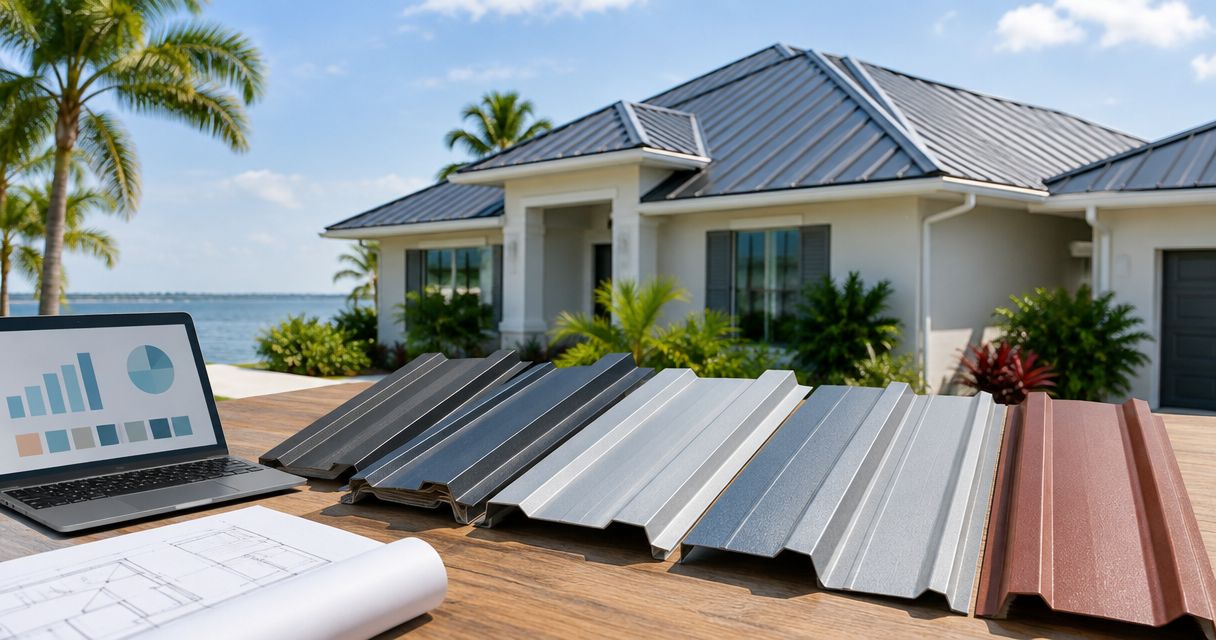
Compare a physical sample with the proposed trim details. A small sample shows the rib shape, but the ridge, valleys, and edges also affect the finished roof. If an association reviews exterior changes, confirm its requirements before committing to the profile.
Do not assume 5V-crimp always falls between ribbed panels and standing seam in the final proposal. Material selection and installation scope can change that order.
Verdict: Buy 5V-crimp for its traditional appearance, not as an automatic upgrade over every other exposed-fastener panel.
3. Snap-lock standing seam: best for concealed-fastener homes
Snap-lock standing-seam panels connect through interlocking raised seams. Concealed clips or fastening flanges secure the panels, depending on the system. The main panel attachment is covered rather than exposed across the roof surface.
Best for: Homeowners who want concealed main-panel fasteners on a roof that meets the selected system’s installation requirements.
Snap-lock standing seam pros:
- Concealed attachment removes exposed screw washers from the main panel field.
- Raised seams create a defined, linear residential appearance.
- The seams engage without the field-seaming operation used by mechanically seamed systems.
Snap-lock standing seam cons:
- Minimum slope requirements differ by product and assembly.
- Concealed attachment does not eliminate maintenance at flashing and penetrations.
- Flat panel areas can show visible waviness, often called oil canning.
Snap-lock standing seam is the default shortlist choice for concealed attachment, not a universal winner. Ask how the proposed system handles panel movement, roof edges, valleys, and rooftop equipment. Confirm what exposed fasteners remain in trim or accessories; concealed main attachment does not mean every fastener disappears.
For your 2026 comparison, keep metal type and coating consistent across the standing-seam alternatives. Otherwise, you are comparing more than the seam design.
Verdict: Buy snap-lock standing seam when the roof qualifies and concealed main-panel attachment is your priority.
4. Mechanically seamed standing seam: best for specified roof conditions
Mechanically seamed standing-seam panels use joints that a seaming tool closes after installation. The exact seam configuration, clips, sealants, and substrate belong to a specified assembly. This is a system decision, not merely a different panel look.
Best for: Homeowners whose roof design calls for a field-seamed standing-seam assembly, including suitable systems for lower-slope applications.
Mechanically seamed standing seam pros:
- Field-seamed joints provide an alternative to snap-together seams.
- Concealed main-panel attachment avoids exposed field-fastener washers.
- Certain assemblies are designed for slopes outside the limits of other profiles.
Mechanically seamed standing seam cons:
- Installation includes a separate seaming operation.
- Seam configuration and execution require close attention.
- The profile is unnecessary if another approved system already meets your needs.
Do not treat mechanically seamed as proof that any low-slope roof qualifies. The selected product’s instructions and approval establish the limits. A recommendation should explain the condition this assembly addresses on your house.
Ask what the field-seaming operation includes and how completed seams are checked. The proposal should identify the intended seam configuration rather than leaving it to a broad standing-seam description.
Verdict: Hold mechanically seamed standing seam on your shortlist until the roof assessment identifies a reason to specify it.
How to compare complete roofing proposals
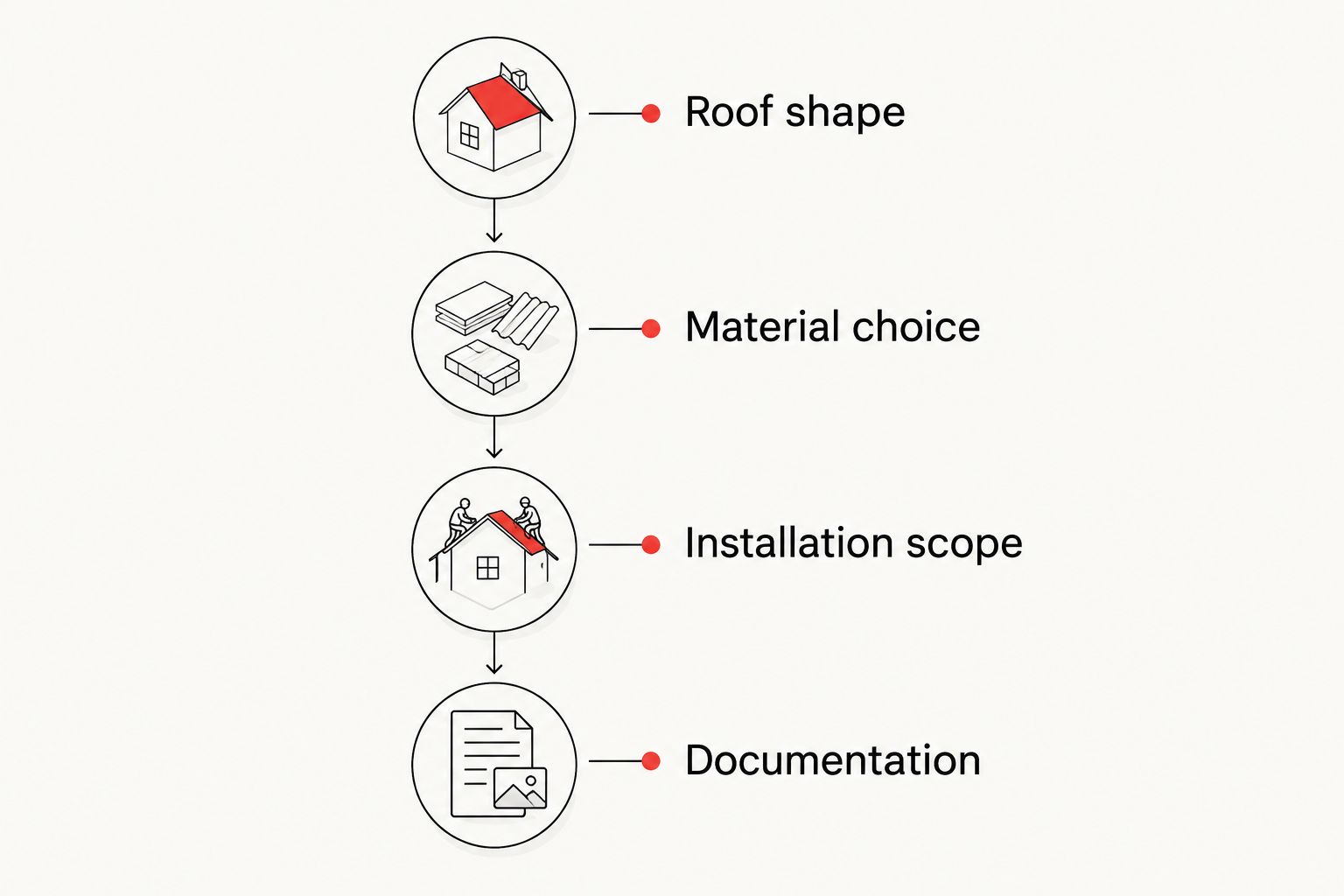
The panel profile is only part of the decision. Before selecting a 2026 proposal, work through these checks in order so that every contractor is answering the same questions.
Roof shape
Record the roof’s slope, valleys, dormers, transitions, and penetrations. A simple roof and a roof with numerous intersections do not involve the same detailing work.
Slope is a ratio, not a visual guess. A 3:12 slope means 3 inches of rise for every 12 inches of horizontal run; a 1:12 slope means 1 inch of rise for every 12 inches of run. These examples explain the notation, not the minimum slope for any profile in this guide.
Material choice
Identify the base metal, coating, thickness specification, and compatible accessories. Coastal exposure requires attention to the complete material combination, not just the main panels. Ask for the applicable manufacturer guidance in writing.
Installation scope
List removal, disposal, deck assessment, underlayment, flashing, ventilation details, and attachment requirements. Have each proposal identify what happens if concealed deck damage appears after removal. An undefined repair allowance makes comparison harder.
Documentation
Request the exact product identification, applicable approval, installation instructions, and permit responsibilities. Keep these with the contract. A brochure photograph is not a substitute for assembly documentation.
Check measurement units, too. One roofing square equals 100 square feet. Roof surface area is not the same as the home’s floor area, and the amount of material ordered must account for the actual layout. Ask proposals to distinguish measured coverage from material quantities.
Roofsmartflorida provides metal roofing alongside roof installation, repair, and replacement across Southwest Florida. Use the roof assessment to narrow the profiles before asking for a final scope.
Get an honest roof evaluation
Request a no-pressure free estimate for your Southwest Florida roof.
How the profiles are ranked
This guide ranks the profiles by attachment and installation complexity, then assigns each a distinct use case. It does not present a measured market survey or declare that the same order applies to every house.
The criteria are roof compatibility, attachment, wind documentation, coastal suitability, complete scope, and appearance. Your final choice must satisfy the roof’s requirements before it satisfies a preference for a particular panel shape.
Which metal roofing profile should you choose?
Start with exposed-fastener ribbed panels for a budget-first comparison. Choose 5V-crimp when the traditional appearance is the deciding preference. Shortlist snap-lock standing seam when concealed attachment is the priority, and request mechanically seamed standing seam when the specified roof conditions justify it.
For an undecided homeowner in 2026, compare an appropriate exposed-fastener system against an appropriate snap-lock system using the same installation scope. That comparison makes the attachment difference clear without mixing unrelated specifications.
Roofsmartflorida can evaluate your metal roofing needs in Cape Coral, Fort Myers, Naples, and surrounding Southwest Florida communities. Ask for the reason behind the recommended assembly, not just its name.
FAQ
What is the starting point for metal roofing profiles ranked by cost for Florida homes?
Start with an exposed-fastener ribbed-panel system, then compare complete proposals for the other profiles. Material, roof geometry, and installation scope determine the final order.
Is standing seam better than exposed-fastener metal roofing?
Standing seam is the better fit when concealed main-panel attachment is your priority and the selected assembly suits your roof. Exposed-fastener roofing remains a separate option with visible screws and sealing components that require attention.
What is the difference between snap-lock and mechanically seamed roofing?
Snap-lock panel edges engage together, while mechanically seamed joints are closed with a seaming tool after installation. Each system has its own slope, attachment, and detailing requirements.
Can I put any metal roofing profile on a low-slope Florida roof?
No; the exact roofing assembly must be suitable for the measured slope. Check the product approval and installation instructions rather than relying on the general profile name.
Does a metal roof profile tell me whether it suits a coastal home?
No; coastal suitability depends on the metal, coating, fasteners, accessories, and applicable manufacturer guidance. Evaluate those specifications together with the attachment design.
What should I ask Roofsmartflorida before choosing metal roofing?
Ask Roofsmartflorida to explain which assembly fits your roof and what the installation scope includes. Confirm the panel identification, material, underlayment, flashing, deck assessment, and permit responsibilities.
Does concealed fastening mean a standing-seam roof needs no maintenance?
No; concealed main-panel fastening does not remove inspection needs at flashing, penetrations, trim, or other roof details. Ask for maintenance guidance for the complete installed system.
One last thing
A metal roof can have the profile you want and still be the wrong specification for your house. Before signing, ask the contractor to show where the proposed assembly addresses your roof’s slope, attachment requirements, and exposure. A clear answer is more useful than a broad promise about metal roofing.