Coastal Southwest Florida homes take a different beating than roofs ten miles inland — salt spray, near-constant humidity, and wind loads that spike every hurricane season. This guide breaks down what actually matters when you're choosing metal roofing for coastal Southwest Florida homes in Cape Coral, Fort Myers, or Naples, and which systems hold up versus which ones look fine in the showroom and fail in year three.
- Standing seam aluminum is the safest metal roofing coastal Southwest Florida homes buy in 2026 for direct salt exposure — Buy.
- Skip exposed-fastener steel panels within a mile of open water; fasteners corrode and loosen years before the panel does.
- Galvalume-coated steel standing seam is the value pick for canal-front homes in Cape Coral and Fort Myers — Consider.
- A wind mitigation inspection often lowers your insurance premium once a qualifying metal roof is installed.
Who this is for
This guide is for homeowners in Cape Coral, Fort Myers, and Naples replacing a roof after storm damage, planning ahead of the next hurricane season, or tired of re-roofing shingles every 12-15 years because of sun and salt. If your home sits within a few miles of the Gulf, a bay, or one of Southwest Florida's canal systems, the roofing decisions below apply to you directly — inland homes have more flexibility on cost-driven choices that coastal homes don't.
Why this matters
Salt-laden air and repeated tropical storm exposure age roofing materials faster than almost anywhere else in the continental U.S. A roofing system that performs well in Ohio can fail on a barrier island home in half the time. Metal roofing, done right, is one of the few systems built to outlast multiple hurricane seasons and multiple owners — Roof Smart of SW Florida sees the difference in service calls between homes with the right metal system and homes with the wrong one.
What to look for in metal roofing for coastal Southwest Florida homes
Wind uplift rating
Florida Building Code wind maps put ultimate design wind speeds for Lee, Collier, and Charlotte counties in the 150-172 mph range, and every roofing assembly installed in 2026 has to be tested and rated to meet it. A metal roof with a documented wind uplift rating for your specific wind zone is non-negotiable on a coastal lot — a system rated for 120 mph inland doesn't automatically qualify near the water.
Corrosion resistance in salt air
Salt air accelerates galvanic corrosion, especially on fasteners, flashing, and cut edges. Aluminum resists this almost indefinitely because it doesn't rust the way steel does, while steel needs a real coating system — Galvalume (AZ50) or better — to hold up within a mile or two of open water.
Fastening system
Standing seam panels use concealed clips with no exposed screw heads, which matters enormously on the coast because exposed fasteners are the first failure point in salt-heavy environments. Once a fastener backs out or corrodes on an exposed-fastener panel, water finds a path in — often years before the panel itself shows any wear.
Wind mitigation and insurance credit eligibility
A metal roof installed to current code specs can qualify a home for wind mitigation credits that lower windstorm insurance premiums. That credit only applies with proper documentation, which means the inspection has to happen after installation, not skipped to save time.
Panel gauge and coating
24-gauge and 26-gauge are the two thicknesses that show up most often on coastal Southwest Florida homes — 24-gauge holds up better under hail and foot traffic during maintenance, 26-gauge costs less and still performs on lower-exposure lots. Coating matters as much as gauge: a Kynar 500 (PVDF) finish resists chalking and fading from UV and salt far longer than a basic painted finish.
Underlayment compatible with current code
Post-2022 code updates (following Hurricane Ian) pushed self-adhering underlayment and sealed deck requirements on many reroofs across Lee and Collier counties. A metal system installed over an underlayment that doesn't meet current requirements creates a gap between what the panel is rated for and what the whole assembly actually delivers.
Top picks for coastal Southwest Florida homes
Standing seam aluminum — the safe pick
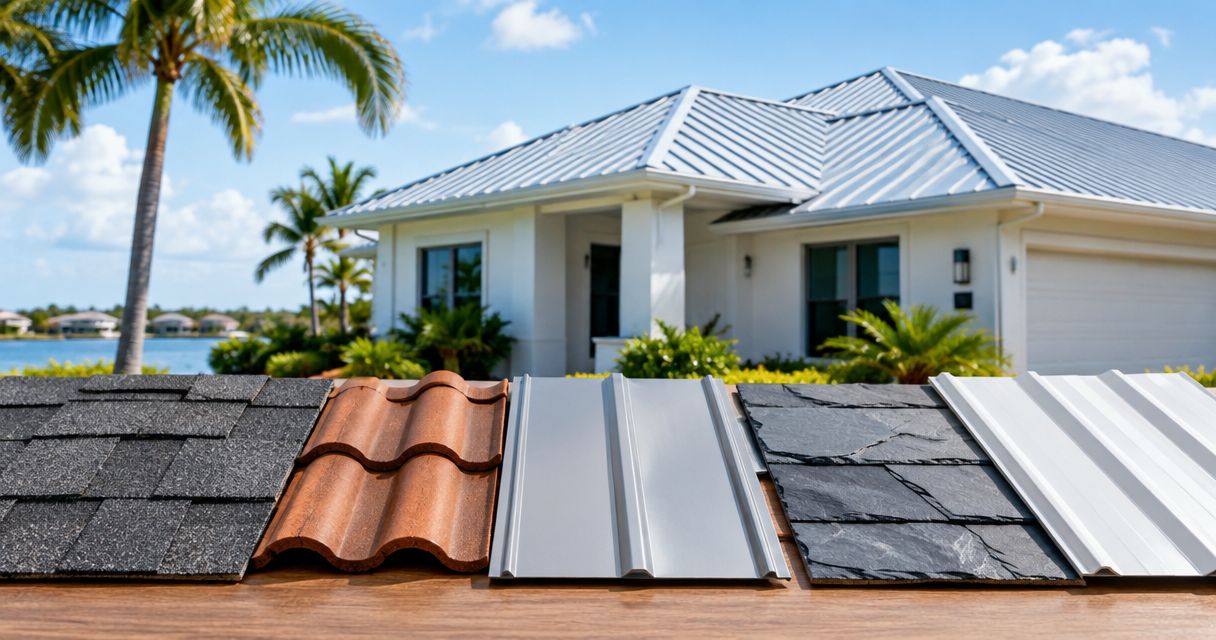
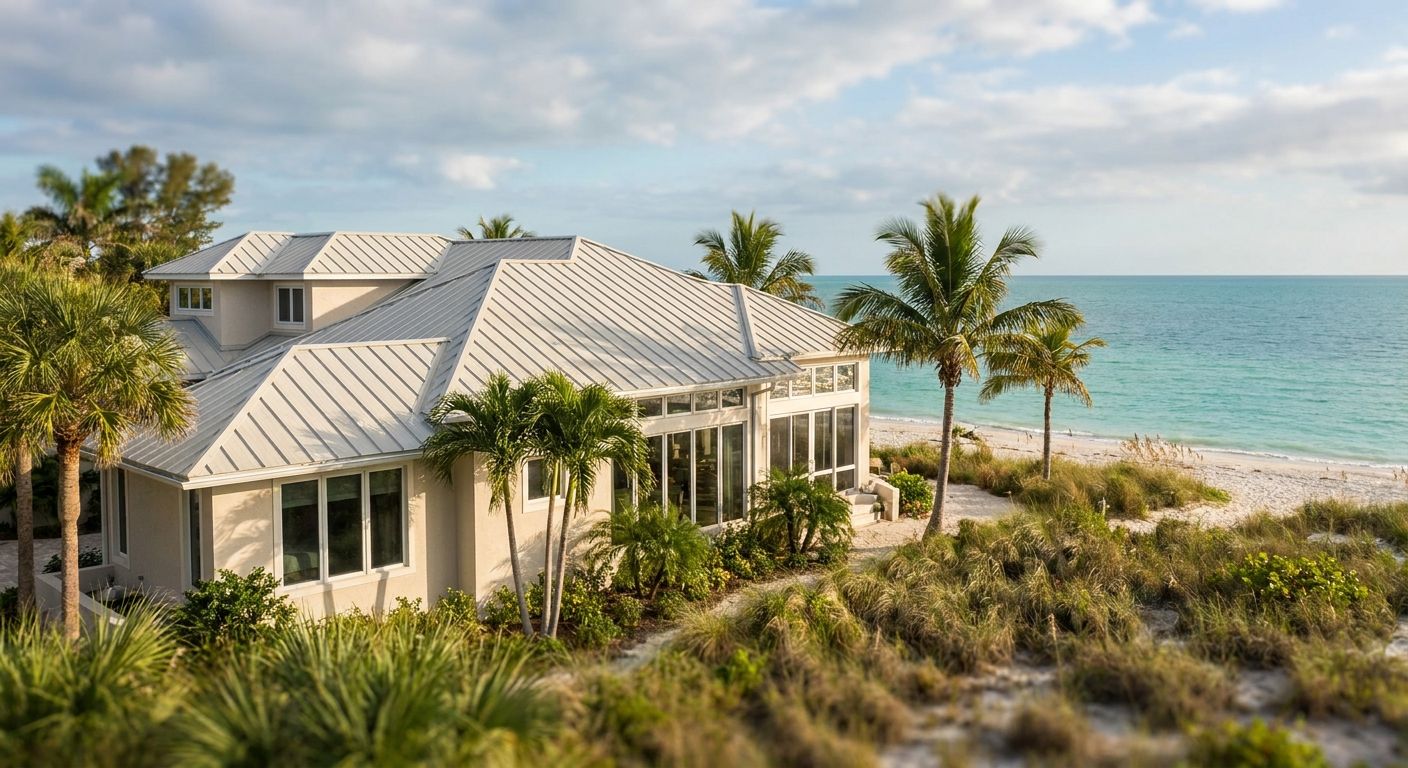
Aluminum doesn't rust, and a standing seam profile hides every fastener under a raised, interlocking seam. Wind uplift testing on these assemblies commonly supports the upper end of Southwest Florida's 150-172 mph design range when installed with the matching clip spacing. For barrier island homes, beachfront lots in Naples, and anything within sight of the water, this is the system with the fewest coastal-specific weaknesses. Explore metal roofing in Naples if you're evaluating this for a beach-proximity property. Verdict: Buy.
Galvalume standing seam steel — the value pick
Galvalume steel with an AZ50 coating costs less than aluminum and still handles moderate salt exposure well, which makes it a strong fit for canal-front and inland-lake homes in Cape Coral and Fort Myers that aren't directly on open Gulf water. It won't outlast aluminum on a true beachfront lot, but on a canal home a mile or two back from the open water, the coating holds up for decades. Verdict: Consider.
Stone-coated steel shingle — the wildcard
This system mimics the look of tile or shake while keeping metal's wind and fire performance, which appeals to homeowners in HOA communities where a visible metal panel roof isn't allowed. The coating adds a layer of protection over the steel substrate, but seams and fastener patterns are more complex than a standing seam run, which means more places for a poor install to go wrong. On a coastal lot, this only makes sense with an installer who documents every flashing detail. Verdict: Consider, with a qualified installer only.
Exposed-fastener corrugated steel panel — the budget pick
This is the cheapest metal roofing option per square, and it's also the one that fails soonest near salt water because every screw penetration is a corrosion point sitting in direct exposure. On a property within a mile of open water, expect fastener issues well before the panel substrate itself degrades. See metal roofing options in Cape Coral before defaulting to this system on a coastal lot. Verdict: Skip for direct coastal exposure — Consider only for inland, low-exposure lots.
What to avoid
- Mill-finish or unrated coated steel panels that look identical to Galvalume on a sample board but carry no documented salt-spray rating — ask for the coating spec sheet, not just the color chip.
- Exposed-fastener systems sold as "just as good" as standing seam for beachfront or open-water lots — the fastener corrosion timeline is the whole argument against them, and it doesn't change because a salesperson says otherwise.
- Skipping the wind mitigation inspection after install because it feels like an extra step — without it, you're paying for a wind-resistant roof and still paying the pre-upgrade insurance rate.
Get a free roofing estimate
Talk through your coastal lot's exposure before you pick a metal system.
Verdict comparison
| System | Salt-air resistance | Fastening | Best fit | Verdict |
|---|---|---|---|---|
| Standing seam aluminum | Highest | Concealed clip | Beachfront, barrier island | Buy |
| Galvalume standing seam steel | High | Concealed clip | Canal-front, inland lake | Consider |
| Stone-coated steel shingle | Moderate-high | Mixed | HOA communities | Consider |
| Exposed-fastener steel panel | Low near water | Exposed screw | Inland, low-exposure | Skip near water |
If your property sits inside a wind mitigation zone that qualifies for insurance credit, get a wind mitigation inspection scheduled for Naples once the new roof is on, not before — the documentation has to reflect what's actually installed.
FAQ
What's the best metal roofing for coastal Southwest Florida homes?
Standing seam aluminum is the best metal roofing for coastal Southwest Florida homes with direct water exposure because it resists corrosion better than any coated steel option. Homes farther from open water can get comparable results from Galvalume steel standing seam at a lower cost.
Is metal roofing better than tile for coastal Florida homes?
Metal roofing generally outlasts tile in high-wind coastal zones because standing seam assemblies resist uplift better than individual tiles that can crack or dislodge. Tile still works well for homeowners prioritizing a specific aesthetic in lower-wind inland areas.
Does metal roofing qualify for wind mitigation insurance credits in Florida?
Yes, a metal roof installed to current wind-rating specifications can qualify for wind mitigation credits that reduce windstorm insurance premiums. The credit requires a post-installation inspection that documents the specific assembly and fastening system used.
How long does a standing seam metal roof last in Southwest Florida?
Standing seam metal roofs commonly run 40 to 70 years of service life, though coastal salt exposure sits at the lower end of that range without regular maintenance. Aluminum systems tend to outperform coated steel over that full range near open water.
Why do exposed-fastener metal roofs fail faster near the coast?
Exposed-fastener panels have hundreds of screw penetrations, and each one is a corrosion point in salt-heavy air. Fasteners typically loosen or corrode well before the metal panel substrate itself shows any wear.
What gauge metal roofing is best for hurricane-prone areas?
24-gauge steel or aluminum handles wind-driven debris and foot traffic during storm-season maintenance better than 26-gauge. 26-gauge still meets Florida Building Code wind ratings on lower-exposure lots at a lower material cost.
Can I install metal roofing over an existing shingle roof in Florida?
Florida Building Code generally requires a full tear-off to the deck for reroofs in most coastal counties rather than layering metal over shingles. A tear-off also lets the underlayment meet current post-2022 code requirements that older shingle installs don't have.
One last thing
The detail most homeowners miss isn't the panel material — it's the fastener and flashing spec written into the contract. Two roofs using the identical aluminum panel can perform completely differently in a coastal storm depending on clip spacing and underlayment, so ask for the wind uplift documentation by assembly, not just by panel type, before signing anything in 2026.