Florida has no automatic roof-age cutoff for homeowners insurance renewal: under Florida Statutes section 627.7011(5), an insurer cannot refuse renewal solely because a roof is less than 15 years old. For roofs at least 15 years old, the law provides an inspection opportunity, and a finding of at least 5 years of remaining useful life protects against refusal based solely on age. In 2026, that protection does not guarantee renewal when the insurer identifies separate condition problems or other underwriting grounds.
- How old can a roof be before insurance wont renew it in Florida? Age alone is not an automatic cutoff.
- Florida Statutes section 627.7011 protects roofs under 15 years from age-only refusal.
- Roofs at least 15 years old have an inspection path; 5 years of remaining useful life matters.
- Roofsmartflorida provides Southwest Florida roofing repair and replacement services; the insurer decides policy renewal.
How old can a roof be before insurance won't renew it in Florida?
A roof does not become automatically uninsurable on its fifteenth birthday. The controlling distinction is whether the insurer objects to age alone or to documented roof condition.
For homeowners considering roof replacement for older Florida homes, establish that distinction before signing a replacement contract.
Florida Statutes section 627.7011(5), the reference for this 2026 explanation of homeowners roof-age protections, sets out these rules:
| Roof situation | Age-related protection | What you should do |
|---|---|---|
| Roof is less than 15 years old | The insurer cannot refuse issuance or renewal solely because of roof age | Verify the installation date and request the specific reason for the insurer's concern |
| Roof is at least 15 years old | The homeowner must have an opportunity for an authorized inspection before replacement is required as a condition of issuance or renewal | Ask for inspection requirements and arrange the inspection at your expense |
| Inspection finds at least 5 years of remaining useful life | The insurer cannot refuse issuance or renewal solely because of roof age | Submit the report and obtain the insurer's written response |
| Roof has documented damage or deterioration | Age-only protection does not resolve separate condition concerns | Get the defects evaluated and ask what corrective evidence is required |
These are homeowners-policy rules, not a universal promise covering every property or insurance arrangement. Ask your agent to confirm their application to your policy, particularly if it is commercial coverage or placed through a surplus-lines insurer.
Why this matters
An age-only objection and a condition-based objection require different responses. Replacing a roof without identifying the actual objection can commit you to work before you understand the insurance requirement.
An inspection report is not a renewal policy, either. It supplies evidence about the roof; the insurer still evaluates the policy under applicable law and its other underwriting requirements.
For your 2026 renewal, keep the roofing decision and the insurance decision connected but separate. A contractor evaluates physical work, while your agent or insurer explains what documentation satisfies the renewal review.
Roofs under 15 years: age alone is not enough
For a roof less than 15 years old, Florida's statutory protection addresses refusal based solely on age. It does not mean a younger roof can have active leaks, damaged coverings, or unresolved defects without insurance consequences.
If a notice describes your roof only as too old, ask the insurer to confirm the recorded installation date. Compare that date with your permit records, completed replacement paperwork, and any previous inspection documents.
A repair invoice is not necessarily proof that the entire roof was replaced. Make sure the document identifies the work performed and the roof area involved rather than assuming every roofing invoice establishes a new installation date.
Best next step: correct the age record and request the written underwriting reason. Do not treat a general comment about older roofs as a complete explanation of your own policy decision.
Roofs at least 15 years old: use the inspection opportunity
For roofs at least 15 years old, the statute requires an opportunity for an inspection by an authorized inspector, at the homeowner's expense, before replacement is required as a condition of issuance or renewal.
Ask your insurer what report format it requires, where to submit it, and which deadline applies. Confirm that the person performing the inspection qualifies under the statute; a general roofing estimate does not automatically serve as the required report.
The inspection needs to address remaining useful life. Photographs showing an attractive roof surface do not establish that conclusion by themselves.
Best next step: arrange the appropriate inspection before assuming replacement is mandatory. The limitation is straightforward: an inspection documents the roof's condition; it cannot turn a deteriorated roof into a sound one.
At least 5 years remaining: protection against age-only refusal
When the authorized inspection determines that the roof has at least 5 years of remaining useful life, the statute prohibits refusal to issue or renew solely because of age.
That finding is not a guarantee of 5 years of uninterrupted coverage. It also does not erase separate underwriting issues, change your policy terms, or establish that a future roof loss will be covered.
Submit the complete report, including supporting material, through the channel your insurer specifies. Ask for written confirmation that the insurer received it and a clear answer about any remaining requirements.
Best next step: obtain the renewal decision, not just a delivery receipt. A report sitting in an email inbox is not confirmation that the insurer has completed its review.
Why roof-related renewal decisions vary
In 2026, the useful question is not simply how old your roof is. It is what the insurer has identified and what evidence addresses that concern.
- Recorded installation date: An incorrect date changes which age-related rule appears relevant. Confirm the date rather than estimating from the home's construction date.
- Documented condition: Leaks, missing materials, deteriorated components, and other defects are different from age alone. Ask which findings support the insurer's decision.
- Remaining useful life: The statutory inspection finding matters for roofs at least 15 years old. A report that omits it does not answer the central age-related question.
- Inspection qualifications: The law calls for an authorized inspector. Confirm eligibility before commissioning a report for this purpose.
- Policy and insurer type: Do not apply homeowners-policy guidance automatically to a business property or a different insurance arrangement. Have your agent identify the applicable requirements.
- Submission requirements: The insurer needs the requested evidence through the correct process. Keep the notice, report, correspondence, and stated deadlines together.
The practical rule is simple: respond to the stated reason, not to a roof-age rumor. Your neighbor's renewal experience does not establish the requirements for your property.
What should you do after a roof-related nonrenewal notice?
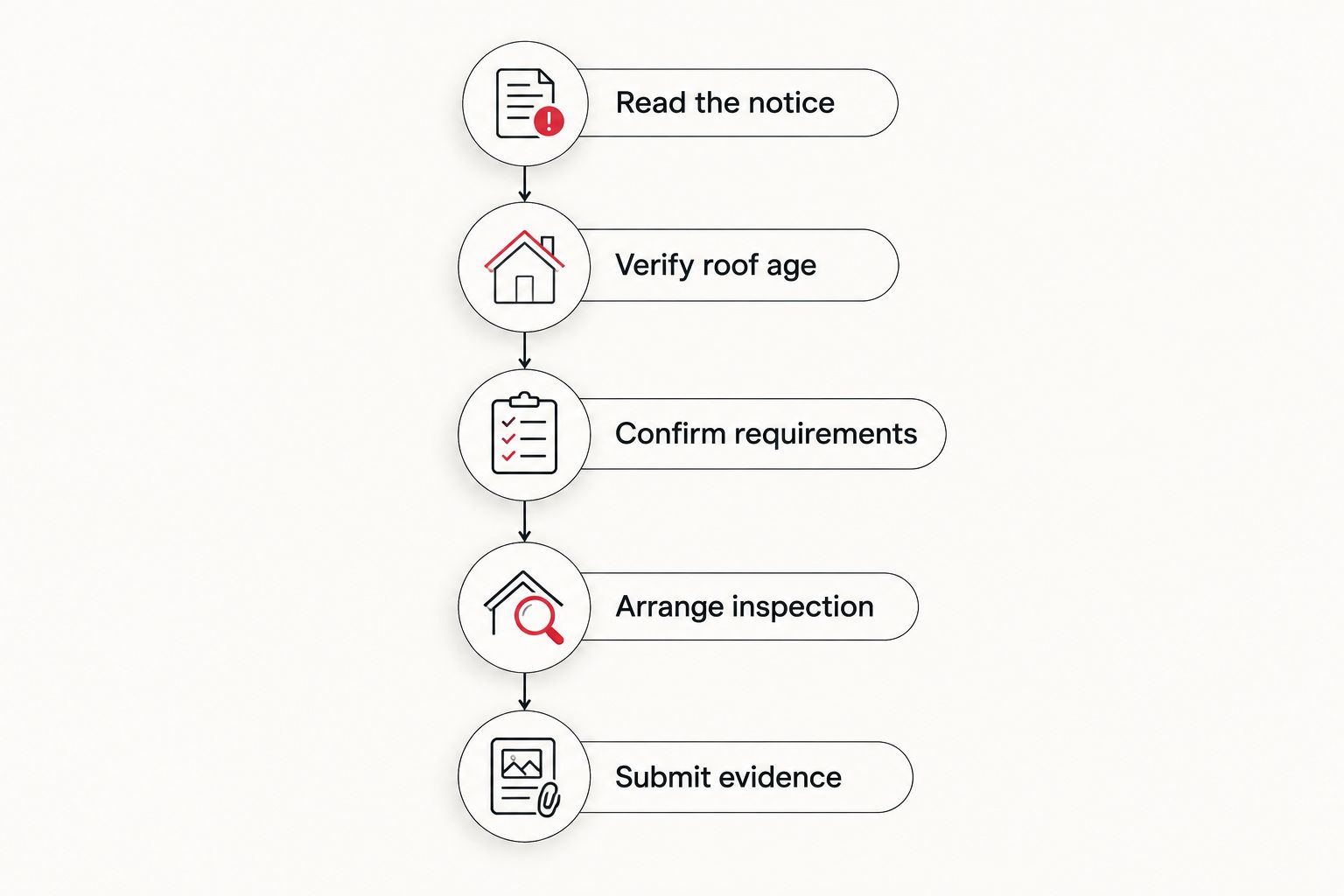
Use this sequence to separate an age dispute from work the roof actually needs. Start when the notice arrives, not when you are ready to choose a contractor.
- Read the notice. Identify whether it is a nonrenewal notice, an inspection request, or a request to correct a condition. Record the effective date and every response deadline stated in it.
- Verify roof age. Gather permit records, replacement contracts, and completion documents. Ask the agent to resolve conflicting dates with the insurer.
- Confirm requirements. Request the specific reason for the decision and ask whether the statutory roof-age inspection process applies. Get the required report format and inspector qualifications in writing.
- Arrange inspection. Have the roof evaluated by an appropriately authorized professional. Ask the report to address the insurer's concerns and remaining useful life where relevant.
- Submit evidence. Send the report and any requested completion documents, retain proof of submission, and request the insurer's written determination.
Continue discussing coverage options with your agent while the review is open. Do not assume that requesting reconsideration suspends the effective date in the notice or keeps your existing coverage in force.
If the explanation remains unclear, ask the insurer to distinguish age, condition, and other underwriting reasons explicitly. For questions about statutory rights or an unresolved insurance dispute, contact the Florida Department of Financial Services consumer assistance team or a qualified Florida attorney.
Should you inspect, repair, or replace the roof?
Choose the response that addresses the documented problem. Inspection, repair, and replacement serve different purposes; none should be presented as an automatic renewal guarantee.
| Option | Best for | Main benefit | Limitation |
|---|---|---|---|
| Authorized inspection | An age-related concern requiring evidence of remaining useful life | Documents condition and supports the statutory review process | Does not correct defects or guarantee renewal |
| Targeted repair | A roof with a defined, repairable defect | Addresses the identified physical problem | Does not reset the installation date or establish whole-roof useful life |
| Roof replacement | A roof whose condition calls for replacement after professional evaluation | Replaces the existing roof system within the agreed scope | Requires a larger construction project and does not resolve unrelated insurance issues |
Roofsmartflorida is a roofing service option for Southwest Florida homeowners facing repair or replacement decisions before renewal. Its stated roofing services include residential repair and replacement across Cape Coral, Fort Myers, Naples, and surrounding Southwest Florida counties.
The service boundary matters: Roofsmartflorida provides roofing work, not an insurance renewal decision. Ask the insurer what completion evidence it needs before agreeing on a scope intended to address an underwriting concern.
Discuss your roof repair or replacement
Explain the roof concerns listed in your insurance notice and discuss the physical work needed.
Can insurance refuse to renew a roof under 15 years old?
Under 15 years old does not mean guaranteed renewal. Florida's protection prevents refusal solely because of roof age, while separate condition concerns or other lawful underwriting reasons still require attention.
Ask the insurer to identify the reason in writing. If it cites damage, request the inspection findings rather than arguing only about the installation date.
Does an inspection showing 5 years remaining guarantee renewal?
At least 5 years of remaining useful life supports protection against age-only refusal, not an unconditional renewal guarantee. For a roof at least 15 years old, the authorized inspection addresses the statutory age issue; it does not settle every other policy requirement.
For your 2026 renewal, request written confirmation of the insurer's decision and any outstanding conditions. Do not infer acceptance from silence.
FAQ
What's the maximum roof age for homeowners insurance in Florida?
Florida does not set a universal maximum roof age that automatically ends homeowners insurance eligibility. Florida Statutes section 627.7011(5) protects roofs under 15 years against age-only refusal and provides an inspection pathway for older roofs.
Can my insurer make me replace a roof just because it is 15 years old?
For a roof at least 15 years old, the statute requires an opportunity for an authorized inspection before replacement is required as a condition of issuance or renewal. A finding of at least 5 years of remaining useful life protects against refusal based solely on age.
Who pays for the roof inspection used to challenge an age requirement?
The homeowner pays for the inspection described in Florida's roof-age provision. Confirm the inspector's statutory qualifications and the insurer's documentation requirements before arranging it.
Does repairing my roof reset its age for insurance?
A repair does not automatically reset the installation date of the entire roof. Submit records describing the actual work and ask the insurer how it will record that work.
Is a wind mitigation inspection the same as a roof condition inspection?
No, a wind mitigation inspection documents wind-resistant construction features rather than serving automatically as a roof remaining-useful-life assessment. Ask your insurer which report it requires for the specific renewal concern.
Does a renewal requirement mean insurance will pay for a new roof?
No, a requirement to repair or replace a roof does not itself establish a covered insurance claim. Coverage depends on the cause of damage and the policy's terms, conditions, and exclusions.
Can Roofsmartflorida guarantee my insurer will renew after roofing work?
No roofing contractor can make the insurer's renewal decision. Roofsmartflorida provides residential and commercial roofing repair and replacement services; confirm the insurer's requirements separately.
One last thing
A report stating 5 years of remaining useful life is not a promise of 5 years of insurance. That distinction is the most important safeguard against misunderstanding Florida's roof-age rule.
Before your 2026 renewal deadline, get the insurer's answer in writing: whether it accepts the report, what work remains necessary, and whether it will renew the policy. Keep that answer with your roof records, not just in a phone-call summary.