Yes, you can sell your house without a 4-point inspection in Florida in 2026; Florida does not require this report for every home sale. The buyer’s insurer, lender, or purchase contract can still make an inspection necessary to complete your particular transaction. The distinction is permission to sell versus the buyer’s ability to obtain insurance and close.
- Can I sell my house without a 4-point inspection in Florida? Yes, but insurance and contract requirements still apply.
- A cash purchase removes mortgage requirements, not insurance requirements or the seller’s disclosure duties.
- Roofsmartflorida provides Southwest Florida roofing services; roofing work does not replace a complete 4-point inspection.
- Confirm the buyer’s insurance requirements before agreeing to repairs or treating an inspection as unnecessary.
Can I sell my house without a 4-point inspection in Florida?
Yes. A 4-point inspection is not a universal Florida requirement for transferring ownership. Whether you need one depends on the transaction, particularly the buyer’s insurance application and the signed contract.
If a roof concern is driving the request, start with the distinction explained in how to pass a 4-point roof inspection in Florida: documenting roof condition is only part of the insurance review.
| Sale situation | Can the sale proceed without the report? | Best for | Main limitation |
|---|---|---|---|
| Cash purchase with no inspection requirement in the contract | Generally yes, if no other applicable transaction requirement calls for it | Buyers who do not need mortgage financing | The buyer’s chosen insurer can still require an inspection |
| Financed purchase | It depends on the lender’s requirements and the insurance needed for closing | Buyers using a mortgage | An unresolved insurance requirement can prevent closing |
| As-is purchase | An as-is agreement does not automatically require or eliminate the report | Parties agreeing on the property’s existing condition | Inspection rights and cancellation rights depend on the contract |
| Purchase where the insurer requests a report | The buyer must resolve that request to obtain the requested coverage | Buyers seeking coverage from that insurer | Skipping the report does not satisfy underwriting |
Do not assume that finding a cash buyer, accepting an as-is offer, or having an existing insurance policy settles the question. Each addresses a different part of the sale.
Why this matters before you accept an offer
A sale can be legally possible and still encounter an insurance problem before closing. That is why the useful question is not simply whether Florida requires the inspection. It is whether this buyer can complete this purchase without one.
For a 2026 sale, ask your real estate agent to separate the contract requirements from the buyer’s insurance requirements. Have the buyer confirm the latter with the insurance agent handling the new policy, rather than relying on a general statement about what insurers usually accept.
Your current policy is not proof that the buyer qualifies for a new policy. The buyer is applying for coverage under the insurer’s applicable underwriting requirements, and your existing coverage does not automatically transfer with the deed.
Resolve the insurance question before negotiating a roof replacement. Otherwise, you risk agreeing to work that does not address the actual obstacle—or overlooking electrical or plumbing concerns that roofing work cannot fix.
What does the inspection actually cover?
A 4-point inspection addresses 4 systems: roofing, electrical, plumbing, and heating and air conditioning. Insurers use the information to evaluate the property’s condition for coverage; it is not a complete assessment of everything a buyer should investigate.
The roof represents 1 of those 4 systems. An inspector’s roof observations do not settle the condition of the 3 other systems, even when the roof is the seller’s main concern.
Keep these documents separate:
- 4-point inspection: Records the condition of the specified systems for an insurance review.
- Full home inspection: Examines a broader range of accessible home components for the buyer’s due diligence.
- Roof assessment or certification: Addresses roofing condition within the scope of that assessment or document.
- Wind mitigation inspection: Documents construction features relevant to wind resistance and potential insurance credits.
These documents serve different purposes. A favorable roof assessment does not replace a requested 4-point report, and a wind mitigation report does not establish that the plumbing or electrical system is acceptable.
Ask the receiving insurer which document it needs, which qualifications it requires from the person completing it, and what supporting photographs or records must accompany it. Do this before booking an appointment.
How to decide whether your sale needs the report
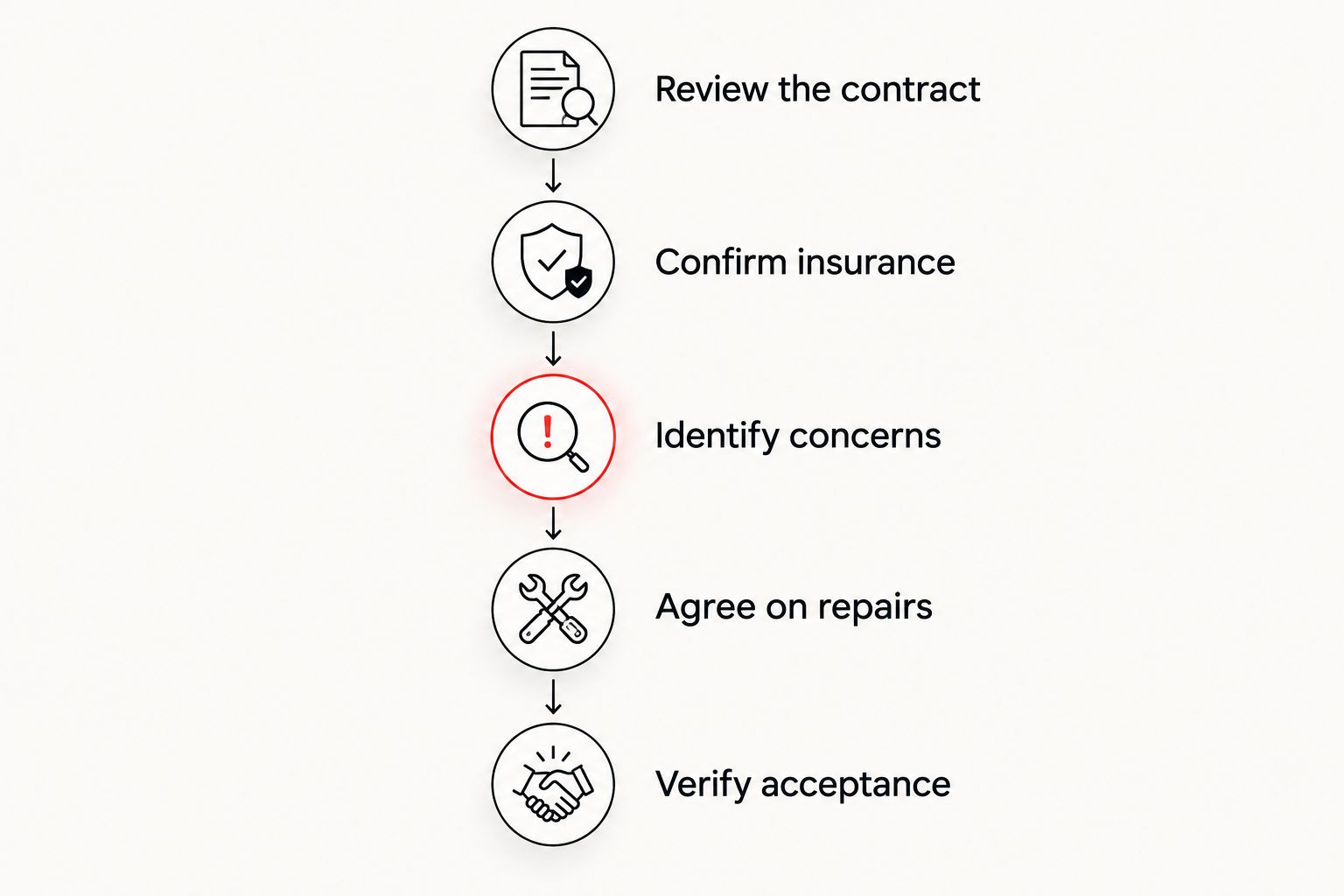
Use this sequence before you promise that the property can close without an inspection. The buyer’s insurance agent answers coverage questions; your real estate professional or attorney answers contract questions.
- Review the contract. Identify inspection rights, financing terms, insurance-related provisions, repair obligations, and deadlines. Do not treat an informal conversation as a substitute for the signed agreement.
- Confirm insurance. Ask the buyer to establish whether the intended insurer requires a 4-point report for this property. A preliminary quote is not the same as confirmation that all underwriting requirements are satisfied.
- Identify concerns. If a report is requested, distinguish missing documentation from an actual defect. An uncertain roof installation date and an active roof leak are different problems, even if both require follow-up.
- Agree on repairs. Put any negotiated work, responsibility, documentation, and timing into the appropriate written agreement. Do not assume a verbal promise changes the contract or satisfies the insurer.
- Verify acceptance. After repairs or document submission, have the buyer confirm what remains outstanding with the insurer and lender. A completed repair is not, by itself, approval to close.
Keep the resulting correspondence with your sale documents. Written requirements give everyone a clear reference when a contractor, inspector, insurance agent, and closing professional are handling different pieces of the transaction.
If someone says the house “failed,” ask for the specific finding and the required response. The useful information is the defect, missing evidence, or underwriting decision—not the label.
Why inspection requirements vary between Florida sales
There is no single answer based only on the property’s address or the seller’s preference. For your 2026 transaction, these factors determine what needs attention:
- The chosen insurer: Carriers set underwriting requirements for the coverage being requested. Another seller’s experience does not establish your buyer’s requirements.
- The property’s age: An insurer can request more condition information for an older home. Do not apply a single age cutoff to every carrier.
- The systems’ condition: Leaks, deterioration, unsafe electrical conditions, and plumbing defects require different responses from missing paperwork.
- The purchase contract: Inspection rights, contingencies, and repair agreements affect what each party must do and when.
- The financing arrangement: A mortgage lender generally requires acceptable property insurance. A cash buyer does not have that mortgage condition but still makes insurance decisions.
- The supporting records: Installation records, permit documentation, photographs, and repair invoices help establish what work occurred. The insurer determines whether the evidence meets its requirements.
Ask about the actual property and proposed policy. Statements such as “cash sales never need inspections” or “every older Florida home needs the same report” leave out the terms that control the transaction.
What should you do if the roof is the obstacle?
Start with the written roof finding. Determine whether the concern involves an active leak, damaged covering, visible deterioration, uncertain age, or an estimate of remaining useful life.
Those findings do not all justify the same work. A repair addresses a defined defect; a replacement addresses a broader roofing need. Neither should be promised solely because someone says a new roof will make the sale easier.
Roofsmartflorida roofing services are best for Southwest Florida sellers who need roof repair or replacement before closing. The company serves residential and commercial properties across Cape Coral, Fort Myers, Naples, and surrounding Southwest Florida counties.
The limit is just as important: roofing work does not resolve the electrical, plumbing, or heating and cooling portions of a 4-point review. It also does not guarantee an insurer’s acceptance or the buyer’s financing approval.
When discussing roofing services, provide the written finding rather than asking a contractor to guess what the insurance company wants. Ask for a scope that identifies the roof problem, proposed work, and documentation you will receive.
Before authorizing that scope, have the buyer confirm whether the insurer needs a repair invoice, updated photographs, another inspection, or a particular form. Avoid assuming that a contractor’s invoice and an insurance inspection report are interchangeable.
Discuss the roof finding
Ask Roofsmartflorida about repair or replacement for the roof concern affecting your sale.
Can I sell my house as-is without a 4-point inspection?
A 4-point inspection is not automatically required just because you sell as-is. However, an as-is contract does not automatically remove the buyer’s inspection rights, insurance requirements, or contractual cancellation rights.
As-is describes the parties’ agreement about property condition and repairs; it is not an exemption from disclosure duties. Florida’s residential disclosure rule, established in the Florida Supreme Court’s Johnson v. Davis decision, concerns known facts materially affecting value that are not readily observable and are not known to the buyer.
Have your real estate attorney address how that rule applies to a known leak or other defect. Skipping an inspection does not erase what you already know.
Does a cash buyer need a 4-point inspection in Florida?
A 4-point inspection is not automatically required for a cash purchase. Paying cash removes the mortgage lender from the transaction, not the buyer’s ability to request inspections or the insurer’s ability to require condition information.
For a cash closing in 2026, confirm both the contract and the buyer’s insurance plans. If the buyer chooses not to obtain coverage, that decision does not eliminate the seller’s disclosure obligations or repair promises already included in the agreement.
Do I have to replace my roof before selling in Florida?
A 4-point inspection request does not automatically mean you must replace the roof before selling. Establish the roof’s condition, the buyer’s insurer’s requirements, and your contractual obligations before agreeing to replacement.
You and the buyer can discuss repairs, replacement, a concession, or proceeding without seller work, subject to the contract and financing requirements. A concession does not repair a defect or compel an insurer to accept it. Confirm whether the proposed arrangement actually allows the buyer to close.
FAQ
Can I sell my Florida house without getting a 4-point inspection first?
Yes. Florida does not require a 4-point inspection before every home sale, but your purchase contract or the buyer’s insurance and financing requirements can make one necessary for the transaction.
Who decides whether the buyer needs a 4-point inspection?
The buyer’s insurer decides whether it requires a 4-point report for the requested coverage. The contract can also contain inspection obligations, and a lender’s insurance requirements can affect closing.
Does selling as-is mean I can ignore a known roof leak?
No. An as-is sale does not eliminate Florida’s applicable disclosure duties for known material defects. Ask your real estate attorney how to disclose the leak and document any repair agreement.
Can a roof inspection replace the whole 4-point inspection?
No. A roof inspection addresses roofing, while a 4-point inspection also covers electrical, plumbing, and heating and air conditioning. The receiving insurer determines which reports it will accept.
Does the seller always have to pay for the inspection?
No. Responsibility for arranging and paying for an inspection depends on the contract and the parties’ agreement. Confirm that responsibility in writing before scheduling it.
Will a repair credit solve an insurance inspection problem?
Not by itself. A credit changes the financial agreement between buyer and seller, but it does not correct the property condition or satisfy an insurer’s repair requirement.
Does a clean 4-point report guarantee the buyer can get insurance?
No. A 4-point report supplies condition information, but the insurer makes the coverage decision using its applicable underwriting requirements. The buyer must confirm acceptance with the insurance agent.
One last thing
A house does not receive one universal “pass” that every insurer must accept. The inspection supplies information; the insurer decides how that information affects the requested coverage.
For your 2026 closing, ask the buyer to confirm whether outstanding insurance requirements have been satisfied—not simply whether the inspection appointment is finished. That distinction helps you separate completed paperwork from an unresolved closing condition.
If roofing work is necessary, give Roofsmartflorida the actual roof findings. Keep insurance approval, contract advice, and roofing work with the professionals responsible for each.