Senior living commercial roofing is the inspection, repair, and replacement of facility roofs with the aim of protecting residents and keeping daily operations running. Unlike an empty commercial building, an occupied senior living facility needs a roofing plan that accounts for resident routines, accessible routes, care services, and emergency access.
- Commercial roofing for senior living facilities starts with resident protection, documented roof conditions, and a workable construction sequence.
- Roofsmartflorida suits Southwest Florida facility operators seeking commercial roof repair or replacement.
- Choose roof repair or roof replacement from inspection findings, not the appearance of an interior stain.
- Require written plans for resident access, daily weather protection, cleanup, and project handover.
Why commercial roofing matters for senior living facilities
A roof project affects more than the maintenance department. Work above bedrooms, dining rooms, treatment spaces, and entrances requires coordination with the people using those spaces below.
For your 2026 roofing plan, separate immediate water protection from the permanent repair decision. An active leak needs attention, but temporary protection does not establish whether the roof needs a localized repair or full replacement. The guide to emergency roof repair for property management companies covers that initial response context.
Resident protection belongs in the project scope, not in an informal conversation after work starts. Specify who approves access changes, who communicates with residents, and who responds when weather or concealed damage changes the plan.
Independent living, assisted living, and skilled nursing operations also need different coordination. Build your scope around the actual services in your building rather than treating every senior community as the same type of property.
How to plan a senior living roofing project
Start with your existing records and staff observations. Then use a professional roof evaluation to resolve questions that require roof access, material assessment, or construction expertise; facility staff should not climb onto the roof to complete this checklist.
The sequence below connects roof condition with operating requirements. Keep both in the same project file so the contractor and facility team work from the same information.
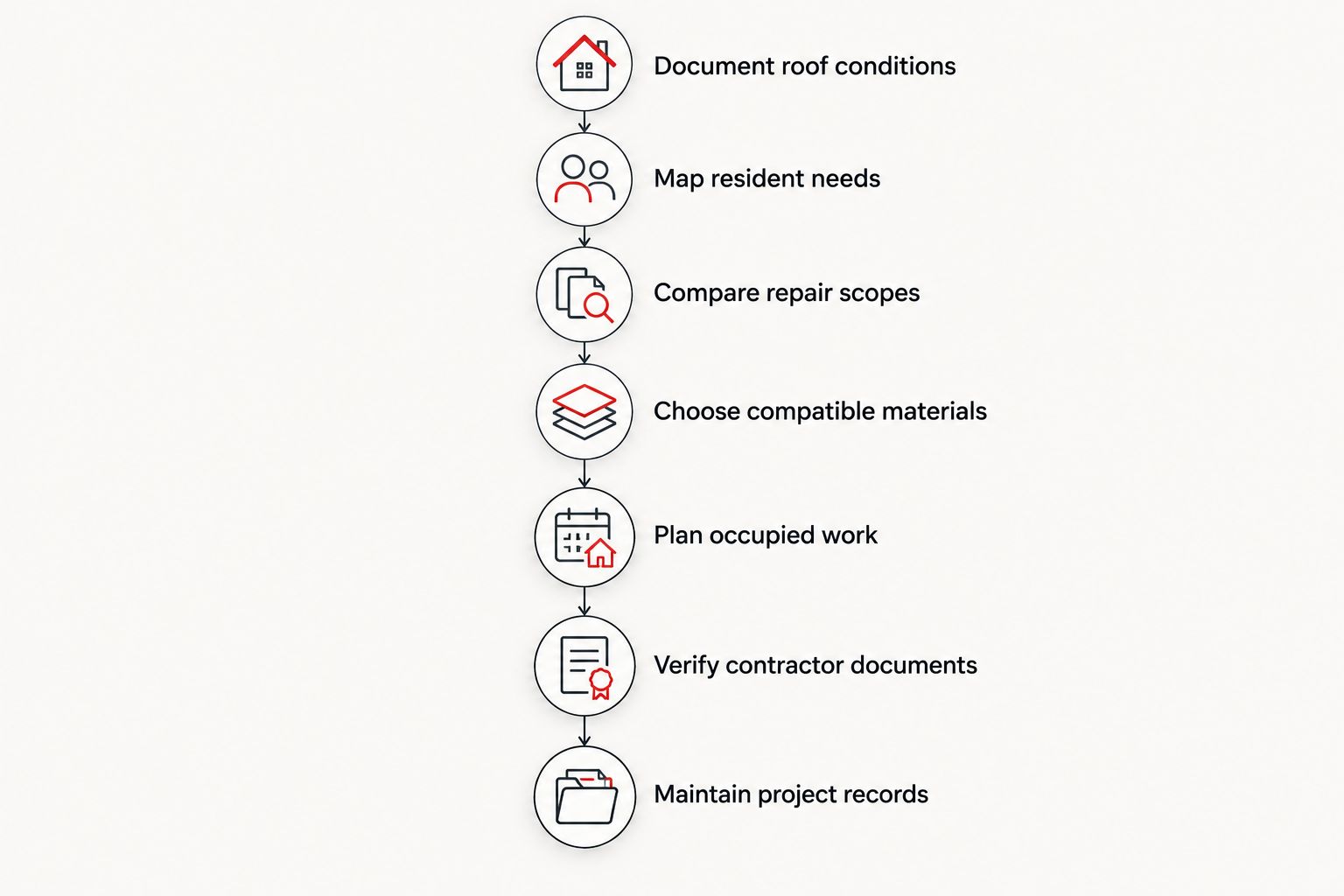
Document roof conditions
Begin with a facility walkthrough and a review of maintenance records. Photograph visible interior stains from safe locations, note when leaks occur, and identify the rooms affected. Keep observations separate from conclusions: a ceiling stain identifies an affected area, not necessarily the roof entry point.
Ask the roofing contractor to connect interior observations with roof findings. The evaluation should explain the condition of the covering, flashings, penetrations, drainage, and any accessible underlying components. Request photographs and a plain-language explanation rather than accepting a replacement recommendation without supporting evidence.
For a 2026 condition file, collect:
- Existing roof plans, repair records, and warranty documents.
- Dated photographs of stains, damp finishes, and visible exterior damage.
- A leak log showing location, weather conditions, and recurrence.
- A roof-area map linked to the rooms underneath.
- Contractor findings that distinguish confirmed damage from further investigation.
Map resident needs
Build an operating map before requesting the final construction schedule. Identify sleeping areas, memory care spaces, dining rooms, medication storage, mechanical equipment, and entrances. Include the building features that matter to your facility rather than copying a generic commercial checklist.
Ask care and operations staff to identify activities that cannot simply move elsewhere. Then discuss noisy work, delivery movements, odors, and temporary access changes with the contractor. If a task conflicts with resident care, resolve that conflict before the work area opens.
Assign responsibility for:
- Resident and family notices in accessible formats.
- Coordination with nursing, housekeeping, dining, and maintenance teams.
- Wheelchair routes and protected building entrances.
- Ambulance access and emergency service routes.
- Decisions about room changes or temporary relocation.
Compare repair scopes
Write down what each proposed scope fixes and what it leaves untouched. A targeted repair addresses a defined defect; replacement renews a broader roof area. Neither is automatically the right answer without an evaluation of the existing assembly.
Roofsmartflorida commercial roofing services fit Southwest Florida facility operators seeking roof repair or replacement. Roofsmartflorida provides commercial roofing installation, repair, and replacement across Cape Coral, Fort Myers, Naples, and surrounding Southwest Florida counties. Bring the condition file and operating map to the evaluation; confirm occupied-facility arrangements in the written proposal rather than assuming them.
Compare each scope against the same questions:
- Which roof areas and defects does the proposal address?
- What evidence supports repair rather than replacement, or the reverse?
- How will the contractor handle concealed damage?
- What remains outside the proposed work?
- What temporary protection is included during construction?
Choose compatible materials
Match the roofing system to the building before comparing appearance or advertised benefits. Roof slope, existing structure, drainage, equipment, and approved installation details all affect the choice. A campus with several building types does not necessarily need the same covering everywhere.
For your 2026 specifications, request the exact proposed system and supporting documentation. Broad labels such as metal, tile, shingle, or flat roofing do not explain the complete assembly. Ask a qualified contractor or design professional to confirm structural suitability and applicable local requirements.
Check these details before approval:
- Roof slope and the proposed system's intended application.
- Deck condition and structural review where needed.
- Attachment, edge, flashing, and penetration details.
- Drainage paths and connections to gutters or roof drains.
- Maintenance access around rooftop equipment.
- Manufacturer instructions and applicable permit requirements.
Plan occupied work
Require a site-specific construction plan that shows where crews, equipment, materials, and residents will move. Keep contractor traffic separate from resident routes wherever the layout allows. Do not rely on a verbal assurance that crews will work around everyone.
The daily weather-protection plan deserves particular attention. Ask how the contractor will secure unfinished areas, respond to changing weather, and communicate a leak during work. Facility staff also need a clear process for reporting debris, odors, excessive noise, or blocked access.
Put these arrangements in writing:
- Work zones, barriers, signs, and protected entrances.
- Crew access, delivery areas, and material storage locations.
- Resident routes and emergency access throughout each phase.
- Coordination around air intakes and planned equipment interruptions.
- Daily cleanup, debris removal, and ground-level hazard checks.
- Weather stop-work decisions and temporary water protection.
Verify contractor documents
Check the contracting business through Florida's official licensing resources and obtain current insurance documentation. Match the business name on the proposal to the entity performing the work. Ask who manages subcontractors and who has authority to approve changes.
Roofsmartflorida offers no-pressure free estimates, giving you a way to start a commercial roofing discussion without committing to a construction scope. An estimate is still only the beginning: verify the project-specific documents and agree on responsibilities before authorizing work.
Your 2026 approval file should contain:
- Verified contractor identity and applicable licensing information.
- Insurance documentation and the facility's required coverage review.
- A written scope with inclusions, exclusions, and change procedures.
- Responsibility for permits and required inspections.
- Named contractor and facility contacts.
- Written warranty terms for the proposed work.
Maintain project records
Make handover part of the contract rather than a request after the crew leaves. Obtain completion photographs, inspection records where applicable, maintenance instructions, and the final scope of work. Record any changes made during construction and the reason for each change.
Close the project with a walkthrough that covers the roof work and the occupied spaces affected by it. Check drainage, entrances, grounds, and reported interior issues. Then assign responsibility for future observations and professional inspections according to the installed system's requirements.
Keep the following records together:
- Final roof-area drawings or marked photographs.
- Approved changes and concealed-damage documentation.
- Permit and inspection closeout records where applicable.
- Manufacturer and workmanship warranty documents.
- Maintenance instructions and contractor contact details.
- Unresolved items with a named owner and completion plan.
Request a commercial roof evaluation
Discuss roof conditions, repair or replacement, and the needs of your occupied facility.
Compare roofing approaches for senior living facilities
The best approach is the one supported by roof condition and facility requirements. Staff-led tracking helps organize the problem, but it cannot replace a professional roof assessment. Likewise, a coating or localized repair should not serve as a substitute for addressing unsuitable underlying conditions.
Use this comparison to frame contractor discussions. These are decision paths, not interchangeable roofing products, and each needs a defined scope.
| Option | Best for | Main advantage | Key limitation |
|---|---|---|---|
| Staff-led condition tracking | Operators assembling records before an evaluation | Connects leaks and resident impacts with specific locations | Does not diagnose concealed roof damage or establish system suitability |
| Roofsmartflorida commercial roofing evaluation | Southwest Florida operators considering commercial repair or replacement | Opens a discussion with a provider offering both services | Occupied-facility procedures and project responsibilities still need written agreement |
| Targeted roof repair | A confirmed localized defect in an otherwise serviceable roof | Limits intervention to the identified problem | Does not renew unrelated deteriorated areas |
| Coating restoration | An existing roof confirmed suitable for the specified coating system | Treats a compatible existing surface without automatically replacing the covering | Requires assessment of substrate condition, moisture, drainage, and compatibility |
| Roof replacement | A roof evaluation supporting renewal of the assembly | Allows a broader construction scope and correction of included defects | Requires more extensive work-zone, weather-protection, and resident coordination |
For 2026 planning, compare proposals on equal terms. A repair limited to a flashing detail and a replacement covering an entire building are not equivalent offers. Ask each bidder to identify the problem, proposed remedy, exclusions, and operating impact before you select a scope.
Common mistakes senior living facilities make
Treating the roof as a maintenance-only project
A technically sound scope still needs an operating plan. Include the facility administrator and care team when work affects resident rooms, routines, or access; maintenance staff should not carry those decisions alone.
Scheduling noisy work without checking resident routines
A contractor's preferred sequence is not automatically suitable for the facility. Identify rest periods, dining services, care activities, and sensitive rooms before agreeing to the schedule, then establish how staff will receive changes.
Accepting a coating without a suitability assessment
A coating proposal needs more than a surface photograph. Require an explanation of compatibility, underlying condition, preparation, drainage, and exclusions before deciding that restoration answers the roof problem.
Confusing a retirement community with a care facility
Age-restricted housing and a facility providing resident care have different operating requirements. Describe the services delivered in your building, access controls, staffing responsibilities, and resident support needs directly in the contractor briefing.
Approving work without a weather-interruption plan
A start date does not explain how an unfinished roof will be protected. Require responsibility for temporary protection, monitoring, emergency communication, and restart decisions before construction begins.
FAQ
What's the best commercial roofing for senior living facilities?
The best roofing approach matches the facility's roof condition, structure, drainage, and operating needs. Choose the system after a professional evaluation, then require a written plan for resident protection and occupied work.
Can residents stay in a senior living facility during roof replacement?
Resident occupancy must be decided through a project-specific safety and operations review. The facility team and contractor should address access, noise, air intakes, weather protection, and any need for temporary relocation before work starts.
Is roof repair better than replacement for an assisted living building?
Roof repair is appropriate when an evaluation supports fixing a localized defect in a serviceable assembly. Replacement is the better scope when the documented condition supports broader renewal; neither decision should rest on an interior stain alone.
Are roof coatings suitable for senior living facilities?
Roof coatings are an option only when the existing roof is suitable for the specified system. Confirm substrate condition, moisture, drainage, compatibility, and preparation requirements before approving restoration.
How should a facility choose a commercial roofing contractor?
Choose a contractor with verified applicable licensing, insurance documentation, and a clear written scope. Require project-specific arrangements for resident access, weather interruptions, subcontractor oversight, and communication.
What should a senior living roof inspection cover?
A senior living roof inspection should assess the covering, flashings, penetrations, drainage, and accessible underlying components. Link findings to interior observations and ask the contractor to distinguish confirmed defects from items requiring further investigation.
Does Roofsmartflorida provide commercial roof repair and replacement?
Roofsmartflorida provides commercial roofing installation, repair, and replacement in Southwest Florida. Its stated service area includes Cape Coral, Fort Myers, Naples, and surrounding counties; confirm the facility's scope and operating requirements during the estimate discussion.
One last thing
Ask the contractor to mark the roof work areas on the same plan your staff uses for resident rooms and emergency access. This simple shared reference connects an overhead construction task with the people and activities underneath it.
Approve the resident-protection plan alongside the roofing scope. If the team cannot explain how entrances, care routines, and unfinished roof areas will be handled, the project is not ready to start.