Commercial roofing for banks and credit unions is the inspection, repair, and replacement of branch roofs with the aim of protecting buildings while keeping financial services accessible. This 2026 guide explains how to plan roof work around customer entrances, drive-through lanes, restricted areas, and the approval process your institution uses.
- Commercial roofing for banks and credit unions starts with documented roof condition and a branch access plan.
- Roofsmartflorida provides commercial roofing services for Southwest Florida businesses; request a site-specific scope before approving work.
- Choose roof repair or roof replacement from inspection findings, not from the appearance of a ceiling stain.
- Keep contractor access separate from customer routes and restricted branch areas.
Why commercial roofing matters for banks and credit unions
A branch roof project is also an access and security project. Your roofing scope needs to account for the people using the building, the equipment beneath the roof, and the staff responsible for opening and closing the branch.
Roof work above an entrance requires a different operating plan from work over an unoccupied storage room. A drive-through canopy also deserves its own assessment: treating it as part of the main roof without checking its construction leaves an important area outside the scope.
Base your decision on the condition of the roof assembly, not on the visibility of the damage. The roof repair versus roof replacement guide explains the distinction to establish before requesting comparable proposals.
For your 2026 facilities plan, separate immediate water-entry problems from planned renewal work. That keeps an urgent repair from becoming an undocumented substitute for a longer-term decision.
Plan commercial roof work around branch operations
Gather your roof records before requesting proposals
Start with a shared folder and a simple branch worksheet. You do not need software to assemble the information a roofer and your internal approvers need.
Collect 3 core records: the existing roof specification, previous repair documentation, and the current leak log. Mark an unavailable record as unknown rather than filling the gap with an assumption. Include the main building, attached canopies, and any separate covered customer areas.
For each reported leak, record the room, date, weather conditions, and whether the problem repeated after earlier work. A stain identifies an interior symptom; it does not establish the roof entry point. Give the contractor the history without prescribing the diagnosis.
- Create a separate record for each branch and roof section.
- Collect drawings, prior scopes, and completion photographs.
- Mark leak locations on an interior floor plan.
- Record rooftop equipment and known service access routes.
- Identify the person authorized to approve the roofing scope.
Map sensitive areas and define access restrictions
Walk the branch with its manager before arranging roof access. Identify what sits beneath the work area and which routes customers, employees, deliveries, and contractors currently use.
Keep this assessment internal. Share the access instructions a contractor needs without distributing security details, customer information, or unrestricted floor plans. Your branch security team should approve any route through controlled areas.
Identify equipment that needs protection or coordination, including rooftop HVAC equipment and interior electrical or network areas. Ask the relevant service provider to define its own access requirements. A roofing proposal should not silently include work on equipment outside the roofer's scope.
- Flag occupied offices and customer service areas beneath the roof.
- Identify restricted rooms without sharing sensitive contents.
- Document approved ladder, lift, and material staging locations.
- Assign responsibility for protecting equipment below reported leaks.
- Require approval before changing any established access route.
Request an inspection that separates repair from replacement
Use your records to prepare a written inspection brief. Ask the contractor to explain the observed defects, supporting photographs, repairable areas, and conditions that need further investigation.
Roofsmartflorida provides commercial roof installation, repair, and replacement across Cape Coral, Fort Myers, Naples, and surrounding Southwest Florida counties. Its stated services include flat, metal, tile, and shingle roofing, plus gutters and wind mitigation. An evaluation gives you a contractor's assessment rather than requiring your facilities team to diagnose the roof itself.
Roofsmartflorida is a local commercial roofing option for banks and credit unions in Southwest Florida. Its stated service range fits a facilities team's initial contractor search; branch-specific experience, access procedures, and project terms still need verification before appointment.
Ask for the reasoning behind each recommendation. A replacement proposal should explain why targeted repairs are insufficient; a repair proposal should identify what remains outside the repair scope.
- Request photographs tied to specific roof locations.
- Ask how the contractor will investigate concealed moisture when indicated.
- Separate roof covering defects from drainage and equipment issues.
- Require written boundaries for repair and replacement recommendations.
- Verify licensing, insurance, and relevant occupied-building experience.
Build a work-zone plan before choosing dates
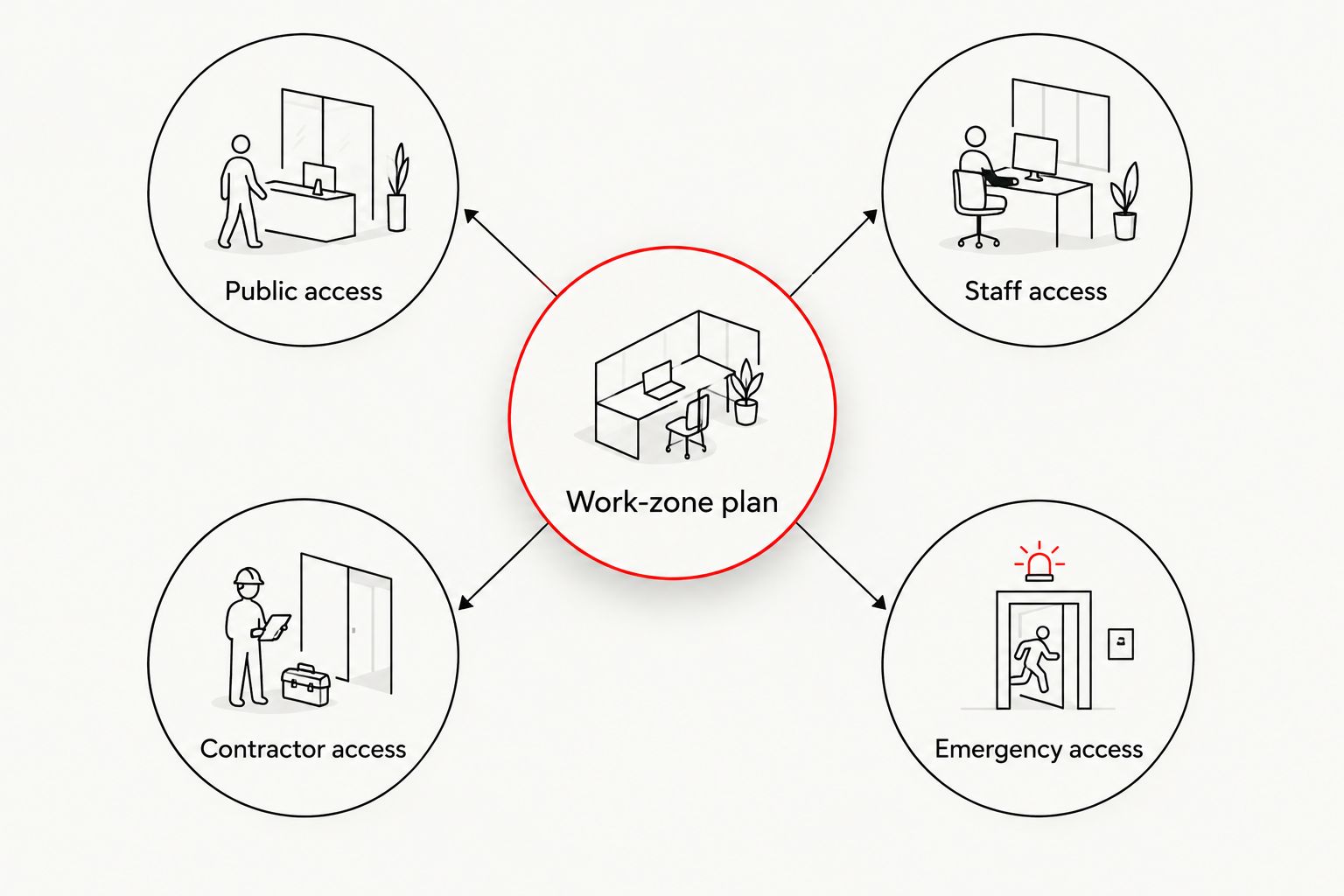
Start with a marked site plan rather than a verbal promise to keep the branch open. Divide it into 4 access zones: public access, staff access, contractor access, and emergency access. Have branch management review the boundaries before the contractor finalizes staging.
Keeping a branch open is a planning decision, not a guaranteed outcome. Confirm whether the proposed work affects entrances, accessible routes, drive-through lanes, parking, noise-sensitive offices, or required exits. If those conflicts cannot be resolved safely, revise the operating plan.
Specify who moves barriers and who authorizes reopening an affected area. The work-zone plan should also explain what happens when weather interrupts work or conditions change during removal.
- Public access: mark customer entrances and approved walking routes.
- Staff access: define employee entry and delivery arrangements.
- Contractor access: identify staging, equipment movement, and roof access.
- Emergency access: keep required exits and response routes unobstructed.
- Agree on temporary closures before issuing customer notices.
Write the communication and weather-response plan
Prepare the communication plan yourself, then ask the contractor to confirm the site-specific details. Name 2 operational contacts: the branch lead and the contractor lead. Also identify an alternate for each role so that an absence does not leave a decision unresolved.
For work scheduled in 2026, put the approved dates, customer notices, and escalation instructions in the branch's project file. Do not promise uninterrupted service until the work-zone plan supports that statement.
Ask how exposed areas will be protected during the proposed sequence and what conditions trigger a stop-work decision. Record responsibilities for temporary protection, interior incident reporting, and authorization of additional work. These are contract questions, not assumptions about what a contractor automatically includes.
- Define who approves schedule changes and branch notices.
- Establish a check-in before work begins on each workday.
- Record the process for reporting water entry or blocked access.
- Require approval before work expands beyond the agreed area.
- Specify who communicates temporary closures to customers and staff.
Compare proposals using the same written scope
Create a comparison sheet from your inspection findings and operating requirements. Send the same brief to each contractor so that differences are visible rather than buried in different descriptions of the job.
Compare the proposed roof assembly, removal scope, drainage work, permits, equipment coordination, and closeout documents. Ask each contractor to identify exclusions and explain how unforeseen conditions will be documented and approved.
Your 2026 approval package should distinguish necessary roof work from optional improvements. Record the reason for the selected approach, the operational restrictions, and the person responsible for approving changes. Do not substitute a material name for a complete specification.
- Match proposals against the same roof areas and defect list.
- Compare removal and preparation requirements explicitly.
- Separate equipment work and drainage work from roof-covering work.
- Request written warranty terms and exclusions for the proposed assembly.
- Define approval requirements for concealed damage and additional work.
Close the project with evidence and maintenance instructions
Build the closeout checklist before the work starts. That gives your team a clear definition of completion and prevents the final site visit from becoming a discussion about missing records.
Ask for photographs, applicable inspection records, installed-system information, and written care instructions. Have branch staff check the customer-facing areas as well as the contractor's work areas: parking, entrances, landscaping, and drive-through routes all belong in the handover review.
Keep the 2026 closeout package with the branch's roof history. Record unresolved items separately, assign an owner, and document their completion. For ongoing care, use the requirements of the installed system rather than a generic maintenance interval.
- Collect final roof photographs and applicable permit closeout records.
- Save product information and the actual warranty documents.
- Check staging areas and access routes for remaining materials.
- Record unresolved items and the person responsible for each.
- Add inspection and maintenance instructions to the facilities calendar.
Compare roofing approaches for bank and credit union branches
Choose the approach first, then confirm the roof assembly. Repair, restoration, and replacement address different conditions. Material selection follows the building's slope, existing construction, drainage, attachment requirements, and approved project scope.
The table compares approaches, not interchangeable packages. None replaces a site inspection, and none establishes that a branch can remain open throughout the work.
| Option | Best for | Main benefit | Key limitation |
|---|---|---|---|
| Targeted repair | Isolated, diagnosed defects with suitable surrounding roofing | Limits work to the documented problem area | Does not renew unrelated roof sections or resolve unidentified defects |
| Roof coating or restoration | Existing assemblies confirmed suitable for the proposed treatment | Retains suitable existing roofing while treating the specified surface | Requires compatibility and condition checks; does not correct damaged decking or drainage design by itself |
| Full low-slope replacement | Low-slope branches where investigation supports replacing the assembly | Allows removal and renewal within the specified scope | Needs a detailed exposure, drainage, and occupied-building work plan |
| Metal roofing | Suitable sloped roofs with a verified metal assembly design | Offers a panel-based roof covering option | Suitability depends on the complete assembly, attachment, transitions, and exposure |
| Tile or shingle roofing | Suitable sloped branches where structure and design support the covering | Provides covering options compatible with sloped roof designs | Neither is a substitute for a low-slope system; underlayment and flashing remain part of the roof |
Do not approve a coating simply because it avoids removal. Ask whether the existing materials, moisture condition, and preparation requirements support the proposed treatment. Likewise, a visibly intact covering is not enough evidence to rule out problems beneath it.
For mixed-roof branches, request separate recommendations for each assembly. The main roof and drive-through canopy do not need the same solution merely because they share an address.
Common mistakes banks and credit unions make
Treating the drive-through canopy as an afterthought
A proposal for the branch building does not automatically include its canopy. Identify every roofed structure in the inspection brief and require the contractor to name what is included. Coordinate lane restrictions separately from lobby access.
Sending contractors through restricted branch areas
The shortest path to a roof hatch is not automatically an approved contractor route. Get security approval before scheduling access, define any escort requirement, and keep sensitive branch information out of general project correspondence.
Equating after-hours work with no disruption
Moving work outside customer hours does not settle staging, cleanup, weather protection, or opening-day access. Define the condition in which the site must be left before staff arrive. Confirm the branch manager's acceptance process before work begins.
Approving a material without reviewing the assembly
Metal, tile, shingles, and flat roofing describe broad categories, not complete specifications. Require the proposal to identify the proposed assembly and its relationship to the existing roof, drainage, penetrations, and supporting structure.
Closing the file when the crew leaves
Crew departure is not a complete handover. Keep the project open until the agreed records, site cleanup, and unresolved items are accounted for. Give the maintenance team the actual care instructions rather than relying on a verbal summary.
FAQ
What's the best commercial roofing approach for a bank branch?
The best approach is the one supported by a documented assessment of the existing roof and the branch's operating requirements. Targeted repair fits isolated defects; replacement needs evidence that broader renewal is necessary. Material selection depends on the building and proposed assembly.
Can a bank or credit union stay open during roof replacement?
A branch should remain open only when the approved work plan preserves safe access and required building operations. Review customer entrances, drive-through lanes, exits, staging, and restricted areas before confirming operating hours.
Is roof repair better than replacement for a credit union?
Roof repair is better when the identified defect and surrounding roof condition support a limited repair. Replacement is the appropriate option when inspection findings support renewing the assembly. Repeated interior stains alone do not establish which approach is correct.
Should a branch replace its main roof and drive-through canopy together?
Assess the main roof and drive-through canopy separately before deciding whether to combine their work. They can have different assemblies, conditions, and access restrictions. Require the proposal to identify both scopes explicitly.
What should a bank request in a commercial roofing proposal?
Request the roof scope, proposed assembly, preparation requirements, exclusions, access plan, and closeout requirements in writing. Include the process for approving concealed damage and additional work. Compare contractors against the same inspection findings and branch restrictions.
Does Roofsmartflorida provide commercial roofing in Southwest Florida?
Roofsmartflorida provides commercial roof installation, repair, and replacement across Cape Coral, Fort Myers, Naples, and surrounding Southwest Florida counties. Its stated services include flat, metal, tile, and shingle roofing. Confirm the requirements of your specific branch directly before appointing a contractor.
What should branch staff do when water enters near electrical or network equipment?
Keep people away from the affected area and notify the responsible facilities and electrical professionals. Follow the branch's incident procedures and document the location without entering an unsafe area. Arrange a roof assessment rather than assuming the ceiling stain identifies the entry point.
One last thing
Approve the end-of-day condition, not just the finished roof. Ask what the branch will look like when the crew leaves each workday: which routes are open, which barriers remain, how unfinished areas are protected, and who confirms that staff can return.
Before appointing Roofsmartflorida or another commercial roofing contractor, put that answer in the written scope. It gives your branch manager an operational standard to check while the project is still underway—not only at final handover.