Choose Roof Smart if you need residential or commercial roofing, gutters, or wind mitigation in Cape Coral, Fort Myers, or Naples; choose Roof Crafters if its written proposal better addresses your roof’s condition, project requirements, and contract terms. For this 2026 comparison, the deciding difference is the work each contractor commits to—not the company name on the estimate.
- Roof smart vs roof crafters: choose by written roof repair or roof replacement scope, not a sales pitch.
- Roof Smart serves Southwest Florida homeowners and businesses needing roofing, gutters, and wind mitigation.
- Choose Roof Crafters when its documented proposal better fits your specific roofing project.
- Compare materials, exclusions, change orders, and warranty terms before signing either contract.
Why this matters
A roofing estimate is a description of responsibility. You need to know what the contractor will remove, repair, install, document, and clean up—and what falls outside the agreement.
Choose the better-defined job, not the more confident presentation. A proposal that names the roof covering but leaves the underlying work vague gives you less information for making a decision.
For a 2026 project, give both contractors the same requirements. Otherwise, you risk comparing a limited repair with a broader replacement, or a basic installation with a proposal that includes additional work.
At a glance
Use this table to separate the client’s stated service fit from the commitments you need in an actual proposal. The Roof Crafters column sets the conditions under which that contractor becomes your better choice.
| Dimension | Roof Smart | Roof Crafters |
|---|---|---|
| Best for | Southwest Florida homeowners and businesses seeking roofing services | Owners whose project is better addressed by its written proposal |
| Location fit | Serves Cape Coral, Fort Myers, Naples, and surrounding Southwest Florida counties | Confirm service at your property address |
| Roof type | Offers shingle, metal, flat, and tile roofing services | Require the proposed roof system and installation scope in writing |
| Repair or replacement | Provides roof repair, installation, and replacement | Prefer its proposal when the recommended work has a clearer documented basis |
| Standout service fit | Roofing services plus gutters and wind mitigation | Prefer its proposal when it better coordinates your required work |
| Project communication | Request a named contact and written updates | Prefer its proposal when communication responsibilities are clearer |
| Pricing model | Request a defined scope, payment schedule, and change-order process | Request the same terms for a like-for-like comparison |
| Warranty and closeout | Check the actual contract and warranty documents | Check the actual contract and warranty documents |
A service list helps you build a shortlist. It does not establish installation quality, response speed, or the terms of your particular contract. Those decisions require project-specific evidence.
Roof Smart fits a Southwest Florida service shortlist
Roof Smart provides residential and commercial roofing services across Cape Coral, Fort Myers, Naples, and surrounding Southwest Florida counties. Its stated work includes installation, repair, and replacement, with shingle, metal, flat, and tile roofing among its services.
Best for: Southwest Florida owners who want to discuss several roofing needs with one service provider. Gutters and wind mitigation are also part of the stated offering, making them reasonable subjects to raise during your evaluation.
The advantage is service fit. The limitation is that a broad offering does not tell you which work belongs in your contract. Ask whether the proposed job includes the related services you need or treats them as separate work.
For Roof Crafters, start with the same property-specific questions. Confirm that the contractor will serve your address and evaluate your existing roof type before discussing a contract. Do not treat a familiar company name as confirmation of either point.
Roof Crafters wins if its roof-system proposal is clearer
Best for: an owner whose competing bids describe materially different roof assemblies. Choose Roof Crafters when its written proposal identifies the required materials and installation details more clearly, and the other proposal remains vague after clarification.
Compare more than the visible surface. Ask each contractor to explain the roof covering, underlayment, flashing, edge details, ventilation where applicable, and how damaged decking will be addressed.
A tile proposal and a shingle proposal are different project options, not interchangeable estimates. Even proposals for the same covering need enough detail to show whether they describe equivalent work.
- Ask for the material manufacturer and exact product identification.
- Ask what existing material will be removed.
- Ask which components will be replaced rather than reused.
- Ask how penetrations and roof-to-wall connections will be addressed.
- Ask what documentation accompanies the completed installation.
The tradeoff is commitment: a detailed proposal can contain choices you do not need. Request an explanation for each recommended addition rather than accepting detail as proof of necessity.
Roof Crafters wins if its repair recommendation has better evidence
Best for: a homeowner deciding between a targeted repair and roof replacement. Choose Roof Crafters when its inspection findings explain the problem and the proposed remedy more clearly than the competing recommendation.
Ask the contractor to connect the recommendation to visible findings. Photos, affected locations, and a plain-language explanation help you understand why the proposed work addresses the problem.
A repair recommendation should distinguish the identified defect from the condition of the surrounding roof. A replacement recommendation should explain why a narrower repair does not adequately address the findings.
Neither a smaller scope nor a larger scope is automatically better. A limited repair has limits; replacement also needs a documented reason. Do not reward either contractor simply for recommending the option you hoped to hear.
For a Cape Coral property, use the roof inspection services guide to prepare your questions before comparing recommendations. Keep the discussion focused on your roof, not a generic description of Florida weather.
Roof Smart fits projects that also need gutters or wind mitigation
Best for: an owner evaluating roofing work alongside drainage or wind-mitigation needs. Roof Smart’s stated services include gutters and wind mitigation, so you can raise those requirements during the same project discussion.
That service combination is useful when you want the roofing proposal to acknowledge related work. It is not a promise that every estimate includes it or that every task follows the same schedule.
Ask the contractor to separate the responsibilities:
- Roofing: What repair, installation, or replacement work is included?
- Gutters: Does the project affect existing gutters, and is any gutter work included?
- Wind mitigation: What service or documentation are you requesting?
- Coordination: Who handles each task, and when does it happen?
Give Roof Crafters the same requirements. If its proposal coordinates those tasks more clearly, that clarity belongs in your decision. If either contractor excludes a task, arrange it separately before assuming the project addresses it.
For your 2026 agreement, insist on the written scope. A discussion about an additional service is not the same as including that service in the contract.
Roof Crafters wins if its communication plan is more accountable
Best for: a property owner who needs clear responsibilities during occupied-building work. Choose Roof Crafters when its written plan better identifies who handles questions, changes, access, and completion.
This matters for both homeowners and commercial property managers. You need a way to resolve practical questions without guessing which person has authority to answer them.
Request a named project contact, the method for reporting concerns, and the process for approving changes. Ask how the contractor will communicate weather interruptions and changes to the expected sequence of work.
For an occupied commercial property, also discuss entrances, parking, deliveries, and areas that must remain accessible. Put those requirements in the project discussion before accepting a plan.
The advantage of a detailed communication plan is accountability. Its limitation is that a document alone does not prove execution. Ask the contractor to explain how the plan applies to your property rather than accepting a general promise to keep you informed.
Neither contractor wins on warranty language alone
Best for: any owner comparing promises about protection after installation. Treat warranty comparison as an equal requirement for both contractors, not a reason to award a winner from a headline.
Material coverage and workmanship coverage address different responsibilities. Read the documents that apply to the proposed products and installation, then ask who handles a problem after completion.
Check these points before signing:
- What work and materials does each document cover?
- What exclusions apply?
- What maintenance or reporting requirements must you follow?
- Who receives a claim or service request?
- Does coverage transfer if ownership changes?
Do not assume a contractor’s verbal explanation replaces the written terms. Ask for clarification when the explanation and document appear inconsistent.
The same standard applies to completion paperwork. Agree on what you will receive, including relevant warranty documents and permit or inspection records where applicable. For a 2026 project, settle that list before work begins.
Pricing: compare contract structure, not just the total
Neither contractor wins on an estimate that describes different work. First align the scope; then compare the financial terms and how each contract handles changes.
Ask both contractors to distinguish defined work from allowances and exclusions. A clearly defined base scope makes the agreement easier to evaluate. Unresolved work needs a clear explanation of how it will be authorized and billed.
Hidden decking damage is a useful discussion point. Ask what happens if the contractor discovers damaged material after removing the existing covering, how the finding will be documented, and how you approve additional work.
Compare these contract elements:
| Contract element | What you should request from either contractor |
|---|---|
| Defined scope | A written list of included materials and work |
| Exclusions | A clear list of work outside the agreement |
| Allowances | An explanation of unresolved quantities or selections |
| Change orders | Written approval before additional work proceeds |
| Payment schedule | Payments tied to clearly described contract terms |
| Completion | A definition of finished work and required paperwork |
The tradeoff is predictability versus flexibility. A tightly defined agreement reduces ambiguity; a project with unresolved conditions needs a transparent change process. Neither structure excuses unclear responsibilities.
Use the same decision process for both contractors
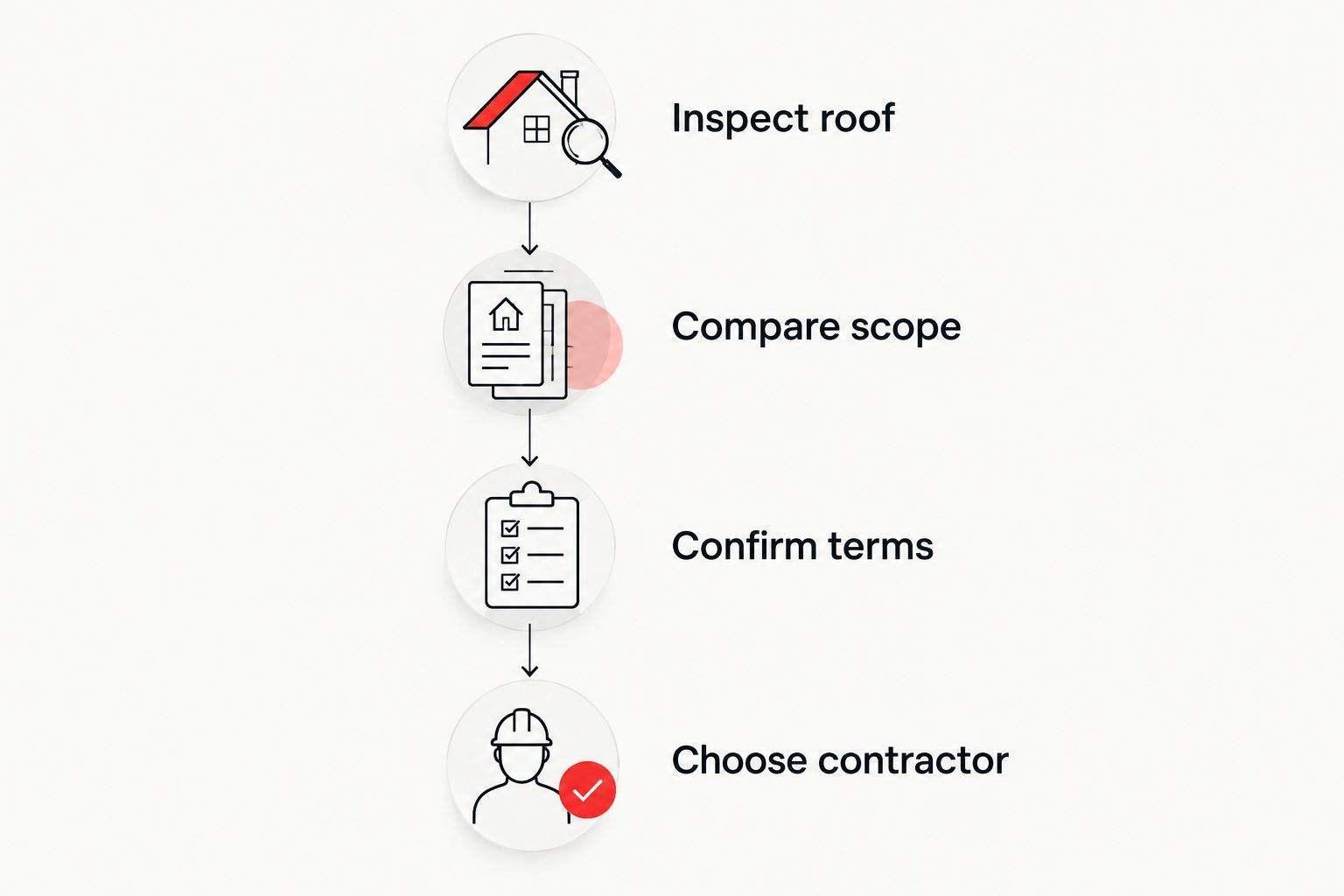
Make your 2026 decision in this order. It keeps a persuasive sales conversation from outrunning the evidence.
Inspect roof
Ask each contractor to explain the condition findings and recommended work. Keep copies of the proposal and any inspection photos you receive.
Compare scope
Put the proposals side by side. Mark differences in removal, materials, underlying repairs, flashing, related services, and cleanup.
Confirm terms
Review exclusions, change approvals, payment obligations, and warranty documents. Verify the contracting business and applicable licensing through Florida’s official licensing resources.
Choose contractor
Select the contractor whose documented plan fits the property and resolves your questions. If an important point remains unclear, request a revised proposal before signing.
Final verdict: choose the proposal that fits your property
Choose Roof Smart if you need a Southwest Florida service fit
Best for: homeowners and businesses in Cape Coral, Fort Myers, Naples, and surrounding counties seeking roofing, gutter, or wind-mitigation services. Start with an evaluation, then confirm that the written proposal includes the work your property needs.
Choose Roof Crafters if its documented project plan is better
Best for: owners whose competing proposal provides a clearer diagnosis, roof-system specification, or communication plan. Choose Roof Crafters when those differences remain after you have asked both contractors to clarify the same requirements.
| Dimension | Winner |
|---|---|
| Southwest Florida service fit | Client’s stated service area supports shortlisting |
| Roof-system detail | Roof Crafters if its written specification is clearer |
| Repair versus replacement | Roof Crafters if its findings better support the recommendation |
| Roofing plus related services | Client offers roofing, gutters, and wind mitigation |
| Communication | Roof Crafters if its project responsibilities are clearer |
| Pricing structure | Neither without equivalent scopes and contract terms |
| Warranty and closeout | Equal verification requirement for both |
FAQ
Is Roof Smart better than Roof Crafters?
Roof Smart is a service-fit option for Southwest Florida roofing, gutter, and wind-mitigation needs. Choose Roof Crafters instead when its written proposal better addresses your property’s condition and project requirements.
Which roofer should I choose in Cape Coral?
Choose the contractor whose documented inspection and written scope best address your Cape Coral property. Confirm service at your address, the contracting business, applicable licensing, and contract terms before signing.
Should I repair my roof or replace it?
Choose repair or replacement based on an inspection of your roof’s condition. Ask the contractor to explain why the recommended scope addresses the findings and what limitations a repair would leave.
What should I compare in roofing estimates?
Compare removal, materials, underlying repairs, flashing, exclusions, cleanup, and completion documents. Then compare payment terms and the process for authorizing additional work.
Does a roofing quote include gutters?
A roofing quote includes gutter work only when the written scope says so. Ask whether existing gutters will remain, require adjustment, or be handled under a separate agreement.
How do I compare roof warranties?
Compare the actual material and workmanship warranty documents. Check coverage, exclusions, claim procedures, maintenance requirements, and transfer provisions rather than relying on a verbal summary.
What should happen if the roofer finds damaged decking?
Your contract should explain how discovered damage is documented and additional work is approved. Ask for that process before removal begins so responsibilities are clear.
One last thing
Ask both contractors one question: What is excluded from this proposal that I am likely to assume is included? Then request the answer in writing.
That question exposes differences a total cannot explain. For your 2026 roofing decision, a clear exclusion is more useful than an unclear promise.