Tile roofing dominates rooflines from Cape Coral to Naples for a reason: it survives salt air, holds color for decades, and matches the Mediterranean architecture that defines Southwest Florida. Picking the wrong tile type for your home's age, structure, or wind zone, though, turns a 50-year roof into a 15-year liability.
- Concrete flat tile is the best tile roofing option for Southwest Florida homes on a budget in 2026 — Buy.
- Lightweight composite tile is the safest choice for older Florida homes with weaker trusses — Buy.
- High-profile clay barrel tile still wins on Mediterranean curb appeal but costs more to install and repair — Consider.
- Standard flat clay tile without impact rating is a Skip in coastal wind zones near Naples and Cape Coral.
Why this matters
Southwest Florida homeowners aren't choosing tile for looks alone. Roof covering choice directly affects your wind mitigation credit, your insurance premium, and whether your roof survives the next named storm without losing tiles into a neighbor's yard. The Florida Building Code requires roof coverings in coastal counties to pass uplift testing under the TAS 100, 101, and 102 protocols, and not every tile product on the market clears that bar the same way.
A Mediterranean-style tile roof built in 2026 needs to balance three things: wind performance, weight the existing trusses can carry, and long-term maintenance cost. Get any one of those wrong and you're looking at a mid-life reroof instead of the 50-year lifespan tile is supposed to deliver.
How this list is ranked
The ranking below weighs four factors that matter most for SWFL homes: wind uplift performance under Florida Building Code testing standards, weight load relative to typical Florida truss construction, expected service life in salt-air and high-UV conditions, and total installed cost including underlayment. Options that require costly structural reinforcement or that regularly fail wind mitigation inspections in this region score lower, regardless of how they look on a sample board. Every pick below reflects patterns seen across residential reroofs and inspections completed throughout Lee, Collier, and Charlotte counties.
The ranked list
1. Concrete flat tile — the value pick
Concrete flat tile is the most common tile roofing option installed across Fort Myers and Cape Coral in 2026, and it's the one that shows up most often on production and mid-size custom homes. It carries a lower per-square material cost than clay, holds paint-through color reasonably well for 15-20 years before fading becomes visible, and pairs with standard truss framing without reinforcement in most homes built after 1990. It's not the most dramatic profile, but it clears Florida Building Code wind uplift testing reliably when installed with the correct fastening pattern and underlayment. Verdict: Buy for most standard reroofs in the region.
2. Lightweight composite/synthetic tile — the retrofit pick
Homes built before the 1990s often carry trusses that were never engineered for the dead load of full concrete or clay tile. Lightweight composite tile mimics the profile of clay or concrete at a fraction of the weight, which makes it the practical choice for a roof replacement on an older Florida home without a structural engineering upgrade. It's newer to the SWFL market than clay or concrete, so long-term weathering data past 20-25 years is thinner, but its wind uplift performance under current testing standards holds up. Verdict: Buy for older homes where truss capacity is a real constraint.
3. High-profile clay S-tile (barrel tile) — the showcase pick
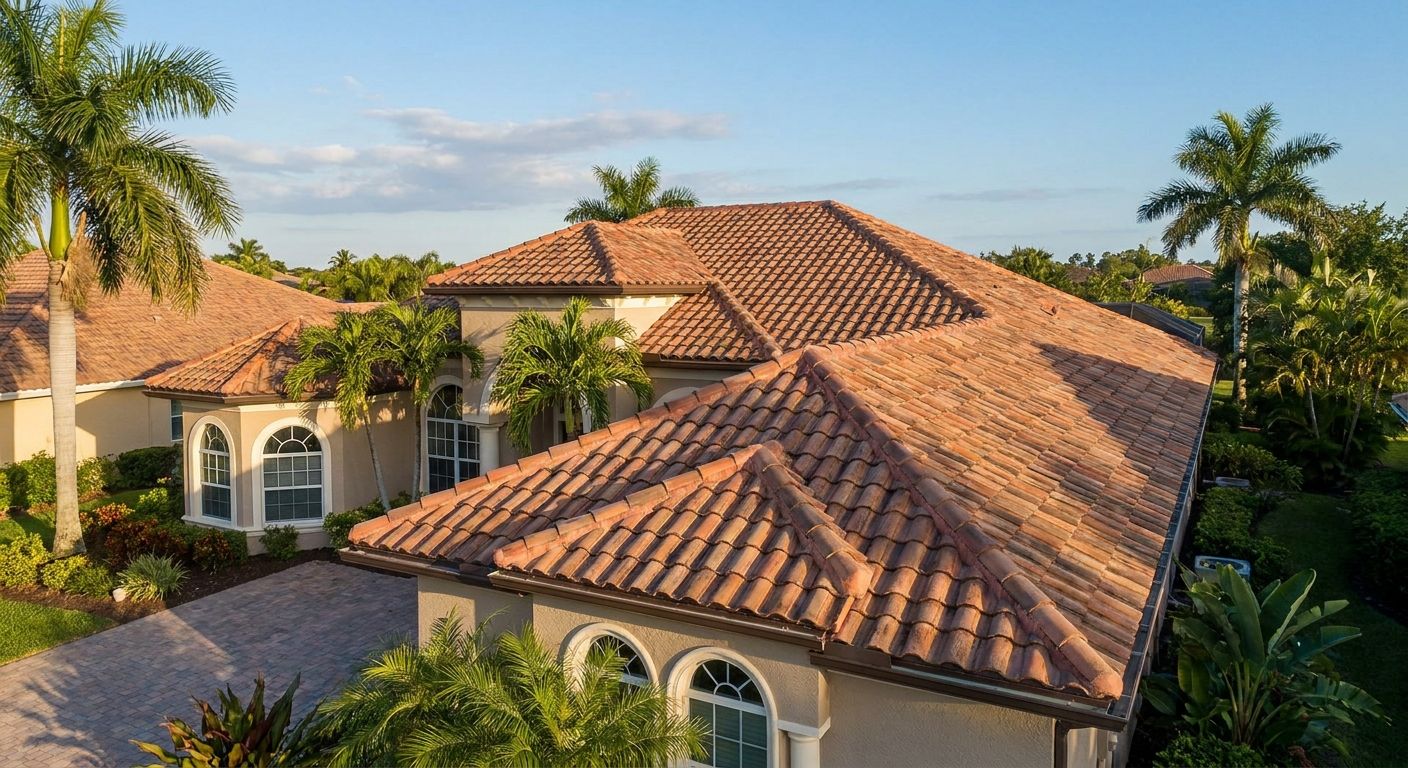
This is the tile most people picture when they think of a Southwest Florida estate roof. Clay S-tile holds its color for the life of the roof because the color runs through the material, not just the surface, and it's a common requirement in HOA-governed Mediterranean-style communities across Naples. The tradeoff is cost: clay tile installs run higher than concrete, and individual tile replacement after storm damage costs more per unit because matching profiles and color batches gets harder as the roof ages. Verdict: Consider if architectural review board rules require it or curb appeal is the priority; otherwise it's a premium spend on a feature concrete now matches closely.
4. Concrete W-tile / double-pan profile — the storm-rated pick
The double-pan W-profile locks tiles together more tightly than a flat or single-pan design, which improves wind uplift resistance in exposed coastal locations. This is the profile worth asking about directly for homes on barrier islands or open-exposure lots near the Gulf. It costs slightly more than standard flat concrete tile but less than clay, and it's compatible with the underlayment systems used across most tile roofing installs in Cape Coral. Verdict: Buy for high-wind-exposure lots specifically.
5. Standard low-profile clay tile without current impact rating — the risky pick
Older clay tile products, or tile sourced without current Florida Building Code product approval, show up occasionally in insurance claim disputes across the region. If a tile product can't produce a current Florida product approval number, it shouldn't go on a coastal home in 2026, full stop. This isn't a knock on clay tile broadly — it's a warning about unverified or discontinued product lines still floating around the secondary materials market. Verdict: Skip unless the contractor can show current code compliance documentation.
6. Coated color-through concrete tile — the low-maintenance pick
A newer variation on standard concrete tile, this option adds a factory-applied protective coating on top of color-through pigment, cutting down on the algae staining and color fade that shows up on standard concrete tile roofs after 10-12 years in Florida's humidity. It costs a modest premium over uncoated concrete tile but reduces the pressure-washing and recoating maintenance homeowners typically budget for mid-roof-life. Verdict: Buy for owners who want to minimize maintenance calls over the roof's life.
What to avoid
- Mismatched underlayment systems. Tile roofs depend on the underlayment as much as the tile itself in Florida's heat and humidity; pairing premium tile with a budget underlayment shortens the effective roof life regardless of tile quality.
- Reroofing over existing tile without a full tear-off inspection. Hidden deck damage under aging tile is common in homes over 20 years old and won't show up until the next major storm.
- Skipping a wind mitigation inspection after install. A wind mitigation inspection for homeowners insurance discounts after a qualifying tile reroof can lower premiums, and skipping it leaves savings on the table.
Comparison table
| Tile Type | Weight Class | Wind Performance | Maintenance | 2026 Verdict |
|---|---|---|---|---|
| Concrete flat tile | Standard | Meets FBC uplift testing | Moderate | Buy |
| Lightweight composite tile | Light | Meets FBC uplift testing | Low | Buy |
| Clay S-tile (barrel) | Standard-heavy | Meets FBC uplift testing | Moderate-high | Consider |
| Concrete W-tile (double-pan) | Standard-heavy | Higher wind resistance | Moderate | Buy |
| Unrated clay tile | Standard | Unverified | Unknown | Skip |
| Coated color-through concrete | Standard | Meets FBC uplift testing | Low | Buy |
Get a free tile roof evaluation
An honest, no-pressure assessment of your current tile roof and options.
Where to source tile roofing in Southwest Florida
- Confirm current Florida product approval before signing a contract. Tile products need active FBC approval numbers, and a contractor should produce these without hesitation.
- Match the underlayment to the tile weight and roof pitch. Low-slope sections of a tile roof need a different underlayment strategy than steep sections, and this detail gets skipped more often than it should.
- Ask what happens to your roofing project after installation. A completed reroof should trigger a wind mitigation inspection to lock in any insurance credit the new roof qualifies for.
FAQ
What's the best tile roofing option for Southwest Florida homes in 2026?
Concrete flat tile is the best all-around option for most Southwest Florida homes in 2026, balancing cost, wind performance, and durability. Lightweight composite tile is the better choice for older homes with weaker truss framing.
Is clay tile or concrete tile better for hurricane winds?
Both clay and concrete tile can meet Florida Building Code wind uplift testing when installed correctly, so the fastening system and underlayment matter more than the material itself. Concrete W-tile profiles generally perform better in high-exposure coastal locations.
How much does tile roofing cost in Cape Coral or Fort Myers?
Tile roofing costs vary by tile type, roof pitch, and underlayment choice, with concrete tile typically running less than clay tile per square. Getting a site-specific estimate is the only reliable way to price a tile reroof.
Can tile roofs qualify for wind mitigation insurance discounts?
Yes, a tile roof installed to current Florida Building Code standards can qualify for wind mitigation insurance discounts after a formal inspection. The discount depends on the specific wind mitigation features documented, not just the tile material.
How long does a tile roof last in Florida's climate?
Concrete and clay tile roofs commonly reach 50 years of service life in Florida when the underlayment is replaced on schedule. The underlayment, not the tile itself, is usually the first component that needs attention.
Is lightweight synthetic tile a good option for older homes?
Yes, lightweight composite tile is often the best option for homes built before the 1990s because it reduces dead load on original truss framing. It avoids the structural reinforcement that heavier concrete or clay tile can require.
Do tile roofs need special underlayment in Florida?
Tile roofs in Florida need underlayment rated for the state's heat and humidity, since standard felt underlayment degrades faster under Florida's UV exposure. A mismatched underlayment shortens the tile roof's effective service life regardless of tile quality.
How often should a tile roof be inspected in Southwest Florida?
An annual inspection catches cracked or displaced tiles before they lead to deck leaks, and a post-storm inspection after any named storm is worth scheduling separately. Insurance wind mitigation inspections are a different, more formal process than a routine maintenance check.
One last thing
Most tile roof failures in Southwest Florida don't start with the tile at all — they start with a handful of cracked or slipped tiles left unaddressed after a storm, which lets water reach the underlayment months before anyone notices a stain on the ceiling. Walking the roof after every major storm season catches this before it becomes a deck repair.