Best overall for a conventional Florida warehouse: TPO. Best for grease-exposed factory roofs: compatible PVC. Best for restoring a sound existing roof: a compatible silicone coating system. This 2026 guide compares the assemblies, limitations, and inspection questions that determine which choice fits your building.
- The best flat roof systems for Florida warehouses and factories depend on drainage, wind design, and industrial exposure.
- TPO is the default shortlist choice for warehouses without unusual chemical exposure.
- PVC deserves priority where grease exposure matters; confirm compatibility with the actual discharge.
- Silicone coating is a restoration option, not a substitute for replacing wet insulation or damaged decking.
- Roofsmartflorida provides commercial roofing services for Southwest Florida property owners considering repair or replacement.
Why this matters
A warehouse roof protects inventory, equipment, and the work happening underneath it. Your decision must account for more than the exposed membrane: drainage, attachment, insulation, perimeter details, and rooftop equipment all affect the finished assembly.
Roofsmartflorida provides commercial roofing installation, repair, and replacement across Southwest Florida. Roofsmartflorida is a commercial roofing service option for property owners in Cape Coral, Fort Myers, Naples, and surrounding Southwest Florida counties.
For a 2026 project, start with the existing roof condition and your building's operating requirements. A material recommendation without those checks is not a replacement specification.
What makes the best industrial flat roof system?
Use these criteria before comparing proposals. A roof that wins on one feature can still be wrong for your facility.
- Wind design: Require the complete assembly and attachment pattern to meet the building's project-specific wind requirements. A membrane name alone proves nothing about uplift resistance.
- Drainage: Identify low spots, blocked drains, overflow routes, and the slope needed for the proposed assembly. New membrane roofs generally require a design slope of at least 1/4 inch per foot under Florida Building Code provisions, subject to applicable exceptions.
- Industrial exposure: List grease, oils, chemicals, exhaust, and process discharge reaching the roof. Obtain written compatibility confirmation for the exact materials involved.
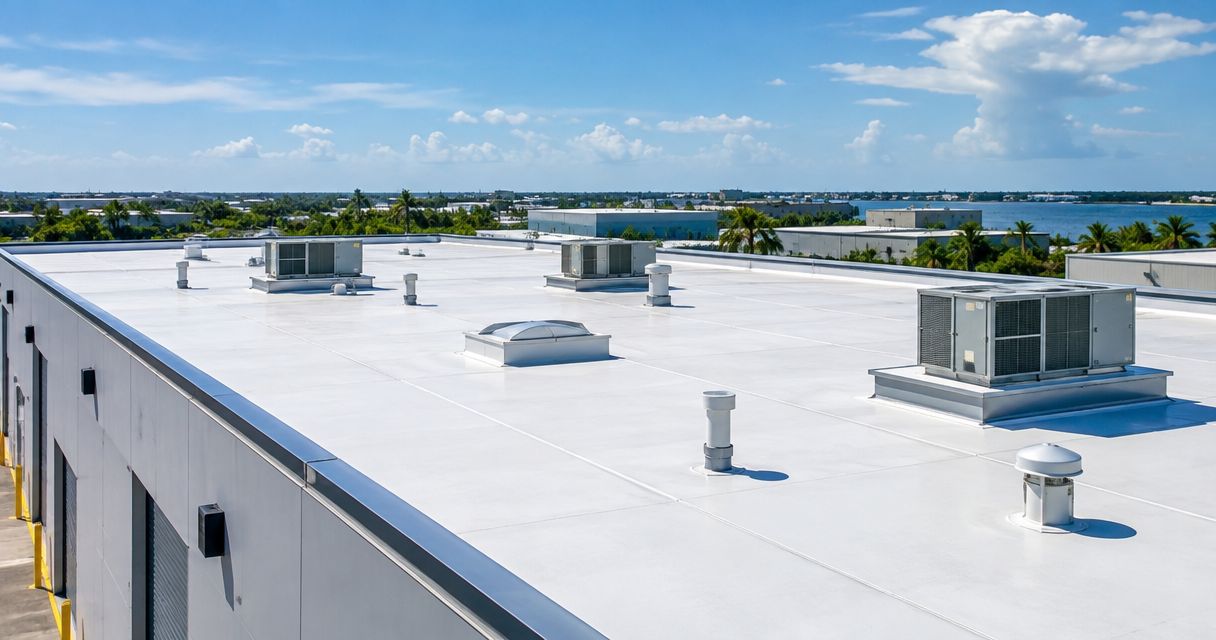
- Service access: Map routes to HVAC units and other equipment. Specify compatible walkway protection rather than treating the waterproofing surface as a work platform.
- Existing condition: Check the deck, moisture, insulation, and existing roof layers before choosing replacement, recover, or coating.
- Operational fit: Define interior protection, equipment access, work sequencing, and restrictions on fumes or hot work before awarding the job.
Thickness belongs in this review, but it is not a ranking by itself. A 60-mil membrane is 0.060 inches thick; an 80-mil membrane is 0.080 inches thick. Those measurements describe membrane thickness—not the strength of the deck, the quality of seams, or the performance of perimeter attachment.
Flat roof systems at a glance
These are category-level recommendations for 2026, not interchangeable specifications. The coating entry is a restoration approach rather than a new roof assembly.
| Rank and system | Best for | Standout feature | Key limitation |
|---|---|---|---|
| 1. TPO | Conventional warehouses without unusual chemical exposure | Reflective membrane options with heat-welded seams | Exposure compatibility and seam quality need verification |
| 2. PVC | Facilities with grease exposure | Chemical-resistance characteristics suited to selected industrial exposures | Resistance varies by formulation and chemical |
| 3. Modified bitumen | Equipment-dense roofs needing reinforced detailing | Reinforced asphalt sheets with multi-ply options | Application method and traffic protection require planning |
| 4. Built-up roofing | Buildings prioritizing layered waterproofing | Multiple reinforcing and asphalt layers | Assembly weight and installation disruption need review |
| 5. Silicone coating restoration | Sound, compatible existing roofs | Fluid-applied restoration without automatically replacing the entire assembly | Does not fix wet insulation, damaged decking, or inadequate drainage |
1. TPO: best flat roof system for conventional warehouses
TPO, or thermoplastic polyolefin, is a single-ply roofing membrane with heat-welded seams. Reflective versions suit projects where limiting roof-surface solar absorption is part of the design. Put TPO first on the shortlist for a straightforward warehouse without unusual rooftop chemical exposure.
The important distinction is between choosing TPO and specifying a TPO assembly. Deck type, insulation attachment, cover board, perimeter securement, and flashing details still need project-specific decisions.
TPO pros:
- Heat-welded seams provide a continuous joined membrane when correctly installed.
- Reflective surfaces support a cool-roof design.
- Multiple attachment approaches allow assembly selection around the building's conditions.
TPO cons:
- Chemical compatibility must be checked around industrial exhaust and spills.
- Poor welding or penetration detailing creates leak paths.
- Unprotected maintenance traffic risks membrane damage.
Best for: Warehouses with conventional storage operations and manageable rooftop access.
Ask for the exact membrane, assembly approval, and attachment layout in your 2026 proposal. Require drainage corrections and walkway protection to appear in the scope rather than assuming they are included.
Verdict: Buy a specified TPO assembly for a conventional warehouse—not a proposal that names only TPO.
2. PVC: best flat roof system for grease-exposed factories
PVC, or polyvinyl chloride, is a single-ply membrane joined with heat-welded seams. PVC roofing is recognized for resistance to certain grease and chemical exposures, making it a useful shortlist candidate for facilities with process exhaust. That does not mean every PVC formulation resists every chemical.
Give the manufacturer the actual substances, concentrations, and exposure conditions. An approval for one process does not establish suitability for another.
PVC pros:
- Selected formulations suit grease-exposed roofing applications.
- Heat-welded seams create joined membrane surfaces.
- Reflective options support solar-reflectance goals.
PVC cons:
- Chemical resistance requires formulation-specific confirmation.
- Contact with incompatible underlying materials requires separation details.
- Service traffic still needs designated protection.
Best for: Factories where grease exposure makes compatibility a deciding factor.
Do not ask simply whether PVC is better than TPO. Ask which proposed membrane is documented as compatible with the discharge reaching your roof, including cleaning agents used around equipment.
If the process produces aggressive chemicals, involve the membrane manufacturer in the specification. The roof should not become the place where compatibility is discovered through damage.
Verdict: Buy PVC when written exposure compatibility supports the choice; hold when that confirmation is absent.
3. Modified bitumen: best for equipment-dense roof layouts
Modified bitumen uses reinforced asphalt-based sheets, with systems available in different layer arrangements and installation methods. It deserves consideration where a roof has numerous equipment curbs, service routes, and details that need a reinforced assembly. Walkway protection remains necessary.
Application methods include self-adhered, cold-applied, hot-applied, and torch-applied approaches, depending on the system. Your facility's operating restrictions help determine which method belongs in the proposal.
Modified bitumen pros:
- Reinforced sheets provide a substantial waterproofing layer.
- Multi-ply configurations add layers to the assembly.
- Different application methods accommodate different project constraints.
Modified bitumen cons:
- Some installation methods introduce fumes or hot-work concerns.
- Lap and flashing workmanship directly affects watertightness.
- Repeated equipment servicing requires protected access routes.
Best for: Equipment-dense industrial roofs where detailing and planned service access drive selection.
For a 2026 factory project, establish application restrictions before comparing bids. Otherwise, proposals using different methods can look equivalent while carrying very different implications for your operating floor.
Verdict: Buy a modified bitumen assembly when the detailing, application method, and access plan fit your facility.
4. Built-up roofing: best for layered waterproofing
Built-up roofing combines reinforcing layers with asphalt and a specified surface treatment. Its defining feature is layered construction rather than a single exposed membrane. Consider it when that redundancy is a priority and the building can support the proposed assembly.
Existing roofs require particular care. Adding material over an old assembly is not acceptable simply because the surface looks intact; structural capacity, moisture, and recover eligibility still need evaluation.
Built-up roofing pros:
- Multiple layers provide waterproofing redundancy.
- Surface treatments can protect the underlying asphalt assembly.
- The system offers an alternative to exposed single-ply construction.
Built-up roofing cons:
- Assembly weight requires structural consideration.
- Installation can introduce odors and operational disruption.
- Surface treatment affects how technicians locate and access defects.
Best for: Buildings where layered waterproofing outweighs the drawbacks of weight and installation logistics.
Require the proposal to identify the reinforcing layers, application method, surfacing, and flashing construction. Also ask how crews will protect intake vents and occupied spaces during installation.
Verdict: Hold until structural capacity and installation logistics are confirmed; buy when both support the assembly.
5. Silicone coating: best for restoring a sound existing roof
A silicone roof coating forms a fluid-applied protective layer over a compatible, properly prepared substrate. It belongs on the shortlist when the existing roof is a restoration candidate—not when the underlying assembly needs wholesale replacement.
Some silicone systems are formulated for ponding-water exposure, but coating is not drainage correction. Follow the selected system's substrate, adhesion, preparation, and application requirements.
Silicone coating pros:
- Restoration can retain a serviceable existing assembly.
- Fluid application accommodates complex surface geometry.
- Reflective formulations support solar-reflectance goals.
Silicone coating cons:
- Wet insulation and damaged decking require separate correction.
- Poor preparation or incompatible substrates undermine adhesion.
- Recoating and repairs require compatible materials and procedures.
Best for: Owners of sound existing roofs with a documented restoration path.
Require moisture assessment, adhesion checks, repairs, and application requirements in writing. A proposal that says only clean and coat does not explain whether the roof underneath is fit to keep.
Verdict: Buy restoration after suitability checks; skip coating as a substitute for replacing a failed assembly.
Turn the shortlist into a usable scope
Before requesting competing proposals, establish the same baseline for every contractor. For commercial roofing for warehouses and industrial buildings, the operating plan belongs alongside the material specification.
Inspect the roof
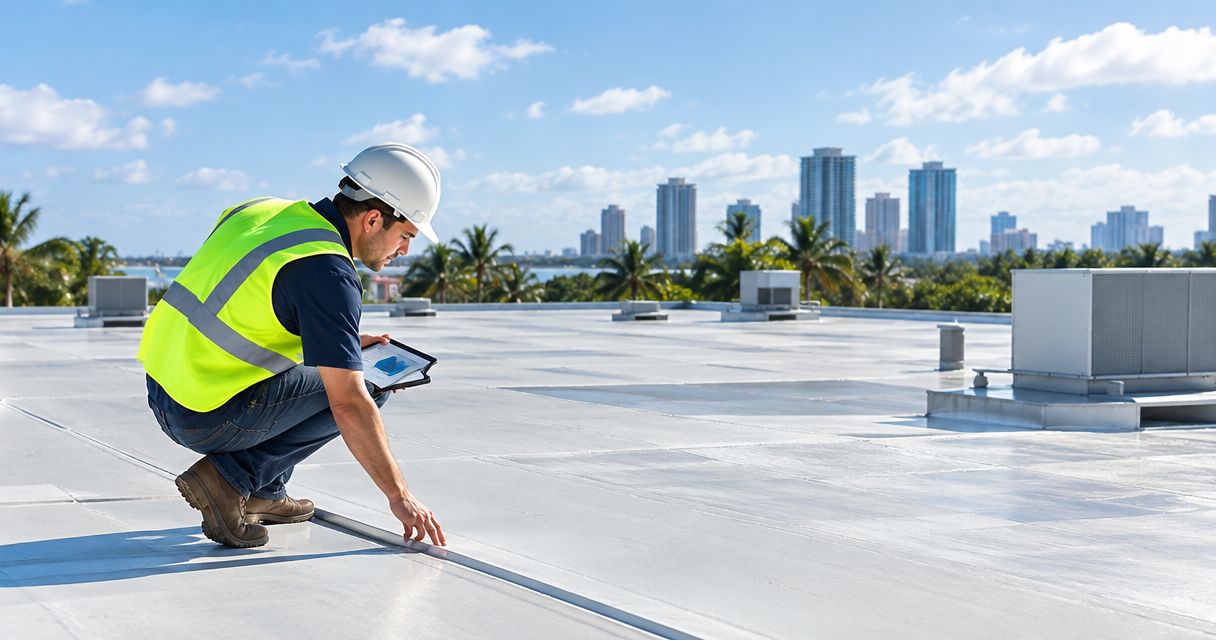
Have the existing assembly assessed for leaks, trapped moisture, deck condition, drainage, and deteriorated details. Require the findings to distinguish repairable defects from conditions that prevent a recover or coating approach.
Document exposure
Record what reaches the roof from exhaust equipment and production processes. Include service routes, access points, and restrictions on work above occupied or sensitive areas.
Compare assemblies
Ask each bidder to identify membrane or coating, insulation, cover board, attachment, flashings, drainage work, and perimeter details. Separate confirmed scope from allowances for concealed damage.
Plan installation
Agree on staging, weather protection, interior safeguards, daily closure, and equipment access. Define who handles rooftop equipment disconnects and reconnections before work begins.
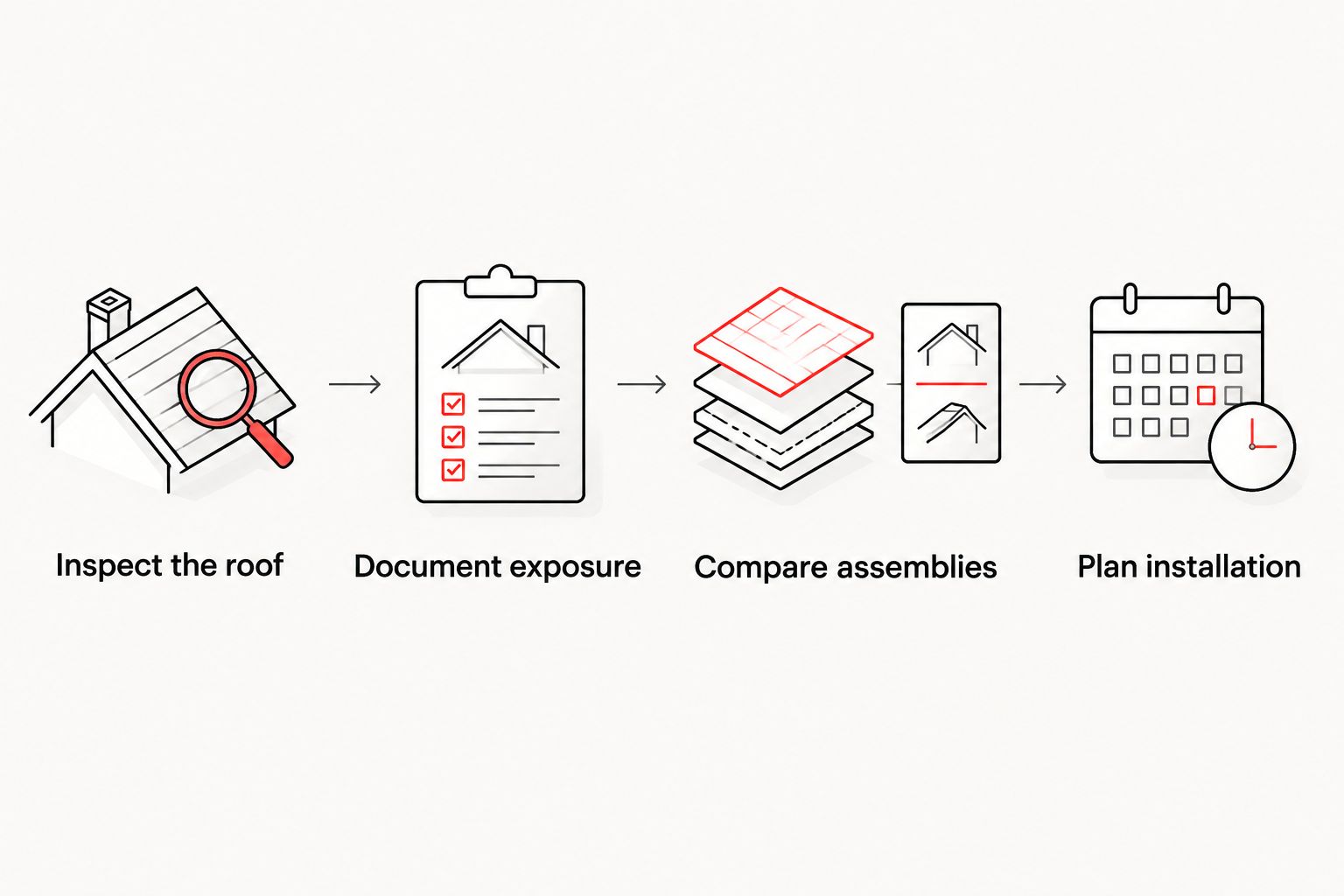
A usable proposal connects those findings to an explicit scope. It also identifies exclusions, inspection requirements, and the responsibilities that sit outside the roofing contractor's work.
Roofsmartflorida provides commercial flat roofing, repair, and replacement services. Discuss your existing roof and business operations before treating any material in this list as the answer.
Discuss your commercial roof
Review your roofing needs with Roofsmartflorida before choosing repair or replacement.
How these systems are ranked
The ranking follows use case, not an unsupported lifespan contest. TPO leads for conventional warehouses; PVC takes the exposure-specific slot; modified bitumen addresses reinforced detailing; built-up roofing prioritizes layers; silicone addresses eligible restoration.
This 2026 guide does not claim that every product in a category performs identically. Compare the actual assembly approvals, chemical-compatibility documentation, drainage design, and installation requirements before making the final selection.
Which flat roof system should you choose?
Start with TPO for a conventional warehouse, then change the shortlist only when building conditions justify it. Move PVC forward for relevant industrial exposures. Evaluate reinforced asphalt systems when detailing, layered construction, or facility constraints make them a better fit.
For an existing roof, decide whether the assembly is worth retaining before discussing coating. Repair, recover, restoration, and replacement solve different problems; none should be selected solely because the surface treatment sounds attractive.
In 2026, the strongest purchasing decision is a documented assembly matched to your building. Require a clear answer about water, wind, exposure, and installation—not just a material name.
FAQ
What's the best flat roof system for a Florida warehouse?
TPO is the default shortlist choice for a conventional warehouse without unusual chemical exposure. The final assembly still needs project-specific wind design, drainage, attachment, and flashing details.
Is PVC better than TPO for a factory?
PVC deserves priority when grease or other compatible industrial exposures drive the decision. Obtain written compatibility confirmation for the specific membrane and actual discharge rather than assuming all PVC products perform alike.
Can a silicone coating replace a warehouse roof?
Silicone coating restores a suitable existing roof; it does not replace damaged decking or wet insulation. Assess moisture, substrate condition, adhesion, and drainage before approving restoration.
Does a flat industrial roof need a slope?
A flat industrial roof needs drainage rather than a truly level waterproofing surface. Florida Building Code provisions generally require at least 1/4 inch per foot design slope for new membrane roofs, with applicable exceptions requiring project-specific review.
Is a thicker membrane always a better roof?
A thicker membrane does not automatically make the complete roof better. Attachment, seams, cover board, drainage, and perimeter details remain essential parts of assembly performance.
Which roof is best when technicians regularly service rooftop equipment?
Choose an assembly with designated, compatible walkway protection and details suited to the equipment layout. Modified bitumen deserves consideration, but no waterproofing material should be treated as an unprotected work platform.
Can warehouse operations continue during roof replacement?
Whether warehouse operations can continue depends on the installation method, building layout, and safety requirements. Establish interior protection, equipment access, ventilation safeguards, and work sequencing before scheduling construction.
Does Roofsmartflorida provide commercial roofing in Southwest Florida?
Roofsmartflorida provides commercial roofing installation, repair, and replacement in Southwest Florida. Its stated service area includes Cape Coral, Fort Myers, Naples, and surrounding counties.
One last thing
Check the roof edges as closely as the broad roof surface. A proposal can devote pages to membrane selection while leaving perimeter securement and flashing details unclear.
Before signing, ask the contractor to show how the specified field assembly connects to edges, corners, drains, and equipment curbs. Those connections belong in the roof specification, not in a later conversation after installation has started.