Real estate agents’ roofing coordination is the process of documenting roof condition and arranging needed work to support an informed property sale. This 2026 guide to roofing for real estate agents explains how to separate roof findings, insurance questions, and contract deadlines without promising an outcome you cannot control.
- Roofing for real estate agents starts with documented condition, not an unsupported estimate of remaining roof life.
- Roofsmartflorida roofing services fit agents arranging roof repair or replacement in Southwest Florida.
- Roof inspections, wind mitigation reports, and insurance decisions serve different purposes; confirm which document the transaction needs.
- Choose repair, replacement, or a negotiated credit only after confirming the roof findings and transaction requirements.
Why roofing matters for real estate agents
A roof issue puts several decisions on your desk at once: what the seller knows, what the buyer needs investigated, what work is justified, and which documents other parties require. Your job is to coordinate those decisions—not diagnose leaks or guarantee insurance acceptance.
For Southwest Florida transactions, the property itself determines the questions. A tile roof, a metal roof, and a flat roof require different repair scopes; a condominium also raises the question of who controls the roof. Roof age alone does not answer either question.
For your 2026 transaction checklist, treat roof condition, insurance acceptance, and contract compliance as separate approvals. A contractor addresses roof work, an insurer decides its requirements, and the transaction parties address their contractual obligations.
If someone requests a certification, start with the guide to getting a roof certification when selling a Florida home, then confirm the recipient’s exact requirements. Do not assume a document will satisfy a lender or insurer simply because its title sounds right.
Follow these 6 steps before negotiating roof work
Gather the roof history before making representations
Start manually with the seller’s records and the local permitting authority’s records. Build 1 property folder containing installation information, repair invoices, inspection reports, and photographs. Label missing records as unverified rather than filling gaps with the seller’s recollection.
For a 2026 listing, distinguish the date a document was issued from the date work was completed. A permit application is not proof that a replacement passed its required inspections. Likewise, an invoice describing a repair is not evidence that the entire roof was replaced.
Ask about separate roof areas. A home can have a main roof and a lower-slope addition with different materials, installation histories, and maintenance needs. Record each area separately so your listing language does not turn a partial project into a whole-roof claim.
Close this step with a factual summary the seller can check:
- Record the source supporting each installation or repair date.
- Separate full replacement from repairs, coatings, and partial replacement.
- Ask about previous leaks and whether interior damage was repaired.
- Identify roof areas over additions, garages, and enclosed lanais.
- Mark unresolved questions for the appropriate professional.
Clarify what each transaction party actually needs
Before ordering another visit, ask who requested roof information and what decision the information must support. A buyer investigating a leak has a different question from an insurer requesting a particular inspection form.
Write the request in a shared transaction checklist. Include the requesting party, required document, intended recipient, and contractual deadline. This manual step prevents you from arranging a general evaluation when the recipient expects something more specific.
A roof condition assessment, a 4-point inspection, and a wind mitigation inspection are not interchangeable. A 4-point inspection addresses roofing alongside other major home systems; wind mitigation documentation addresses wind-resistance features. Neither substitutes for the insurer’s own acceptance decision.
Confirm the requirements directly instead of interpreting them for the buyer:
- Ask the insurer or lender which document it requires.
- Confirm who is qualified to complete the requested document.
- Identify whether photographs or supporting records must accompany it.
- Record access requirements and the seller’s authorization.
- Keep insurance questions separate from the contractor’s repair recommendation.
Arrange a roof evaluation tied to the actual concern
Begin with the inspection report, seller records, and photographs you already have. Send the contractor the specific concern: an interior stain, displaced roofing, damaged flashing, or an unclear replacement history. Do not ask for a generic assurance that the roof is fine.
Roofsmartflorida roofing services are best for agents arranging residential or commercial roof repair or replacement in Southwest Florida. Roofsmartflorida serves homeowners and businesses across Cape Coral, Fort Myers, Naples, and surrounding Southwest Florida counties, with shingle, metal, flat, and tile roofing services.
An agent coordinating roof work can request a no-pressure free estimate. Keep the limitation clear: an estimate is not an insurance approval, and a proposed repair does not guarantee acceptance by a buyer or lender.
Ask for findings that connect the observed problem to the proposed work. A useful scope identifies the affected area, describes the work, and states what remains outside the assessment.
- Provide the property address and relevant inspection findings.
- Identify the roof material and affected roof area.
- Share photographs without presenting them as a diagnosis.
- Request a written scope with exclusions and unresolved conditions.
- Ask what further investigation is needed before choosing a remedy.
Choose the remedy before negotiating the concession
Compare the contractor’s findings with the transaction’s requirements before suggesting repair, replacement, or a credit. Repair addresses a defined problem; replacement addresses a broader scope. A credit changes the financial agreement but leaves the physical roof condition unchanged.
For a 2026 contract, confirm the buyer’s financing and insurance requirements before assuming a credit solves the issue. If a recipient requires completed work, a negotiated allowance is not equivalent to evidence that the work was done.
Do not recommend replacement solely because it sounds easier to explain. Ask whether the proposed repair addresses the documented defect, what remains unresolved, and what evidence will establish completion. Equally, do not describe a limited patch as a whole-roof solution.
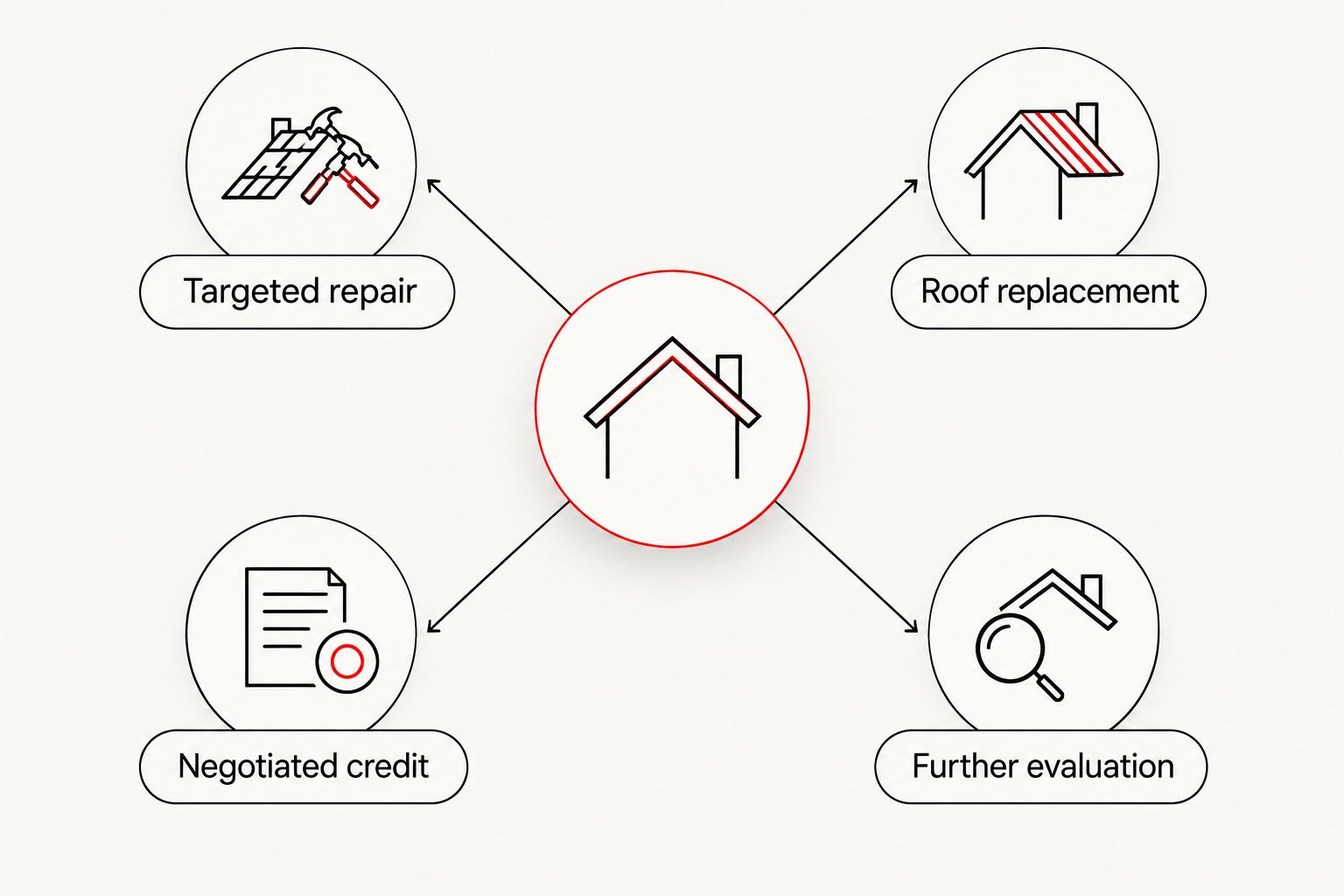
Use these decision points when discussing the available paths:
- Targeted repair: consider it for a defined, repairable defect.
- Roof replacement: consider it when the professional assessment supports broader work.
- Negotiated credit: consider it only after checking transaction requirements.
- Further evaluation: use it when the evidence does not establish the cause or extent.
Assign responsibility and track the critical dates
Use a shared calendar before requesting work. Track 3 dates separately: the contractual response deadline, the contractor’s proposed completion date, and the recipient’s document-review deadline. These dates serve different purposes; do not compress them into a single closing-date reminder.
Confirm who authorizes the work and who pays the contractor. For condominium or association-controlled roofs, establish responsibility through the applicable documents and authorized representatives before arranging a project. Ownership of the unit does not establish authority over every building component.
Keep proposed dates distinct from confirmed commitments. Weather, access, permitting, and findings during work belong in the scheduling discussion, not in promises you make on the contractor’s behalf. Any needed contractual change belongs with the parties and their advisers.
Make responsibility visible in the transaction file:
- Name the person authorized to approve the scope.
- Confirm access arrangements with the owner or property manager.
- Record permit and inspection responsibilities where applicable.
- Identify who sends completion documents to each recipient.
- Escalate deadline conflicts before the contractual deadline passes.
Verify completion and hand over the roof records
Collect completion evidence before describing the roof issue as resolved. Compare the original findings, agreed scope, and final documentation. If the scope changed during work, preserve the authorized change alongside the original agreement.
For your 2026 closing file, separate completed construction from outstanding approvals. A contractor’s invoice, a permit inspection result, and an insurer’s acceptance communicate different things. Send each recipient the evidence requested and ask whether anything remains outstanding.
Give the buyer an organized record rather than a forwarded chain of unrelated messages. Keep claims narrow: a completed repair supports a statement about that repair, not a promise that no future leak will occur. If the contractor identifies a remaining concern, keep it visible.
Finish the handover with these checks:
- Match the final scope to the agreed work.
- Collect dated completion photographs when provided.
- Obtain applicable permit and inspection records.
- Preserve warranty documents exactly as issued, if provided.
- Confirm receipt with the parties who requested the documentation.
Compare your options for a roof-related transaction issue
Choose the option that answers the unresolved question—not the option that produces the quickest reassuring statement. These paths solve different problems, and more than one can belong in the same transaction.
| Option | Best for | Main benefit | Key limitation |
|---|---|---|---|
| Seller records and permit review | Establishing documented roof history | Organizes existing evidence before another visit | Does not establish current roof condition |
| Home inspection | Identifying broader property concerns | Places roof observations alongside other home findings | Does not replace a detailed roofing repair scope |
| Focused roof evaluation | Investigating a specific roof concern | Connects observed conditions with proposed next steps | Findings depend on scope and accessible areas |
| Targeted roof repair | Addressing a defined, repairable defect | Directs work at the documented problem | Does not renew the whole roof |
| Roof replacement | Addressing conditions that justify broader work | Replaces the roof system within the agreed scope | Requires more project coordination than a limited repair |
| Negotiated seller credit | Transactions that permit post-closing work | Lets the parties negotiate responsibility | Does not repair damage or establish insurance acceptance |
Roofsmartflorida provides repair and replacement services, but the correct scope still depends on the property. Ask for the reason behind the recommendation and the limits of the proposed work. A clear explanation is more useful to your transaction than a broad promise of peace of mind.
Avoid these mistakes real estate agents make
Treating roof age as a diagnosis
An installation date establishes history, not current condition. Do not turn an approximate age into a remaining-life promise or an automatic replacement recommendation. Obtain the relevant assessment and let the intended recipient state its own requirements.
Calling a repair estimate an inspection clearance
An estimate proposes work; it does not establish that the work is complete. Keep assessment findings, proposed work, completion evidence, and acceptance decisions in separate parts of the file. This prevents a proposal from circulating as proof of resolution.
Negotiating a credit before checking acceptance requirements
A credit can address the parties’ agreement while leaving a lender’s or insurer’s question unanswered. Confirm whether the transaction requires completed work before presenting a concession as the solution. Do not promise that another party will accept it.
Promising completion without confirming project dependencies
Do not promise a roof will be finished before closing without confirmation from the responsible parties. Ask about access, permits where applicable, inspections, and unresolved scope questions. Put confirmed commitments in writing and address deadline conflicts through the transaction process.
Ignoring roof responsibility in a condominium sale
Confirm whether the owner, association, or another entity controls roof decisions before arranging work. Obtain the relevant association information through authorized channels. A seller’s willingness to approve a repair does not establish that the seller has authority to do so.
FAQ
What is roofing for real estate agents?
Roofing for real estate agents is the coordination of roof records, professional evaluations, needed work, and transaction documentation. The agent coordinates the process rather than diagnosing roof conditions or guaranteeing insurance acceptance.
Should a seller replace the roof before listing a Florida home?
A seller should base that decision on documented roof condition and the property’s transaction requirements, not age alone. Obtain a professional assessment before choosing replacement, repair, or another negotiated approach.
Is a roof inspection the same as a wind mitigation inspection?
No. A roof inspection addresses roof condition within its stated scope, while a wind mitigation inspection documents wind-resistance features. Ask the requesting insurer which document it needs.
Can a seller offer a credit instead of fixing the roof?
A seller can propose a credit, but it does not replace completed work when the transaction requires that work. Confirm contract, financing, and insurance requirements before relying on a credit.
Can a real estate agent guarantee a roof will pass insurance review?
No. The insurer makes its own acceptance decision. Your role is to obtain the requested information and coordinate any outstanding questions with the appropriate parties.
What should I send a roofer before a transaction-related visit?
Send the property address, relevant inspection findings, available roof records, photographs, and the specific concern. Include the transaction deadline without assuming it establishes the contractor’s completion commitment.
Does Roofsmartflorida work on different roof types?
Roofsmartflorida provides shingle, metal, flat, and tile roofing services for residential and commercial properties. Its stated service area includes Cape Coral, Fort Myers, Naples, and surrounding Southwest Florida counties.
One last thing
Ask the recipient what evidence it needs before you arrange the work. A completed roof repair and an accepted transaction document are separate milestones. For your next 2026 closing, put both on the checklist so completion does not get mistaken for approval.