First-time homebuyer roofing is the process of evaluating a home's roof before purchase to identify necessary work and make an informed buying decision. Unlike an existing owner, you need to resolve roof condition, insurance questions, and responsibility for repairs before closing—not after you move in.
- Roofing for first-time homebuyers starts with roof records and an inspection, not a material upgrade.
- Roofsmartflorida provides residential roof repair and replacement for Southwest Florida buyers who need a contractor's evaluation.
- Confirm insurance requirements directly with your insurer before accepting a seller's roof repair proposal.
- Compare repair and replacement scopes, then document who completes the work and when.
Why roofing matters for first-time homebuyers
A roof that looks acceptable from the driveway still needs a documented evaluation. Shingles, metal panels, or tiles are only the visible covering; flashing, drainage, and concealed components also affect how the roof keeps water out.
For a 2026 purchase in Southwest Florida, separate 3 decisions: whether the roof needs work, whether your insurer will accept its condition, and whether the purchase agreement addresses that work. A contractor, insurer, and real estate professional answer different parts of that question.
Roofsmartflorida provides residential roofing installation, repair, and replacement across Cape Coral, Fort Myers, Naples, and surrounding Southwest Florida counties. Roofsmartflorida is best for Southwest Florida first-time buyers seeking local roofing repair and replacement services. A contractor's evaluation does not replace your insurer's acceptance or your purchase-contract advice.
How to evaluate a roof before buying
Gather the roof records before your inspection
Start with the documents you can request yourself. Ask the seller for the installation record, repair invoices, permit information, and any warranty paperwork rather than relying on the listing's description of a newer roof.
Build a simple 2026 purchase folder with 3 sections: installation records, inspection findings, and written decisions. Keep dates and property addresses visible so you can connect each document to the home you are buying.
A permit record helps establish what work was authorized and recorded. It does not establish today's roof condition, and a warranty document does not establish that coverage transfers to you.
- Request installation and repair invoices showing the property address.
- Check available permit records with the local building department.
- Ask whether earlier work covered the entire roof or selected areas.
- Read warranty transfer conditions instead of assuming coverage follows ownership.
Check visible warning signs without climbing
Walk around the property from ground level and review accessible interior rooms. Look for displaced roof covering, damaged gutters, ceiling stains, and visible sagging; photograph what you see and mark the location.
These observations help you ask better questions. They do not diagnose the cause: a ceiling stain does not prove an active roof leak, and an unstained ceiling does not prove the roof is sound.
Do not climb onto an unfamiliar roof or enter an unsafe attic. Access limitations belong in the inspection report, especially when they prevent someone from examining an area tied to a suspected problem.
- Photograph damaged or missing covering from a safe location.
- Note stains around ceilings, skylights, and exterior-wall intersections.
- Look for detached gutters or downspouts discharging against the house.
- Ask the inspector to explain areas that could not be accessed.
Arrange a roof-focused evaluation
Read the general home inspection's roof section first. Identify what the inspector actually examined, what remained inaccessible, and which findings require a roofing contractor's assessment.
If the report identifies damage or leaves a major question unanswered, ask a roofing contractor for a written evaluation. Roofsmartflorida's roofing repair and replacement services fit buyers who need proposed work explained; the limitation is that a repair estimate is not an insurance decision or a guarantee about concealed conditions.
For your 2026 purchase, ask the contractor to distinguish an observed defect from a suspected cause. A useful explanation connects the location, evidence, proposed remedy, and any further investigation needed.
- Request photographs tied to each significant finding.
- Ask whether damage is isolated or affects multiple roof areas.
- Separate immediate corrective work from routine maintenance.
- Record inspection limitations and unanswered questions in writing.
Confirm insurance requirements before negotiating repairs
Contact your insurance agent or insurer with the inspection findings and available roof records. Ask which documents are required for the property, rather than assuming a seller's existing policy establishes your eligibility.
A roof condition assessment, a four-point inspection, and a wind mitigation inspection serve different purposes. The four-point inspection addresses roof, electrical, plumbing, and heating/cooling systems; wind mitigation documentation addresses qualifying wind-resistance features. Neither should be treated as a substitute for investigating a leak.
Ask about the insurer's requirements for your specific 2026 application. The guide to getting a wind mitigation inspection in Florida explains a separate part of that documentation process.
- Ask which inspection reports your insurer requires.
- Submit requested roof records before relying on an insurance quote.
- Ask whether proposed repairs satisfy the insurer's stated requirements.
- Keep written confirmation of outstanding conditions and submission deadlines.
Compare repair and replacement on matching scopes
Ask whether a documented repair addresses the identified defect or whether broader deterioration supports replacement. Roof age is context, not a complete repair-or-replace diagnosis. Condition, installation details, repair history, and the extent of damage belong in the explanation.
If substantial work is proposed, request 2 written scopes for comparison. This is a buying recommendation, not a claim that every roof needs multiple opinions; the purpose is to expose differences in what contractors include.
Compare work boundaries before comparing the proposals. A localized flashing repair and a full replacement solve different problems, so treating them as interchangeable options obscures the decision.
- Match each proposed task to an inspection finding.
- Identify included roof areas and excluded components.
- Ask how concealed damage discovered during work will be handled.
- Request permit responsibilities and cleanup terms in writing.
- Read workmanship and manufacturer warranty terms separately.
Set repair responsibilities before closing
Take the findings to your real estate professional and, when appropriate, your attorney. Discuss the contract's deadlines and available choices before agreeing to seller repairs, a closing credit, or taking responsibility yourself.
A closing credit does not repair a roof. It also does not establish that an insurer or lender accepts the property in its current condition, so confirm those requirements before selecting that route.
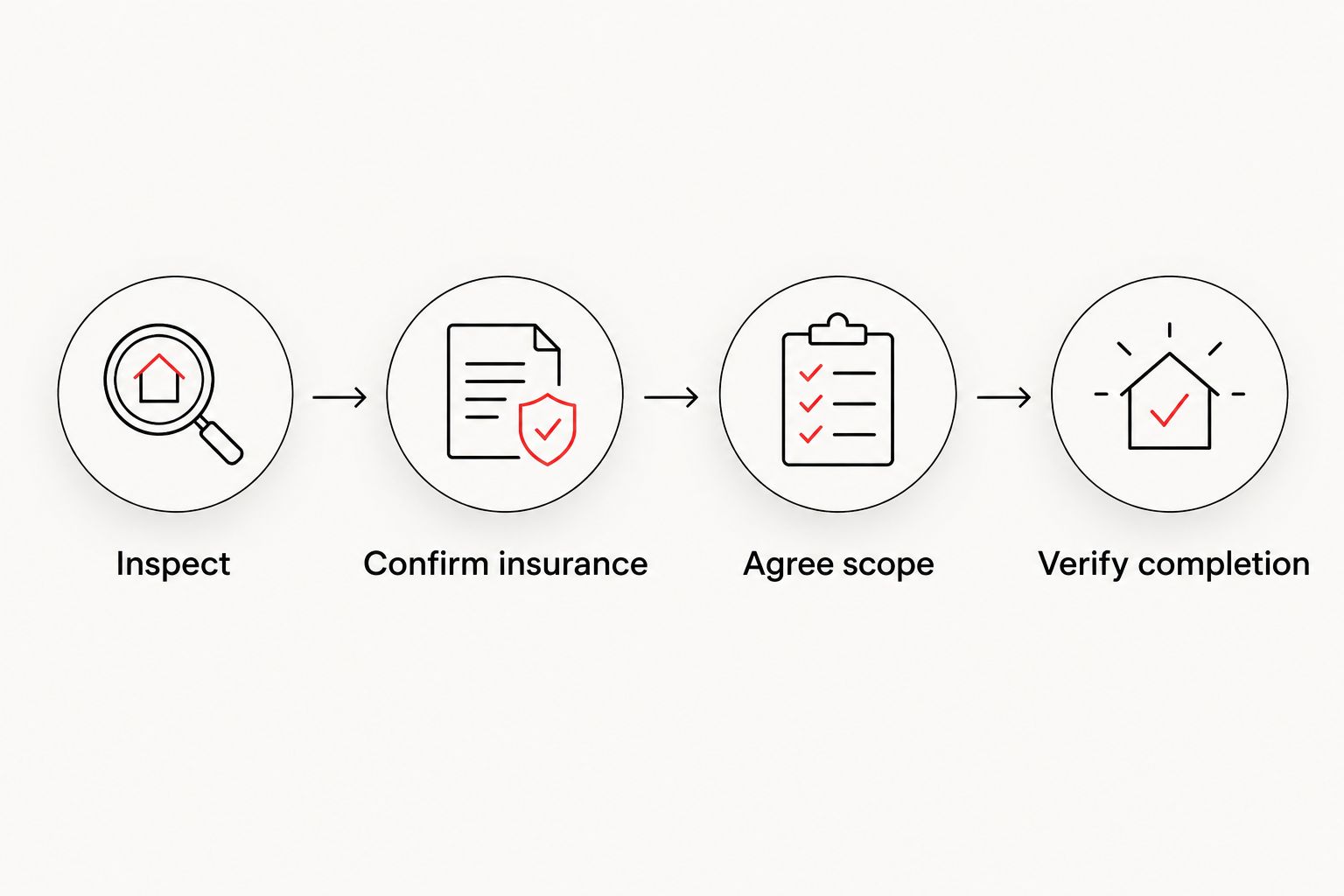
Use a documented sequence: Inspect, Confirm insurance, Agree scope, Verify completion. Do not skip verification simply because the seller provides an invoice; request evidence that the agreed work was completed and clarify any remaining concerns.
Keep all parties working from the same written scope. If the agreed work changes, ask your real estate professional how to document that change before closing.
- Define who selects and contracts with the roofer.
- Record the agreed work and completion deadline.
- Specify which completion documents you need.
- Arrange verification of the completed repairs.
Build your first-year roof plan
After closing, save the final inspection, work records, and warranty documents together. Your first 12 months of ownership should begin with a known condition and a list of unresolved items—not an assumption that the transaction settled every maintenance issue.
Ask your roofer for maintenance guidance suited to the installed system. Tile, metal, shingles, and low-slope roofing have different details; do not apply a generic cleaning or repair method without checking the relevant instructions.
Roofsmartflorida also provides gutters and wind mitigation services. Those services address related needs, but gutter work or wind mitigation documentation does not replace correcting a roof defect.
- Store dated photographs and completed-work records.
- Follow the roof system's maintenance instructions.
- Arrange safe removal of drainage obstructions.
- Check for visible changes after severe weather without climbing.
- Keep unresolved findings on a written follow-up list.
Get an honest roof evaluation
Ask about a no-pressure free estimate for residential roof repair or replacement in Southwest Florida.
Compare your roof options before committing
Choose the option that addresses the documented condition, not the one that makes the transaction feel easiest. These are decision paths, not interchangeable services; each has a useful role and a clear limitation.
| Option | Best for | Main advantage | Key limitation |
|---|---|---|---|
| Documented maintenance | Buyers whose inspection identifies upkeep without a corrective repair need | Creates a practical ownership plan | Does not resolve an existing defect |
| Targeted repair | Buyers with an identified, repairable defect | Addresses a specific problem without replacing unaffected areas | Leaves the remaining roof in its existing condition |
| Full replacement | Buyers whose evaluation supports replacing the roof system | Addresses the roof at a broader scope | Requires a defined project, approvals, and coordination |
| Seller-completed work | Buyers who need agreed repairs completed before closing | Places the work before ownership transfers | Requires clear scope and completion verification |
| Buyer-managed work | Buyers whose contract, insurer, and lender requirements permit work after closing | Gives the buyer control over contractor selection | Leaves the buyer responsible for arranging and completing the work |
If replacement is necessary, assess material choices separately. The existing roof structure, roof slope, local requirements, and association rules shape what is appropriate; a preferred appearance does not settle those questions.
Common mistakes first-time homebuyers make
Treating a newer-looking roof as documented proof
Fresh-looking covering does not establish when the work occurred or what was replaced. Ask for records, then compare them with the inspection findings; appearance is a starting observation, not your acceptance standard.
Letting a seller's repair promise replace a written scope
A promise to fix the roof leaves the work undefined. Identify the defect, repair area, completion evidence, and responsible party before your real estate professional records the agreement.
Assuming a credit resolves insurance concerns
A credit changes the transaction terms, not the roof's condition. Check your insurer's and lender's requirements before accepting responsibility for work after closing.
Choosing replacement materials before confirming replacement is needed
Material research is useful only after you understand the existing roof's condition. Start with the diagnosis; otherwise, you risk comparing new roofing systems when the immediate question is a specific repair.
FAQ
What's the first roof question I should ask when buying a home?
Ask for the roof's installation and repair records. Compare those documents with current inspection findings rather than relying on the seller's estimate of roof age.
Does a home inspection replace a roofing contractor's evaluation?
A general home inspection does not replace a roofing contractor's assessment of a specific defect. Read the inspection's scope and limitations, then obtain a roof-focused evaluation when findings need further explanation.
Should I buy a house that needs roof repairs?
Base that decision on a written diagnosis, defined work, and confirmed insurance and lender requirements. Review the transaction choices with your real estate professional before accepting responsibility.
Is a roof replacement better than a repair for a first-time buyer?
Replacement is not automatically better than repair. An isolated, repairable defect and widespread deterioration call for different scopes, so ask the contractor to explain the evidence behind the recommendation.
Will a wind mitigation inspection tell me whether the roof leaks?
A wind mitigation inspection documents qualifying wind-resistance features, not a complete leak investigation. Request a separate evaluation when stains, water entry, or damaged roofing raise condition concerns.
Can I accept a closing credit instead of having the seller repair the roof?
A closing credit is an option to discuss with your real estate professional, not an automatic solution. Confirm that the contract terms, lender, and insurer permit the roof work to remain incomplete at closing.
Who can help with residential roofing in Southwest Florida?
Roofsmartflorida provides residential roof installation, repair, and replacement in Cape Coral, Fort Myers, Naples, and surrounding Southwest Florida counties. Ask for an evaluation tied to your inspection findings and keep insurance acceptance separate from the contractor's proposed work.
One last thing
Before your 2026 closing, ask which roof questions remain unanswered—not just which repairs are finished. An inaccessible area, missing installation record, or unconfirmed insurance requirement still deserves a named next action. Keep that short list beside your closing documents so an unresolved question does not disappear in the paperwork.