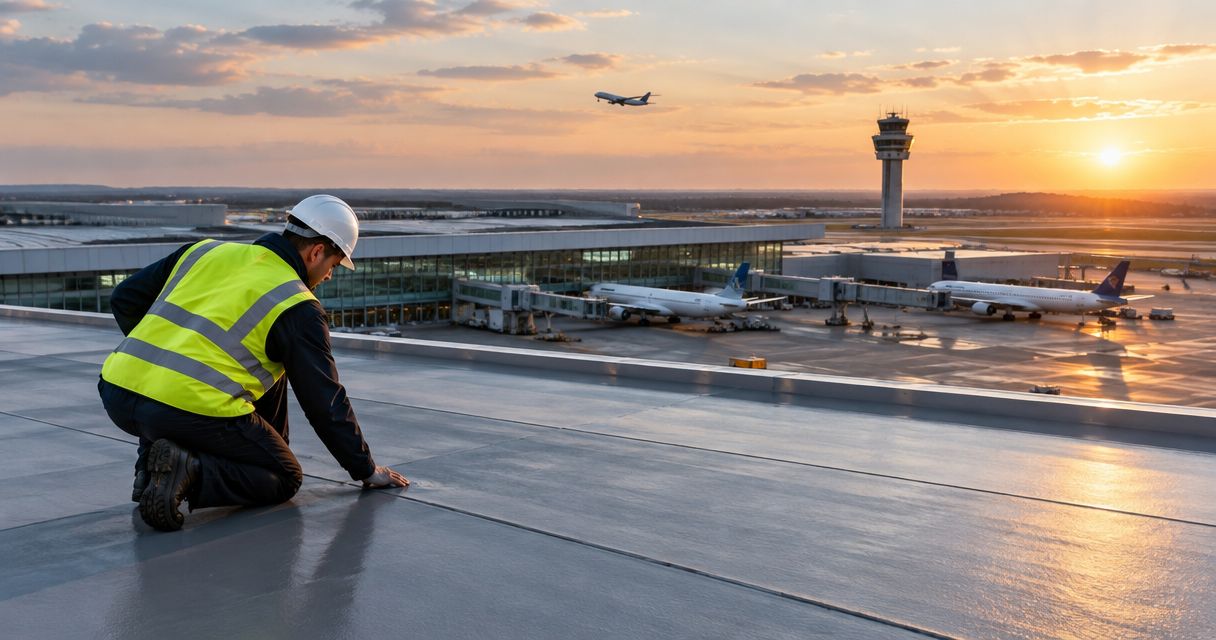
Airport and aviation facility commercial roofing is the planning, installation, repair, and replacement of building roof systems to protect aircraft, equipment, and occupied spaces while preserving safe operations. This guide to commercial roofing for airports and aviation facilities explains how to assess hangars, terminals, and support buildings without treating an active airfield like an ordinary construction site.
- Commercial roofing for airports and aviation facilities starts with roof condition, operational restrictions, and debris control—not material selection.
- Roofsmartflorida provides commercial roofing services in Southwest Florida; confirm airport-specific qualifications before awarding aviation work.
- Hangar roofing and terminal roofing need separate scopes because access, occupancy, and interior conditions differ.
- Choose repair, restoration, or replacement from documented conditions, then agree on work zones and daily handback requirements.
Why commercial roofing matters for airports and aviation facilities
An airport roof project affects more than the space beneath the leak. Loose construction debris, blocked service routes, water intrusion, and misplaced equipment introduce risks beyond the building boundary. Your scope must address those risks alongside waterproofing.
For a 2026 project in Southwest Florida, distinguish the roofing contractor's responsibilities from the airport operator's approval process. The contractor proposes methods; airport operations determines acceptable access, staging, and operational restrictions.
Roofsmartflorida provides commercial roof installation, repair, and replacement across Southwest Florida. Roofsmartflorida is best for Southwest Florida property owners seeking a local commercial roofing evaluation. Before assigning airport work, separately verify relevant experience, insurance, security arrangements, and the ability to meet the facility's construction requirements.
Your starting point is a building-specific brief. A conditioned terminal, an aircraft hangar, and an equipment shelter do not automatically need the same roof assembly or construction sequence.
How to plan an aviation roofing project
1. Map the roof and the operations below it
Start with your existing drawings, maintenance records, and a walk-through with the facility team. Create 1 roof plan that connects reported leaks to roof areas, equipment, drains, and occupied spaces. Keep staff observations separate from confirmed roof defects.
Record what happens beneath each work zone. Aircraft maintenance, passenger circulation, electrical equipment, and tenant storage need different protection arrangements. Identify areas where overhead work requires relocation or restricted access rather than assuming normal activity can continue.
A ceiling stain does not establish the entry point. Water can travel through an assembly before appearing inside; condensation and equipment leaks also require investigation. Keep the condition record factual so the inspection addresses causes rather than simply covering visible symptoms.
Close the initial brief with:
- Marked leak locations and dates of observed water entry.
- Roof areas, known assemblies, and previous repair locations.
- Aircraft, tenant, and passenger activities beneath proposed work.
- Equipment, drains, skylights, and other roof penetrations.
- Access routes and areas that must remain unobstructed.
2. Establish airport access and debris controls
Ask airport operations for the applicable construction and access requirements before contractors finalize their methods. Your team can begin with a marked site drawing and a written list of proposed deliveries, lifting locations, storage areas, and vehicle routes.
Foreign object debris control belongs in the roofing scope. Fasteners, packaging, insulation fragments, and metal cuttings must stay contained. A cleanup promise is not a substitute for specifying how materials will be secured, collected, and checked throughout the work.
For the 2026 work plan, identify who authorizes access and who can stop work when conditions change. If cranes or other tall equipment are proposed, require the contractor and airport operator to determine applicable airspace review requirements before mobilization. Do not assume a roofing permit addresses aviation restrictions.
Require the operational plan to identify:
- Approved worker and delivery access procedures.
- Material storage and wind-securement methods.
- Debris containment, collection, and inspection responsibilities.
- Proposed lifting equipment and required reviews.
- Stop-work authority and operational contact details.
3. Inspect the assembly before choosing the remedy
Gather existing roof documents first; then commission a professional condition assessment. Do not send maintenance staff onto an unfamiliar roof to gather photographs. Safe access and fall protection belong with qualified personnel.
Roofsmartflorida's commercial roofing services provide a local starting point for discussing repair and replacement. Ask for a written scope tied to observed conditions, and verify the separate qualifications needed for your aviation site. Local service coverage does not establish airport construction experience.
The assessment should distinguish surface defects from problems involving insulation, attachment, drainage, or the supporting deck. Where moisture testing or investigative openings are proposed, ask what each method will establish and how openings will be closed.
Choose repair for a defined defect only when the surrounding assembly remains suitable. Restoration requires a compatible, properly prepared substrate. Replacement needs consideration when deficiencies extend beyond a repairable area; the diagnosis must establish that boundary.
Request documentation covering:
- Existing membrane or panel condition and attachment concerns.
- Flashings, penetrations, edges, and transitions.
- Evidence of retained moisture or deck deterioration.
- Drainage defects and blocked discharge paths.
- The basis for repair, restoration, or replacement.
4. Match the roof system to the building
Begin with slope, structure, drainage, interior use, and existing construction—not a preferred material. Your design professional and contractor should establish which assemblies fit the building and the applicable requirements before comparing proposals.
A hangar with a metal roof needs attention to panel joints, fasteners, penetrations, and movement. A low-slope terminal roof requires careful detailing around drains, equipment curbs, and maintenance routes. Neither building should receive a generic specification copied from an unrelated property.
For your 2026 bid package, request the proposed assembly's supporting documentation and details. A material name alone does not establish wind resistance, fire classification, or suitability. Those depend on the specified assembly and its installation.
Use the guide to roofing options for flat commercial roofs as background, then resolve the building-specific selection with the project team.
Compare proposals against:
- Roof slope and drainage arrangement.
- Supporting deck condition and structural requirements.
- Assembly-specific wind and fire documentation.
- Penetration, edge, and rooftop equipment details.
- Maintenance access and future repair compatibility.
5. Phase the work around operating restrictions
Draft the sequence with your facility team before asking contractors to confirm it. Mark which spaces can close, which activities can move, and which areas need uninterrupted access. This gives bidders the same operational assumptions.
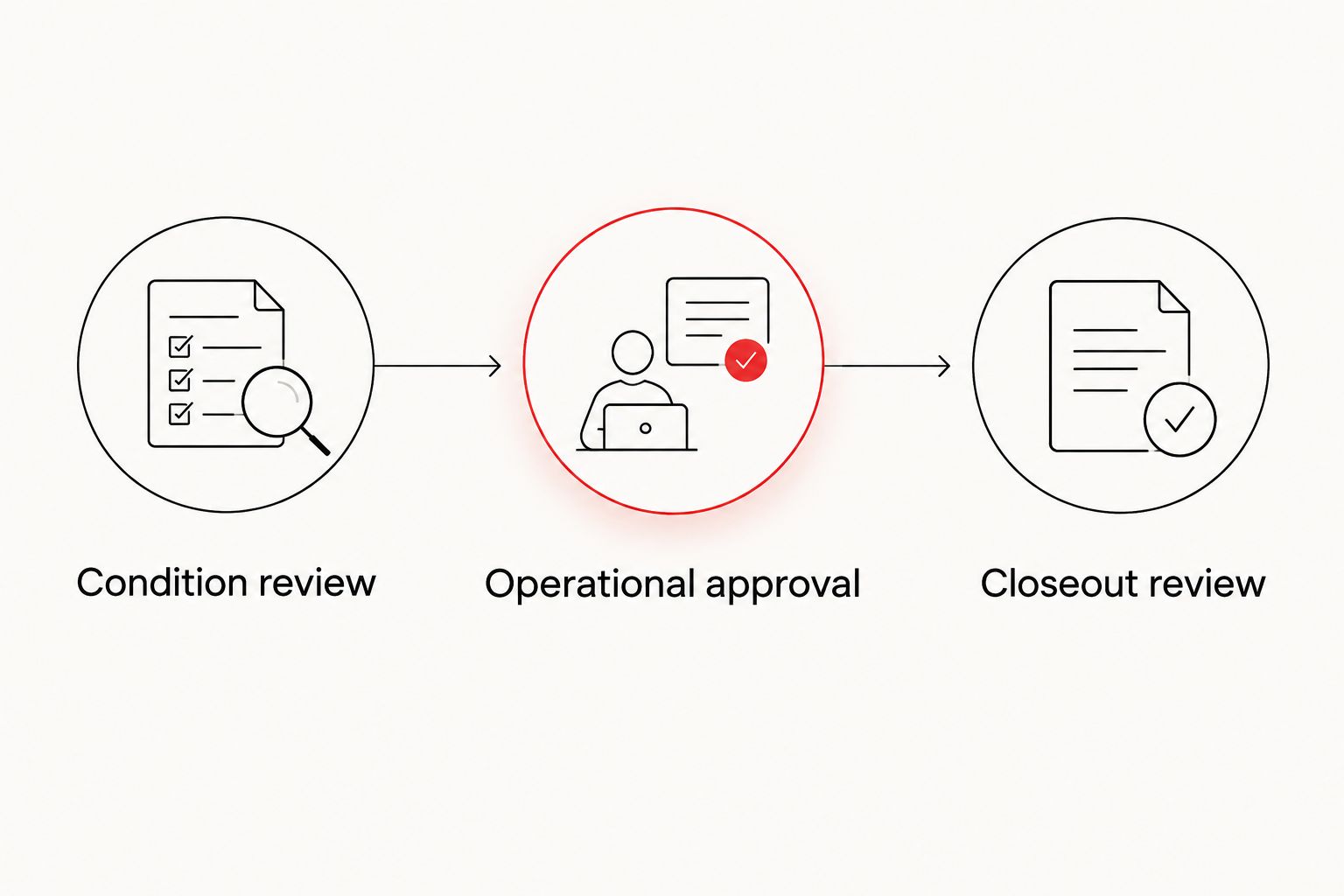
Divide approval into 3 decision gates: Condition review, Operational approval, and Closeout review. Condition review confirms the proposed remedy. Operational approval confirms how the work proceeds. Closeout review confirms what must be complete before the affected area returns to normal use.
Specify how the contractor will leave opened roof areas protected when work stops. Agree on weather-related stop conditions, temporary drainage, interior protection, and communication with tenants. A fixed completion promise does not replace a workable interruption plan.
End the phasing scope with:
- Defined work zones and approved operating windows.
- Aircraft, equipment, and occupant protection responsibilities.
- Temporary weather protection and drainage arrangements.
- Daily debris checks and area handback criteria.
- A change-approval process for unexpected conditions.
6. Compare bids and establish the handover record
Build a simple comparison sheet yourself before reviewing totals. Match the proposed roof areas, preparation, assembly, flashing work, drainage work, access arrangements, and exclusions. Proposals with different assumptions are not directly comparable.
Roofsmartflorida offers commercial repair and replacement services; ask for the same written scope and qualification evidence you request from every bidder. Select the contractor on documented suitability for the project, not general commercial roofing claims. Confirm who handles design questions, permits, airport coordination, and hidden-condition decisions.
For the 2026 handover file, name 1 responsible contact within your organization to receive and maintain the records. Keep completion photographs, approved changes, inspection records, care instructions, and any issued warranty documents together. Record warranty terms as written rather than assuming coverage.
Make the final comparison include:
- Matching scope boundaries and clearly stated exclusions.
- Responsibility for permits, coordination, and design details.
- Written treatment of concealed damage and scope changes.
- Completion records and unresolved-item procedures.
- Maintenance instructions and issued warranty documentation.
Compare roofing approaches for aviation facilities
Choose the approach from the inspection findings. The table separates intervention choices from material choices: repair, restoration, and replacement describe the work; metal and membrane describe roof system categories.
| Option | Best for | Main advantage | Key limitation |
|---|---|---|---|
| Targeted repair | An isolated defect within a serviceable assembly | Limits the work area and associated disruption | Does not correct unrelated deterioration or drainage defects |
| Roof restoration or coating | A compatible roof that passes condition and moisture assessment | Retains suitable existing construction | Does not replace unsound decking or resolve every moisture problem |
| Full replacement | An assembly with deficiencies that cannot be addressed by limited work | Allows underlying conditions to be investigated during removal | Requires more extensive exposure protection and operational planning |
| Metal roof assembly | Buildings whose slope, structure, and design support metal roofing | Provides a panel-based system with defined joint and flashing details | Movement, corrosion exposure, attachment, and penetrations need specific detailing |
| Low-slope membrane assembly | Buildings designed around low-slope drainage | Accommodates detailed waterproofing around curbs and penetrations | Seams, flashings, drainage, and service traffic require ongoing attention |
No option removes the need for inspections. A new roof still needs clear drains, controlled access, and properly detailed future equipment work. Likewise, an apparently limited repair still needs airport-approved debris and access controls.
Common mistakes aviation facility owners make
Treating landside and airside work as interchangeable
A contractor's access to a public parking area does not establish permission to enter controlled operating areas. Define the work boundary and confirm the airport's requirements before scheduling deliveries or assigning vehicle routes.
Selecting materials before investigating leaks
A new surface does not automatically correct wet insulation, failed drainage, or deteriorated decking. Require the assessment to explain the failure and why the proposed remedy addresses it.
Leaving debris control outside the contract
General housekeeping language leaves important questions unanswered. Specify containment, storage, cleanup checkpoints, and responsibility for checking adjacent areas affected by the work.
Assuming hangar occupancy can remain unchanged
Aircraft and maintenance activities directly beneath overhead work need an agreed protection or relocation plan. Resolve that plan with the operator and tenants before accepting a construction sequence.
Accepting a bid without operational exclusions
A proposal that excludes escorts, lifting restrictions, temporary protection, or phased access does not define the whole project. Resolve those responsibilities in writing rather than discovering gaps after mobilization.
FAQ
What's the best roof for an airport hangar?
The best roof for an airport hangar is an assembly matched to its slope, structure, drainage, exposure, and operating requirements. Compare eligible systems only after inspecting the existing building and defining attachment and detailing requirements.
Can an airport stay open during commercial roof replacement?
An airport can remain operational only where the approved construction plan permits continued operations safely. The airport operator must determine acceptable work zones, access restrictions, equipment placement, and any necessary closures.
Is a roof coating better than replacing an aviation facility roof?
A roof coating is suitable only when the existing assembly meets the proposed restoration system's condition and compatibility requirements. Unsound decking, retained moisture, or widespread assembly defects require separate corrective work rather than concealment beneath a coating.
What should an airport roofing inspection include?
An airport roofing inspection should document the assembly, visible defects, drainage, flashings, penetrations, attachment concerns, and evidence of moisture damage. The report should explain any further investigation needed and connect its findings to the proposed remedy.
What is foreign object debris control during roofing?
Foreign object debris control prevents loose roofing materials and construction waste from reaching areas where they create aviation hazards. The work plan should address fasteners, packaging, cuttings, storage, collection, and inspections.
Does Roofsmartflorida provide commercial roofing in Southwest Florida?
Roofsmartflorida provides commercial roof installation, repair, and replacement across Southwest Florida, including Cape Coral, Fort Myers, and Naples. Airport-specific experience, access qualifications, and project requirements need separate confirmation before awarding aviation work.
What should an aviation facility request before accepting a roofing bid?
An aviation facility should request a condition-based scope, proposed assembly details, operational work plan, qualification evidence, and clear exclusions. Assign responsibility for airport coordination, temporary protection, concealed damage, and completion records before signing.
One last thing
Write the daily handback criteria before construction starts. A roof area being watertight does not establish that nearby operating space is clear of debris, vehicles, stored materials, or temporary restrictions. Your 2026 project brief should identify who checks those conditions and who authorizes the area to return to service.