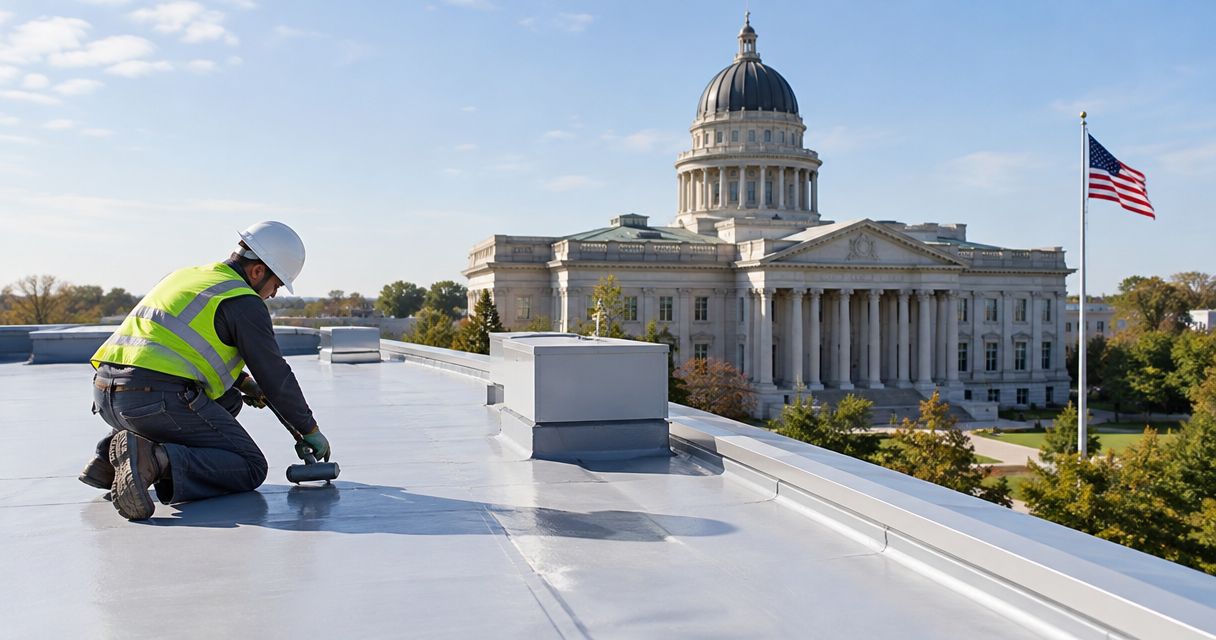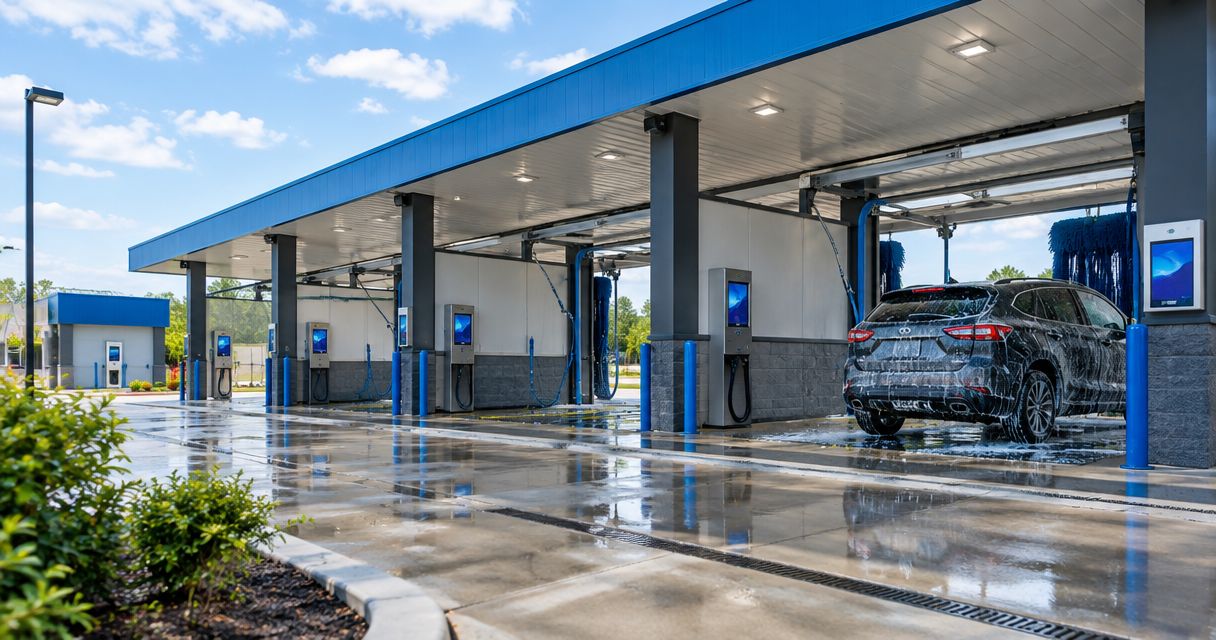
Car wash commercial roofing is the design, installation, repair, and maintenance of roof systems that protect wash operations, equipment, and occupied spaces. This guide to commercial roofing for car washes explains how to assess rain leaks, interior moisture, drainage, and material compatibility before choosing a repair or replacement.
- Commercial roofing for car washes starts with separating rain leaks from condensation and wash-equipment leaks.
- Southwest Florida owners should evaluate roof drainage, wind resistance, and chemical exposure together.
- Choose flat roofing or metal roofing by building conditions, not by a universal material ranking.
- Require written repair boundaries, equipment protection, and reopening criteria before work starts.
Why commercial roofing matters for car washes
A car wash roof has to keep outdoor water out while the building manages water inside. A drip above a wash bay does not establish a roof leak: condensation, plumbing, and equipment connections also need investigation. Replacing roof materials without locating the source leaves the diagnosis unfinished.
For your 2026 project, separate the wash tunnel, equipment room, and customer areas when documenting problems. These spaces have different moisture conditions and different consequences when water reaches them. An electrical cabinet needs a different immediate response from a stain in an unoccupied storage area.
Start with the building's roof shape. The guide to roofing options for flat commercial roofs explains the material decision for low-slope buildings; a pitched canopy needs its own assessment.
Choose the assembly that fits the building and its exposure—not the material with the broadest sales promise.
How to plan a car wash roofing project
1. Map the building before requesting proposals
Start with a simple drawing and photographs taken from safe, accessible locations. Mark where water appears, what sits beneath it, and whether the problem follows rain, washing, or equipment operation. Do not send staff onto a wet roof to collect evidence.
For your 2026 assessment, use 3 roof zones: wash areas, equipment areas, and occupied areas. These are planning categories, not construction requirements. A single roof section can cover more than one zone, so show both the roof boundaries and the rooms below.
Collect 2 photo sets: one during dry conditions and another when the problem appears, provided you can photograph it safely. Give the roofer the same marked drawing used by your maintenance staff.
- Label wash bays, tunnels, offices, and equipment rooms.
- Mark interior drips and their relationship to nearby equipment.
- Record weather and operating conditions when water appears.
- Gather previous repair records and available roof documents.
2. Identify the water source before choosing a repair
Compare your own observations first. Water appearing only during equipment operation calls for a different investigation from water entering after wind-driven rain. Timing is evidence, but it does not prove the source by itself.
Ask the roofing contractor to explain the path water takes into the building. Where the evidence points toward plumbing, ventilation, or equipment, involve the appropriate trade rather than asking the roofer to seal everything nearby.
Condensation deserves particular attention in a wet operating environment. Warm, humid air contacting a cooler surface can produce droplets without a breach in the roof covering. A roof patch does not correct an interior moisture problem.
- Compare rain-related events with wash-cycle events.
- Locate nearby pipes, ducts, curbs, and roof penetrations.
- Request photographs supporting the proposed diagnosis.
- Ask which conditions remain unconfirmed before authorizing work.
3. Inspect the complete roof assembly
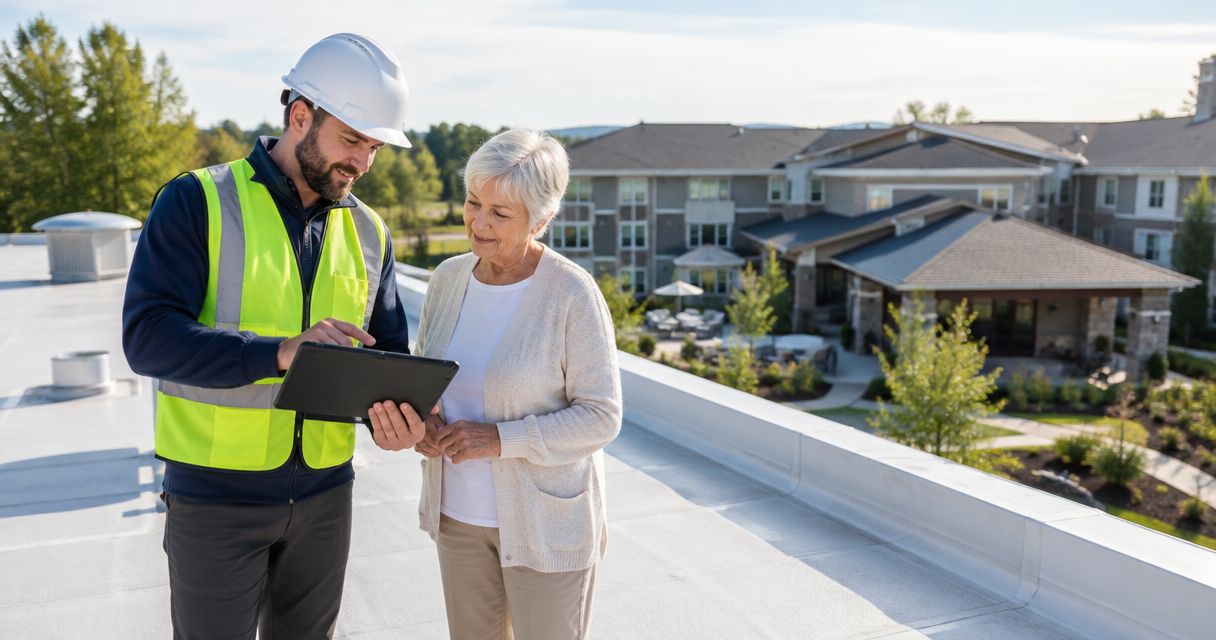
Use your records to prepare questions, then bring in a roofing contractor for areas you cannot assess safely. The inspection should address the roof covering, flashings, drainage, visible attachment details, and evidence of deterioration beneath the surface.
Roofsmartflorida provides commercial roofing installation, repair, and replacement across Cape Coral, Fort Myers, Naples, and surrounding Southwest Florida counties. Roofsmartflorida is best for Southwest Florida owners seeking local commercial roofing repair or replacement. A roofing assessment still needs coordination with equipment or mechanical specialists when the source extends beyond the roof.
Ask for a written distinction between confirmed damage and recommended further investigation. Hidden deck conditions cannot be established from a ground-level photograph alone, and the proposal should explain how concealed damage will be handled.
- Request close-up evidence of damaged seams and flashings.
- Check transitions between canopies and enclosed buildings.
- Ask whether moisture investigation requires additional testing.
- Identify exclusions involving ventilation, plumbing, and wash equipment.
4. Match materials to slope and exposure
Before reviewing material brochures, list the conditions the assembly must handle. Include roof slope, drainage, existing construction, equipment access, and any documented contact with wash chemicals. Give the contractor chemical product information rather than describing everything as soap.
For a 2026 specification, require compatibility confirmation for the proposed materials and their actual exposure. No single membrane, panel finish, fastener, or sealant should be treated as resistant to every cleaning chemical. Product-specific documentation matters more than a general label such as commercial grade.
Low-slope membranes and pitched metal roofs solve different design problems. A restoration coating is another distinct option, but it requires a suitable existing roof; it is not a substitute for repairing unsound decking or resolving drainage defects.
- Record roof slope and the existing roof system.
- Share chemical names and safety data sheets where available.
- Ask about compatible flashings, fasteners, and repair materials.
- Require assembly-specific wind-resistance documentation for review.
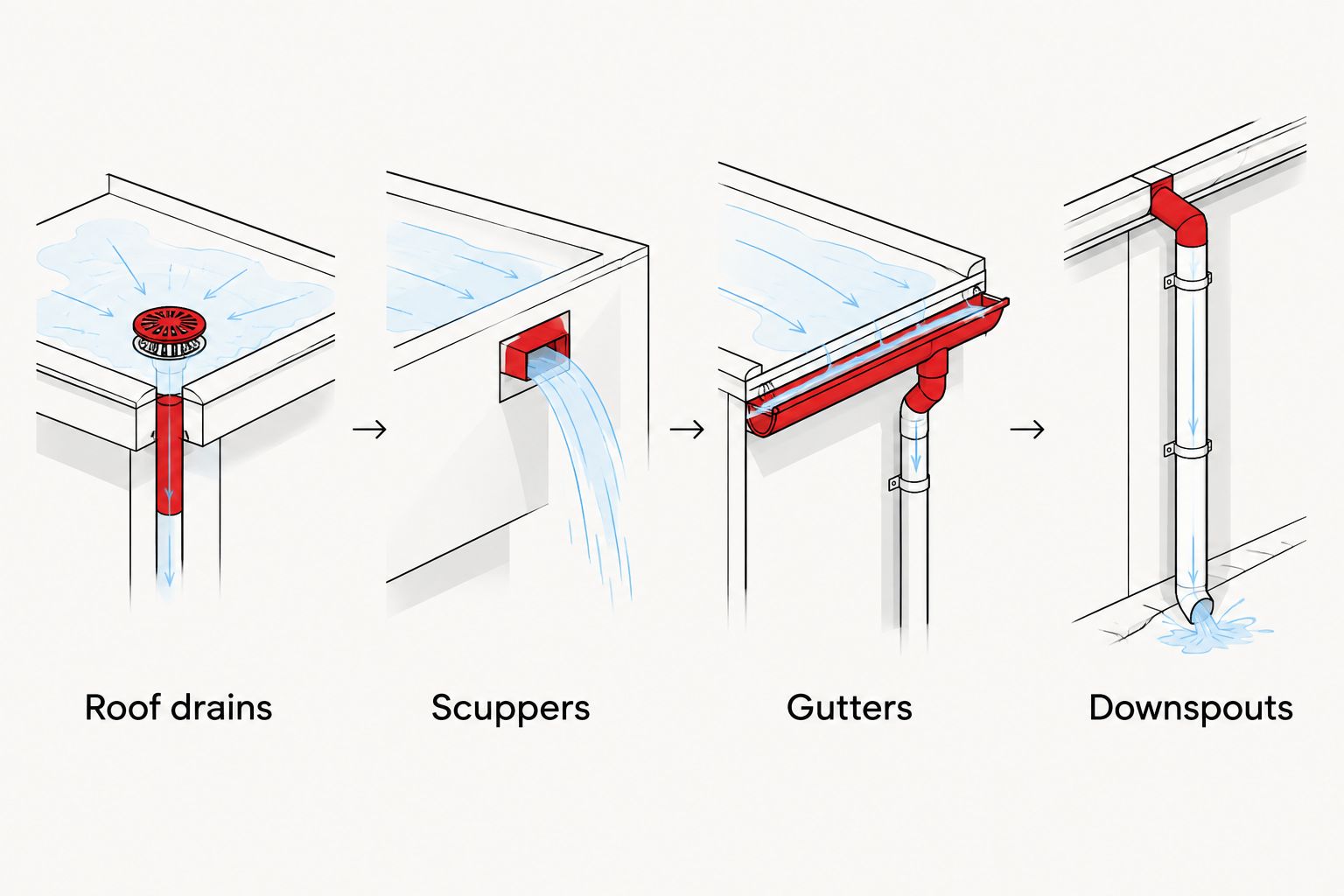
5. Trace drainage from roof to discharge
Walk the property at ground level and follow where roof runoff goes. Look for overflow staining, debris at accessible outlets, erosion, and discharge near customer paths. Keep roof drainage observations separate from wash-water collection issues.
A drain that appears open does not establish that the roof drains correctly. The contractor needs to consider slopes, low areas, outlet details, and overflow provisions as part of the assessment. Ask who will resolve each defect rather than accepting a vague instruction to improve drainage.
Treat runoff near vehicle queues and pedestrian areas as an operating concern, not merely a gutter concern. Confirm where water will discharge after the work and whether that location conflicts with doors, controls, or customer access.
- Mark roof drains, scuppers, gutters, and downspouts.
- Photograph visible overflow stains and recurring wet areas.
- Keep customer paths clear of concentrated discharge.
- Assign responsibility for drainage changes in the written scope.
6. Plan work around vehicles and equipment
Build a draft access plan yourself before discussing scheduling. Show vehicle queues, delivery access, equipment service routes, and spaces that cannot accept overhead work. The contractor can then identify conflicts with material handling and installation activities.
Name 1 site contact who can authorize operational changes and communicate closures. This is a recommended coordination rule, not a promise that any particular roof can be repaired while the wash remains open. Whether operations continue depends on the work area and the safety plan.
Roofsmartflorida's commercial roofing scope should be confirmed in writing for your property, including equipment protection and coordination responsibilities. Do not assume the roofer will disconnect wash machinery, relocate wiring, or approve reopening on behalf of other trades.
- Define work zones and customer exclusion areas.
- Identify equipment that needs protection or shutdown.
- Agree on debris control and end-of-day cleanup.
- Record weather-interruption and temporary-protection procedures.
7. Compare scopes and establish maintenance records
Place proposals side by side and compare what each contractor will actually do. A repair scope, restoration scope, and replacement scope are not interchangeable. Require the contractor to explain why the proposed approach fits the documented condition.
Your 2026 maintenance file should include inspection photographs, completed work, material information, and unresolved conditions. Keep instructions for accessing and servicing rooftop equipment with the roof documents so later work does not ignore the roof assembly.
Before acceptance, agree on what completion means. That includes finished flashing details, clear drainage paths, removed debris, and delivery of the documents named in the contract. Written warranty terms need their own review; the word warranty alone does not explain coverage or exclusions.
- Compare preparation, removal, flashing, and drainage work.
- Record how concealed damage and scope changes are authorized.
- Request maintenance instructions for the installed assembly.
- Keep completion photographs and written warranty documents.
Compare roofing options for your car wash
Best means suitable for your roof—not best across every car wash. Use this table to frame the contractor discussion, then check the proposed assembly against the building assessment. Material category alone does not establish chemical compatibility, wind resistance, or suitability for the existing structure.
| Option | Best for | Main advantage | Key limitation |
|---|---|---|---|
| Targeted repair | Localized defects in an otherwise serviceable roof | Addresses a defined failure without replacing unaffected areas | Does not resolve widespread deterioration or unrelated moisture sources |
| Single-ply membrane | Suitable low-slope roof assemblies | Provides a continuous roof covering with detailed seams and penetrations | Material, attachment, and chemical compatibility require project-specific review |
| Metal roofing | Suitable sloped roofs and canopies | Sheds water through a sloped panel assembly | Panel details, corrosion exposure, and condensation still need attention |
| Modified bitumen | Suitable low-slope assemblies where a layered system is specified | Uses a reinforced bituminous roof covering | Installation method and equipment protection need careful coordination |
| Restoration coating | Existing roofs confirmed suitable for restoration | Retains suitable existing roof components | Does not make unsound decking or trapped moisture acceptable |
| Full replacement | Roofs whose documented condition supports replacement | Allows removal and rebuilding within the agreed scope | Requires a more extensive work zone and operational plan |
Ask each bidder to identify the strongest reason against their recommended option. A useful answer names a real constraint—such as access, substrate condition, or exposure—and explains how the scope addresses it.
Discuss your commercial roof
Ask Roofsmartflorida about repair or replacement for your Southwest Florida property.
Common mistakes car wash owners make
Treating every overhead drip as roof failure
Water over a wash tunnel needs investigation before a roofing decision. Record whether it appears during rain, operation, or both. Approve a repair tied to an identified defect, not a patch placed beneath a guess.
Selecting materials without sharing chemical information
A roofer cannot evaluate a specific exposure from the phrase car wash chemicals. Provide the products used near affected surfaces, describe how contact occurs, and request compatibility documentation. Do not substitute a broad durability claim for that review.
Protecting the roof but overlooking the machinery
Roof work above sensors, controls, conveyors, and customer vehicles requires defined protection and access arrangements. Put responsibilities in the contract. A plan that protects only the finished roof leaves the operating business out of the scope.
Coating over unresolved moisture or drainage problems
A restoration proposal needs evidence that the existing assembly is suitable. Ask how wet areas, unsound materials, and drainage defects will be identified and addressed. A new surface appearance does not establish that hidden conditions were corrected.
Accepting an open-ended operating plan
Statements such as work around your business do not define safe access or reopening. Identify closure areas, decision-makers, and temporary protection before work begins. Keep customers out of designated work zones even when the rest of the site remains open.
FAQ
What's the best commercial roofing for car washes?
The best commercial roofing for a car wash is the assembly suited to its slope, existing construction, drainage, and actual exposure. Compare suitable low-slope systems or sloped metal roofing only after assessing those conditions; no material is the default winner.
How do I know whether a car wash drip is a roof leak?
A car wash drip needs source tracing before it can be classified as a roof leak. Record whether it follows rain, equipment operation, or both, then have the relevant roofing, plumbing, or mechanical components assessed.
Is metal roofing better than a membrane for a car wash?
Metal roofing is not automatically better than a membrane for a car wash. Metal suits appropriate sloped assemblies, while membranes serve appropriate low-slope assemblies; detailing, exposure, and the existing building determine suitability.
Can my car wash stay open during roof work?
Keeping a car wash open depends on the work scope and an agreed safety plan. The contractor and operator need to define exclusion zones, equipment protection, vehicle access, and any required shutdowns before work starts.
Can a roof coating fix my leaking car wash roof?
A roof coating is an option only when the existing roof is suitable for the proposed restoration system. Damaged substrates, wet materials, and drainage defects require assessment and appropriate corrective work rather than being covered without investigation.
Does Roofsmartflorida provide commercial roof replacement?
Roofsmartflorida provides commercial roofing installation, repair, and replacement in Cape Coral, Fort Myers, Naples, and surrounding Southwest Florida counties. Confirm the proposed assembly, equipment coordination, and work boundaries in the property-specific scope.
What should I prepare before requesting a car wash roof assessment?
Prepare a building sketch, safe-location photographs, leak observations, previous repair records, and available roof documents. Include relevant chemical information and operating restrictions so the assessment addresses the wash environment as well as the roof.
One last thing
Add a leak log to your 2026 operating records before buying another patch. Note rainfall, wash activity, affected locations, and nearby equipment operation whenever water appears. A dry-weather drip during a wash cycle is a useful diagnostic clue—not proof that the roof covering has failed. Better evidence gives each trade a clearer problem to solve.