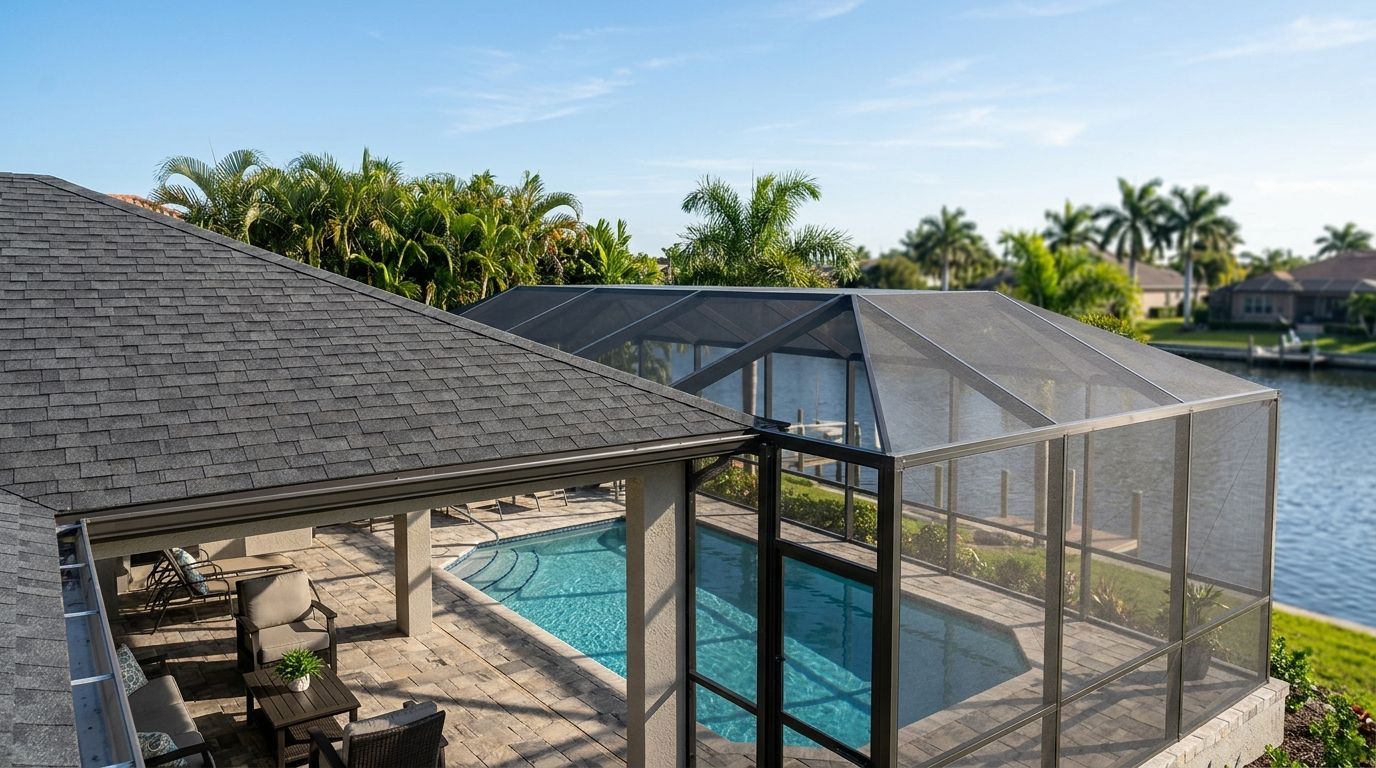
Roofing for lanai and pool cage enclosures in Southwest Florida means sealing the point where your home's main roofline meets a screened pool cage or lanai frame, so wind-driven rain during summer storms and hurricane season doesn't track back under the shingles or tile. Homeowners in Cape Coral, Fort Myers, and Naples deal with a hybrid structure most roofers elsewhere never see: a permitted, code-built roof tied into an aluminum screen enclosure that flexes in wind and drains differently than a standard eave.
- Roofing for lanai and pool cage enclosures in 2026 centers on flashing the tie-in seam, not the enclosure itself.
- Flat and low-slope lanai roof sections fail at the transition seam more often than the field material itself.
- Standing seam metal is the most common upgrade for SW Florida lanai roofs replaced after 2026 storm seasons.
- Wind mitigation inspections often check the roof-to-cage attachment separately from the main roof deck.
- A roofer, not a pool cage contractor, should own the seam where cage meets roofline.
Why roofing matters for pool cage and lanai homeowners
A pool cage doesn't carry its own roof deck. It's an aluminum frame with screen panels bolted or ledger-mounted to your house, and in most SW Florida layouts the lanai sits directly under an extension of the main roof, or under a separate low-slope section covered in the same shingle, tile, or metal as the house. That seam is a known weak point: enclosure attachment brackets penetrate the roof deck, and every penetration is a potential leak path.
Homeowners searching for roofing for lanai and pool cage enclosures are almost never shopping for a new pool cage. They're dealing with a leak at the tie-in, a roof replacement that has to work around an existing cage, or a wind mitigation inspection that flagged the attachment. The fix belongs to the roofer, not the cage installer, because the roof deck, underlayment, and flashing are roofing scope.
Inspect the roof-to-cage attachment point first
Before anyone touches shingles, tile, or metal panels, the seam where the lanai frame meets the house needs a direct look, not a guess from the ground.
- Check for cracked or missing sealant at every bracket where the cage frame bolts into the fascia or roof edge.
- Look for granule loss or lifted tile immediately around the attachment line — a sign water has been working under the field material.
- Run a hose test along the seam if a leak has already shown up on the lanai ceiling or pool deck.
- Pull back a section of soffit or fascia trim near the attachment to check for rot or rust staining.
- Confirm the enclosure's ledger board, if there is one, is still solidly fastened and not pulling away from the structure.
Match the roofing material to the lanai's exposure
A lanai roof section often faces more direct sun and rain than the rest of the house because it's lower-pitched and closer to the pool deck's reflected heat and moisture.
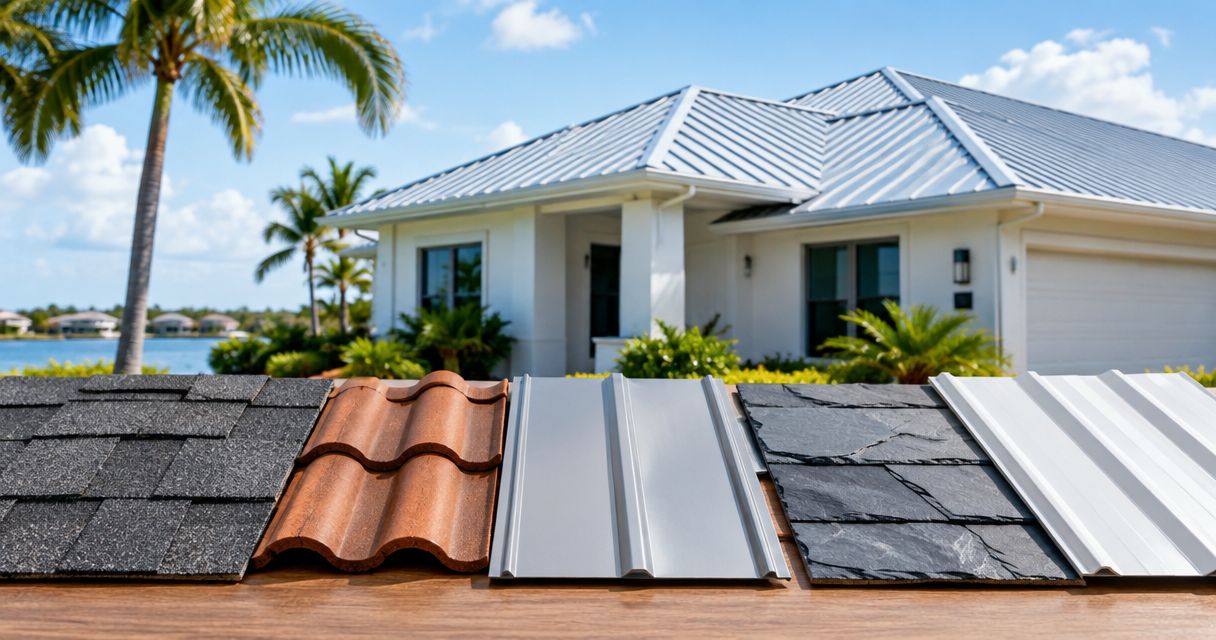
- Asphalt shingle sections over a lanai extension need the same wind-rated shingle class as the main roof, not a downgrade.
- Concrete or clay tile matches the house aesthetic on Mediterranean-style homes but adds weight the cage attachment point has to account for.
- Standing seam metal handles low-slope lanai overhangs better than shingle because it sheds water faster and has fewer seams for wind to lift.
- Flat or low-slope sections under a screened cage often use modified bitumen or a coating system rather than shingle, since shingle needs slope to shed water correctly.
For homes weighing metal against tile on a coastal lot, the best roofing materials for Florida hurricanes breaks down wind ratings by material class.
Flash and seal every transition seam
This is the step that actually stops leaks at a pool cage tie-in — everything else is groundwork for this.
- Step flashing at every point the cage frame penetrates the roof deck, not just a bead of caulk over the bracket.
- Counter-flashing where a lanai roof section meets a taller wall of the main structure.
- Butyl or polyurethane sealant rated for continuous UV exposure, since Florida sun degrades cheaper sealants within a season or two.
- A fresh underlayment layer under any re-flashed section, not a patch over old felt or synthetic underlayment.
Route water away from the pool deck
A lanai roof that drains straight onto the pool deck or into the cage's base track causes standing water and algae, and it stresses the screen frame's footing over time.
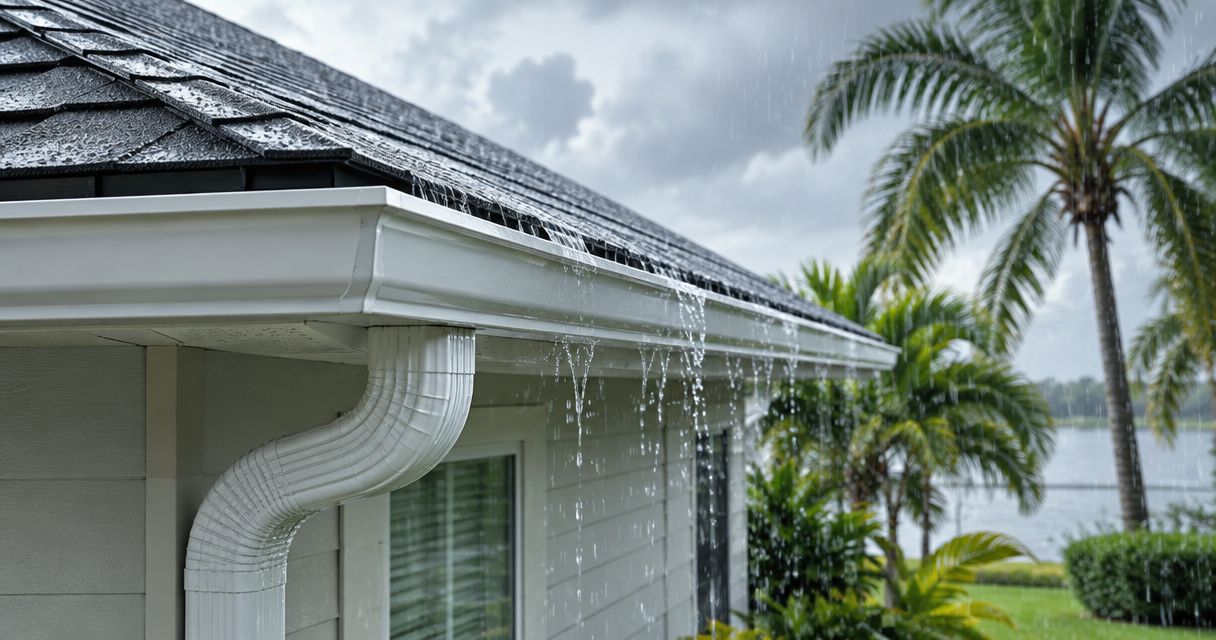
- Gutter runs along the lanai roof edge, sized for the actual roof area draining into them, not an afterthought piece.
- Downspouts routed past the pool deck and cage footprint, never discharging inside the screened area.
- Splash blocks or extensions at grade so water doesn't pool against the cage's foundation track.
When the existing gutter system on the main house needs to extend across a new lanai roof section, how to install seamless gutters on a Florida home covers sizing and slope for high-rainfall runs.
Confirm the enclosure meets wind mitigation standards
Wind mitigation inspections in SW Florida look at roof deck attachment, roof-to-wall connections, and secondary water barrier — and a pool cage tie-in sits right in that inspection zone.
- Verify the roof-to-wall connection method at the lanai (clips vs. straps) is documented for the inspector.
- Confirm the secondary water barrier extends under any re-roofed lanai section, not just the main house field.
- Ask whether the cage attachment itself falls under a separate wind-load rating from the county, since that's outside roofing scope but affects the inspection outcome.
Homeowners chasing an insurance discount tied to this inspection should read wind mitigation inspection for homeowners insurance discounts before scheduling, since incomplete roof-to-cage documentation is a common reason discounts get denied.
Sequence the roofing work around the screen enclosure
Re-roofing a lanai section with an existing cage in place takes more coordination than a standalone roof job.
- Confirm with the roofer whether the cage needs partial disassembly at the attachment points before tear-off starts.
- Schedule debris removal so torn-off tile or shingle doesn't damage screen panels below.
- Photograph the existing attachment hardware before removal, in case the cage installer needs to match bracket spacing on reinstall.
Maintain the transition after installation
Once the new roof section and reflashed seam are in, a short annual check keeps the tie-in from becoming next year's leak call.
- Walk the seam line each spring before rainy season starts, looking for lifted sealant or shifted brackets.
- Clear debris from the gutter run along the lanai roof edge at least twice a year given SW Florida's leaf and storm debris load.
- Note any new staining on the lanai ceiling immediately rather than waiting for a bigger leak to show.
Roofing options for lanai and pool cage roof sections compared
| Option | Best for | Key limitation |
|---|---|---|
| Asphalt shingle | Matching an existing shingle-roofed house extension | Needs full slope; struggles on very low-pitch lanai sections |
| Standing seam metal | Low-slope lanai overhangs and coastal wind exposure | Higher material cost per square than shingle |
| Concrete or clay tile | Mediterranean-style homes wanting a uniform roofline | Adds weight the cage attachment framing must support |
| Flat / modified bitumen | Fully flat lanai roof sections with no usable slope | Needs a coating or recoat cycle to hold up under UV |
Verdict: standing seam metal wins for most lanai and pool cage roof sections in Southwest Florida because it sheds water fast on low pitch and holds up to coastal wind without the seam count of shingle. Homes with an existing tile roofline are the exception — matching material keeps the resale look intact even if metal performs better on paper.
Homes on barrier islands or within a mile of the water should also weigh salt exposure, covered in metal roofing for coastal Southwest Florida homes.
Get a free lanai roof evaluation
An honest look at your roof-to-cage tie-in, no pressure.
Common mistakes pool cage and lanai homeowners make
- Letting the cage installer handle roof flashing. Screen enclosure crews install aluminum frames, not roof underlayment — flashing the tie-in is roofing work and should stay with a roofer.
- Treating a lanai roof leak as a screen problem. Water tracking down a cage post usually originates at the roof seam above it, not the screen panel itself.
- Skipping the flat section during a full roof replacement. Homeowners replace the main roof and leave the old flat lanai section untouched, creating a mismatched warranty and a weak point.
- Ignoring wind mitigation documentation for the lanai tie-in. Insurance discounts get denied when the inspection can't confirm the attachment method at the lanai roof line.
- Choosing tile for weight reasons without checking the cage frame's load rating. A heavier roof section over a lanai can stress an older cage's support posts.
FAQ
Does a pool cage need its own roof?
No — a pool cage is a screened aluminum frame, not a roofed structure. The roofing work involved is the section of the house roof that ties into the cage frame, plus flashing at every attachment point.
What causes leaks where a lanai meets the main roof?
Cracked or missing sealant at cage attachment brackets is the most common cause. The fix is re-flashing the seam and replacing underlayment under the affected section, not just resealing the surface.
Is metal or tile better for a lanai roof section in Southwest Florida?
Standing seam metal handles low-slope lanai overhangs and coastal wind better than tile, but tile matches the roofline on Mediterranean-style homes already roofed in tile.
Can I re-roof a lanai section without removing the pool cage?
Often yes, though the roofer may need partial disassembly at the attachment points depending on how the cage is fastened. A roofing crew experienced with pool cage tie-ins will confirm this during inspection.
Does a pool cage tie-in affect a wind mitigation inspection?
Yes — inspectors check roof-to-wall connections and secondary water barrier at the lanai roof section the same way they check the main roof, and incomplete documentation there can affect insurance discount eligibility.
How often should the roof-to-cage seam be checked?
Once a year, ideally before rainy season, is enough for most homes. Homes with an older cage or a history of leaks benefit from checking twice a year.
What roofing material sheds water best on a flat lanai section?
Modified bitumen or a coated flat roof system handles a fully flat lanai section better than shingle, which needs slope to drain correctly.
One last thing
The roof-to-cage seam usually fails years before the field roofing does — a 2026 shingle roof can look fine while the flashing around a decade-old pool cage attachment has already opened up. Have the seam checked on its own schedule, separate from the rest of the roof's inspection cycle.