Seamless gutter installation in Florida runs on tighter tolerances than most DIY guides admit — humidity, hurricane-season downpours, and fascia rot change the math. This guide walks through the actual install sequence, the mistakes that cause overflow during a Southwest Florida thunderstorm, and when the job belongs to a licensed crew instead of a ladder and a rivet gun.
- Seamless gutter installation on a Florida home needs 5-inch K-style aluminum at minimum, .032 gauge or heavier — anything thinner dents in hail.
- Slope should run 1/4 inch per 10 feet toward downspouts; flat runs overflow during a 2026-level summer storm.
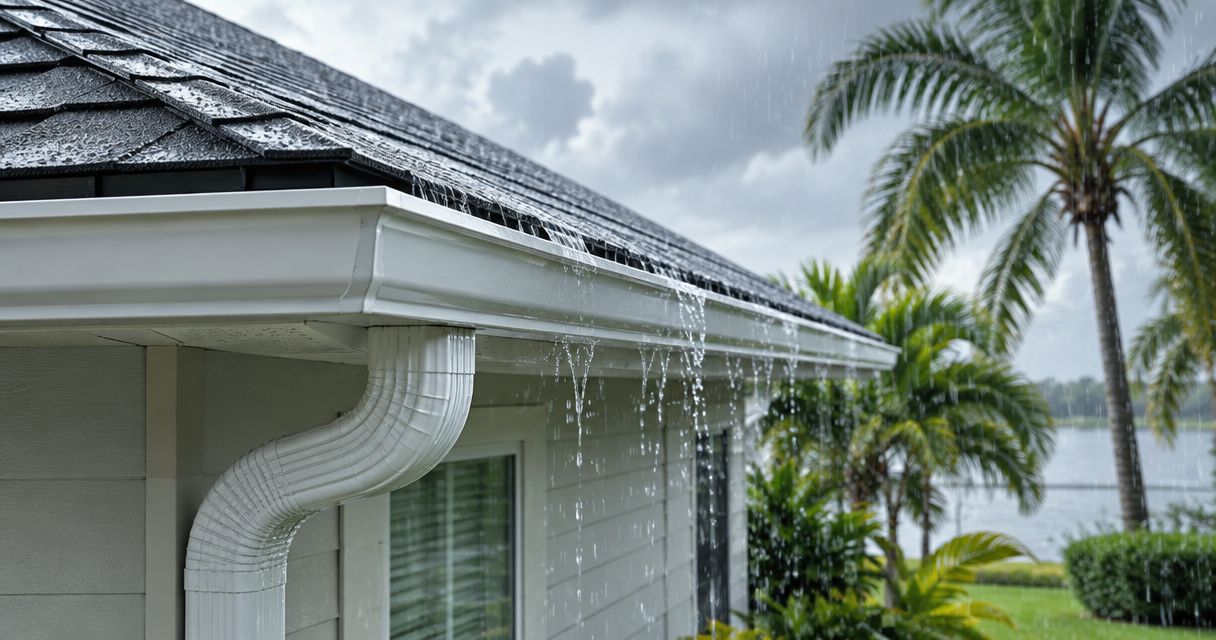
- Downspouts belong every 30-35 feet of run — skip this and you get sheeting off the fascia in heavy rain.
- DIY seamless gutter installation is possible on single-story homes; two-story and tile-roof homes verdict: hire a licensed roofer.
- Roof Smart of SW Florida verdict: pair gutter work with a wind mitigation check during the same visit in 2026.
Why this matters
Florida gets roughly 50-60 inches of rain a year, most of it compressed into the June-through-September wet season, and a clogged or undersized gutter system dumps that water straight against the fascia board and foundation. Seamless gutters cut leak points because there's no seam to fail every 10 feet like sectional gutter, but the seamless part only works if the crimping, hangers, and slope are right on the first pass — you can't patch a bad seam later because there isn't one.
Homes in Cape Coral, Fort Myers, and Naples also deal with wind-driven rain during named storms, which pushes water sideways under standard drip edges. That's a separate problem from gutter sizing, but it's why a lot of roofing crews handle gutters and wind mitigation inspections on the same appointment instead of treating them as unrelated line items.
What you'll need
- Seamless gutter machine (rented or contractor-owned — this is what forms continuous aluminum coil into K-style profile on site)
- 5-inch or 6-inch K-style aluminum coil, .032 gauge minimum for Florida wind exposure
- Hidden hangers, spaced every 24-32 inches
- End caps, corner miters, and downspout outlets
- Rivets and gutter sealant rated for exterior UV exposure
- Level, chalk line, and a stable ladder rated for the fascia height
- Downspout tubing and elbows, plus splash blocks or a drainage extension
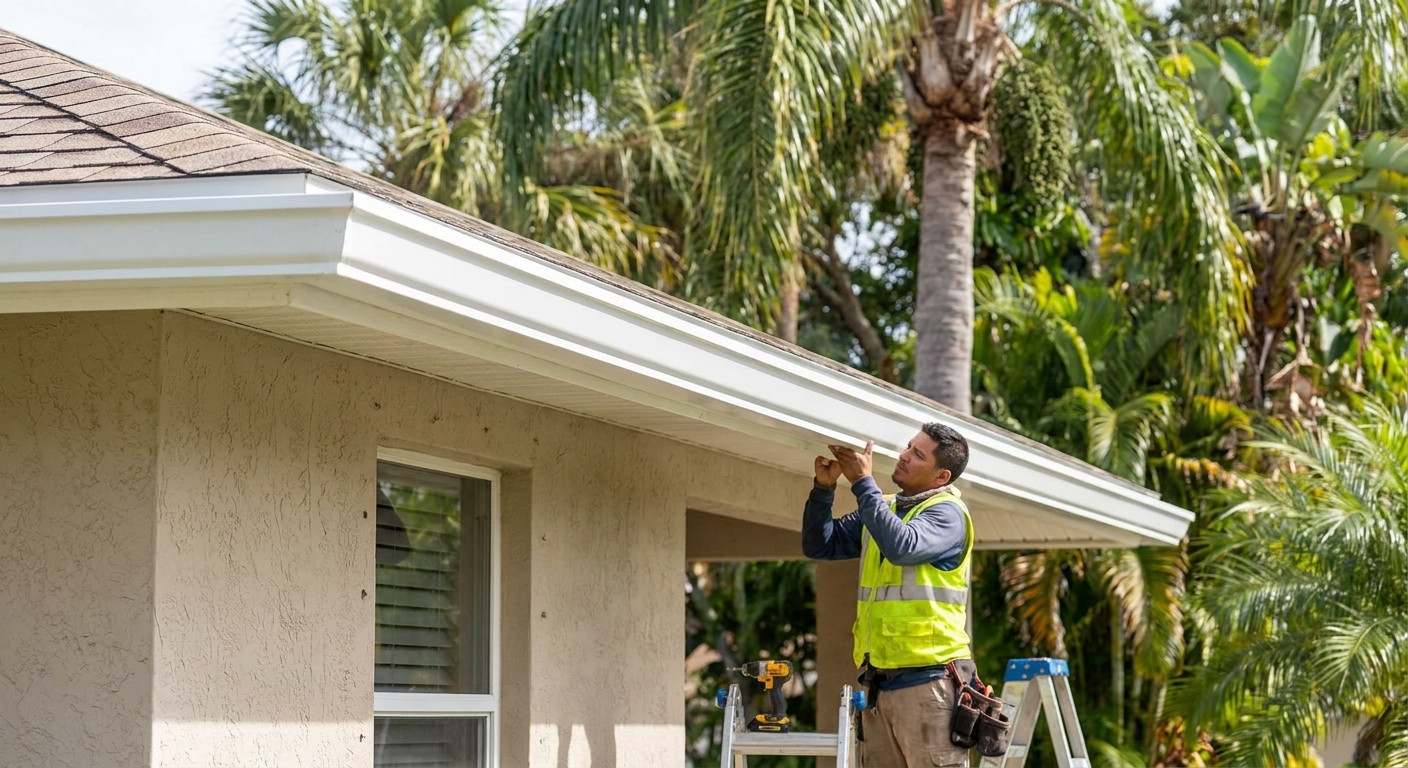
- A second set of hands — 5-inch stock in 30-foot lengths is unwieldy for one person on a ladder
If your fascia board shows soft spots, water staining, or rot, that's a repair job first. Hanging new gutters on compromised fascia just relocates the failure six months out.
The steps
1. Inspect and measure the fascia line
Walk the full perimeter and note every roofline change, valley, and downspout location before cutting anything. Measure total linear footage per elevation — this determines how much coil to run through the machine and how many downspouts the run needs. A typical single-story Southwest Florida home runs 150-220 linear feet of gutter across all elevations.
2. Mark the slope
Snap a chalk line at the high end near the roof corner, then drop 1/4 inch for every 10 feet of run toward the downspout location. On a 40-foot run that's roughly 1 inch of total drop. Skipping this step is the single biggest cause of standing water and overflow during heavy rain — flat-hung gutters look fine until the first real storm.
3. Run the gutter machine
Feed the aluminum coil through the machine to form continuous K-style gutter to the exact measured length, with mitered corners cut and fitted on site. This is the step that makes seamless gutter installation seamless — there's no field-cut seam along the straight runs, only at corners and end caps.
4. Install hidden hangers
Space hangers every 24 to 32 inches, tighter on runs that see heavy roof runoff or sit under a steep pitch. Screw into solid fascia or rafter tails, never just into the gutter lip. Undersized or oversized hanger spacing is the second most common failure point after slope.
5. Set downspouts
Place a downspout outlet at least every 30-35 feet of gutter run, and always at the low end of a sloped section. A single downspout trying to drain a 60-foot run backs up during a heavy 2026 wet-season downpour — this is where most overflow complaints originate.
6. Seal and rivet joints
Rivet corner miters and end caps, then run exterior-rated gutter sealant along every joint from the inside. Let sealant cure per label time before the first test — most products need several hours minimum, longer in high humidity.
7. Test with a hose
Run water at the high end of each section and watch for pooling, sheeting over the back edge, or slow drainage at the downspout. Fix any pooling now — it means the slope isn't consistent even if it measured right on paper.
8. Recheck after the first real rain
After the first genuine storm, walk the perimeter and check for overflow points, detached hangers, or debris buildup at outlets. This catches issues a hose test won't reveal, like wind-driven rain overshooting a gutter that's technically sized correctly.
Get a gutter and roof inspection
Free, no-pressure evaluation across Cape Coral, Fort Myers, and Naples.
Troubleshooting
- Water overflows at corners. Usually a miter joint that wasn't sealed fully on the inside seam — reseal and retest before assuming the gutter is undersized.
- Gutters sag between hangers. Hanger spacing is too wide, most often on runs installed with hangers every 40+ inches instead of the recommended 24-32.
- Standing water after rain stops. Slope is flat or reversed somewhere in the run — recheck with a level, don't just eyeball it.
- Downspout backs up during storms. One outlet is trying to handle too much linear footage; add a second downspout rather than upsizing the tubing.
- Gutters pull away from fascia. The fascia board itself is soft or rotted underneath — this is a repair issue, not a hanger issue, and needs to be fixed before rehanging.
- Debris clogs outlets fast under oak or palm canopy. Gutter guards help, but on heavy tree cover expect to clean outlets more than once a season regardless.
Tools and resources
- Seamless gutter machine (rental yards and roofing supply houses carry these; most contractors own one)
- 5-inch or 6-inch .032-gauge aluminum coil in your fascia color
- Level and 30-foot chalk line for slope marking
- A stable, properly rated extension ladder — never a stepladder for fascia-height work
- A licensed roofing contractor for two-story homes, tile roofs, or any job where fascia repair is needed first
Roof Smart of SW Florida handles gutter installation alongside roof repair and wind mitigation work, which matters if your fascia needs attention before gutters go up — one visit instead of coordinating two separate contractors.
FAQ
What's the best gutter size for a Florida home?
5-inch K-style aluminum is the standard minimum for Florida homes, with 6-inch recommended for steep rooflines or heavy tree canopy. Anything thinner than .032 gauge dents easily under hail or debris impact.
Is seamless gutter installation better than sectional gutters?
Yes, seamless gutters have far fewer leak points because the long runs are formed on site with no field seams every 10 feet. Sectional gutters leak at those seams within a few years in Florida's rain volume.
How much does seamless gutter installation cost in 2026?
Cost varies by linear footage, gauge, and downspout count, so get a site-specific estimate rather than relying on a national average. A free evaluation from a local roofer will give you an accurate number for your home.
Can I install seamless gutters myself?
Single-story homes with straightforward rooflines are DIY-feasible if you rent a gutter machine and have a helper. Two-story homes, tile roofs, or fascia in poor condition are better handled by a licensed contractor.
How often should gutters be cleaned in Southwest Florida?
Clean gutters at least twice a year, before and after hurricane season, and more often under oak or palm canopy. Clogged outlets during a 2026 wet-season storm cause overflow even on a correctly sloped system.
What slope do gutters need for proper drainage?
Gutters need roughly 1/4 inch of drop for every 10 feet of run toward the downspout. A flat-hung gutter looks fine until the first heavy rain, then it overflows at the low points.
Do gutters help with roof wind mitigation in Florida?
Gutters themselves aren't a wind mitigation feature, but water management around the roofline reduces fascia and soffit damage that compounds storm impact. Many Florida roofers check gutters and wind mitigation credits during the same inspection.
How many downspouts does a typical home need?
Plan on one downspout for every 30-35 feet of gutter run. A single downspout trying to drain a longer run backs up and overflows during heavy 2026 storm rainfall.
One last thing
Most overflow calls Roof Smart of SW Florida gets after a storm trace back to hanger spacing, not gutter size — homeowners upgrade to 6-inch gutters expecting a fix, then keep the same 40-inch hanger gaps and get the same sagging problem a year later. Fix the spacing before you fix the size.