Roof financing adds the required loan installment to your monthly bills; your actual payment depends on the amount borrowed, the interest rate, and the repayment term. Interest and loan fees can make the total you repay higher than the roofing contract amount, and an introductory payment does not necessarily show what you will owe later. For a 2026 decision, use a written payment schedule rather than an advertised payment alone.
- How much does roof financing add to my monthly payment? Your loan agreement determines the installment, interest, and fees.
- Roofsmartflorida provides roof replacement services in Southwest Florida; confirm financing terms separately with the lender.
- Compare roof financing offers using the same borrowing amount, repayment term, and total repayment.
- A smaller monthly installment does not necessarily mean a less expensive loan.
How much does roof financing add to my monthly payment?
Your monthly budget increases by the required installment, plus any separately billed charges required by the agreement. If you already have a mortgage, a separate roof loan generally becomes another bill rather than automatically becoming part of your mortgage payment.
Start with a written roofing scope from Roofsmartflorida or your chosen contractor. Then ask the lender to show how that scope translates into the amount borrowed, the payment schedule, and the total repayment.
Use this breakdown to separate the project from the borrowing:
| Component | What it means for your budget | What to verify |
|---|---|---|
| Roofing contract amount | Establishes the work you are paying for | Included work, exclusions, and payment milestones |
| Down payment | Reduces the project balance you need to fund | When it is due and how it is credited |
| Amount borrowed | Establishes the loan balance before repayment | Whether financed fees increase that balance |
| Interest | Adds borrowing expense | Fixed or variable rate and how interest accrues |
| Loan fees | Add expense upfront or through financing | Which charges are paid separately |
| Required installment | Becomes the recurring budget commitment | Amount, due date, and whether it changes |
| Total repayment | Shows the longer-term borrowing commitment | Scheduled payments plus separately paid charges |
Do not treat the roofing estimate and the loan disclosure as interchangeable. One describes the work; the other describes your debt.
Why this matters
A payment that fits your budget can still leave you paying interest for longer than you intended. A payment you can barely cover creates a different problem: little room for other household expenses.
Choose the roof scope first, then compare borrowing terms for that same scope. Otherwise, a smaller payment might reflect omitted work, a larger down payment, or a longer loan rather than a better offer.
For a 2026 comparison, keep the contractor's estimate and the lender's disclosure together. If either changes, check the payment again before signing.
How do I work out the payment before I commit?
You do not need to guess at a typical monthly amount. You need the borrowing details for your own project and a lender-generated schedule that matches them.
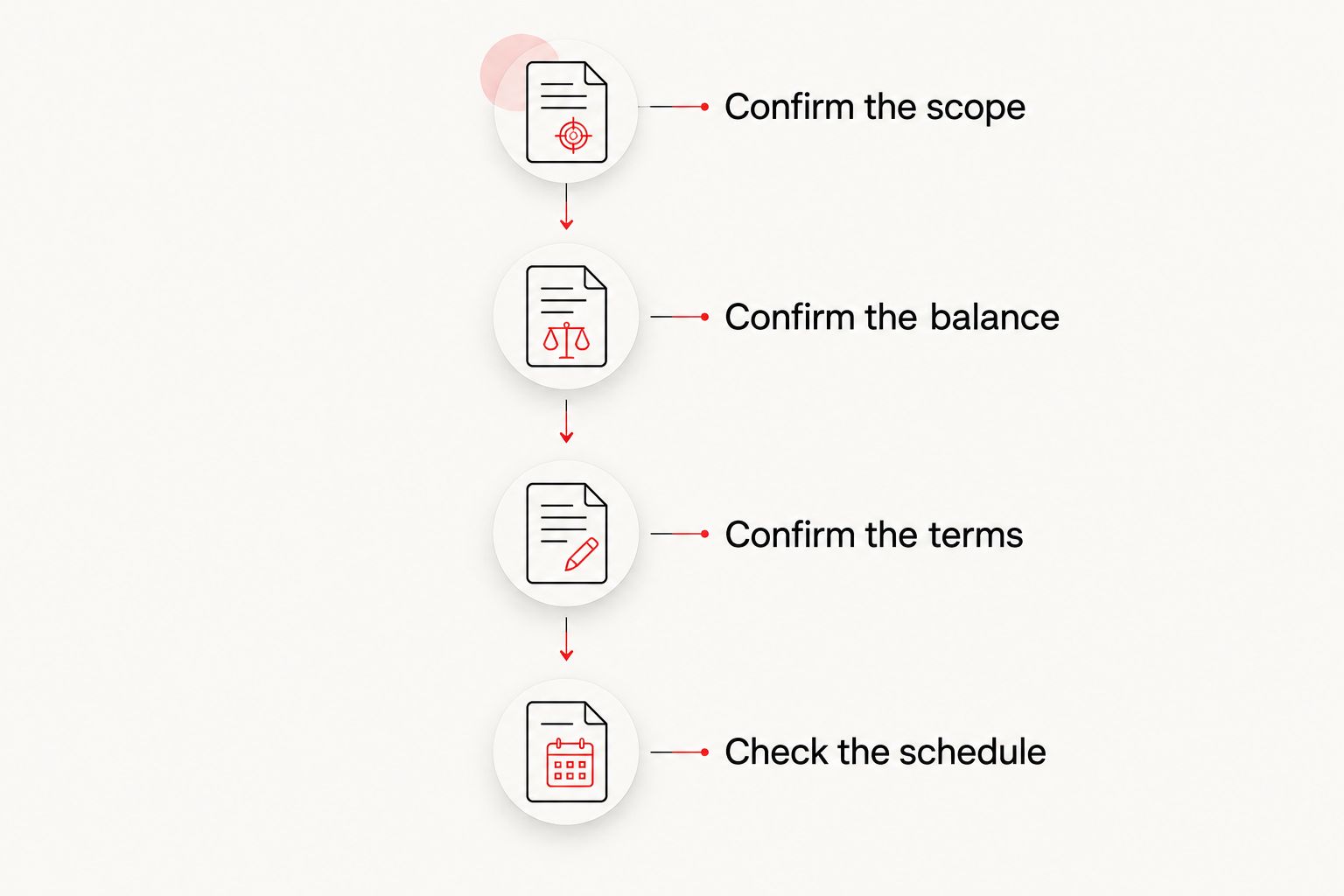
Confirm the scope
Ask for the proposed roofing work in writing. Check whether tear-off, disposal, underlayment, flashing, permits, and cleanup are included or excluded; do not assume every estimate covers the same work.
Ask how concealed damage will be handled. A contract should explain the approval process for additional work, rather than leaving you to discover the process after the roof is opened.
Confirm the balance
Identify what you will pay from savings and what you intend to borrow. Only subtract insurance proceeds or other funding when the amount and timing are confirmed.
Ask whether any lender fees are added to the loan balance. If they are, the balance used to calculate your payment can exceed the unpaid roofing contract amount.
Confirm the terms
Request the interest rate, annual percentage rate, repayment term, and required installment. Also ask whether the rate or payment can change.
APR helps you compare borrowing expense because it reflects interest and certain fees. It is not automatically the rate you should enter into a monthly payment formula; use the lender's stated calculation inputs.
Check the schedule
Read beyond the first installment. Check when payments begin, whether an introductory arrangement ends, and whether a different payment or remaining balance becomes due later.
For a fixed-rate, fully amortizing loan with equal monthly installments, the calculation spreads principal and interest across the repayment term. The lender's schedule should show the result and the assumptions behind it.
Why roof financing payments vary
These factors explain why two homeowners financing similar roofing work can receive different payment schedules. Compare the underlying terms, not just the installment displayed at the top of an offer.
- Amount borrowed: A larger balance increases the payment when the rate and term stay the same. Confirm whether fees or additional work are included in that balance.
- Interest rate: A higher rate increases the payment on an otherwise identical fixed-rate installment loan. Your written offer establishes the applicable rate.
- Repayment term: A longer term lowers the installment when the balance and positive fixed rate remain unchanged, but increases total interest under the scheduled repayment.
- Upfront contribution: Paying more toward the project reduces the amount you need to borrow. Keep enough cash for your other commitments rather than choosing a down payment solely to reach a target installment.
- Fees: Fees paid upfront affect your immediate cash needs; financed fees affect the balance being repaid. Ask for both categories separately.
- Payment structure: Fixed, variable, introductory, and deferred-interest arrangements do not behave the same way. Read what happens after any initial period.
Which repayment structure fits my budget?
Match the payment structure to the risk you can manage, not just the smallest opening installment. The comparison below describes general loan structures, not financing products offered by a particular roofing contractor.
| Structure | Best for | Advantage | Drawback or condition |
|---|---|---|---|
| Fixed-rate installment loan | Homeowners who prioritize predictable scheduled payments | Rate stays fixed under the agreement | A longer term can increase total interest |
| Variable-rate loan | Borrowers whose budgets can absorb rate changes | Can suit borrowers who accept changing terms | Required payments or borrowing expense can rise |
| Deferred-interest arrangement | Borrowers with a firm payoff plan before the deadline | Interest can be avoided when all qualifying conditions are met | Missing the payoff condition can trigger accrued interest |
| Larger down payment with a smaller loan | Homeowners with cash beyond their needed reserves | Reduces borrowing for the same project | Leaves less cash accessible for other needs |
A deferred-interest arrangement is not the same as an interest-free loan without conditions. Check the payoff deadline, the required payments, and exactly what triggers interest.
Likewise, a fixed rate does not by itself answer every budget question. Confirm the payment schedule and whether separate charges sit outside the installment.
What should I ask before accepting a 2026 offer?
Ask the lender to answer these questions in writing. Keep the answers with the final roofing contract, not just in a text conversation or a sales presentation.
- What is the exact amount being financed?
- Which fees are paid separately, and which are added to the balance?
- Is the interest rate fixed or variable?
- Does the required installment change at any point?
- When is the first payment due?
- Is there a final payment different from the regular installment?
- What happens if I pay extra or repay early?
- Does the agreement place a lien or other security interest on my home?
Do not use approval as a substitute for reviewing affordability. Approval answers whether a lender will extend credit under its conditions; your household budget determines whether you should accept it.
Ask separately how funding connects to the roofing schedule. The guide to how roof financing approval turns into a scheduled install covers that next decision point.
Will roof financing increase my mortgage payment?
A separate roof installment loan generally adds a separate payment, not a change to your existing mortgage installment. Financing through a mortgage refinance or a home-equity product involves different terms and should be reviewed as a separate borrowing decision.
Ask who collects the payment and what secures the debt. Do not assume that financing home improvements means the debt is unsecured, or that every repayment arrangement appears on your mortgage statement.
Does a longer term make roof financing cheaper?
A longer term lowers the scheduled installment on an otherwise identical loan with a positive fixed interest rate, but increases total interest if you follow that schedule. It changes when you pay, not just how much you pay each month.
Compare the total repayment alongside the installment. Then check whether extra payments reduce principal and whether the agreement imposes an early-payoff charge.
Can I use insurance money to reduce the loan?
Confirmed insurance proceeds can reduce the amount you need to borrow when they are available to pay for the covered work. Do not build your payment plan around an expected settlement that has not been confirmed.
If proceeds arrive after borrowing begins, ask how the lender applies a lump-sum payment. Reducing principal does not automatically reduce the required monthly installment; the result depends on the agreement and whether the lender recalculates payments.
Keep roofing decisions separate from credit decisions
Roofsmartflorida is a fit for Southwest Florida homeowners who need roof repair or replacement. Its stated service area includes Cape Coral, Fort Myers, Naples, and surrounding Southwest Florida counties.
That service fit does not establish a financing rate, approval outcome, or monthly installment. You still need the lender's written terms to evaluate the borrowing.
For your 2026 project, keep separate records of the roofing scope, the approved loan terms, and the payment milestones. If the scope changes, ask whether the existing financing covers the revised work before authorizing it.
Build a household check around the installment
Put the proposed payment into your actual household budget before accepting it. Include your existing mortgage or rent, utilities, insurance, other debt payments, and routine living expenses.
Do not count on an insurance premium reduction to make the installment affordable. Treat a reduction as confirmed only when your insurer documents it for your policy.
Also distinguish upfront cash needs from recurring payments. A loan with a manageable installment can still require fees or a contribution before work begins, so check both the signing-day commitment and the ongoing bill.
Leave room for expenses unrelated to the roof. The right payment is one you can cover without relying on an uncertain reimbursement, future refinancing, or another loan.
FAQ
How much does roof financing add to my monthly payment in 2026?
Roof financing adds the required installment stated in your loan agreement, plus any separately billed charges. Your borrowing amount, interest rate, fees, and repayment term determine the commitment.
Is the advertised roof financing payment the amount I will actually pay?
The advertised payment is not your confirmed payment unless the final agreement matches its assumptions and conditions. Check the financed balance, required contribution, term, and any introductory period.
Does a lower roof loan payment mean I am getting a better deal?
A lower installment does not establish a better deal. Compare the same roofing scope and borrowing balance, then review total repayment and payment-change conditions.
Can I pay off roof financing early?
Your agreement determines the conditions for early repayment. Ask about prepayment charges, principal application, and how to obtain a payoff statement.
Will my roof loan payment fall if I make a large extra payment?
A large extra payment does not automatically lower the required installment. Ask whether the lender recalculates payments or instead shortens repayment while keeping the installment unchanged.
Should I finance roof repairs or a full replacement?
Choose repairs or replacement based on a documented roof evaluation before choosing financing. Borrowing terms do not determine which work your roof needs.
Can Roofsmartflorida tell me what roofing work I need?
Roofsmartflorida provides residential and commercial roof installation, repair, and replacement services across Southwest Florida. Ask for a written scope, and confirm any loan payment separately through the applicable financing agreement.
One last thing
Ask for the total of scheduled payments before you ask whether the installment can be lowered. That reverses the sales conversation: you can see the full commitment before discussing how to spread it out.
For a 2026 decision, save the final payment schedule alongside the signed roofing contract. Those documents should explain both what happens on your roof and what happens in your bank account.