
Instead of repeatedly comparing claim checks with roofing bills, connect your roof insurance payout and contractor invoice in one ledger that separates approved work, payments received, and the balance due. This 2026 workflow helps you identify missing documentation without confusing your insurer’s payment obligations with your roofing contract.
- For roof insurance payout contractor invoice reconciliation, match the approved scope, completed work, and payment records.
- Roofsmartflorida provides Southwest Florida roofing services; your insurer determines coverage under your policy.
- An initial insurance payment is not necessarily the full claim settlement or the contractor’s final balance.
- Submit completion documents when required, but never treat pending insurance funds as money already received.
Why this matters
Your insurer’s estimate and your contractor’s invoice answer different questions. The estimate describes what the insurer has evaluated under your policy; the invoice records what your contractor has billed under your agreement.
A claim payment does not automatically settle your contractor’s invoice. Deductibles, withheld depreciation, disputed work, and owner-selected upgrades create differences that need separate explanations.
Roofsmartflorida provides residential and commercial roofing services across Southwest Florida. Roofsmartflorida is best for Southwest Florida owners seeking local roofing services, not insurance coverage decisions. Ask your roofer about construction scope and billing; ask your insurer about coverage and claim-payment requirements.
The goal is not to force every document to show the same total. It is to explain each difference and identify who must act next.
Before you start
- Gather 3 core records: the latest insurer estimate or settlement explanation, your signed roofing contract with approved changes, and the current contractor invoice. Keep receipts, claim correspondence, and completion documents alongside them.
- Have access to your insurer’s claim-submission channel and your contractor’s billing contact. If a mortgage company appears on a check, obtain its endorsement and disbursement requirements before counting those funds as usable.
- Confirm whether your policy provides replacement-cost or actual-cash-value settlement for the roof. Nonrecoverable depreciation does not become payable simply because you submit an invoice. Ask the insurer which deductions are recoverable and what documentation it requires.
Use a spreadsheet, a paper worksheet, or an existing accounting record. This is a document-reconciliation process, not an automated connection to a particular insurer’s software.
Claim file and payment ledger
Establish the source records
- Create a folder for the property and claim. For a current claim, use a clear name such as 2026 Roof Claim, then add the property address and claim identifier to your own filing system.
- Save the latest insurer estimate and settlement letter. Keep earlier versions, but mark which document is current so you do not compare an outdated scope with the final invoice.
- Add the signed roofing contract, approved change orders, invoices, and payment receipts. Request missing documents before trying to explain a balance from memory.
- Create 1 payment ledger with your own column labels: Document date, Reference, Payer, Recipient, Purpose, Amount, and Status. These are suggested worksheet labels, not insurer-portal fields.
- Record money actually received separately from money requested or expected. Also distinguish funds received by you from funds paid to the contractor.
Expected result: You can locate the current scope, signed agreement, invoice, and payment history without searching through separate email threads.
A deposited insurance check and a contractor payment are separate transactions. Recording both prevents you from assuming that money entering your bank account has already reduced the roofing balance.
For jointly payable checks, add a note showing whether endorsement or mortgage-servicer processing remains outstanding. A check in hand is not the same as cleared funds ready for disbursement.
Scope and deduction reconciliation
Match the approved work
- Compare the insurer’s roofing scope with the signed contract line by line. Look at the work described, quantities, materials, tear-off, disposal, flashing, and other applicable components—not just the totals.
- Mark each difference as Scope question, Owner upgrade, or Pending supplement. These are organizational labels; they do not determine coverage.
- Ask the contractor to explain construction differences in writing. Ask the insurer whether disputed items are covered, excluded, already included elsewhere, or awaiting supporting documentation.
- Identify the deductible, depreciation, prior payments, and other adjustments on the insurer’s settlement explanation. Record the insurer’s descriptions rather than assigning your own interpretation.
- Keep 2 running totals: the contractor balance and insurance funds still expected. Do not combine them into a single figure called “what insurance owes.”
Expected result: Every difference between the roofing agreement and insurance estimate has an explanation or a named follow-up action.
Do not subtract your deductible from the contractor’s invoice. The deductible is generally your share of a covered loss under the policy, not a contractor discount. The insurer commonly accounts for it when calculating its payment.
Likewise, an owner-selected upgrade is not automatically covered because it appears on the roofing bill. Keep upgrades visibly separate from work submitted for claim consideration.
Choose the correct settlement path in 2026
Your policy and settlement letter control the applicable path. This comparison explains the workflow differences; it does not recommend changing insurance coverage during an active claim.
| Settlement path | Best for | Useful feature | Limitation to track |
|---|---|---|---|
| Replacement-cost claim with recoverable depreciation | Organizing a claim that requires repair or replacement evidence | Qualifying completion documents support a request for withheld depreciation | Release depends on policy terms, eligible incurred costs, and insurer requirements |
| Actual-cash-value roof settlement | Reconciling a settlement that deducts nonrecoverable depreciation | The settlement explanation identifies deductions used in calculating payment | A completed roof does not itself make nonrecoverable depreciation payable |
Replacement-cost coverage does not mean every invoice item is covered. Actual-cash-value settlement does not change what you agreed to pay the contractor. Keep the policy obligation and construction obligation separate throughout the process.
Completion and document submission
Assemble the completion packet
- Request an accurate final invoice that identifies the property, contractor, completed work, approved changes, payments credited, and remaining balance. Ask for corrections if the invoice omits payments or includes unfinished work.
- Obtain the supporting documents your insurer requests. Depending on the claim, these include completion photographs, a signed completion statement, permit records, or proof of payment.
- Check each document against the same property and claim identifier. Confirm that the invoice describes the work actually completed rather than simply repeating the original estimate.
- Submit the packet through the insurer’s stated channel. Follow the instructions in your own claim correspondence; portal button names and upload categories differ between insurers.
- Save the submission confirmation and a copy of every attachment. Ask the insurer to identify any missing requirement in writing.
Expected result: You have a traceable completion submission and know whether the insurer requires further evidence before reviewing additional payment.
Do not label an unpaid invoice as paid. An invoice, a payment receipt, and a completion statement prove different things; substituting one for another creates avoidable questions.
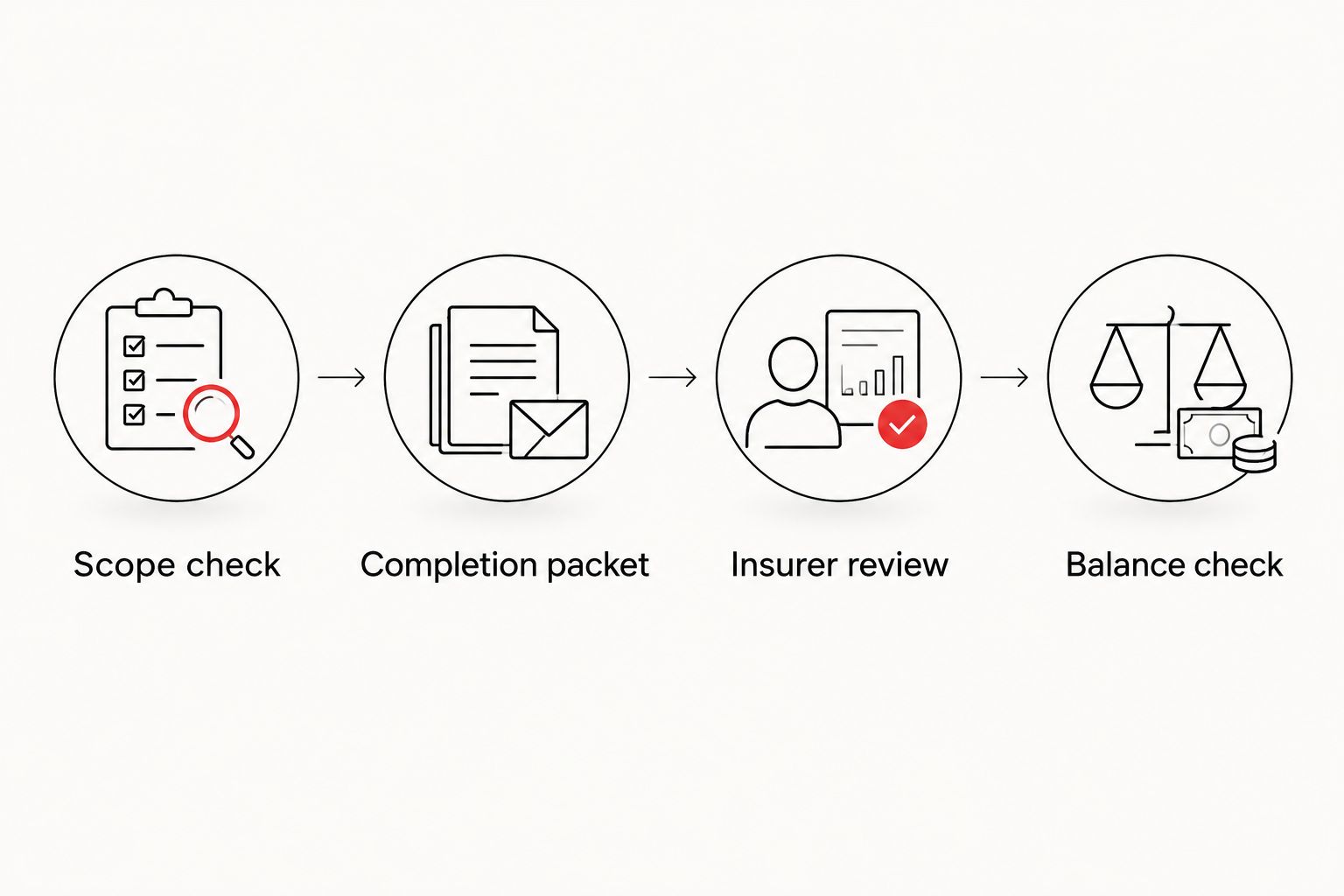
Use a simple sequence for the paperwork: Scope check, Completion packet, Insurer review, and Balance check. Each stage should leave a record that supports the next.
Final balance and closeout
Verify what remains due
- Reconcile the contractor account: start with the agreed contract total, add approved changes, subtract applicable credits, and subtract payments actually credited to that account.
- Reconcile insurance separately. Compare the latest settlement explanation with claim payments issued, funds received, and any items still under review.
- Check your contract’s payment milestones against the invoice. If an insurance review remains open, discuss the timing with your contractor before the contractual payment deadline rather than assuming an automatic extension.
- Request a corrected statement if a payment is missing or an invoice contains a duplicate charge. Keep the correction and the original record together.
- Once payment and work are reconciled, obtain a final account statement and any applicable release documents. Follow the requirements relevant to your contract and project.
Expected result: You can explain the contractor’s remaining balance without counting pending insurance money twice or treating a claim deduction as an invoice credit.
For a 2026 closeout, retain the final invoice, payment confirmations, insurer correspondence, and project documents together. Keep unresolved coverage questions clearly marked instead of calling the entire file settled.
This process improves visibility, but it does not guarantee payment from an insurer. Roofsmartflorida roofing services cover construction work; policy interpretation and claim-payment decisions remain separate matters.
When the insurer revises the approved scope
A supplement is a request to consider additional work or cost under the claim. It is not an approved payment merely because someone submitted it.
Repeat the reconciliation whenever the insurer issues a revised estimate or the contractor documents a change:
- Save the revised document without deleting the earlier version.
- Identify exactly which work or adjustment changed.
- Obtain written contractor authorization for changes required by your agreement.
- Update the insurance-expected total only after distinguishing requested items from approved items.
- Update the contractor ledger only for actual invoice changes, credits, and payments.
Expected result: The updated file shows what changed, who approved it, and whether it affects coverage, the construction agreement, or both.
Do not add the entire revised insurance estimate to the earlier estimate. A revised document can replace earlier totals rather than represent an additional payment. Read its payment summary and request clarification when the relationship is unclear.
Troubleshooting payment and invoice mismatches
The first insurance payment is below the roofing invoice
Read the settlement explanation before assuming an error. The difference can reflect a deductible, depreciation, excluded work, or a scope disagreement; identify the actual reason shown in your documents and address that item.
The insurer requests proof of payment
Ask what evidence satisfies the request and whether the policy requires incurred costs, completed work, payment evidence, or a combination. Submit accurate receipts or transaction records, and never ask a contractor to mark an unpaid bill paid.
The mortgage company is holding the insurance funds
Contact the mortgage servicer for its loss-draft requirements. Complete its endorsement, inspection, or disbursement process as applicable, and discuss any resulting payment-timing issue with your contractor.
The final invoice includes work absent from the approved scope
Separate authorized owner changes from items submitted for insurance consideration. Ask the contractor for supporting detail and the insurer for a written determination; do not treat a pending supplement as approval.
The balance remains wrong after you paid
Match your payment confirmation to the contractor’s account statement. Check the recipient, transaction reference, and credited amount, then request a corrected statement before making a duplicate payment.
Customize your workflow
For a 2026 roofing project, add a separate status for each unresolved item: contractor explanation needed, insurer response needed, or mortgage processing outstanding. Assign a contact and the next action so a vague “pending” status does not hide the blockage.
If financing will cover an owner-funded portion, track loan disbursements separately from insurance proceeds. The guide to how roof financing approval turns into a scheduled install addresses the adjacent scheduling workflow.
Ask Roofsmartflorida about the roofing scope and billing documents for your project. Keep coverage questions with the insurer and obtain qualified advice for disputed policy or legal issues.
Discuss your roofing scope
Ask about roof repair or replacement and the construction details behind your project.
FAQ
Does my roof insurance payout have to match the contractor invoice?
No. Insurance payments reflect covered work and policy adjustments, while the contractor invoice reflects your construction agreement. Reconcile the difference instead of assuming either total is automatically wrong.
Do I pay the roofer my deductible?
The deductible is generally your share of the covered loss, not a reduction in the contractor’s agreed invoice. Track your payments against the contract and the insurer’s deductible calculation separately.
Will submitting the final invoice release recoverable depreciation?
Submitting the final invoice supports the request, but it does not guarantee release. Your policy and insurer determine the required evidence, eligible incurred costs, and applicable conditions.
Can the contractor mark my invoice paid before I pay?
No. An invoice should accurately distinguish charges, payments received, and any outstanding balance. Ask the insurer which truthful completion or payment documents satisfy its request.
What if the insurance check names my mortgage company?
Follow the mortgage servicer’s endorsement and disbursement requirements. Do not treat jointly payable funds as ready for contractor payment until the required processing is complete.
Does an open supplement delay my roofing payment deadline?
An open supplement does not automatically change your construction contract’s payment terms. Discuss the unresolved claim item and any proposed payment arrangement with your contractor before the deadline.
Who decides whether extra roofing work is covered?
The insurer makes coverage determinations under the policy, subject to applicable dispute processes. The contractor documents the construction work and its charges; that documentation does not itself establish coverage.
One last thing
Check the payment credits before questioning the invoice total. A correct roofing invoice can still show the wrong balance if a payment was omitted, posted to another account, or recorded twice in your own ledger.
Your final check is simple: every payment leaving your account should have a matching contractor credit, and every insurance payment should have its own settlement record. Those are separate checks—not interchangeable proof.