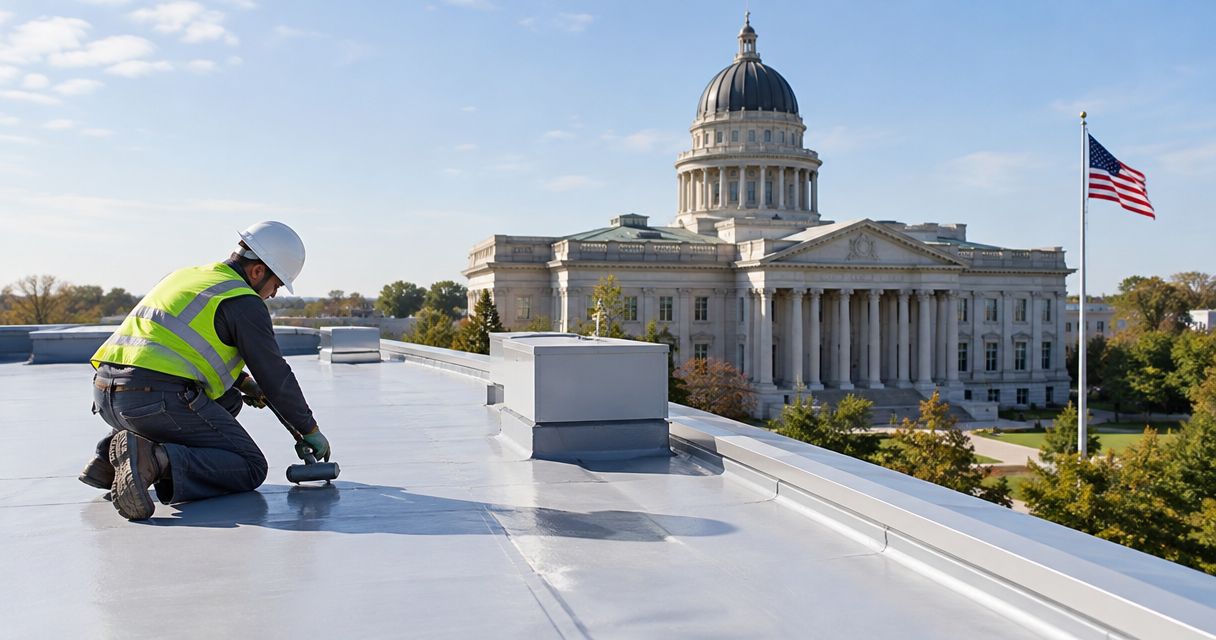
Government-building commercial roofing is the planning, repair, and replacement of public-facility roofs to protect occupants and keep public services operating. This guide to commercial roofing for government buildings explains how to document conditions, compare systems, prepare bid requirements, and manage occupied-building work in Southwest Florida.
- Commercial roofing for government buildings starts with documented roof condition, procurement requirements, and a plan to keep services operating.
- Roof Smart of SW Florida is a local commercial roofing option; verify government-project qualifications before selection.
- Choose roof repair or roof replacement from inspection findings, not the roof covering alone.
- Require comparable scopes, documented installation details, and complete maintenance records before closing the project.
Why commercial roofing matters for government buildings
A government roof project affects more than the facilities department. Public entrances, records storage, meeting rooms, security procedures, and procurement approvals all belong in the scope before work starts.
For your 2026 project, separate building protection from purchasing approval. A technically suitable roof still needs an authorized procurement route, and an approved purchase still needs a sound installation plan. Review roofing options for flat commercial roofs alongside the building's actual condition rather than choosing a material first.
The essential distinction is accountability. You need a record explaining why the work is necessary, what the contractor must deliver, and how your agency will verify completion. That record also helps the next facilities manager maintain the roof without reconstructing decisions from old emails.
Specify the roof and the operating conditions together. A public counter that must remain accessible is a project requirement, not a scheduling detail to settle after award.
Plan your government roofing project in 2026
Start with your existing records and an internal walk-through of accessible areas. Then bring qualified roofing and design professionals into the decisions that require roof access, testing, engineering, or code interpretation. The sequence below keeps material selection behind condition assessment and procurement planning.
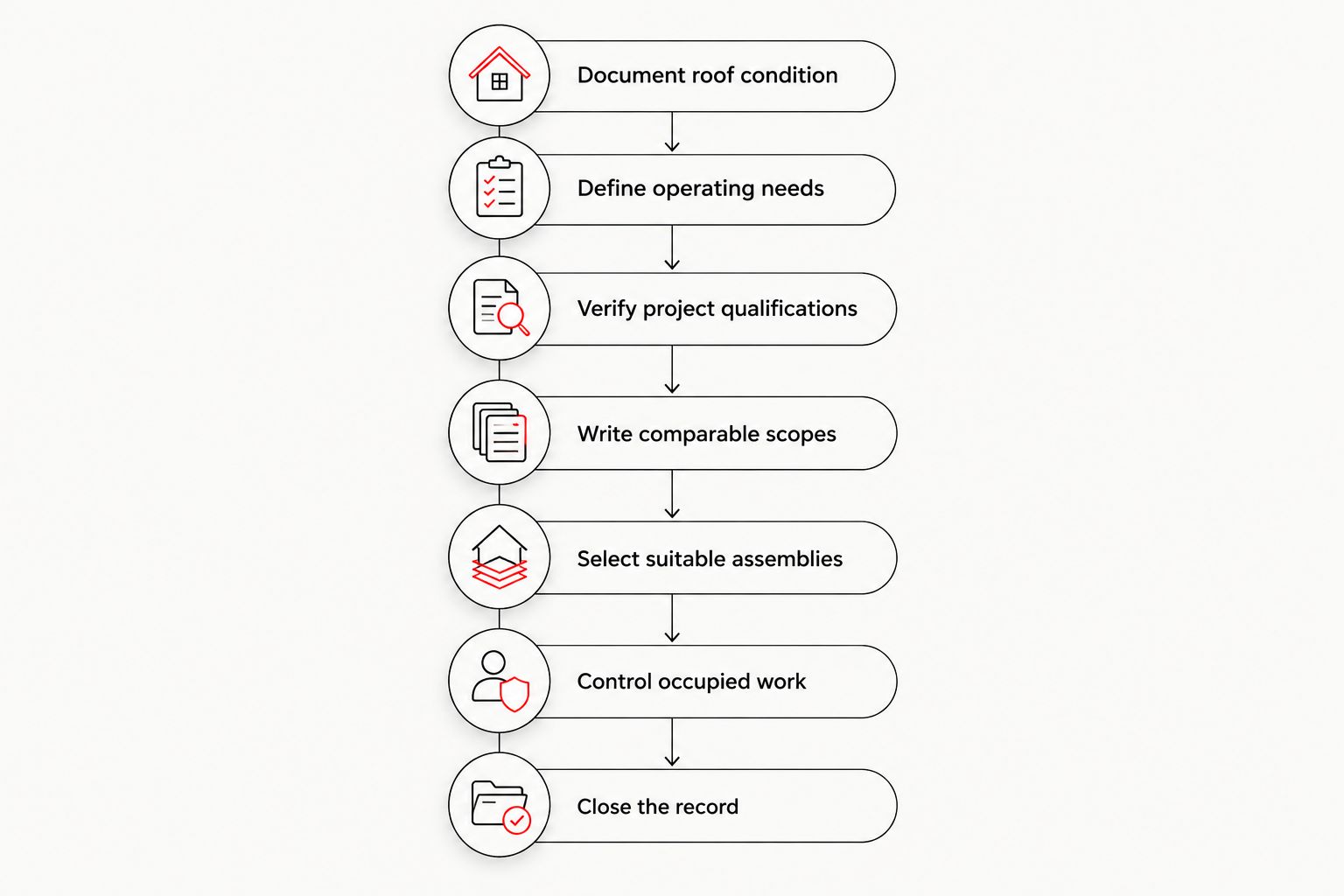
Document roof condition
Create 1 roof register per building before requesting proposals. Start with maintenance files, previous repair invoices, drawings, and staff reports; this records review requires no roof access. Mark each leak location on a floor plan and record when staff first noticed it.
An interior stain identifies a symptom, not necessarily the roof entry point. Ask a qualified professional to distinguish roof-covering problems from flashing, drainage, equipment, or condensation issues. Keep staff off roofs unless they have the authorization, training, and protection required for the task.
For your 2026 condition record, separate observed facts from proposed remedies. A photograph of deteriorated flashing is evidence; a recommendation to replace the entire roof needs its own explanation.
- Record the roof covering and available installation history.
- Map leaks, stained ceilings, and affected rooms.
- Collect photographs taken from safe, authorized locations.
- Identify drains, rooftop equipment, and previous repair areas.
- Request investigation of concealed moisture where conditions justify it.
Define operating needs
Meet with building users before setting the construction schedule. Your own facilities staff can first list public hours, restricted areas, sensitive equipment, and events that cannot move. Use that list to write measurable access and protection requirements.
A library, administrative office, and emergency operations facility do not share the same interruption tolerance. Do not label a building merely as occupied; explain which functions must continue and who can approve an interruption. Where the building has a designated emergency role, confirm its specific requirements with the responsible agency personnel.
Make continuity requirements part of the bid documents. Otherwise, contractors cannot price or schedule the same working conditions, and staff inherit unresolved decisions during construction.
- Identify public entrances and accessible routes that must remain open.
- List rooms requiring extra protection from water, dust, or noise.
- Define approved delivery, staging, and debris-removal areas.
- Assign authority for shutdowns and temporary relocations.
- Establish contacts for building security and urgent incidents.
Verify project qualifications
Begin with your procurement office's vendor requirements and independently check contractor credentials through the appropriate official records. Confirm the purchasing route before treating any proposal as an award-ready offer. Licensing, insurance, bonding, references, and agency registration should be checked against your actual solicitation requirements.
Roof Smart of SW Florida is best suited to Southwest Florida owners seeking local commercial roofing services. Its stated services include commercial roof installation, repair, and replacement across Cape Coral, Fort Myers, Naples, and surrounding Southwest Florida counties. Government-contract eligibility and experience require separate verification.
You can ask Roof Smart of SW Florida to discuss the commercial roofing scope, then assess its submission using the same requirements applied to every bidder. A local service offering does not establish compliance with a public solicitation.
- Confirm the license covers the proposed work.
- Check insurance and any required bonding documentation.
- Request references relevant to occupied commercial facilities.
- Verify vendor registration and solicitation-specific qualifications.
- Confirm who handles permits, design coordination, and subcontractors.
Write comparable scopes
Draft the scope internally from the condition record, then have the appropriate roofing or design professional resolve technical requirements. Use 3 scope categories: base work, alternates, and concealed-condition work. This separates the required project from optional changes and discoveries that need authorization.
For a 2026 solicitation, describe removal, substrate preparation, drainage details, penetrations, temporary protection, and closeout requirements. Naming only a roof covering leaves bidders to make different assumptions about the rest of the work.
Roof Smart of SW Florida provides commercial repair and replacement services, but the agency should retain control of procurement and acceptance requirements. Ask every bidder to identify exclusions explicitly rather than burying them in general proposal language.
- Define removal and preparation requirements.
- Identify equipment, curbs, drains, and flashing within the scope.
- Require separate descriptions of base work and alternates.
- Set a written process for concealed-condition authorization.
- State inspection, documentation, and acceptance requirements.
Select suitable assemblies
Compare complete roof assemblies after confirming roof slope, deck condition, drainage, exposure, and applicable requirements. A membrane name or metal profile alone does not describe attachment, insulation, edge details, or penetrations. Ask the responsible professional to connect each proposed assembly to the building's conditions.
The comparison below identifies starting points for evaluation, not interchangeable specifications. Repair is appropriate only where the investigation supports a bounded remedy; replacement needs a defined scope for the underlying components too.
Choose the assembly that fits the building and can be maintained by its owner. A system that depends on access or maintenance your agency cannot provide needs reconsideration before award.
- Confirm compatibility with the deck and roof geometry.
- Review drainage and roof-edge details.
- Require documentation supporting applicable wind and fire requirements.
- Evaluate access for future equipment service and roof repairs.
- Check maintenance duties and proposed warranty terms before acceptance.
Compare government-building roofing options
Use this table to organize the technical discussion. Each option needs project-specific review; none establishes suitability for a particular public facility without inspection and design checks.
| Option | Best for | Main advantage | Key limitation |
|---|---|---|---|
| Targeted repair | Localized defects with a serviceable surrounding assembly | Limits the work to a defined problem | Does not resolve broader deterioration or concealed damage outside the repair |
| Single-ply membrane | Low-slope roofs with compatible substrates and details | Provides a membrane-based weather barrier | Seams, penetrations, attachment, and traffic protection need careful detailing |
| Modified bitumen | Low-slope projects suited to a layered asphalt-based assembly | Offers a layered roofing approach | Installation method and occupied-building restrictions must be coordinated |
| Metal roofing | Buildings with suitable roof geometry and structural support | Provides a panel-based roof covering | Movement, penetrations, fasteners, and coastal exposure need appropriate detailing |
| Roof coating | Existing roofs confirmed suitable for the proposed coating | Adds a compatible protective layer without replacing the entire assembly | Does not correct wet insulation, structural defects, or unsuitable substrates |
Do not approve a coating solely because it avoids tear-off. Require evidence that the existing roof is suitable, along with preparation and compatibility requirements. Likewise, do not assume metal is the right choice merely because another agency building uses it.
Control occupied work
Build a work-zone plan with your facilities team before mobilization, then require the contractor to explain how the installation sequence meets it. Start with a marked site plan showing access, staging, protected routes, and restricted areas. Review that plan with building security and department contacts.
During your 2026 project, separate weather protection from the general schedule. Ask how open work areas will be protected, who monitors changing conditions, and who receives an urgent notification. Do not accept a calendar alone as evidence that these responsibilities are covered.
Assign a named agency contact for daily coordination. The contractor's field lead and your representative need a clear route for resolving conflicts without relying on occupants to negotiate around active work.
- Confirm barriers, signs, and protected pedestrian routes.
- Coordinate rooftop equipment work with responsible service providers.
- Review noise, odor, dust, and debris controls.
- Require an end-of-shift weather-protection check.
- Record incidents, approved changes, and unresolved deficiencies.
Close the record
Prepare the closeout checklist before construction finishes. Your facilities team can assemble the document index while work proceeds, rather than waiting until final payment to discover missing records. Acceptance should follow the contract's inspection and correction process, not simply the removal of equipment.
Keep 2 handover copies: a searchable digital set and an accessible facilities copy. Include the installed assembly, approved changes, inspection records, maintenance instructions, and the actual warranty documents. Record what your agency must do to preserve any applicable warranty rights.
Roof Smart of SW Florida should be evaluated against the same closeout requirements as any selected contractor. Request the documents in the solicitation so responsibility is clear before work starts.
- Track deficiencies through documented correction and acceptance.
- Collect permit and inspection closeout records where applicable.
- File installed-system information and approved substitutions.
- Record warranty contacts, exclusions, and maintenance duties.
- Assign responsibility for future inspections and leak reporting.
Discuss your commercial roofing scope
Review repair or replacement needs for your Southwest Florida commercial building.
Common mistakes government building teams make
Treating every public facility alike
A permit office and a public-safety facility have different operating needs. Identify the services that cannot stop and attach those requirements to the scope before bidders plan their work.
Letting a proposal define the entire project
A contractor's proposal reflects its stated scope and assumptions. Your agency still needs to define procurement conditions, acceptance criteria, security requirements, and who approves changes.
Choosing from roof age alone
Age belongs in the condition record, but it does not explain the extent or cause of damage. Use inspection findings to justify repair or replacement and retain that reasoning in the project file.
Leaving concealed conditions undefined
Wet insulation or deck deterioration can change the required work. Establish how discoveries are documented and authorized so field decisions do not bypass agency approval.
Closing the project without maintenance ownership
A completed installation still needs responsible oversight. Assign the person or department that keeps records, arranges maintenance, and reports damage before the project team disperses.
FAQ
What's the best roofing system for a government building?
The best roofing system fits the building's deck, slope, drainage, exposure, and operating requirements. Compare complete assemblies after a condition assessment rather than selecting by material name alone.
Can a government building stay open during roof replacement?
Continued occupancy depends on the work scope and an approved protection and access plan. Define public routes, sensitive areas, equipment interruptions, and authority to stop work before construction starts.
Should a public facility repair its roof or replace it?
Choose repair when the investigation supports a localized remedy within a serviceable surrounding roof. Consider replacement when findings establish broader problems that a limited repair will not address.
Does a local roofing contractor automatically qualify for government work?
No. Government-project eligibility requires separate checks against the agency's procurement rules and solicitation requirements. Verify licensing, insurance, vendor registration, bonding where required, and relevant qualifications.
Is a roof coating a substitute for replacement?
A coating is an option only when the existing roof is suitable for the proposed system. It does not correct structural defects, wet insulation, or incompatible underlying materials.
What should a government roof bid include?
A government roof bid should address the defined assembly, preparation, drainage details, occupied-building controls, exclusions, and closeout requirements. Require bidders to identify assumptions so the agency can compare equivalent scopes.
What records should facilities staff receive after roofing work?
Facilities staff should receive installed-system information, approved changes, inspection records, maintenance instructions, and applicable warranty documents. Keep those records accessible to the people responsible for future roof care.
One last thing
Write the next leak-reporting procedure before the current project closes. Give staff a way to record the room, time, weather conditions, and photographs without attempting roof access. Consistent reports help the responsible professional investigate a new symptom without confusing it with an old repair.
Add that procedure to your 2026 handover package. It turns a construction file into a usable maintenance record.