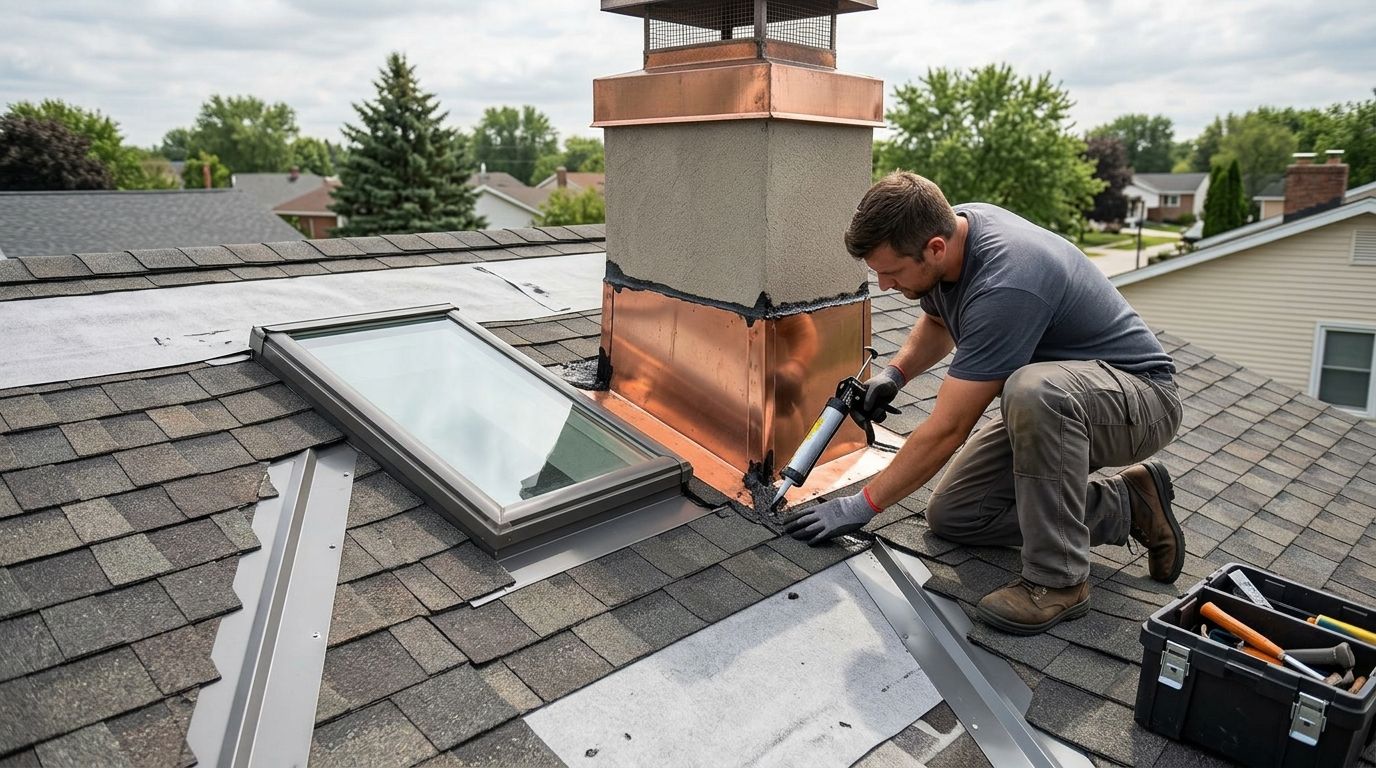
Roof leak repair around chimneys and skylights for Southwest Florida homeowners means finding and sealing the flashing, curb, and underlayment failures that let wind-driven rain into the house at every roof penetration — not just caulking the visible crack. Chimneys and skylights break the roof deck into separate sections, and every seam around them is a spot where a Florida downpour finds a way in. Homes in Cape Coral, Fort Myers, and Naples deal with this more than most regions because the rainy season delivers sideways rain on a near-daily basis from June through September.
Roof leak repair around chimneys and skylights costs less and lasts longer when the flashing and underlayment get fixed, not just the surface crack. If you're seeing a stain on the ceiling below a chimney or skylight, these signs mean your roof needs emergency repair, and waiting through another storm turns a small flashing fix into a deck replacement.
- Roof leak repair around chimneys and skylights starts at the flashing, not the caulk line on top.
- Most leaks near penetrations trace back to cracked step flashing or a failed skylight curb seal, not the shingles.
- DIY sealant buys weeks, not years — flashing and underlayment repair is the fix that holds through a Florida rainy season.
- Roof Smart of SW Florida handles chimney and skylight leak repair for homes in Cape Coral, Fort Myers, and Naples.
Why leak repair at chimneys and skylights matters in SW Florida
Chimneys and skylights sit in the roof plane as separate structures with their own thermal movement, their own flashing systems, and their own failure points. A shingle roof can go 20 years without a leak in the open field and still leak at the chimney within 8 years if the counter-flashing was never cut into the masonry correctly.
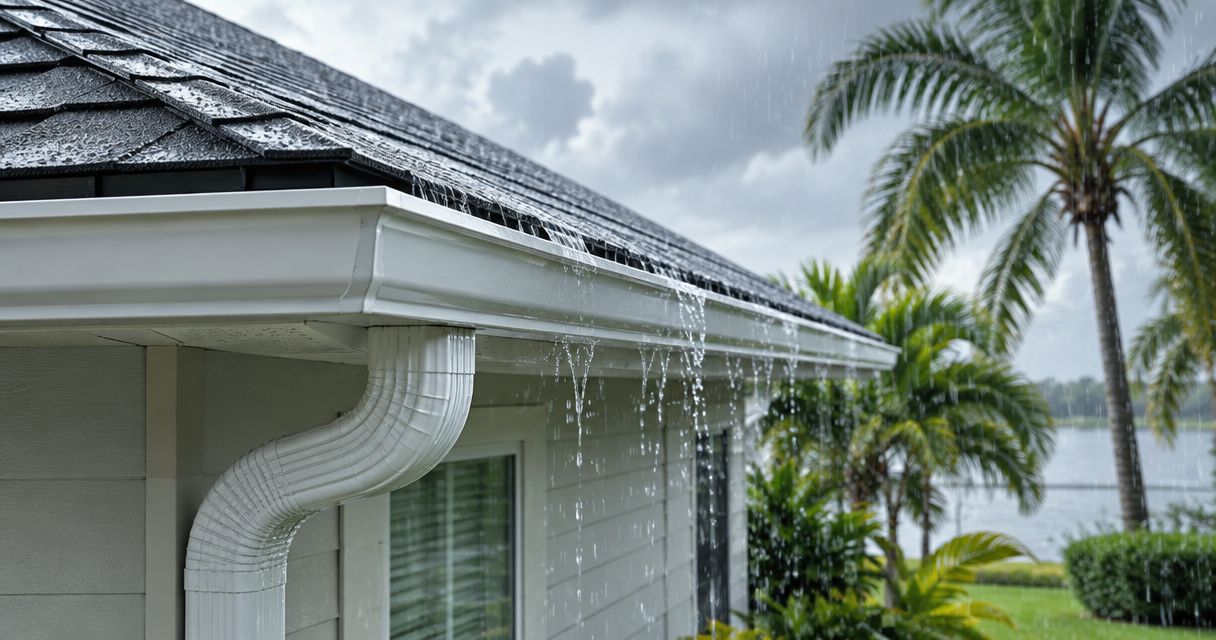
Southwest Florida's rainy season pushes water sideways under gusts that flat flashing details don't always resist. That is why preventing roof leaks during Florida's rainy season means treating penetration flashing as a recurring maintenance item, not a one-time install. A skylight curb sealed properly a decade ago can still fail in 2026 once the sealant dries out and nobody rechecks it.
Humidity compounds it. Water that gets past a cracked flashing joint doesn't drip straight through — it sits in the underlayment and decking, feeding rot long before a homeowner sees a ceiling stain.
How to fix roof leaks around chimneys and skylights
Inspect the flashing before you touch anything else
Most chimney and skylight leaks trace to flashing, not to the roofing material around it. Start here every time.
- Check step flashing on both sides of the chimney for lifted edges or rust-through
- Check counter-flashing where it meets brick or stucco — gaps here send water down the chimney chase
- Check the skylight head flashing on the uphill side for cracked or shrunken sealant
- Look for bare metal or pinholes on any flashing older than 10-12 years
- Check end laps and corners, where two flashing pieces overlap
Trace the water path in the attic, not just the ceiling
A drywall stain rarely sits directly under the actual entry point. Water travels along rafters and sheathing first.
- Go into the attic with a flashlight during or right after rain
- Follow dark streaks along rafters back toward the chimney chase or skylight curb
- Check insulation for compression and dark staining, a sign of a slow ongoing leak
- Note the exact rafter bay so the repair crew finds the entry point from outside without guessing
- Photograph everything — roofers and insurance adjusters both want that record
Check the skylight curb and seal, not just the glass
Skylight leaks get blamed on the glass unit when the real failure is almost always the curb flashing or the sealant around it.
- Inspect the sealant bead around the full skylight frame for cracking and shrinkage
- Check curb height — a curb under 4 inches invites wind-driven rain and ponding
- Look for daylight gaps between the frame and the curb
- Separate condensation trails from true leak trails; they look alike and need different fixes
Repair the underlayment, not just the surface
A tube of roofing cement over a crack buys weeks. A lasting fix means pulling the roofing material back and repairing what sits underneath.
- Pull back roofing material at least 12 inches around the chimney or skylight
- Replace saturated or torn underlayment instead of covering it
- Re-flash with new step and counter-flashing rather than resealing rusted metal
- Use self-adhering underlayment at the penetration for a second line of defense
- Re-lay the roofing material over the new flashing before final sealing
This is where a licensed roofer's work and a homeowner's sealant tube part ways. Roof Smart of SW Florida treats chimney and skylight leak repair as flashing-and-underlayment work on shingle, tile, and metal roofs across Cape Coral, Fort Myers, and Naples — not a surface patch.
Match the repair method to your roof material
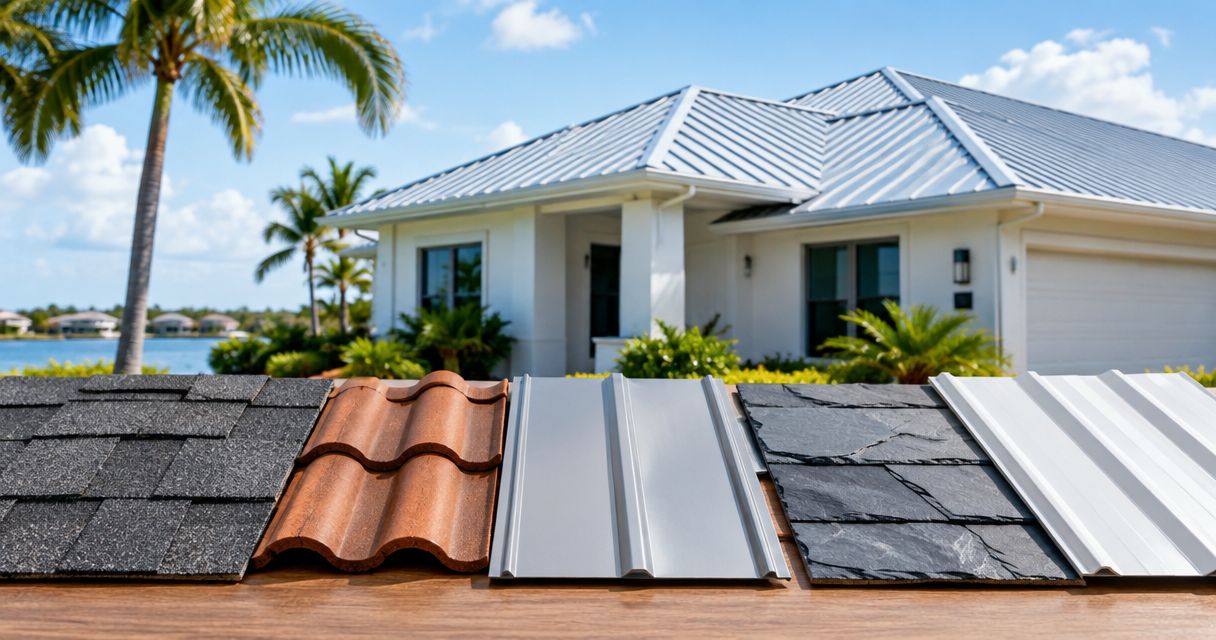
Tile, shingle, and metal roofs flash differently around penetrations, and the wrong method is a common cause of repeat leaks.
- Tile roofs need pliable metal flashing woven under the tile courses, not surface-mounted metal
- Shingle roofs need step flashing woven into each course plus continuous counter-flashing at the chimney
- Metal roofs need boot flashing or custom-formed pieces sealed with butyl tape, not silicone alone
- Low-slope sections beside a chimney often need a fully adhered membrane detail instead of standard flashing
If your home has clay or concrete tile, the sequence for lifting and resetting courses matters as much as the flashing itself — extending the life of a tile roof in SW Florida covers how that material handles repairs.
Test the repair before you call it done
A repair that hasn't been tested under water is a guess.
- Run a hose over the flashing and curb for 15-20 minutes while someone watches the attic
- Recheck after the next real rain event, not only after the hose test
- Recheck sealant lines after a full heat cycle, since Florida temperature swings stress new sealant fast
- Log the repair date so the next inspection has a baseline
Get flashing checked before hurricane season
Chimney and skylight flashing takes the worst of wind-driven rain during named storms. A pre-season check turns an emergency into a scheduled repair.
- Schedule the inspection before June, not after the first named storm
- Ask specifically about chimney counter-flashing and skylight curb condition, since general inspections sometimes skip them
- Get a written estimate that separates flashing repair from deeper deck or underlayment work
- Confirm the contractor's Florida license number before signing
Get your chimney or skylight leak inspected
Free, no-pressure estimate for homes in Cape Coral, Fort Myers, and Naples.
Comparing your options for chimney and skylight leak repair
| Option | Best for | Key limitation |
|---|---|---|
| DIY sealant or roofing cement | A same-day stopgap before rain arrives | Lasts weeks, not years; leaves wet underlayment in place |
| Handyman flashing patch | Minor cosmetic gaps on a newer roof | Usually unlicensed for insurance documentation; no workmanship warranty |
| Licensed leak repair by Roof Smart of SW Florida | Active leaks at chimneys, skylights, and valleys | Requires a scheduled visit instead of an instant fix |
| Full roof replacement | Roofs past 15-20 years with several leak points | Much larger project scope than a targeted repair |
Deciding between a targeted flashing repair and a bigger project comes down to roof age and how many leak points you have. The roof repair vs roof replacement in Florida breakdown sets out the age and damage thresholds that tip a homeowner from one to the other.
“If you can see the crack from the roof surface, you are looking at the symptom — the leak entered under the flashing.”
Common mistakes homeowners make with these leaks
- Sealing the top instead of the source. Caulk over the visible crack ignores water entering from beneath or beside the flashing.
- Ignoring a slow leak because the stain is small. By the time drywall discolors, the underlayment and decking have usually been wet for months.
- Skipping the attic check. Fixing what's visible from the ground without confirming the entry point means the leak returns with the next storm.
- Waiting until after storm season. A roof that looked fine in April fails at the chimney flashing during the first named storm of the 2026 season.
- Assuming a new roof means new flashing. Some re-roof jobs reuse old counter-flashing at the chimney to save labor, which sets up a repeat leak within a few years.
FAQ
What causes most roof leaks around chimneys and skylights?
Cracked or rusted flashing and failed sealant at the curb or counter-flashing cause most of these leaks, not the roofing material itself. Water follows the flashing seam into the underlayment long before it shows as a ceiling stain.
Can I fix a roof leak around a chimney myself?
A sealant patch can stop a leak for a few weeks, but it does not address damaged flashing or wet underlayment underneath. A lasting fix means pulling the roofing material back and re-flashing, which is licensed roofing work.
How much does roof leak repair around a chimney cost in 2026?
Cost depends on how much flashing, underlayment, and decking need replacement and on your roof material. Ask for a written 2026 estimate that separates flashing repair from deeper deck work before you approve a scope.
Is a skylight leak always the skylight's fault?
No. Most skylight leaks come from curb flashing or the sealant bead around the frame rather than the glass unit. A curb under 4 inches tall is especially exposed to wind-driven rain during Florida storms.
How often should chimney and skylight flashing be inspected?
Check flashing at least once a year, ideally before hurricane season begins in June. Roofs past 10-12 years need a closer look because both the metal and the sealant degrade with age.
Does homeowners insurance cover chimney or skylight leak repair?
It depends on cause: storm damage is often covered, while gradual wear on aged flashing usually is not. Document the leak with photos and an inspection report before filing a claim.
What is the difference between step flashing and counter-flashing?
Step flashing is woven into each shingle course along the side of a chimney; counter-flashing is set into the masonry above it to cover the step flashing's top edge. Both must be intact for the joint to shed water.
Should I replace the skylight or only the flashing around it?
If the frame and glass unit are sound, replacing the curb flashing and sealant usually ends the leak. Full skylight replacement makes sense only when the frame is cracked or the internal seal has failed.
One last thing
A chimney or skylight leak that finally shows up as a ceiling stain in 2026 almost always began with a flashing crack that was invisible from the ground a year or two earlier. The lag between flashing failure and visible drywall damage is longer than most homeowners assume — which is exactly why the annual look at flashing beats reacting to the stain.