Gutter installation for waterfront homes on canals in Cape Coral, Fort Myers, and Naples has to account for wind-driven rain, salt air corrosion, and drainage that can't dump straight into a seawall or dock. A standard inland gutter spec will underperform on a canal lot within a season or two.
- Seamless aluminum gutters remain the standard pick for canal-front homes in 2026; copper costs more but resists salt corrosion longer.
- Waterfront lots need tighter hanger spacing than inland homes because wind off open water pushes more volume through the system.
- Downspouts should route away from seawalls, docks, and shoreline plantings to stop erosion and standing water at the foundation.
- Gutter guards cut mangrove and palm debris clogging, a bigger issue on canal lots than on inland properties.
- Roof Smart of SW Florida sizes seamless gutter systems for waterfront wind and rain loads across Cape Coral, Fort Myers, and Naples.
Why gutter installation matters for waterfront and canal-front homes
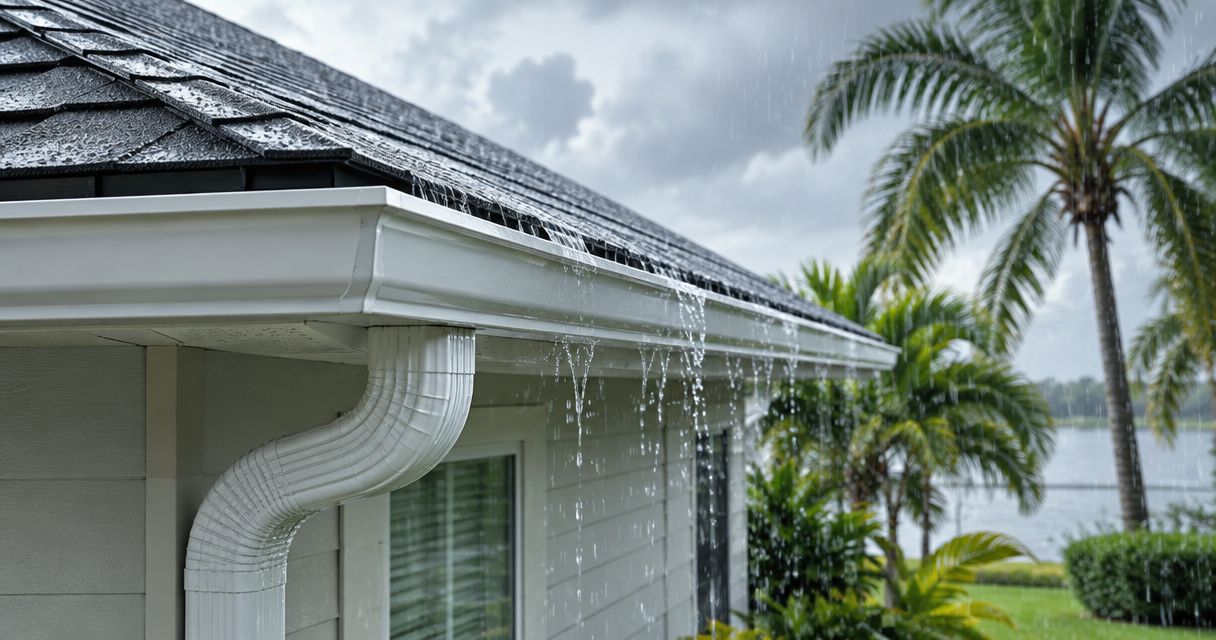
A canal-front roof catches more wind-driven rain than a home a half-mile inland, and that water has to go somewhere fast. Standard 5-inch K-style gutters handle typical residential roof runoff, but many waterfront homes in Southwest Florida are moving to 6-inch systems specifically because storm bands off the Gulf and inland waterways dump rain in short, heavy bursts rather than steady drizzle.
Salt air is the other variable inland gutter specs don't account for. Uncoated steel hangers and screws corrode faster within a few hundred feet of open water than the same hardware on a home set back further from the canal. Roof replacement for waterfront and canal-front homes already factors this into fastener and flashing choices, and gutter installation needs the same logic applied to hangers, end caps, and downspout brackets.
Wind mitigation inspections also touch gutter attachment points indirectly, since inspectors look at how the roof edge and fascia are secured. A gutter system installed with corroding or undersized fasteners can complicate that inspection down the line, even though gutters themselves aren't a wind mitigation line item.
The step-by-step approach
Choose a gutter material rated for salt exposure
Material choice is the first decision, and it's the one homeowners get wrong most often by copying whatever their inland neighbor used.
- Seamless aluminum with marine-grade powder coating handles most canal-front applications and is the standard pick for 2026 installs.
- Seamless copper resists salt corrosion longer than aluminum but costs more and needs fascia reinforced for the added weight.
- Vinyl gutters are not recommended within sight of open water; UV and salt exposure degrade them faster than metal.
- Stainless steel fasteners and hangers, not standard galvanized steel, are worth the upcharge near seawalls and docks.
Size the system for higher rain volume
Canal lots often need a step up from what an inland home the same size would use.
- 6-inch gutters instead of the standard 5-inch size on roofs over roughly 2,000 square feet.
- 3x4-inch downspouts instead of 2x3-inch on runs collecting water off large roof planes.
- One downspout per 30-40 linear feet of gutter run as a general starting point, adjusted for roof pitch.
- Oversized outlets at valleys and low points where water concentrates during heavy bands.
Space hangers for wind-driven rain
Wind coming off open water pushes rain sideways into gutters, not just down, which stresses hangers differently than a sheltered inland roof.
- Hanger spacing of 24 inches instead of the 36-inch spacing common on inland installs.
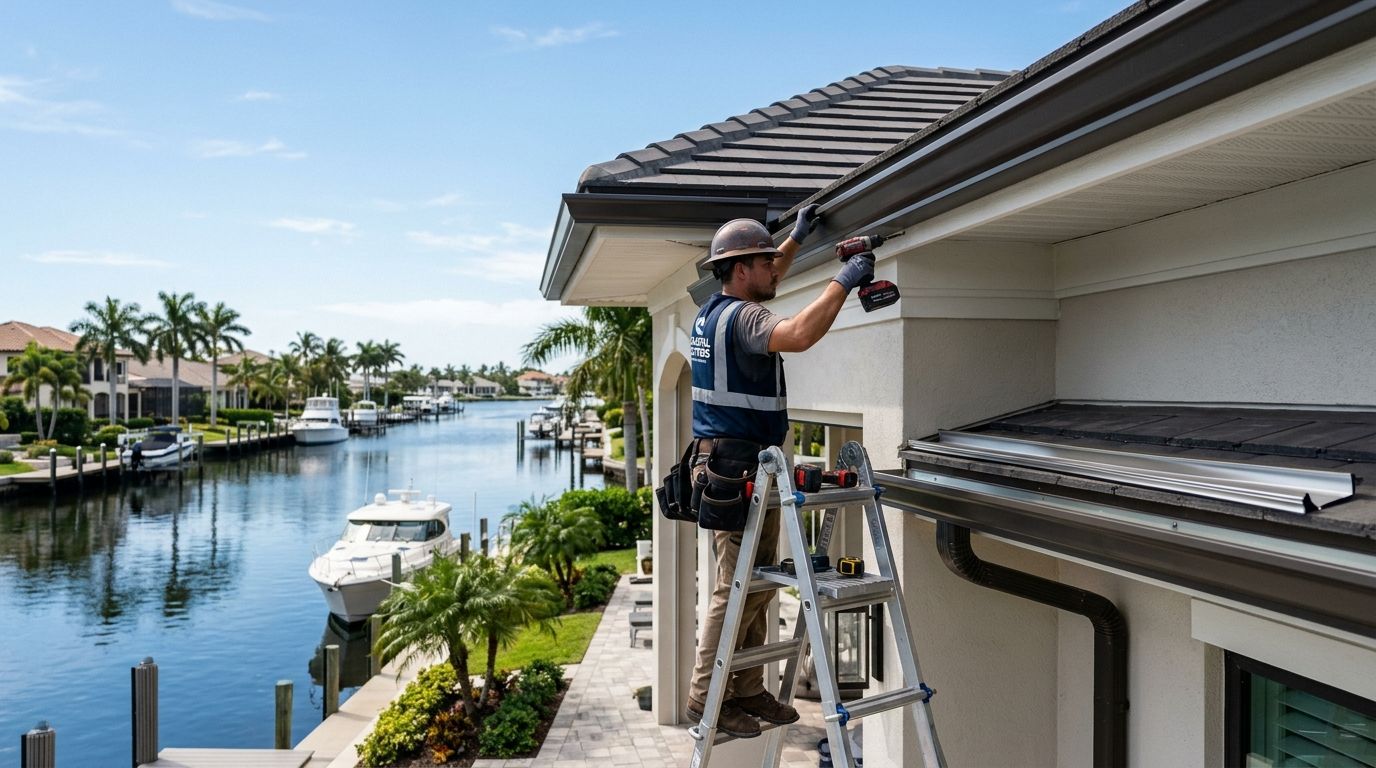
- Hidden hangers screwed into the fascia board rather than spike-and-ferrule systems, which loosen faster under wind load.
- Extra hangers at inside and outside corners where wind uplift concentrates.
- Fascia inspection before installation, since rotted or soft fascia won't hold hangers regardless of spacing.
Route downspouts away from seawalls and docks
Where the water goes after it leaves the gutter matters as much as how it gets collected on a canal lot.
- Extensions or splash blocks that carry discharge at least 4-6 feet from the seawall edge.
- Grading checks to confirm downspout discharge doesn't pool back toward the foundation.
- Avoiding direct discharge onto dock decking or seawall caps, which accelerates erosion underneath.
- Tie-ins to an existing drainage swale where the lot has one, instead of free discharge onto turf.
Add debris protection for mangrove and palm litter
Canal lots near mangrove buffers or heavy palm canopy clog faster than open inland yards. Installing seamless gutters on a Florida home covers the base install; guards are the add-on that keeps it clear between cleanings.
- Micro-mesh guards for fine palm frond debris and seed pods.
- Reverse-curve guards where leaf volume is heavy but debris is larger.
- Guard installation timed with the gutter install itself rather than retrofitted later, which saves a second labor trip.
- Guards checked, not just gutters, during any post-storm inspection.
Match the install to wind mitigation and insurance requirements
Gutters aren't a wind mitigation credit item on their own, but the roof edge work done during gutter installation overlaps with what inspectors document.
- Fascia and drip edge condition noted before gutters go up, since both factor into a wind mitigation inspection for insurance discounts.
- Fastener type and corrosion resistance documented for future insurance renewal inspections.
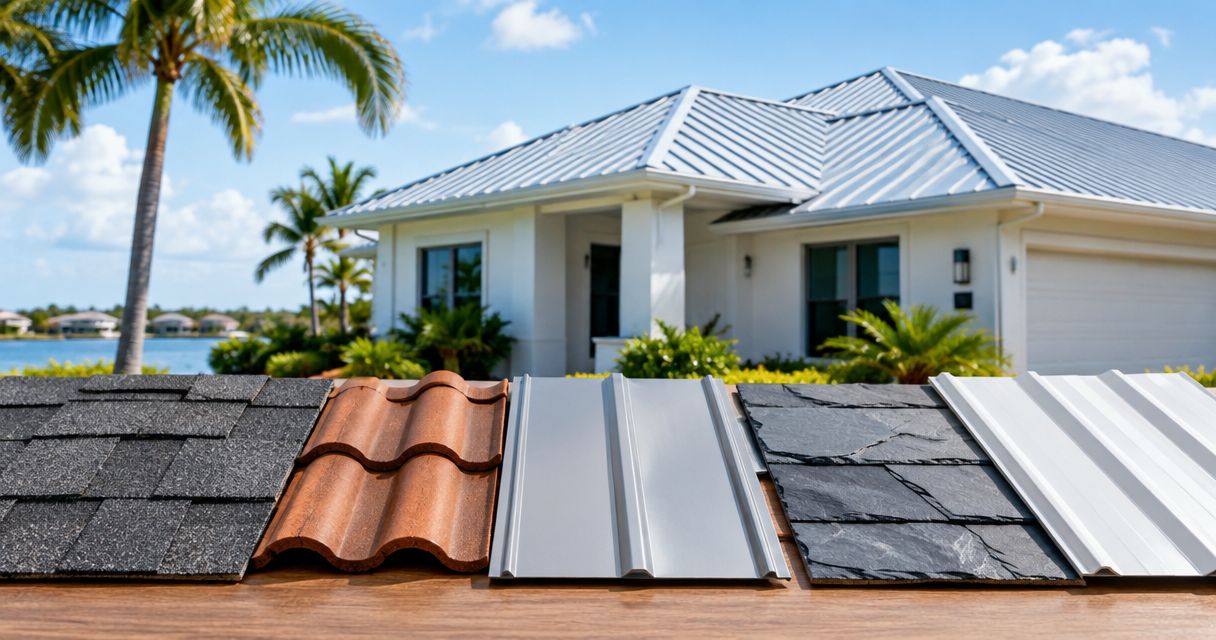
- Coordination with roofing material choice, particularly on homes considering metal roofing for coastal Southwest Florida homes, since metal roof edges attach gutters differently than shingle fascia.
Schedule cleaning ahead of hurricane season
Florida's hurricane season runs June 1 through November 30, and canal-front gutters fill with storm debris faster than inland systems during that stretch.
- Cleaning scheduled in May, before the season's first named storms.
- A second cleaning in late summer if mangrove or palm canopy is heavy.
- Downspout flow tested with a hose after cleaning, not just a visual check of the gutter trough.
- Guard systems inspected for mesh damage after any named storm passes through the area.
Comparing gutter options for waterfront homes
| Option | Best for | Key limitation |
|---|---|---|
| Seamless aluminum gutters | Most canal-front homes in 2026 | Powder coating can chip in salt spray over time and needs recoating |
| Seamless copper gutters | Long-term coastal exposure, upscale finishes | Added weight requires reinforced fascia and hangers |
| Gutter guards (mesh or reverse-curve) | Homes near mangrove canopy or heavy palms | Doesn't stop fine sand or grit blown off open water |
| Box gutters | Larger canal-front roofs with high runoff volume | Custom fabrication extends install time |
Seamless aluminum is the practical buy for most canal-front homes in 2026. Copper is a hold for homeowners planning to stay long-term and willing to pay more upfront for corrosion resistance. Box gutters are a consider only on larger roof planes where standard K-style sizing can't keep up.
Common mistakes on waterfront gutter installations
- Using inland sizing specs on a canal lot that actually needs 6-inch gutters and larger downspouts.
- Skipping guards near mangrove buffers, leading to overflow before the first named storm of the season.
- Aiming downspout discharge straight at a seawall cap or dock, which erodes the base underneath over a few seasons.
- Sticking with galvanized steel fasteners instead of stainless near open water, cutting hardware life significantly.
- Treating gutter cleaning as a one-time spring job instead of a pre- and mid-season routine.
Get a gutter estimate for your waterfront home
Free, no-pressure evaluation for canal-front and coastal properties.
FAQ
What's the best gutter material for waterfront homes in Florida?
Seamless aluminum with marine-grade coating is the standard choice for canal-front homes in 2026. Seamless copper resists salt corrosion longer but costs more and needs reinforced fascia to carry the added weight.
Is gutter installation different for canal-front homes than inland homes?
Yes. Canal-front homes typically need 6-inch gutters instead of 5-inch, tighter hanger spacing, and downspout routing that avoids seawalls and docks.
How often should gutters be cleaned on a waterfront property?
Twice a year at minimum, once in May before hurricane season starts June 1 and again in late summer if mangrove or palm debris is heavy.
Do gutter guards help on canal-front lots with mangroves or palms?
Micro-mesh or reverse-curve guards cut down on frond and seed pod clogging significantly, though they don't stop fine sand blown off open water.
Does gutter installation affect a wind mitigation inspection?
Gutters aren't a wind mitigation credit item themselves, but the fascia and drip edge work done during installation overlaps with what inspectors document for insurance discounts.
How much rain do gutters on waterfront homes in SW Florida need to handle?
Wind-driven rain off open water pushes more volume through gutters in short bursts than steady inland rainfall, which is why many canal-front homes upgrade to 6-inch systems.
Can seamless gutters be installed on tile roofs near the water?
Yes, seamless gutters attach to tile roof fascia the same way they do on shingle roofs, with hanger spacing adjusted for wind exposure near the canal.
What's the biggest mistake homeowners make with gutters on canal-front homes?
Using inland-spec sizing and standard galvanized hardware instead of the larger downspouts and corrosion-resistant fasteners a canal lot actually needs.
One last thing
Salt spray corrodes uncoated steel hangers faster within a few hundred feet of a canal than the same hardware on a home set back even a half-mile inland, which is why hanger material matters as much as gutter material on waterfront installs in 2026. Homeowners who upgrade the gutter trough but skip the hardware upgrade often end up replacing hangers years before the gutters themselves fail.