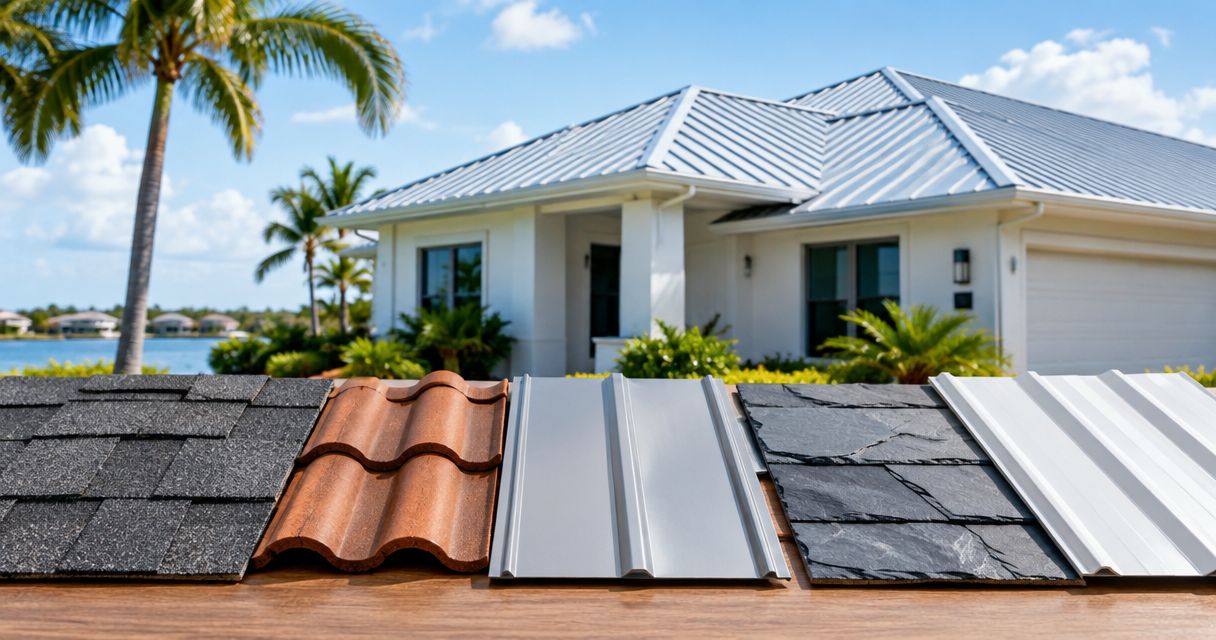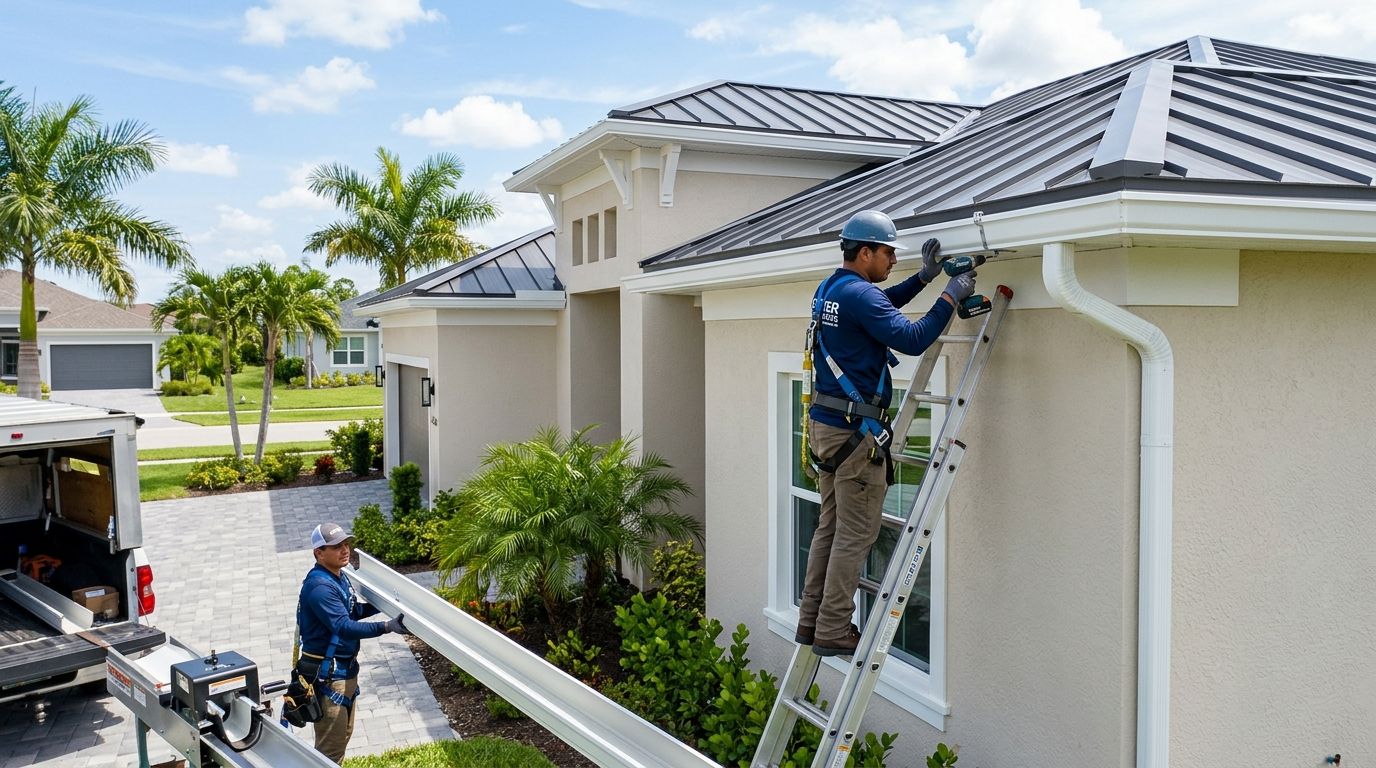
New construction gutter installation is the process of fitting seamless aluminum gutters and downspouts onto a freshly built home before final landscaping, sized and placed to handle Southwest Florida's rain volume and wind exposure. Builders in Cape Coral, Fort Myers, and Naples treat this step differently than a retrofit: gutters go up while fascia is still exposed, before sod and driveways lock in the grading, and often before the homeowner has moved in to notice a problem.
- Seamless aluminum gutters installed during dry-in, not after landscaping, is the standard for gutter installation for new construction homes in SW Florida in 2026.
- SW Florida averages roughly 53 inches of rain a year, so 5-inch K-style gutters undersize fast on long fascia runs.
- Gutter guards installed before landscaping cost less in labor than retrofitting them after sod, pavers, and pool cages go in.
- Timing gutters with the roofer's schedule, not a separate contractor, avoids fascia damage on brand-new trim.
Why gutter installation matters for new construction homes
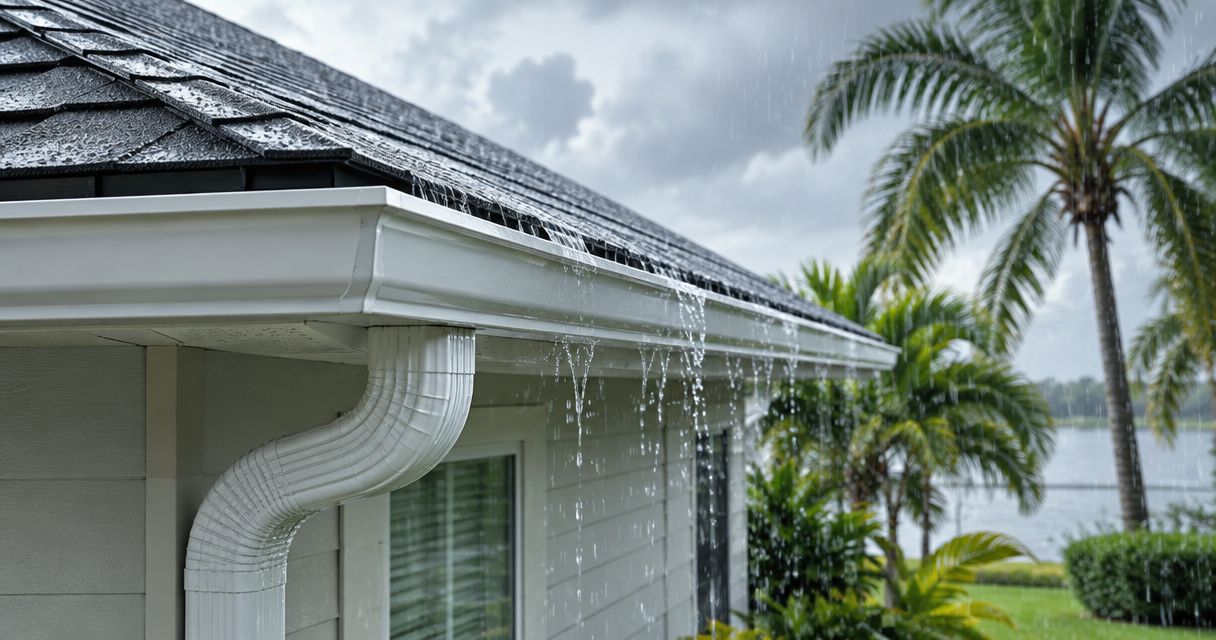
A new-build roof without gutters dumps water straight onto fresh sod, foundation edges, and pool cage footers. In SW Florida, where afternoon storms from June through September can drop an inch of rain in under 30 minutes, that runoff erodes new landscaping and pushes water toward the slab faster than older homes with settled grading ever see.
Builders and homeowners searching for new construction and spec home roofing usually ask about gutters in the same breath as the roof itself, because both jobs share scaffolding, fascia access, and inspection windows. Getting gutter installation for new construction homes right the first time means fewer callbacks after the homeowner moves in and notices water staining the stucco.
Roof Smart of SW Florida treats gutters as part of the roof package on new builds, not an afterthought bolted on after closing. That sequencing is the difference between a clean install and a rushed one.
Time gutter installation with roof dry-in, not after final CO
Gutters mounted after the certificate of occupancy is issued often mean drilling into finished stucco, moving pool cage screens, or working around irrigation heads that weren't there during framing.
- Schedule gutters right after roof dry-in, while fascia boards are still exposed and unpainted
- Coordinate with the framer on fascia board thickness before gutter hangers get ordered
- Confirm downspout locations before driveway pavers and irrigation lines are set
- Avoid working around finished landscaping, which adds labor hours and risk of plant damage
Size gutters and downspouts for Florida rain intensity, not national averages
Standard 5-inch K-style gutters are the residential default nationwide, but SW Florida's rain intensity during named storms and summer squalls pushes past what a single downspout on a 40-foot fascia run can clear.
- Use 6-inch K-style gutters on rooflines over 2,500 square feet or with long, unbroken fascia runs
- Add a downspout every 35-40 feet of gutter run, not the older 40-50 foot rule of thumb
- Oversize downspouts to 3×4 inches on high-pitch tile roofs where water sheets off faster
- Check that downspout outlets tie into a drainage plan, not just a splash block on new sod
Match fascia and drip edge details before gutters go on
Gutters hang off the fascia board and drip edge, so any gap in that detail shows up as a leak or a sag within the first year.
- Confirm drip edge extends past the fascia by at least a half inch before hangers go on
- Check fascia board is solid wood or properly wrapped composite, not bare OSB
- Verify roof-to-gutter pitch sends water into the trough, not behind it
- Flag any fascia rot or misalignment to the roofer before gutter crews show up
Choose seamless aluminum over sectional for new builds
Seamless aluminum is the standard material for seamless gutter installation on new Florida homes because it's formed on-site to the exact fascia length, cutting the number of seams that fail first during a heavy downpour.
- Seamless aluminum: fewer joints, lower long-term leak risk, standard choice for most new builds
- Sectional vinyl: lower upfront labor but seams are the first failure point in heavy rain
- Copper: highest material cost, best fit for custom waterfront or Mediterranean-style homes
- Match gutter color to fascia or trim during the same site visit that finalizes the roof color
Add gutter guards before landscaping locks in, not after
Retrofitting gutter guards for storm season after sod, pool screens, and mature landscaping are installed costs more in labor because crews have to protect finished work while they climb.
- Install guards during the same site visit as gutters, before scaffolding comes down
- Prioritize guards on homes near oaks, palms, or canal-front foliage that drop debris year-round
- Skip guards on homes with minimal tree cover if budget is the deciding factor
- Plan for guards on any home going up near a golf course or preserve lot with heavy leaf drop
Verify hanger spacing for wind load, not just gravity
A gutter that survives gravity fine can still peel off in a 60 mph gust if hangers are spaced too far apart, which matters for wind mitigation documentation on new builds.
- Space hidden hangers no more than 24 inches apart on new installs
- Tighten spacing to 16 inches on corners and downspout transitions
- Use stainless or aluminum fasteners, never galvanized, to avoid rust streaks on new stucco
- Ask whether gutter attachment method affects wind mitigation inspection paperwork
Schedule a final walk-through before landscaping crews arrive
Once sod, irrigation, and driveways are in, fixing a slope problem means protecting finished work instead of just adjusting a hanger.
- Run a hose test on every downspout before the final CO walk-through
- Check for standing water in the trough, a sign of reverse pitch
- Confirm downspout discharge doesn't point at the foundation or a neighbor's lot line
- Photograph gutter attachment points for the builder's punch list before drywall inspection closes out
Gutter options for new construction homes compared
| Option | Best for | Key limitation |
|---|---|---|
| Seamless aluminum gutters | Most new construction homes in SW Florida | Requires on-site roll-forming equipment during install |
| Sectional vinyl gutters | Budget builds, smaller footprints | Seams leak first under heavy summer downpours |
| Copper gutters | Custom waterfront or Mediterranean-style homes | Highest material cost, requires specialized soldering |
| Gutter guards (add-on) | New builds near canals, oaks, or preserve lots | Adds labor cost, doesn't fix bad slope or hanger spacing |
Verdict: seamless aluminum gutters, sized to 6 inches on long fascia runs and paired with guards on tree-heavy lots, is the right call for most new construction homes in SW Florida in 2026.
Common mistakes on new construction gutter installs
- Installing gutters before final grading is confirmed — water pools at the foundation instead of draining away
- Waiting until after landscaping to add gutter guards — labor costs climb once crews have to protect finished sod and pavers
- Using one downspout on a 50-foot fascia run — the gutter overflows during a fast summer storm
- Treating gutters as a separate trade from the roof — fascia gets damaged when two crews aren't coordinated
- Skipping the hose test before final walk-through — reverse pitch and hanger gaps get discovered by the homeowner instead of the builder
Get gutters locked into the build schedule
Free evaluation for new construction homes in Cape Coral, Fort Myers, and Naples.
FAQ
What's the best gutter type for new construction homes in SW Florida?
Seamless aluminum K-style gutters are the standard choice for new construction homes in SW Florida in 2026 because they're formed on-site with fewer seams to fail. Copper is an option for high-end custom builds, and vinyl sectional is a lower-cost fallback for budget projects.
Is gutter installation included in a new roof for new construction?
Gutter installation is usually scoped separately from the roof itself but scheduled at the same time, right after dry-in. Coordinating both with one contractor avoids fascia damage between trades.
How much rain do SW Florida gutters need to handle?
SW Florida averages around 53 inches of rain a year, with the bulk falling June through September in short, heavy bursts. That volume is why 6-inch gutters and a downspout every 35-40 feet outperform the national 5-inch, 40-50 foot standard.
Should new construction homes get gutter guards immediately installed?
Yes, if the lot has mature trees, canal-front foliage, or is near a golf course or preserve. Installing guards during the same visit as the gutters is cheaper than retrofitting after landscaping is finished.
How long does gutter installation take on a new home?
A single-family new build typically takes one day for seamless aluminum gutter installation once fascia is ready, though larger homes with multiple rooflines can run longer. Scheduling around the roofer's dry-in timeline keeps it from becoming a bottleneck.
Do new construction homes need gutters for wind mitigation credits?
Gutters themselves aren't a wind mitigation credit item, but hanger spacing and attachment method can come up during a wind mitigation inspection. Confirming attachment details during install avoids a re-inspection later.
Can gutters be installed before the roof is completely finished?
Gutters go up after dry-in and drip edge are set but don't require the full roof system to be complete. Waiting until after final CO instead means drilling into finished stucco and working around landscaping.
What's the difference between seamless and sectional gutters?
Seamless gutters are formed on-site to the exact fascia length, cutting the number of joints to almost none. Sectional gutters use pre-cut pieces joined with seams, which are the first point of failure during a heavy Florida downpour.
One last thing
Most new-build punch lists check the roof and skip the hose test on gutters entirely. Running water through every downspout before the final walk-through catches reverse pitch and undersized runs while the crew is still on-site and it costs nothing to fix at that stage.