Florida storm season turns clogged gutters into a roof problem fast — standing water backs up under shingles, soffits rot, and foundation soil erodes within a single wet season. This guide ranks the best gutter guards for Florida storms by how they hold up against wind-driven rain, palm debris, and the sand-fine grit that clogs mesh in Cape Coral, Fort Myers, and Naples.
- Stainless steel micro-mesh guards are the top pick for Florida storms — they block sand-fine debris that clogs standard screens.
- Reverse curve (hooded) guards handle the heaviest downpours without overflow, a must for SW Florida's summer deluges.
- Foam insert guards are the budget option but degrade faster in year-round UV and humidity — Consider, not Buy.
- Bottle-brush guards rank last for Florida homes — they trap oak and palm debris instead of shedding it.
- Pairing gutter guards with a wind mitigation inspection can support Florida homeowners insurance discounts.
Why this matters
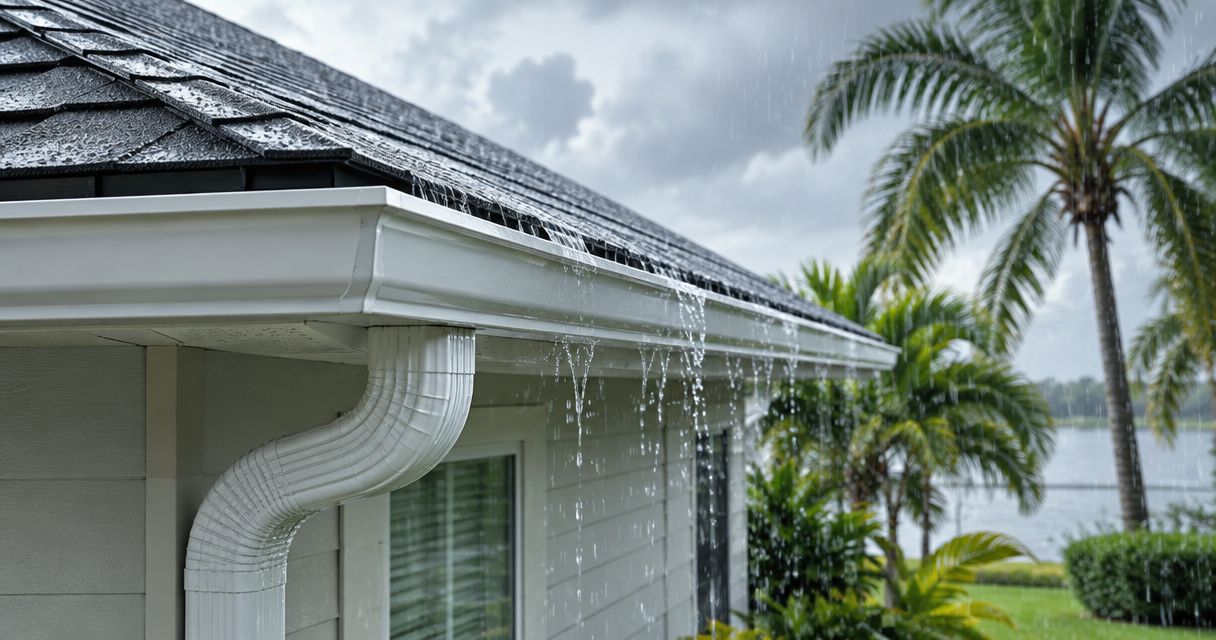
A clogged gutter during a Southwest Florida downpour doesn't just overflow — it pushes water back under the drip edge, and over a full 2026 storm season that repeated soaking rots fascia boards and invites carpenter ants. Homeowners in Cape Coral and Fort Myers deal with a second problem most of the country doesn't: fine sand and shell dust from coastal winds that clog standard screen guards within a season.
Roof Smart of SW Florida sees the same failure pattern every hurricane season: gutter guards rated for northern leaf debris fail on Florida roofs because the debris here is different — palm fronds, seed pods, and grit, not just oak leaves. The picks below are ranked for that reality, not a generic national buying guide.
How this list was ranked
Each gutter guard type below is scored on four factors that matter specifically for Florida: debris shedding in high wind, flow rate during heavy downpour, material durability under year-round UV and humidity, and maintenance frequency. Types that perform well in cooler, drier climates but clog or degrade in Gulf Coast conditions get marked down even if they're popular nationally. This isn't a manufacturer-sponsored ranking — it reflects install and service patterns Roof Smart tracks across Cape Coral, Fort Myers, and Naples roofs.
The ranked list
1. Stainless steel micro-mesh guards — the storm-season workhorse
Micro-mesh guards use a fine stainless steel screen bonded to a rigid frame that mounts under the shingle course. The mesh openings are small enough to stop sand-fine grit and seed pods while still letting rainwater through during a downpour.
Stainless steel resists the salt-air corrosion that eats through cheaper aluminum mesh within a few storm seasons along the coast. Maintenance drops to roughly once a year for most Cape Coral and Naples homes instead of the quarterly cleanouts open gutters need. Verdict: Buy — this is the top pick for gutter guards for Cape Coral homes facing salt air and storm debris together.
2. Reverse curve (hooded) guards — the high-volume pick
Reverse curve guards use surface tension to pull water around a curved nose and down into the gutter channel, while debris slides off the front edge. They're built for volume — the design was originally engineered for commercial roofs shedding heavy rainfall fast.
That makes them a strong match for Southwest Florida's summer thunderstorm pattern, where two inches of rain can fall in under an hour. The tradeoff is a higher upfront install cost and a look some homeowners find bulkier than mesh. Verdict: Buy for high-rainfall properties, Consider for homes prioritizing a lower profile.
3. Perforated aluminum guards — the mid-range balance
Perforated aluminum panels sit somewhere between micro-mesh and reverse curve — solid aluminum sheets punched with small holes across the surface. They're lighter than steel mesh and cost less to install across a full roofline.
The holes are larger than micro-mesh, so fine sand and small seed debris can work through over a few storm seasons, especially on homes near live oaks or Australian pines. Fort Myers homes with heavy tree cover should expect biannual cleaning even with these installed. Verdict: Consider — solid for moderate debris, not the top choice near heavy tree canopy.
4. Foam insert guards — the budget option
Foam inserts are triangular foam strips wedged into the gutter channel, letting water soak through while blocking larger debris on top. They're the cheapest option to buy and the easiest to install without a contractor.
Florida's UV exposure and humidity break down foam faster than in drier climates — the foam can degrade, sag, and start holding standing water instead of shedding it within a couple of storm seasons. That standing water becomes a mosquito breeding spot during the wet season. Verdict: Skip for full-time Florida homes; Consider only for seasonal or rental properties on a tight budget.
5. Bottle-brush guards — the one to pass on
Bottle-brush guards are cylindrical bristle inserts that sit inside the gutter, letting water flow between the bristles while catching debris on top. They're inexpensive and require no fasteners, which is their main appeal.
The bristle design traps rather than sheds — palm fronds, seed pods, and pine needles common across Fort Myers and Naples get caught and mat down over a single wet season, forcing more manual cleanouts than an open gutter would need. Verdict: Skip for Florida storm exposure.
Comparison table
| Guard type | Best for | Debris shedding | Maintenance | Verdict |
|---|---|---|---|---|
| Stainless micro-mesh | Coastal, sandy debris | Excellent | ~1x/year | Buy |
| Reverse curve/hooded | Heavy downpour volume | Very good | ~1-2x/year | Buy |
| Perforated aluminum | Moderate tree cover | Good | 2x/year | Consider |
| Foam inserts | Seasonal/rental use | Fair | 2-3x/year | Skip (full-time homes) |
| Bottle-brush | Low-budget, low-debris | Poor | 3-4x/year | Skip |
Where to source and install gutter guards in Florida
- Match the guard to your gutter system, not the other way around. Gutter guards installed on undersized or poorly pitched gutters will overflow in a downpour regardless of guard type — get the gutter run itself checked first. Homeowners planning a new gutter system should review how to install seamless gutters on a Florida home before choosing a guard.
- Get guards installed by a roofing contractor, not a gutter-only installer, when the fascia or drip edge shows wear. A roofer catches rot or flashing issues a gutter installer isn't licensed to flag.
- Time the install before June. Getting guards on before the start of the 2026 Atlantic hurricane season means one less thing to check when a named storm is 72 hours out.
Get a free gutter guard evaluation
No-pressure estimate for Cape Coral, Fort Myers, and Naples homes.
What to avoid
- Guards sold as "universal fit" without a Florida-specific debris rating — most are engineered and tested for northern leaf loads, not sand grit and palm debris.
- DIY foam or brush inserts on a home with active roof leaks — the guard won't fix a drainage problem, and trapped moisture under a bad drip edge gets worse, not better.
- Any guard install that skips checking your existing flashing — a gutter guard bolted over failing drip edge just hides the leak point until the next storm.
FAQ
What are the best gutter guards for Florida storms?
Stainless steel micro-mesh guards rank highest for Florida storms in 2026 because they block sand-fine debris and resist salt-air corrosion. Reverse curve guards are the runner-up for homes that need to handle very high rainfall volume.
Do gutter guards stop hurricane damage?
Gutter guards reduce clogging and overflow during heavy rain but don't prevent wind damage to the gutter system itself. Wind mitigation features on the roof, not the gutters, are what insurers evaluate for storm-related discounts.
Are foam gutter guards good for Florida homes?
Foam gutter guards are a budget option but degrade faster than mesh or aluminum under Florida's year-round UV and humidity. They work better for seasonal or rental properties than full-time Southwest Florida homes.
How often do gutter guards need cleaning in Florida?
Stainless micro-mesh guards typically need cleaning about once a year in Cape Coral and Naples, while bottle-brush or foam guards can need attention three to four times a year near heavy tree cover.
Can gutter guards affect my homeowners insurance?
Gutter guards themselves aren't part of Florida's wind mitigation credit, but a wind mitigation inspection covering the full roof system can support insurance discounts. Ask about a wind mitigation inspection for homeowners insurance discounts alongside any gutter work.
Do gutter guards work with tile roofs?
Most gutter guard types install under the drip edge regardless of roof covering, including tile, metal, or shingle. The mounting method changes slightly by roof type, so confirm compatibility with your installer before ordering.
What's the difference between micro-mesh and reverse curve gutter guards?
Micro-mesh uses a fine screen to filter out small debris while reverse curve guards use a curved surface to shed debris off the front edge entirely. Micro-mesh wins on filtering sand and grit; reverse curve wins on raw rainfall volume.
Should I install gutter guards before hurricane season?
Yes — getting gutter guards installed before June 1, the start of the Atlantic hurricane season, means one less pre-storm task when a named system approaches. Installers also see fewer scheduling delays outside peak storm-prep weeks.
One last thing
The guard material matters less than most homeowners assume — the bigger factor across Fort Myers and Cape Coral homes is whether the gutter system was pitched correctly to begin with. A perfect micro-mesh guard on a flat-pitched gutter still overflows in a downpour; fixing the pitch before adding any guard solves more storm-season headaches than the guard itself.