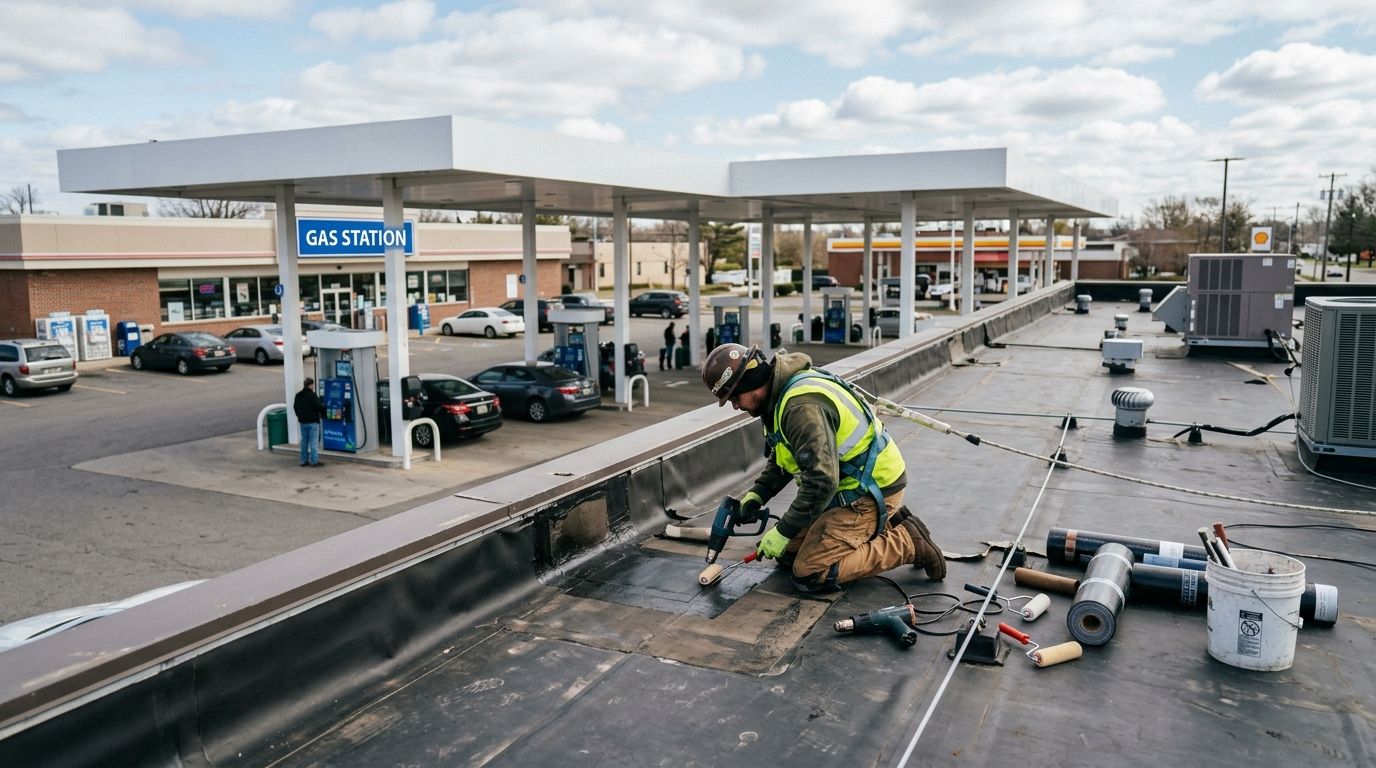
Flat roof repair for gas stations and convenience stores is the process of patching, coating, or replacing a low-slope membrane over a retail building or fuel canopy so the roof stops leaking without shutting down pumps, registers, or the walk-in cooler. Gas stations run 24/7, sit next to fuel vapor and grease exhaust, and often have two separate roof systems — the store and the canopy — that fail on different timelines. A repair plan built for a house doesn't hold up here; a plan built for this segment has to account for downtime, fire code, and insurance documentation.
- Flat roof repair for gas stations must treat the canopy and the store roof as two separate systems with different failure points.
- TPO and modified bitumen membranes near fryers and fuel islands degrade faster from grease and vapor exposure than standard commercial roofs.
- Roof Smart of SW Florida schedules gas station and convenience store repairs around operating hours so pumps and registers stay open.
- Spot repair works for isolated leaks under 100 square feet; anything wider calls for a full membrane or coating assessment.
- Skipping documentation on a gas station roof repair is the fastest way to lose a fuel-line insurance claim later.
Why flat roof repair matters for gas stations and convenience stores
A convenience store roof leak doesn't just mean a wet ceiling tile. It means water over the register, over packaged food inventory, or dripping near an electrical panel a few feet from a fuel shutoff. Insurance carriers that cover fuel-adjacent commercial property look hard at roof maintenance records after a claim, and a station with no documented flat roof repair for commercial buildings history is a harder sell for a fast payout in 2026.
Canopy roofs add a second problem most retail buildings don't have. The canopy over the pumps is structurally separate from the store, usually a standing-seam metal or single-ply system bolted to steel columns, and it takes direct wind load with almost nothing to break the gusts. Southwest Florida's storm season means a canopy repair delayed past spring can turn into an emergency call in August 2026.
How to handle flat roof repair for gas stations and convenience stores
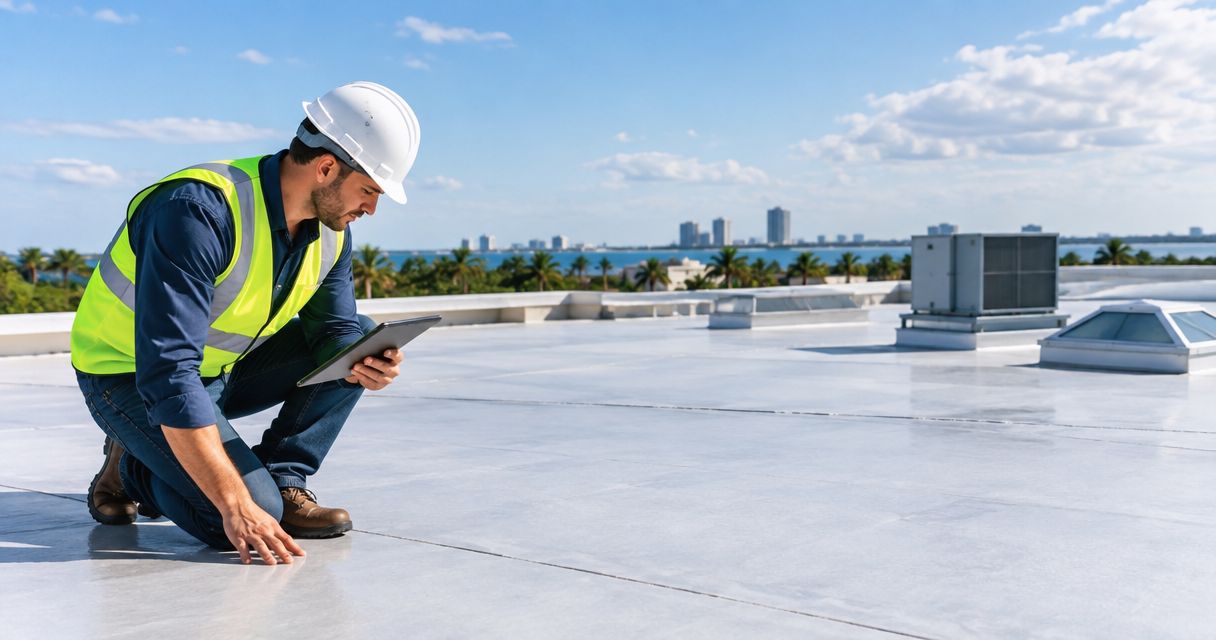
Inspect penetrations and canopy seams first
Most leaks on this building type start at a penetration, not the open field of the membrane. HVAC curbs, exhaust vents from the food-service area, and canopy light fixtures are the highest-failure points on a gas station roof.
- Check pipe boot seals around vent stacks for cracking or shrinkage
- Inspect HVAC curb flashing where rooftop units sit
- Look at canopy fascia seams for separation after wind events
- Confirm exhaust hood penetrations from any food-prep area are properly sealed, not just caulked
Check drainage and ponding water
Flat roofs on gas stations often have less slope than they should because canopy structures and rooftop equipment were added after the original roof went in. Standing water that sits more than 48 hours accelerates membrane breakdown and voids most manufacturer warranties.
- Walk the roof after a rain event to mark standing water locations
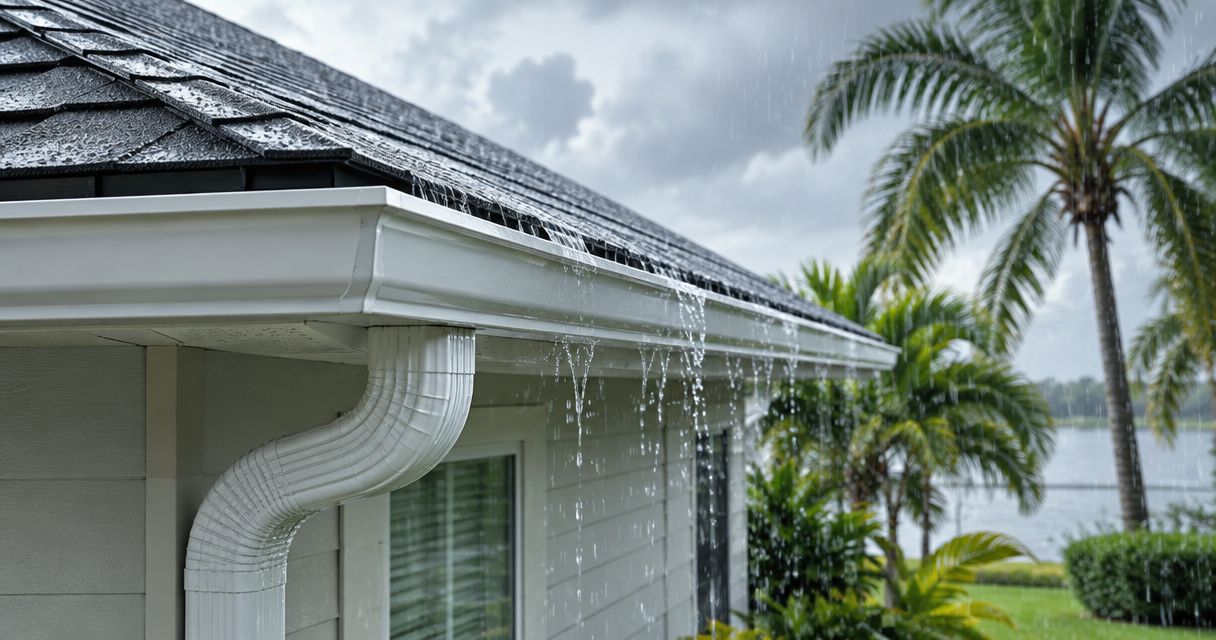
- Check scupper drains and gutter outlets for debris blockage
- Look for reverse slope near HVAC curbs or added equipment pads
- Note any area where ponding recurs in the same spot after every rain
Test the membrane for wear specific to fuel and grease exposure
Grease vapor from a food-service counter and fuel vapor near the canopy both attack membrane surfaces faster than plain weather exposure. A membrane that looks fine from the ground can be brittle or delaminating up close.
- Check for granule loss on modified bitumen sections
- Press-test TPO or PVC seams for adhesion failure
- Look for discoloration or softening near exhaust fan outlets
- Check metal canopy panels for coating breakdown from fuel vapor exposure
Schedule repairs around operating hours
A gas station cannot close for a roof job the way an office building can. Repair sequencing matters as much as the repair itself.
- Confirm the crew can work the canopy section without blocking fuel islands
- Schedule membrane work over the store in early morning or overnight hours at 24-hour locations
- Section off repair zones so at least half the pump islands stay operational
- Coordinate with the fire marshal or local code office if welding or torch-applied materials are involved
Choose spot repair, coating, or full replacement based on scope
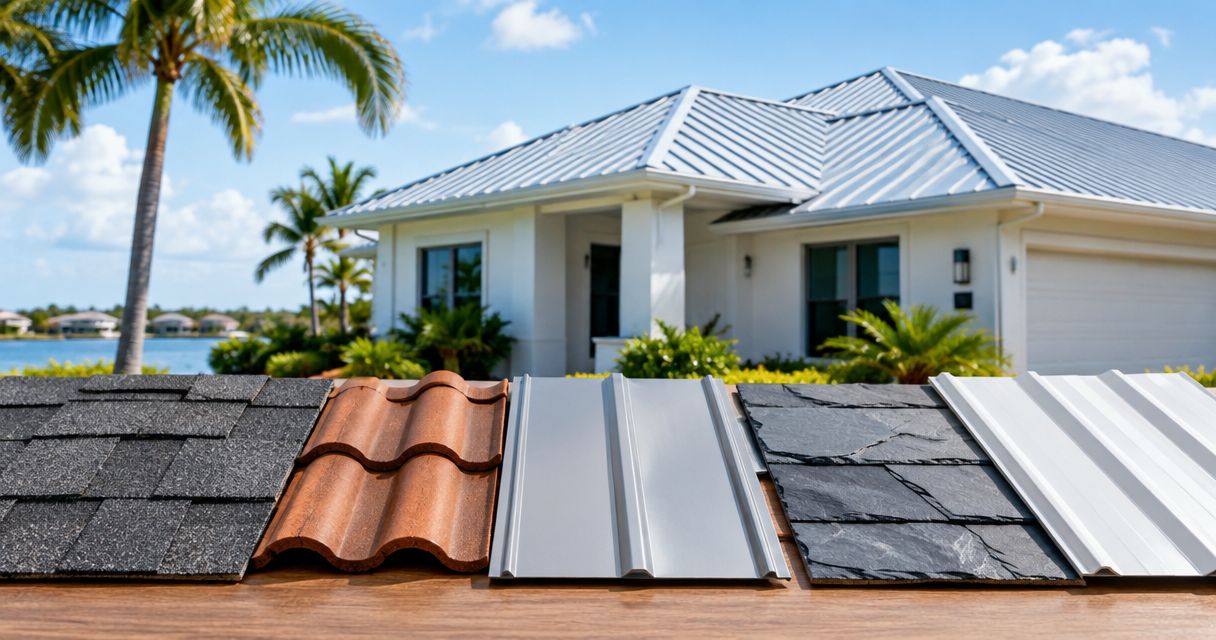
A licensed roofer scopes the damage before recommending a fix — patch, coat, or replace. Spot repair covers isolated leaks under roughly 100 square feet with sound membrane around them. A roof coating for commercial flat roofs extends the life of a membrane that's aging but not failing across the field. Full replacement is the call once ponding, granule loss, and seam failure show up together in multiple zones.
- Get a written scope that separates canopy work from store roof work
- Ask whether the coating option carries a warranty covering this site type
- Confirm the existing membrane is compatible with the proposed coating chemistry
- Request photos of every penetration before and after the repair for your insurance file
File documentation for insurance and warranty purposes
Gas stations carry higher-liability insurance than a standard retail box because of the fuel storage on site. A repair with no paper trail is a weak position if a claim ever comes up.
- Keep dated photos of every repair, not just the invoice
- Request a written scope of work with material specifications
- Save manufacturer warranty documentation for any coating or membrane installed
- File a copy with your property manager or insurance broker the same month the work is done
Set a recurring inspection cadence
A one-time repair without a follow-up plan is how small leaks turn into ceiling damage over a register. Convenience stores that inspect twice a year catch problems before they become emergencies.
- Inspect before hurricane season, typically April or May
- Inspect again after the wettest months, typically October
- Check canopy bolts and fascia seams at each visit, not just the store roof
- Log every inspection so a pattern of recurring issues shows up over time
Get a flat roof estimate before storm season
Free, no-pressure evaluation for gas stations and convenience stores across SW Florida.
Comparison of flat roof repair options for gas stations
| Option | Best for | Key limitation |
|---|---|---|
| Spot repair | Isolated leak under roughly 100 sq ft with sound surrounding membrane | Doesn't address widespread granule loss or ponding elsewhere on the roof |
| Silicone or acrylic coating | Aging membrane that's intact but showing UV or vapor wear | Won't fix structural leaks or areas already damaged by standing water |
| Modified bitumen replacement | Store roofs needing a durable torch- or cold-applied system | Torch-applied work near fuel islands requires added fire code coordination |
| TPO or PVC single-ply replacement | Canopy roofs and stores wanting a lighter, seam-welded system | Higher labor to weld seams correctly around dense penetrations |
| Full tear-off and rebuild | Roofs failing across multiple zones — ponding, seams, and membrane wear together | Longest timeline, so downtime planning matters most here |
The honest trade-off: coating is the cheapest path and the most oversold one. It buys years on a sound membrane and buys nothing on a saturated one.
Common mistakes gas stations make with flat roof repair
- Treating the canopy and the store as one roof. They're built differently, fail differently, and need separate attention on the same visit.
- Patching over grease-contaminated membrane. A patch won't adhere to a surface with residual grease film, and the repair fails within months.
- Delaying repair to avoid shutting down pumps. A scheduled half-day repair costs far less than an emergency call after water reaches an electrical panel.
- Skipping fire marshal coordination for torch-applied work. Modified bitumen installs near fuel islands can trigger a stop-work order if code isn't cleared first.
- No photo documentation before the repair. Adjusters ask for before-and-after evidence, and a station without it waits longer for a claim decision in 2026.
FAQ
How much does flat roof repair for gas stations cost in 2026?
Cost depends on scope — spot repair, coating, or full replacement — and whether the canopy and store roof both need work. A licensed roofer scopes the site before quoting, since fuel-vapor exposure and code coordination add variables a standard commercial quote doesn't have.
Can a gas station stay open during flat roof repair?
Yes, most repairs are sequenced so at least half the pump islands and the register stay operational. Overnight or early-morning scheduling is common at 24-hour locations.
Is the canopy roof the same system as the store roof?
No. The canopy is a separate structure, usually metal or single-ply, bolted to its own steel columns, and it fails on a different timeline than the store roof.
What causes convenience store roof leaks near the food-service counter?
Grease vapor from exhaust fans degrades membrane faster than plain weather exposure, especially around the exhaust hood penetration. That is usually the first place to inspect.
How often should a gas station inspect its flat roof?
Twice a year is the standard cadence — once before hurricane season in spring and once after the wettest months in fall. Canopy bolts and fascia seams need a look at every visit.
Does insurance require documentation for gas station roof repairs?
Most fuel-adjacent commercial policies expect a maintenance record. Dated photos, a written scope of work, and warranty paperwork speed up any future claim.
When does a gas station need full replacement instead of a coating?
Once ponding water, seam failure, and membrane granule loss appear in multiple zones at the same time, coating no longer addresses the underlying problem.
Is torch-applied roofing allowed near fuel islands?
It can be, but it requires fire marshal coordination in most Florida jurisdictions before work starts. That step is easy to miss and causes project delays.
One last thing
The canopy fails first more often than the store roof does — it takes direct wind load with no windbreak, and its bolts loosen years before anyone notices water on the pump island. Check the canopy fascia seams every time you check the store roof, not only after a named storm.