Yes, you can get a new roof with no money down in Florida if you qualify for financing that covers the project without an upfront contribution. You still owe the financed balance, interest, and any applicable fees; no money down does not mean a free roof. In 2026, confirm the lender's approval and the roofer's payment requirements separately before signing either agreement.
- Can you get a new roof with no money down in Florida? Yes, with qualifying financing and matching contractor terms.
- No-down-payment roof financing still creates a repayment obligation; compare APR, fees, and total payments.
- Roofsmartflorida provides roof replacement services in Southwest Florida; confirm financing separately rather than assuming it is included.
- Insurance coverage and home-improvement assistance are separate from financing; neither guarantees a roof without an upfront contribution.
Why this matters
A roof replacement decision involves both the work your home needs and the way you pay for it. A payment plan does not establish that replacement is necessary, and a roofing estimate does not establish that you qualify for a loan.
Roofsmartflorida is a local roofing service option for Southwest Florida homeowners who need a roof replacement evaluation. Its stated services include residential roof repair and replacement across Cape Coral, Fort Myers, Naples, and surrounding Southwest Florida counties. Start with an evaluation through Roofsmartflorida, then discuss payment arrangements without assuming a particular lending offer exists.
Can you get a new roof with no money down in Florida?
Yes. The arrangement works when approved financing covers the contracted work and the contractor does not require a separate payment from you before starting. Both conditions matter: approval for less than the project balance leaves a gap you must address.
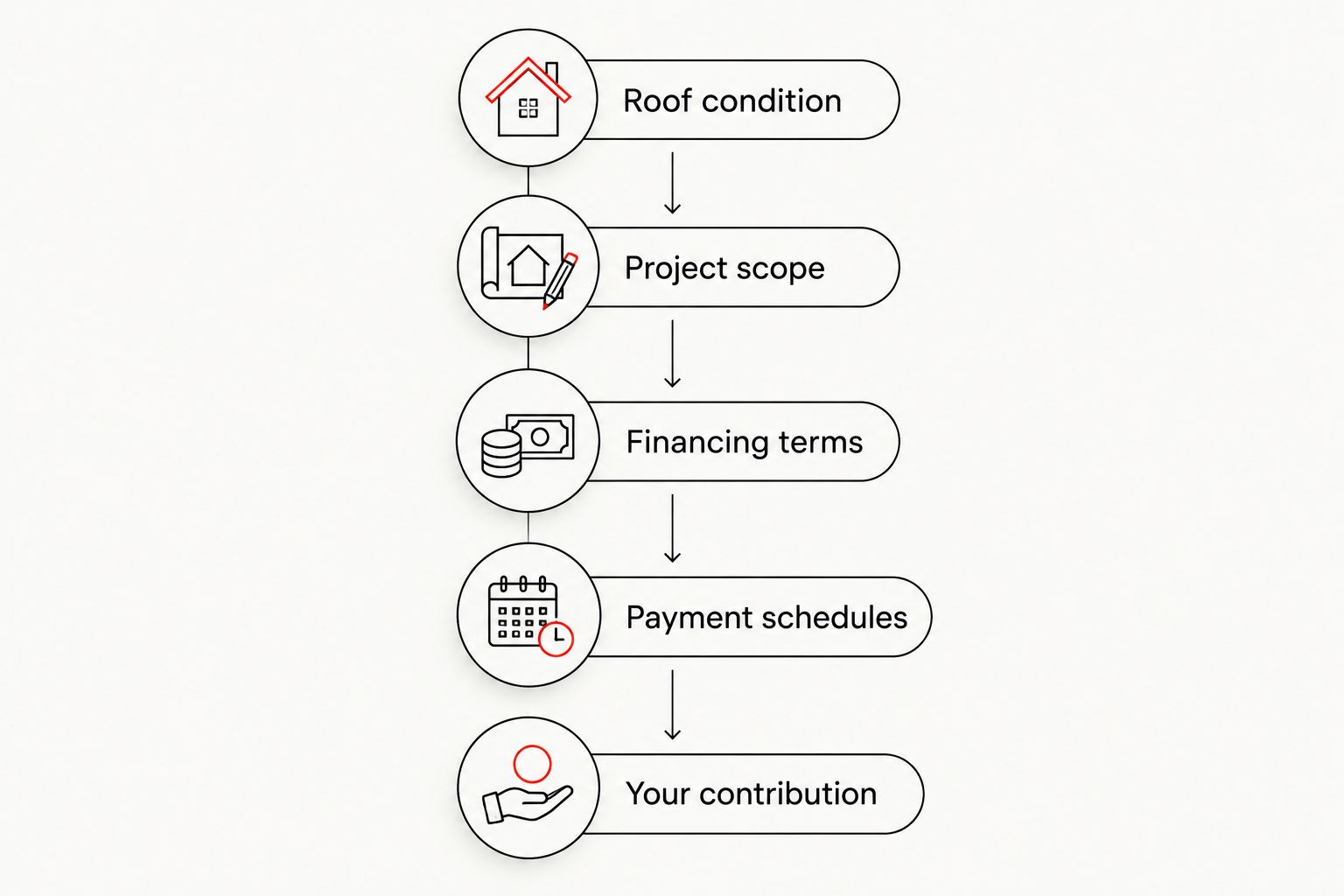
Use this sequence to establish whether an offer actually meets your needs:
- Confirm the roof's condition. Get a written explanation of why replacement is recommended instead of repair.
- Define the project. Request an itemized scope covering removal, installation, permits, disposal, and how hidden damage will be handled.
- Get the financing terms. Identify the lender, approved amount, APR, repayment schedule, fees, and any conditions still outstanding.
- Match the payment schedules. Ask when the contractor expects payment and when the lender releases funds.
- Identify your contribution. Have the contractor and lender explain anything you must pay outside the financing.
Treat no money down as a contract term to verify, not a promise to infer from an advertisement. A preliminary qualification is not the same as final approval, and final approval is not the same as money being released.
The practical question is whether the complete project can proceed without cash from you at the start. Ask it directly, then request the answer in writing. That includes any deposit, lender charge, or work excluded from the approved amount.
Which financing routes should you compare?
You can investigate contractor-arranged financing, a personal loan, or borrowing against home equity. These are financing categories, not confirmed offers from any particular roofer. Whether any route requires an upfront contribution depends on its terms and your approval.
| Financing route | Best for | Main advantage | Main drawback | What to verify |
|---|---|---|---|---|
| Contractor-arranged financing | Homeowners who want to review financing alongside a roofing proposal | Connects the application process with the proposed project | Convenience does not establish that the terms are competitive | Lender identity, APR, fees, funding conditions, and contractor payment schedule |
| Unsecured personal loan | Borrowers who want financing separate from the contractor | Does not use the home as collateral | Approval and borrowing terms depend on the lender's assessment | Approved proceeds, deductions from proceeds, repayment terms, and funding timing |
| Home-equity borrowing | Homeowners with equity who understand secured debt | Uses an existing ownership interest to support borrowing | The home secures repayment, and default can put it at risk | Closing requirements, fees, rate structure, draw rules, and payment obligations |
Compare written offers for the same roofing scope. Otherwise, you cannot tell whether a difference comes from the financing or from omitted work.
Contractor-arranged financing
Best for homeowners who want a coordinated application process, provided the written terms hold up against alternatives. Ask whether the contractor introduces you to an independent lender and who makes the credit decision. Do not treat a salesperson's assurance as lender approval.
The trade-off is convenience versus the need for an independent comparison. Review the lending agreement yourself, even when the contractor helps with the application, and keep a copy separate from the roofing contract.
Unsecured personal loans
Best for borrowers who want to choose a roofer independently of the financing source. Ask whether any origination fee is deducted from the loan proceeds. A loan's stated amount and the amount actually disbursed are not always identical.
The benefit is separation between the lender and the roofing contractor. The limitation is that approval does not automatically produce enough usable funds to cover the entire project or align with the roofer's payment schedule.
Home-equity borrowing
Best for homeowners who understand and accept the risks of debt secured by their property. A home-equity loan and a home-equity line of credit have different structures, so ask how funds are released and how payments are calculated.
The central drawback is collateral risk. Do not choose secured borrowing solely because the initial payment looks manageable; understand what happens if your income changes or the borrowing terms allow payments to change.
Why no-money-down roof financing varies
There is no universal approval standard covering every lender or roofing contract. For a 2026 application, evaluate the actual offer rather than relying on someone else's approval experience.
- Credit history: Lenders assess your borrowing record under their own underwriting requirements. A contractor cannot guarantee the result of that review.
- Income and existing obligations: The lender evaluates repayment capacity. Provide accurate information rather than treating an initial estimate as an approval.
- Project scope: The financing must cover the work you authorize. Repairs discovered after removal require a documented plan for approval and payment.
- Property and collateral requirements: Secured borrowing depends on the property as well as the borrower. Confirm which ownership, valuation, and documentation requirements apply.
- Funding and contractor terms: A lender's disbursement schedule must work with the contractor's contract. Ask who resolves a timing mismatch before installation is scheduled.
A financing approval should answer what you can borrow. Your roofing contract should answer what the contractor will deliver. Neither document substitutes for the other.
What should you check beyond the monthly payment?
Compare the full repayment obligation, not just the advertised payment. Extending repayment can reduce the scheduled payment while increasing the interest paid over the life of a loan. A manageable opening payment is not proof of a suitable agreement.
For each 2026 offer, request the disclosures and read these items together:
- APR: Use the disclosed annual percentage rate when comparing borrowing terms, rather than focusing only on the stated interest rate.
- Fees and proceeds: Establish which charges are financed, deducted from disbursement, or payable separately.
- Payment start: Confirm the first due date and whether interest begins before payments are required.
- Promotional conditions: Check expiration dates, repayment requirements, and what happens if you do not meet them.
- Early repayment: Ask whether a prepayment penalty or other restriction applies.
- Total payments: Review the disclosed repayment total alongside the roof's contracted scope.
Deferred payments and deferred interest are not interchangeable. Some deferred-interest arrangements impose interest from the original transaction date if the promotional balance is not paid as required. Read the actual agreement rather than assuming a payment holiday eliminates interest.
Also ask how a cancellation, financing denial, or reduced approval affects the roofing contract. Do not assume you can cancel construction without consequences merely because the financing did not work out.
Does insurance mean you can replace the roof without paying?
No. Insurance coverage depends on the policy, cause of damage, claim decision, deductible, and settlement terms. A lender's approval does not change any of those conditions, and an insurer's inspection does not guarantee payment for replacement.
A no-money-down financing arrangement is not permission to waive an insurance deductible. Florida law prohibits roofing contractors from offering to waive, rebate, or otherwise offset an applicable property-insurance deductible. Keep the insurance claim, roofing contract, and financing agreement consistent.
For a 2026 claim, request a written explanation from your insurer of your deductible, covered work, settlement conditions, and remaining responsibility. Ask the contractor to identify differences between the insurance scope and the proposed roofing scope instead of describing the entire project as covered.
Can I finance the amount insurance does not cover?
Financing can address an uncovered balance if the lender approves that use and the agreement permits it. First establish your actual responsibility; do not borrow against an assumed insurance settlement or treat financing as a deductible waiver.
Does an old roof automatically qualify for an insurance replacement?
An old roof does not automatically qualify for an insurance-funded replacement. Coverage depends on the policy and the facts of the loss, not simply the roof's age or a contractor's recommendation to replace it.
Can a Florida assistance program eliminate the upfront payment?
Do not assume assistance means no money down. Eligibility, approved work, funding, application procedures, and disbursement rules determine whether a program helps your particular project. A reimbursement arrangement is different from money provided before construction.
Before relying on a program in 2026, check its current official requirements directly. Ask whether approval must come before work starts, whether your proposed roofing work qualifies, whether you must contribute funds, and when assistance is paid.
The same discipline applies to any promised grant. A contractor's estimate is not a grant award, and an application is not approval. Do not sign a repayment obligation on the assumption that unconfirmed assistance will cover it later.
How do you turn approval into a roof installation?
Move to scheduling only after the project scope, funding conditions, and payment responsibilities agree. Review the steps from roof financing approval to a scheduled installation if you need to organize that handoff.
Ask the contractor who handles permits, what must happen before materials are ordered, and how changes are authorized. Require written change orders for additional work rather than allowing a financing limit to become permission to spend the full approved amount.
Roofsmartflorida provides residential roof installation, repair, and replacement services. Its roofing services do not, by themselves, establish that you qualify for financing or that a particular lender will fund your project. Confirm those arrangements separately.
Start with a roof evaluation
Discuss the roofing work your home needs before committing to a borrowing arrangement.
FAQ
Can you get a new roof with no money down in Florida?
Yes, if you qualify for financing that covers the project and the contractor does not require a separate upfront contribution. Confirm both conditions in writing before authorizing work.
Does no money down mean my new roof is free?
No, no money down describes the upfront payment requirement, not the repayment obligation. You remain responsible for the financed balance, interest, and applicable fees under the agreement.
Can I get roof financing with bad credit?
Approval depends on the lender's underwriting requirements and your financial circumstances. Do not rely on a guaranteed-approval claim or assume a contractor can override the lender's decision.
Is contractor financing better than a personal loan?
Neither route is automatically better. Compare written APR disclosures, fees, usable proceeds, repayment obligations, and funding schedules for the same roofing project.
Can a Florida roofer waive my insurance deductible?
Florida law prohibits roofing contractors from offering to waive, rebate, or otherwise offset an applicable property-insurance deductible. Financing does not remove that responsibility.
Does Roofsmartflorida guarantee no-money-down financing?
A financing guarantee is not established by Roofsmartflorida's roofing services. Ask about any current arrangements directly and obtain the lender's written decision and terms.
Should I sign the roofing contract before financing is approved?
Do not sign without understanding what happens if financing is denied or falls short. Review cancellation terms, payment deadlines, and any financing condition before committing.
One last thing
Ask what happens if the approved loan is smaller than the final authorized roofing scope. That question exposes a gap that an attractive payment advertisement does not answer. Get the process for hidden damage, additional work, and your approval in writing before removal begins.
Keep the lending disclosures, roofing proposal, signed contract, and change orders together. You should be able to match every authorized item of work to a clear payment responsibility without relying on a verbal promise.