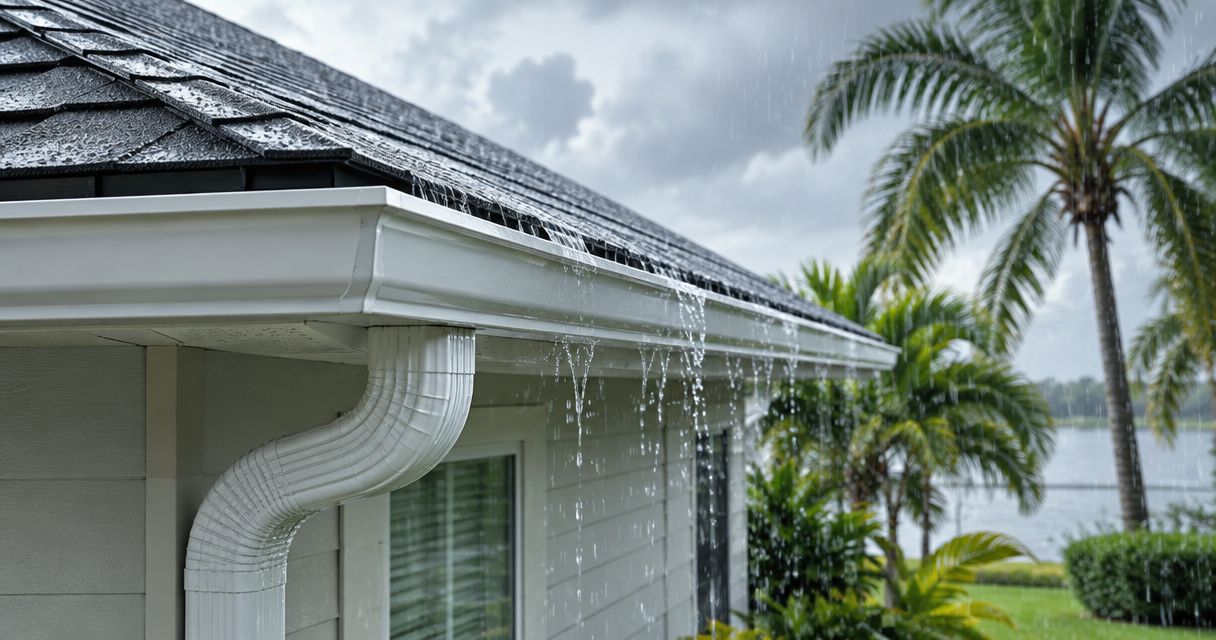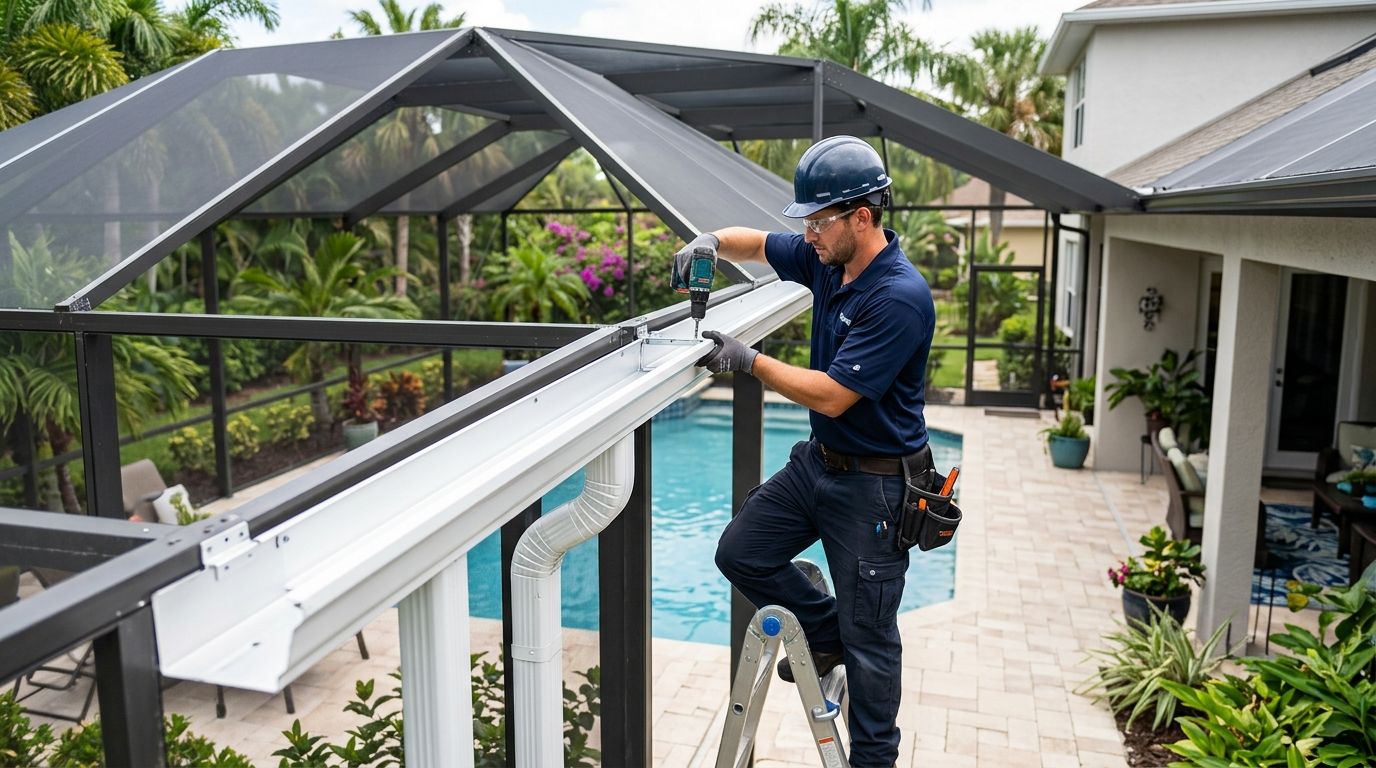
Gutter installation for pool cage runoff is the process of adding seamless aluminum gutters and downspouts along a screened enclosure or lanai roofline so rainwater sheds away from the pool deck instead of pooling against it. Pool cage and lanai structures span wider, flatter rooflines than a standard house eave, which means water sheets off in sheets rather than a single drip line — a mismatch standard residential gutter setups aren't built to handle.
- Gutter installation for pool cage runoff needs K-style seamless aluminum sized for wide lanai rooflines, not standard house gutters.
- Downspouts should route at least 4-6 feet from the pool deck expansion joint to stop paver staining and erosion.
- Screwed hangers every 24 inches beat spike-and-ferrule on cage-adjacent fascia in Southwest Florida's wind zones.
- Skipping gutter guards under oak or palm canopy leads to clogged downspouts within one 2026 rainy season.
Why gutter installation for pool cage runoff matters in Southwest Florida
A screened pool cage sheds a large surface area of rainwater onto a narrow deck footprint. Without gutters, that runoff drips directly onto the cage's screen track, stains pavers, and pools against the pool's expansion joint — the exact seam that lets water migrate under the deck and cause settling over a few rainy seasons.
Homeowners searching for roofing for pool cage and lanai enclosures usually land there after noticing standing water along the cage's low edge or dark streaks on the screen mesh. Gutters solve the runoff half of that problem; the roofline itself is a separate structural question.
Cape Coral, Fort Myers, and Naples all see intense, short-duration downpours through the summer months — the kind that dump more rain in 20 minutes than a slow northern rain does in three hours. A lanai roof without gutters concentrates that volume into a handful of drip points instead of spreading it across a gutter run, which is why pool decks near unguttered cages show staining faster than the rest of the house.
Update your runoff map before you buy anything
Walk the pool cage perimeter during or right after a storm and mark where water actually goes, not where you assume it goes.
- Note every drip line visible on the screen track or lower aluminum frame
- Photograph staining or algae streaks on pavers directly below the roofline
- Check for standing water within 12 inches of the pool deck expansion joint
- Flag low points on the cage roofline where water visibly pools before running off
- Confirm whether existing house gutters already dump water toward the cage area
This walk-through takes 15 minutes and tells a contractor exactly where hangers, downspouts, and extensions need to go — skipping it is the single biggest reason gutter installs get redone within a year.
Choose the gutter profile for lanai and cage runoff
Most Southwest Florida lanai and pool cage installs use K-style seamless aluminum rather than half-round, because K-style carries more water per linear foot and mounts flatter against low-slope cage fascia.
- K-style seamless aluminum: highest capacity per foot, standard choice for cage rooflines
- Half-round: lower capacity, chosen mainly for aesthetic match on historic-style homes
- Vinyl sectional: lowest cost, seams leak faster under heavy Florida rain rates
- .032-inch gauge aluminum: the heavier-duty standard for storm-prone coastal counties, versus the thinner .027-inch gauge used on lighter-exposure builds
Size downspouts for Florida rain intensity
Undersized downspouts are the most common failure point on pool cage gutter jobs, because installers copy house-gutter downspout counts onto a wider, flatter cage roofline.
- Use 3-by-4-inch downspouts instead of 2-by-3-inch on any run over 20 feet
- Add one downspout per 35-40 feet of gutter run on cage and lanai roofs
- Position downspouts at the lowest point of each roof section, not evenly spaced by default
- Confirm outlet size matches gutter capacity — a wide gutter feeding a narrow downspout backs up in heavy rain
Route water away from the pool deck and foundation
Getting water into a downspout only solves half the job — where it lands after that determines whether your deck stays dry or stains.
- Extend downspouts a minimum of 4-6 feet past the pool deck's expansion joint
- Use splash blocks or flexible extensions on decks that can't be re-graded
- Tie into a French drain where the lot slopes back toward the house
- Never discharge directly onto pavers set in polymeric sand — it erodes the joint over repeated storms
Add gutter guards for oak and palm debris
Canopy trees over a pool cage load gutters with leaf litter and palm fronds faster than open-sky rooflines, and a clogged gutter on a cage overflows straight back onto the screen.
- Micro-mesh guards block small leaf debris better than solid-hood covers
- Reverse-curve guards shed heavy leaf loads but need periodic brush-off
- Guard installs pair with the same hanger spacing used for the gutter itself
- Homeowners under mature oak canopy should plan on guard inspection at least twice a year
Detailed profile comparisons live on the gutter guards for Florida storm season page if the canopy load on your lot is heavy enough to justify the upgrade.
Install or upgrade seamless gutters the right way
Seamless aluminum is formed on-site to match the exact roofline length, which matters more on a cage than a house because cage fascia rarely runs in clean, straight sections.
- Hangers screwed every 24 inches outperform spike-and-ferrule attachment in wind-prone counties
- Slope gutters at a quarter-inch per 10 feet toward the downspout, never flat
- Seal end caps and corners with gutter-grade sealant rated for UV exposure
- Confirm fascia board condition before attachment — soft or rotted fascia won't hold hangers through a storm season
A step-by-step walkthrough of proper technique is on the how to install seamless gutters on a Florida home page, useful reference whether a homeowner hires it out or wants to understand what a crew should be doing.
Maintain gutters through hurricane season
Gutters installed correctly in 2026 still need seasonal attention, because Southwest Florida's storm pattern loads debris fast between June and November.
- Clear gutters before June 1 and again after any named storm passes through
- Check downspout outlets for soil or mulch blockage after heavy rain events
- Inspect hanger screws for loosening after sustained wind
- Re-check slope annually — fascia settling shifts pitch over a few years
Know when to call a pro versus DIY
Cage-adjacent gutter work carries risks a standard house gutter job doesn't: ladders set near screen panels, tight clearances between gutter and cage framing, and fastener choices that can void a screen enclosure's own warranty if done wrong.
- DIY works for simple cleaning and debris clearing on ground-level runs
- Hire out any job requiring ladder placement inside or against the cage structure
- Get a professional measurement before ordering seamless gutter stock — cage rooflines are rarely square
- Bring in a licensed contractor if fascia shows rot, since that's a repair job before gutters go up at all
Gutter options for pool cage and lanai runoff compared
| Option | Best for | Key limitation |
|---|---|---|
| Seamless K-style aluminum | Most pool cage and lanai rooflines | Requires on-site fabrication, not a same-day DIY box-store fix |
| Half-round aluminum | Homes prioritizing an architectural match | Lower water capacity per foot than K-style |
| Vinyl sectional | Budget-limited, low-exposure runs | Seams fail faster under Florida's heavy rain intensity |
| Gutter guard add-on | Lots with heavy oak or palm canopy | Adds an install step and periodic brush-off maintenance |
| French drain / downspout extension | Lots with poor natural grading away from the deck | Doesn't fix the gutter itself, only the discharge point |
Verdict: seamless K-style aluminum, sized with 3-by-4-inch downspouts and routed at least 4-6 feet past the pool deck, is the right call for the majority of Southwest Florida pool cage and lanai runoff jobs in 2026 — vinyl sectional is a Skip on any run over 20 feet, and half-round is a Hold unless the aesthetic match matters more than capacity.
Common mistakes homeowners make with pool cage gutters
- Fastening gutters to the screen cage frame instead of the roof fascia — the aluminum cage framing isn't built to carry gutter load and flexes under wind, pulling hangers loose
- Skipping downspout extensions — dumping water two feet from the pool deck's expansion joint just relocates the staining problem instead of solving it
- Ignoring canopy debris load — a gutter that looked fine at installation clogs within one storm season under mature oak or palm cover without guards
- Assuming a small lanai roofline doesn't need slope calculations — flat-pitched gutters on cage roofs pool water at the low corner and overflow onto the screen track
Regular upkeep matters as much as the initial install — the how to clean seamless gutters in Florida guide covers the cleaning cadence that keeps a properly sized gutter system working through a full 2026 storm season.
Get a free pool cage gutter estimate
Roof Smart evaluates your cage roofline and pool deck runoff at no cost.
FAQ
Do pool cages need gutters in Florida?
Most pool cages benefit from gutters because the wide, low-slope roofline sheds rainwater in concentrated sheets rather than a single drip line. Without gutters, that runoff pools against the pool deck's expansion joint and stains pavers over repeated storms.
What size downspout is right for a lanai gutter run?
A 3-by-4-inch downspout handles most lanai and pool cage gutter runs over 20 feet, versus the smaller 2-by-3-inch size used on standard house eaves. Undersized downspouts back up during Southwest Florida's heavy summer downpours.
Is seamless gutter better than sectional for a pool cage?
Seamless aluminum is generally better because it's formed to the exact roofline length with fewer joints that can leak. Sectional vinyl costs less upfront but the seams fail faster under Florida's rain intensity.
How far should a downspout extend from the pool deck?
Downspouts should discharge at least 4 to 6 feet past the pool deck's expansion joint. Discharging closer than that just relocates staining and erosion to a different spot on the same deck.
Do gutter guards make sense for a pool cage under oak trees?
Yes, gutter guards are worth the added install step when mature oak or palm canopy overhangs the cage roofline. Without guards, leaf litter clogs downspouts within a single rainy season and sends overflow back onto the screen.
Can I attach pool cage gutters to the screen enclosure frame?
No, gutters should attach to the roof fascia, not the aluminum screen cage framing. Cage framing flexes under wind load and isn't built to carry gutter weight, which pulls hangers loose over time.
How often should pool cage gutters be cleaned in Southwest Florida?
Clear pool cage gutters before the rainy season starts in June and again after any major named storm. Lots with heavy tree canopy may need a mid-season check as well.
What gutter gauge holds up best in coastal Southwest Florida?
.032-inch aluminum is the heavier-duty gauge standard for storm-prone coastal counties, compared to the thinner .027-inch gauge used in lower-exposure areas. The thicker gauge resists denting from wind-driven debris.
One last thing
The detail most homeowners miss: a pool cage gutter system only works if the fascia behind it is sound, and Southwest Florida fascia boards near a pool deck take on more moisture exposure than the rest of the house because of splash-back and humidity trapped inside the screen enclosure. Check fascia condition before ordering seamless gutter stock in 2026 — hangers screwed into soft wood will pull loose in the first real storm regardless of how well the gutter itself is sized.