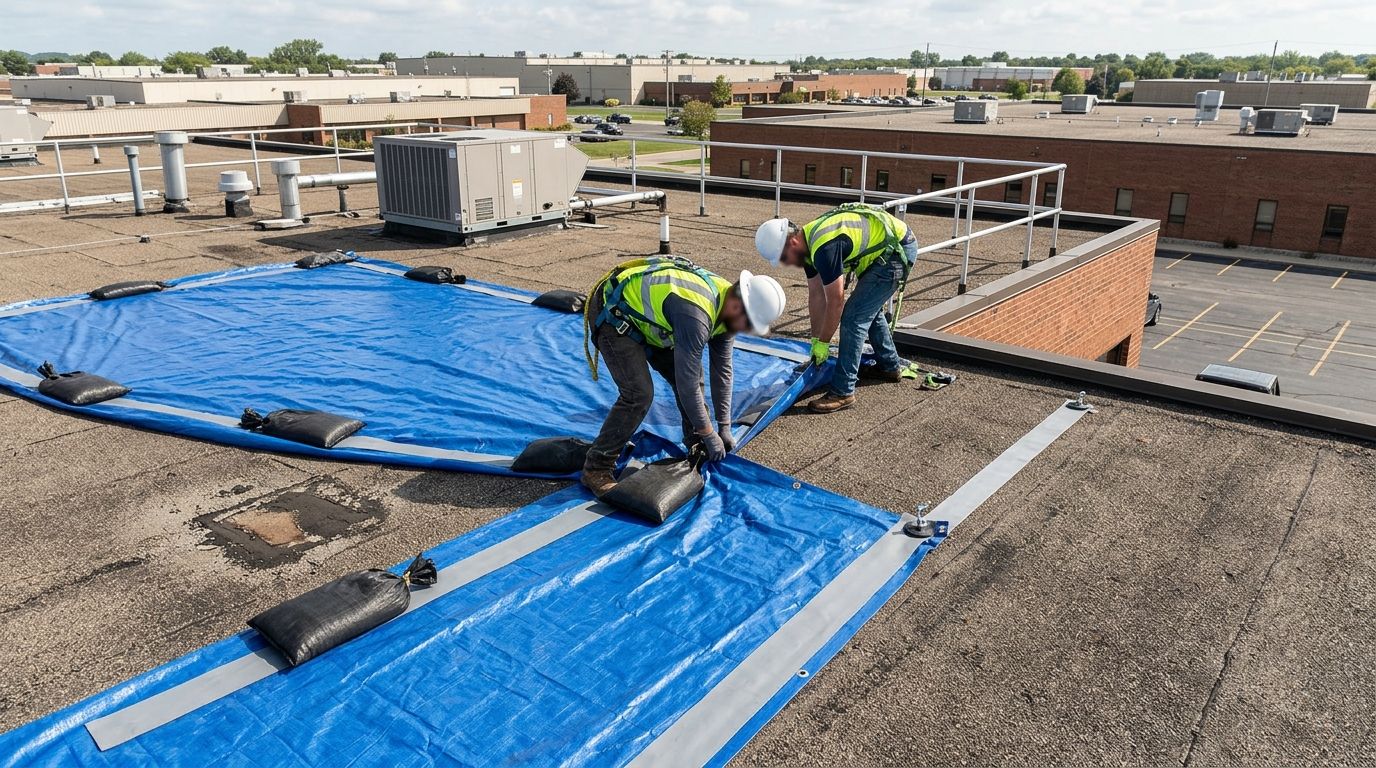
Emergency roof tarping for commercial buildings is a temporary waterproof covering installed over storm-damaged sections of a roof to stop water intrusion until permanent repairs can happen. A warehouse, retail plaza, or industrial facility in Cape Coral, Fort Myers, or Naples needs a faster, larger-scale response than a single-family home — bigger roof spans, rooftop HVAC penetrations, and business interruption costs that add up by the hour, not the day.
- Emergency roof tarping for commercial buildings stops water intrusion within hours of wind or hail damage — call a licensed contractor before anyone climbs up.
- Roof Smart of SW Florida tarps warehouses, retail centers, and industrial roofs across Cape Coral, Fort Myers, and Naples on a no-pressure, free-estimate basis.
- Photograph every damaged section before the tarp goes down — insurance adjusters need the 'before' evidence, not the covered version.
- A properly anchored commercial tarp holds through repeat 2026 hurricane-season wind events; a rushed, under-anchored one fails in the first follow-up storm.
Why emergency roof tarping matters for commercial and industrial buildings
A residential roof leak ruins drywall. A commercial roof leak ruins inventory, shuts down a production line, or forces a retail tenant to close for the day — and every one of those outcomes shows up on a claim or a lease dispute. Southwest Florida's June-through-November storm window means warehouses and strip centers face repeat exposure in a single season, not a one-off event.
Property managers juggling multiple buildings need a contractor who can mobilize fast and document the damage the way a commercial insurance policy requires. That's a different job than emergency roof repair for property management companies on a single duplex — the scale, the paperwork, and the tenant notifications all change. If your damage traces back to a specific named storm rather than gradual wear, the broader emergency roof tarping after storm damage guide covers the same urgency principles for residential roofs too.
The emergency tarping process, step by step
Get everyone off the roof and account for hazards first
Before anything gets covered, confirm the roof is safe to approach. Storm-damaged commercial roofs hide risks that residential roofs usually don't.
- Check for downed power lines near rooftop equipment
- Look for standing water pooling near skylights or roof hatches
- Watch for signs of structural sag on flat or low-slope sections
- Confirm gas line vents and exhaust stacks are still intact
- Keep employees and tenants away from the affected area until it's cleared
Document every damaged square foot before it's covered
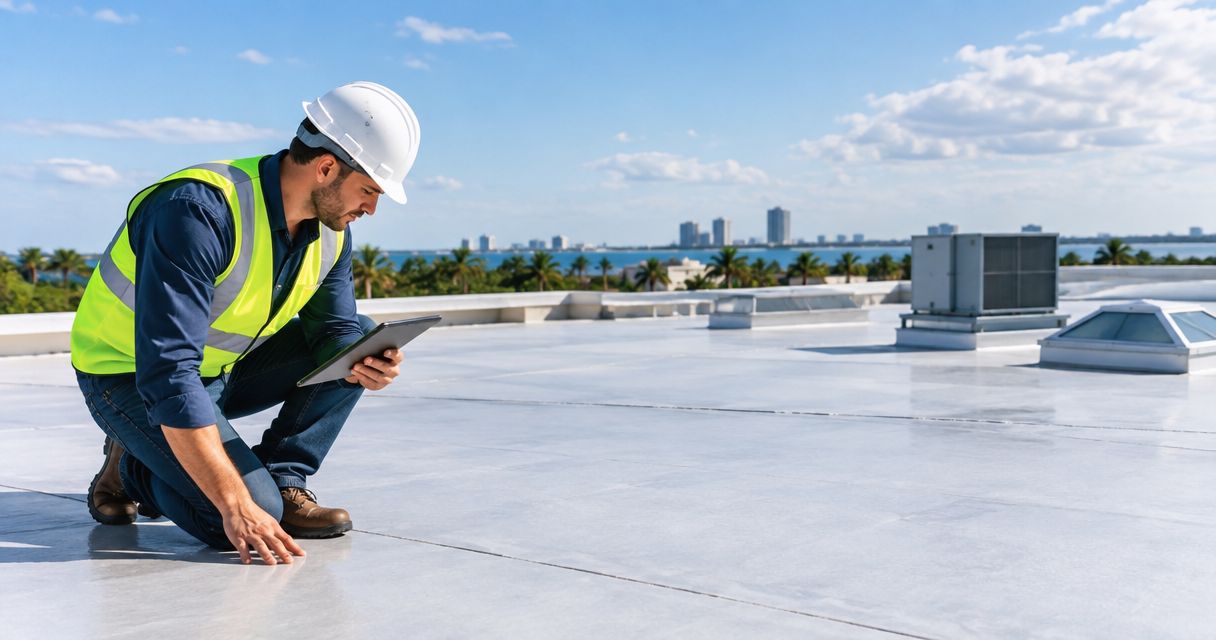
Once the roof is safe, documentation comes before the tarp — not after. Commercial insurance adjusters lean on photo evidence far more than residential claims do.
- Take wide shots of the full damaged section, then close-ups of tears or punctures
- Photograph interior ceiling stains room by room
- Timestamp every photo and note the date and time of the storm
- Estimate the affected square footage by roof section, not a single total
- Start a written damage log you can hand to the adjuster and the roofer
Call a licensed commercial roofer for the tarp install
This is where a DIY approach on a large commercial roof usually breaks down. A residential-grade tarp and a ladder don't cover a 20,000-square-foot warehouse membrane, and an unlicensed crew can void parts of a commercial policy. Roof Smart of SW Florida handles flat roof repair for commercial buildings across Cape Coral, Fort Myers, and Naples, and that's the faster, more defensible path once the roof is stable enough to work on.
- Verify the contractor's Florida roofing license and commercial liability coverage
- Ask directly about square footage capacity for the crew and equipment on hand
- Confirm same-day or next-morning availability during active storm season
- Ask what anchoring method they use on membrane roofs versus shingle or metal
- Request a written scope of work before the crew starts
Choose the right tarp material and anchoring system for a large span
Material and anchoring matter more on a commercial roof than most owners expect. A tarp that's fine on a 1,500-square-foot house roof underperforms badly across a 15,000-square-foot industrial span.
- Use reinforced polyethylene tarps rated for sustained wind, not light-duty poly sheeting
- Anchor with batten strips and fasteners designed for the roof deck type, not just sandbags
- Avoid nailing directly through an intact TPO or modified bitumen membrane outside the damaged zone
- Overlap seams by several inches minimum to prevent wind-driven rain from working underneath
- Account for the tarp's own weight and wind load on a large flat expanse
Seal HVAC curbs, skylights, and roof penetrations first
Water doesn't stay where it enters. On industrial and warehouse roofs, penetrations are usually the fastest path to equipment damage below.
- Rooftop HVAC units and their curbs
- Exhaust vents and plumbing stacks
- Skylights and roof hatches
- Pipe boots and conduit penetrations
- Expansion joints on older industrial roofs
Inspect and re-secure the tarp daily until the permanent repair happens
A tarp is a stopgap, not a fix, and Southwest Florida's 2026 storm pattern means a second system can roll through before the permanent repair is scheduled.
- Check the tarp after every rain event, not just once a week
- Watch for pooling water on flat sections that stresses the seams
- Re-tighten straps and battens after any wind gust event
- Log every inspection date for the insurance file
Schedule the permanent repair or replacement before the tarp's lifespan runs out
A tarp is not designed to hold indefinitely. Once the building is stable, move to a permanent fix on a real timeline instead of letting the temporary cover become the long-term plan.
- Request a full roof assessment covering the entire affected system, not just the tarped section
- Compare repair versus full replacement cost based on the roof's age and remaining life
- Get the proposal and timeline in writing before work starts
- Ask about warranty terms on the completed repair
- Plan the work window around business operating hours to limit downtime
Comparing tarping options for commercial and industrial buildings
| Option | Best for | Key limitation |
|---|---|---|
| DIY tarp and tape | Small, low-slope leaks you can safely reach | Rarely survives a second storm; can complicate an insurance claim |
| General handyman | Minor, non-urgent residential jobs | Usually not licensed or insured for commercial roof work |
| Licensed commercial roofer | Warehouses and industrial buildings, retail centers, multi-tenant properties | Response windows shift during peak 2026 hurricane season demand |
| Roof coating as a stopgap | Minor ponding on flat roofs without an active leak | Does nothing for an open puncture or torn membrane |
Verdict: for any roof over a few hundred square feet with an active leak, a licensed commercial crew is the only option that holds through a second storm and keeps the insurance paperwork clean.
Common mistakes commercial property owners make with emergency tarping
- Waiting for the adjuster before tarping. Delaying coverage to "wait for approval" turns a roof leak into a mold and ceiling-collapse claim that's harder to get paid.
- Using a residential-grade tarp on a large flat roof. Undersized coverage leaves seams exposed to the next wind-driven rain event.
- Skipping photo documentation of square footage. Adjusters need scale, not just a few close-up shots of the worst spot.
- Hiring a crew without commercial licensing. A handyman's residential license doesn't cover industrial or warehouse roofing in Florida.
- Ignoring HVAC curbs and penetrations. Water travels along the deck and can damage equipment in a section of the building nowhere near the original hole.
Get emergency tarping from Roof Smart of SW Florida
Free, no-pressure estimate for storm-damaged commercial and industrial roofs.
FAQ
What is emergency roof tarping for commercial buildings?
It's a temporary waterproof cover installed over a storm-damaged or leaking section of a commercial roof to stop water intrusion until a permanent repair happens. It protects inventory, equipment, and interior space from ongoing damage.
How much does emergency roof tarping cost in 2026?
Cost varies by roof size, material, and how many penetrations need sealing, so get a written estimate for your specific building rather than relying on a general number. A licensed commercial roofer can quote the job after seeing the affected square footage.
How long does a commercial roof tarp last?
A tarp is a temporary fix meant to last days to a few weeks, not a long-term solution. It needs daily inspection after rain and wind events and should come off once the permanent repair is scheduled.
Is emergency roof tarping covered by commercial insurance?
Many commercial policies cover emergency mitigation steps like tarping when documented properly with photos and a written scope of work. Check your specific policy language and confirm with your adjuster before work starts.
How fast can a roofer tarp a warehouse after a storm?
Response time depends on the size of the affected area, crew availability, and how many other buildings are calling in during the same storm event. Confirming same-day or next-morning availability when you first call narrows down realistic timelines.
Can I tarp my own commercial roof?
You can for a small, safely accessible area, but large spans, steep sections, or roofs with HVAC penetrations need a licensed crew with the right anchoring equipment. An improperly anchored DIY tarp often fails in the next wind event.
What's the difference between residential and commercial roof tarping?
Commercial tarping covers much larger spans, more roof penetrations like HVAC curbs and skylights, and requires documentation suited to commercial insurance policies. It also usually demands faster mobilization because business interruption costs accrue by the hour.
Does tarping stop mold growth after a roof leak?
Tarping stops new water from entering, which slows further mold growth, but it doesn't dry out or remediate water already inside the building. Interior moisture still needs separate attention once the roof is secured.
One last thing
The detail insurance adjusters flag most often on commercial tarping claims isn't the size of the hole — it's whether the anchoring method punctured an otherwise intact membrane outside the damaged zone. Nailing straight through a good section of TPO or modified bitumen to hold down a tarp creates new leak points and turns one claim into two. Ask any commercial roofer directly how they plan to anchor the tarp before they climb up in 2026's storm season.