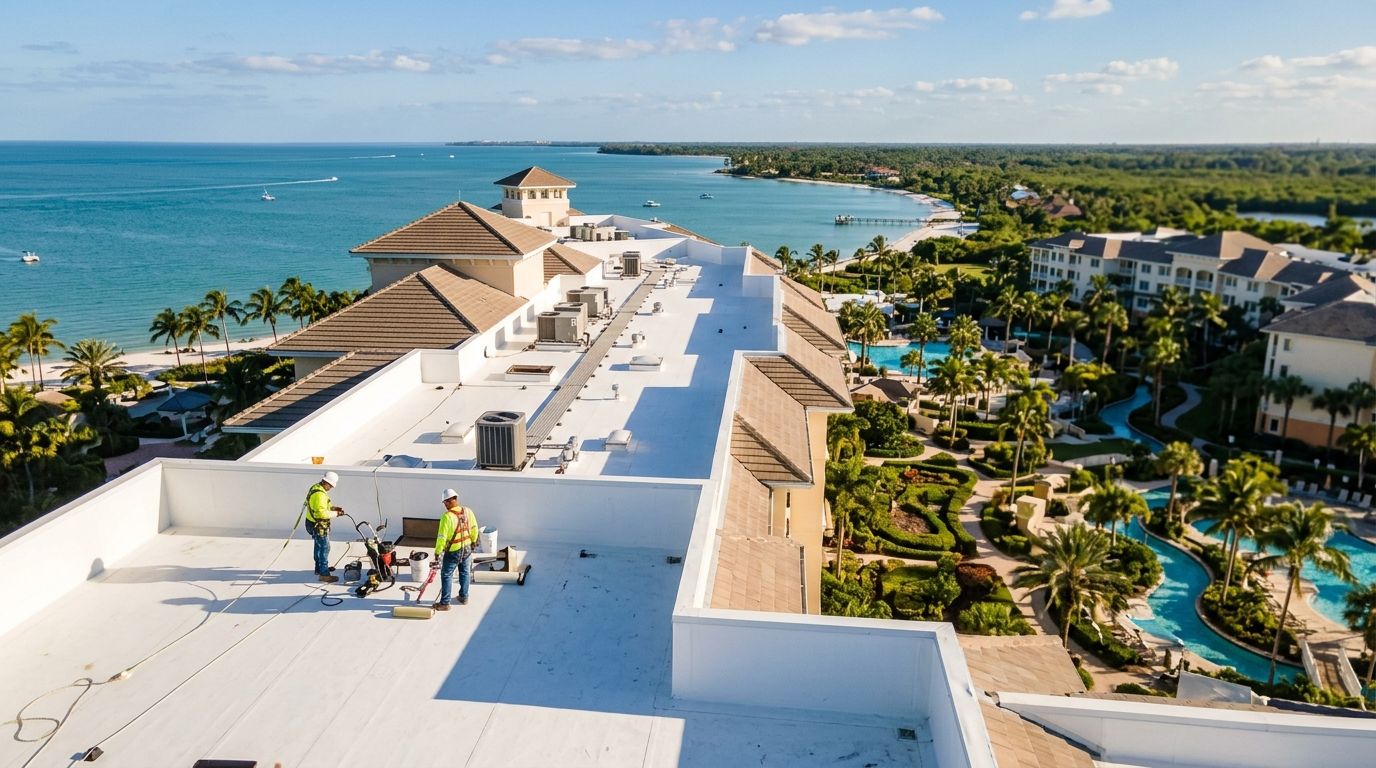
Commercial roofing for hotels and resorts in Southwest Florida means installing, repairing, and maintaining large-format flat, metal, or tile roof systems built to keep guest rooms dry and HVAC equipment protected through hurricane season without shutting down occupied wings. Hospitality roofs carry different pressure than a standalone retail building: a leak over a guest room becomes a refund and a review, and a roof failure during peak season can shut down bookings for weeks.
- Commercial roofing for hotels and resorts in SW Florida means flat, low-slope systems rated for hurricane wind uplift.
- Roof Smart of SW Florida recommends TPO or modified bitumen for large flat sections over guest wings.
- Wind mitigation inspections support commercial insurance renewals for coastal hospitality properties.
- Phased repairs scheduled around occupancy keep rooms bookable while crews work section by section.
- Skipping annual inspection turns a small flat-roof issue into an emergency tarp job during storm season.
Why commercial roofing matters for hotels and resorts
A hotel or resort roof in Cape Coral, Fort Myers, or Naples covers far more square footage than a typical commercial building, and most of it is flat or low-slope. That means ponding water, membrane seams, and HVAC penetrations are the failure points that matter most, not shingle wind resistance.
Hurricane Ian made landfall near Cape Coral in 2022 with sustained winds near 150 mph, and it exposed how many flat commercial roofs along the Gulf Coast were carrying deferred maintenance. Hotels that had current commercial roofing services in Naples contracts and documented inspection records recovered faster with insurance carriers than properties with no paper trail.
Insurance underwriting for hospitality properties in 2026 increasingly asks for wind mitigation documentation and inspection history before renewal. A resort that treats its roof as a line item instead of an asset ends up negotiating from a weaker position at claim time.
Verdict: a hotel or resort roof in SW Florida needs a scheduled maintenance plan, not a call-when-it-leaks approach, and Roof Smart of SW Florida builds that plan around occupancy, not just the calendar.
Prepare your roof before hurricane season starts
Hospitality properties can't afford a mid-season scramble. Pre-season prep for a hotel roof looks different from a single-family home because you're coordinating around guest bookings, not just weather.
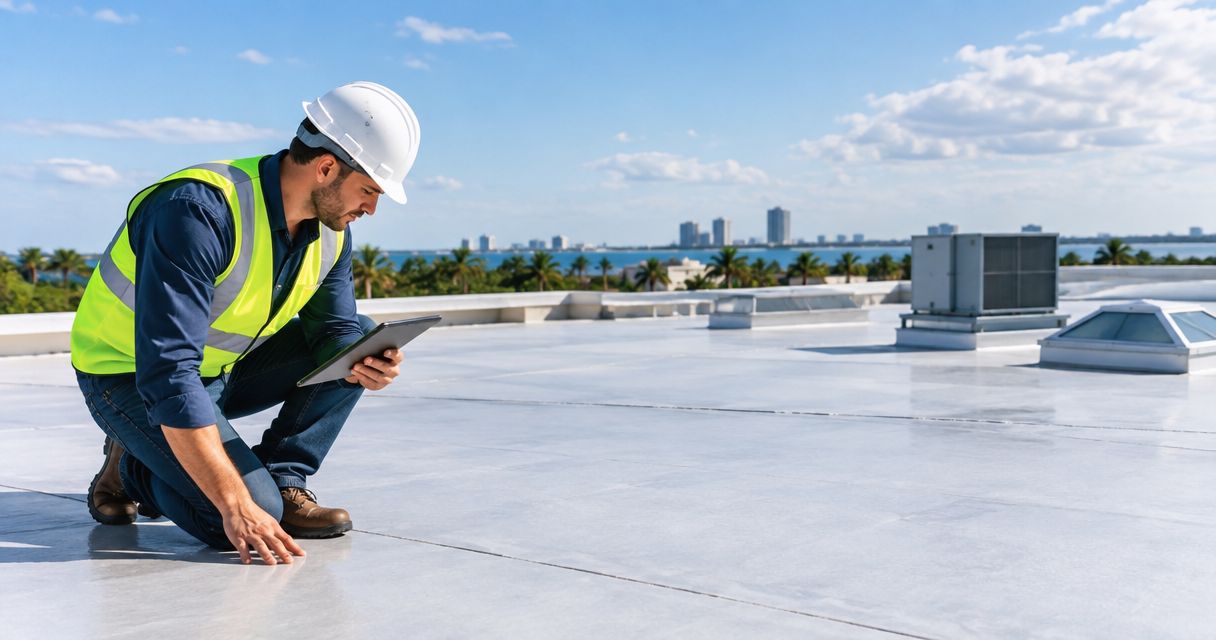
- Schedule a full roof inspection by May, before the June 1 start of hurricane season
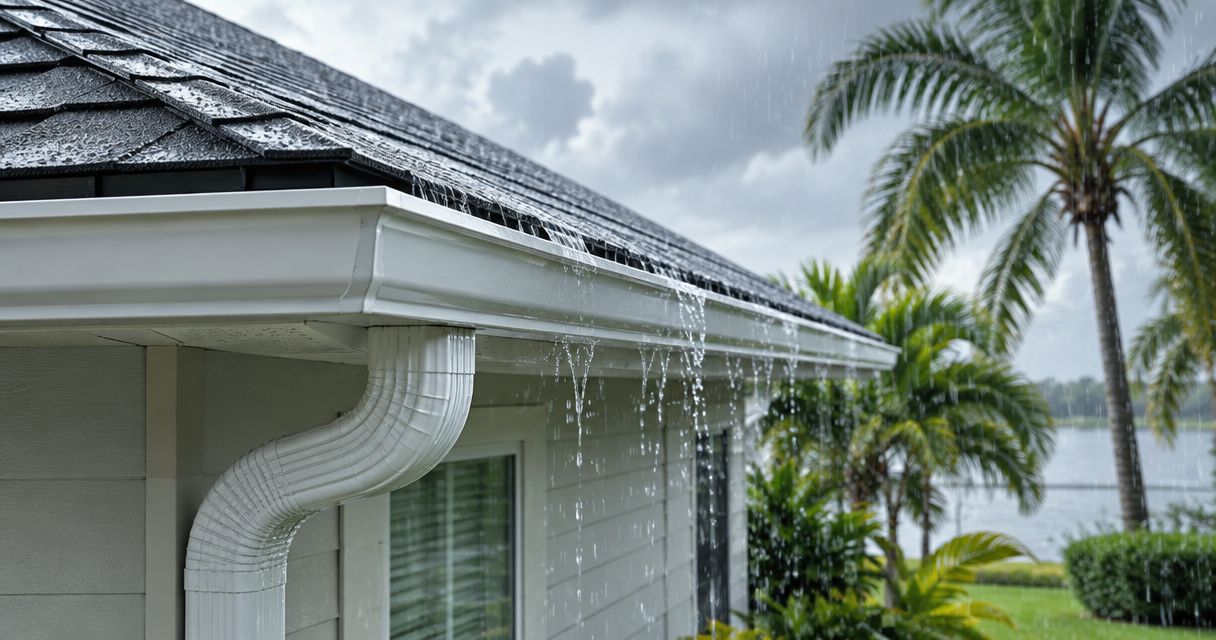
- Check every roof drain and scupper for debris buildup from palm fronds and construction dust
- Verify flashing around rooftop HVAC units, elevator penthouses, and antenna mounts
- Confirm loose gravel ballast and coping caps are secured against wind uplift
- Walk the roof after any named storm passes within 100 miles, even without visible damage
Getting this right early means fewer surprises. Review the full checklist in how to prepare your roof for hurricane season in SW Florida before booking your pre-season inspection.
Choose the right roof system for a hospitality building
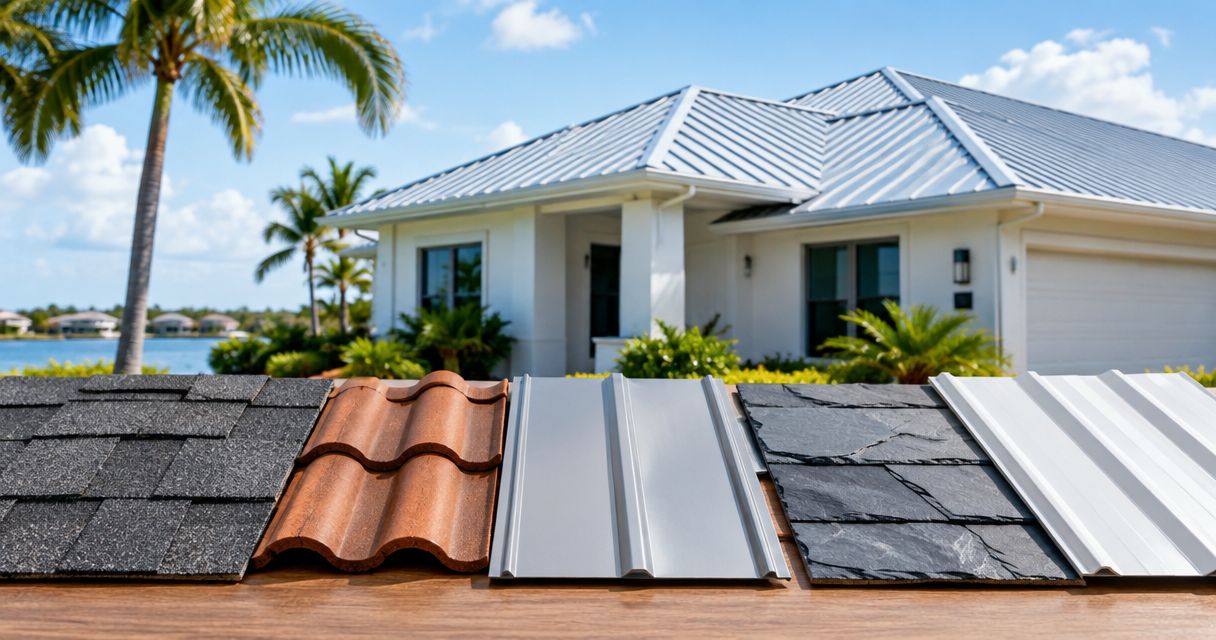
Most hotels and resorts in the region run a mix of flat low-slope roofing over guest wings and metal or tile over entryways, porte cocheres, and clubhouse structures. Matching the system to the section matters more than picking one material for the whole property.
- TPO membrane for large flat sections, since it reflects heat and welds at seams instead of relying on adhesive alone
- Modified bitumen for sections with heavy foot traffic from HVAC service crews
- Standing seam metal for porte cocheres and covered walkways exposed to wind-driven rain
- Tile for Mediterranean-style resort architecture where the roofline is part of the brand
- EPDM as a lower-cost flat option, though it holds up worse under standing water than TPO
Schedule repairs around occupancy, not the calendar
A property manager who schedules roof work like a residential job ends up closing rooms unnecessarily. Hotels get better results phasing work.
- Break large flat roofs into sections and work one section per week during low-occupancy periods
- Run repairs over unoccupied wings first if the property has seasonal closures
- Coordinate crane and material staging with valet and loading dock schedules
- Keep one crew lead as the single point of contact for the general manager
- Document daily progress with photos for both the owner and the insurance file
Get a wind mitigation inspection tied to insurance
Wind mitigation inspections document roof-to-wall connections, roof deck attachment, and opening protection. A current inspection report is often the difference between a renewal quote and a non-renewal notice for coastal hospitality properties in 2026.
- Confirm the roof deck attachment method is documented for the whole roof, not a sample area
- Verify secondary water barrier presence under the primary roof covering
- Check that all roof-mounted equipment has hurricane-rated tie-downs
- File the report with your insurance carrier the same week it's completed, not months later
Install or renew flat roof coatings
A reflective coating extends the service life of an existing flat roof and cuts rooftop surface temperature, which matters for a hotel running HVAC units around the clock. Coatings are a maintenance tool, not a replacement substitute, once the membrane underneath has failed.
- Silicone coatings hold up better than acrylics under Florida's ponding-water conditions
- Acrylic coatings cost less but need reapplication more often in high-UV climates
- Coating over a membrane with active leaks seals the problem in place temporarily
- Get a moisture scan before coating an older roof to check for wet insulation underneath
See current options in roof coatings for commercial flat roofs in Florida before deciding between coating and full replacement.
Set up a standing maintenance plan
Reactive repair costs more over a 10-year window than a scheduled plan, and it creates unpredictable downtime for a property that depends on full room availability. A hotel with 40 or more rooftop HVAC penetrations needs more frequent checks than a small retail box.
- Quarterly inspections instead of annual for properties over 50,000 square feet of roof
- A standing work order for drain and scupper clearing before every named storm
- A logged history of every repair tied to roof section, not just a single building record
- One point of contact who signs off on repairs instead of rotating engineering staff
Roof Smart of SW Florida structures ongoing roof maintenance plans for commercial property managers around this kind of section-by-section tracking.
Document everything for insurance claims
After a storm, the properties that get paid fastest are the ones with a maintenance paper trail already on file, not the ones building the case from scratch after the damage happens.
- Keep dated photos from every inspection, not just the most recent one
- Save every invoice tied to a specific roof section or building address
- File the wind mitigation report with the carrier before renewal, not after a claim
- Request a written scope of damage from the contractor within 48 hours of a storm event
“If a hotel roof section fails during check-in season, the fix costs far more than the inspection that would have caught it.”
Comparison: flat commercial roof options for hotels and resorts
| Option | Best for | Key limitation |
|---|---|---|
| TPO membrane | Large flat sections over guest wings | Seam welds need periodic re-inspection |
| Modified bitumen | High-traffic areas near HVAC access points | Heavier system, adds roof load |
| Standing seam metal | Porte cocheres, walkways, entry canopies | Not suited to large flat expanses |
| Tile | Mediterranean-style resort rooflines | Higher weight load, specialized repair |
| EPDM | Budget-conscious flat roof sections | Weaker performance under standing water |
Get a commercial roof evaluation
Free, no-pressure estimate for hotel and resort properties across SW Florida.
Common mistakes hotels and resorts make
- Treating the whole roof as one system. A resort with tile over the lobby and TPO over guest wings needs separate maintenance schedules, not one blanket inspection date.
- Closing full wings for repairs that only need a section. Phased work by roof section avoids unnecessary room revenue loss.
- Skipping the moisture scan before recoating. Coating over wet insulation traps the problem instead of fixing it.
- Letting wind mitigation reports go stale. A report older than the current insurance renewal cycle often doesn't count toward a premium credit.
- Rotating the point of contact for repairs. Losing track of which section was repaired when makes 2026 insurance claims slower to process.
FAQ
What's the best roof system for a hotel in SW Florida?
TPO membrane is the most common choice for large flat sections over guest wings because it reflects heat and welds at the seams. Porte cocheres and entry canopies usually use standing seam metal instead, since flat systems don't suit smaller pitched structures.
Is commercial roofing for hotels different from retail or office roofing?
Yes, hotel roofs are larger, carry more rooftop HVAC penetrations, and require phased work to avoid closing occupied rooms. Retail and office roofs can usually be handled as a single project without the same occupancy constraints.
How often should a resort get its roof inspected?
Properties over 50,000 square feet of roof area benefit from quarterly inspections instead of an annual check. Smaller hospitality buildings can run annually, with an added inspection after any named storm passing within 100 miles.
Does a wind mitigation inspection lower commercial insurance costs?
A current wind mitigation report documenting roof deck attachment and roof-to-wall connections is often required for renewal and can support a premium credit. The report has to reach the carrier ahead of the renewal date to count.
Can a flat roof coating replace a full roof replacement?
No, a coating extends the service life of a membrane that is still structurally sound but does not fix a failed roof. A moisture scan before coating shows whether the underlying insulation is dry enough for a coating to make sense.
How long does commercial roof replacement take on a hotel?
Timelines depend on roof size and phasing, since most hospitality replacements run section by section rather than all at once. Get a section-by-section schedule in writing before work starts.
What causes most roof leaks on hotel flat roofs in Florida?
Ponding water at low points, failed seams on aging membranes, and flashing gaps around rooftop HVAC units cause most leaks on flat hospitality roofs. Debris-clogged drains and scuppers make ponding worse during the rainy season.
Should a resort use one contractor for roofing and gutters?
Using one contractor for both keeps inspection records and repair history in one place, which speeds up insurance documentation. It also avoids the finger-pointing that happens when a leak sits at the boundary between roof and gutter work.
One last thing
The hotels that come out of a Gulf Coast storm season with the fewest closed rooms are rarely the ones with the newest roof. They're the ones with the most complete inspection paper trail. Adjusters move faster when roof history is documented section by section instead of filed as one vague annual note. Start that habit in 2026, not after the next named storm forces it.