Yes, a roof can leak without any visible damage inside the house: water can wet roof decking, insulation, or concealed framing before it leaves a ceiling stain. A clean ceiling does not rule out a leak, but a musty smell or attic discoloration alone does not prove the roof is responsible. This 2026 guide explains what to check, what requires professional attention, and when to act.
- Can a roof leak without any visible damage inside the house? Yes—water can remain concealed above ceilings.
- Roofsmartflorida provides roof repair for Southwest Florida homeowners; diagnosis should come before a repair decision.
- Wet insulation, recurring odors, and rain-related dampness warrant investigation, even without ceiling stains.
- Condensation, plumbing leaks, and air-conditioning drainage problems can resemble roof leaks.
Why this matters
Do not use ceiling stains as your only test for a roof leak. A ceiling shows the condition of its visible surface, not everything happening above it. Water can follow framing, collect in insulation, or travel toward an exterior wall without immediately reaching the room below.
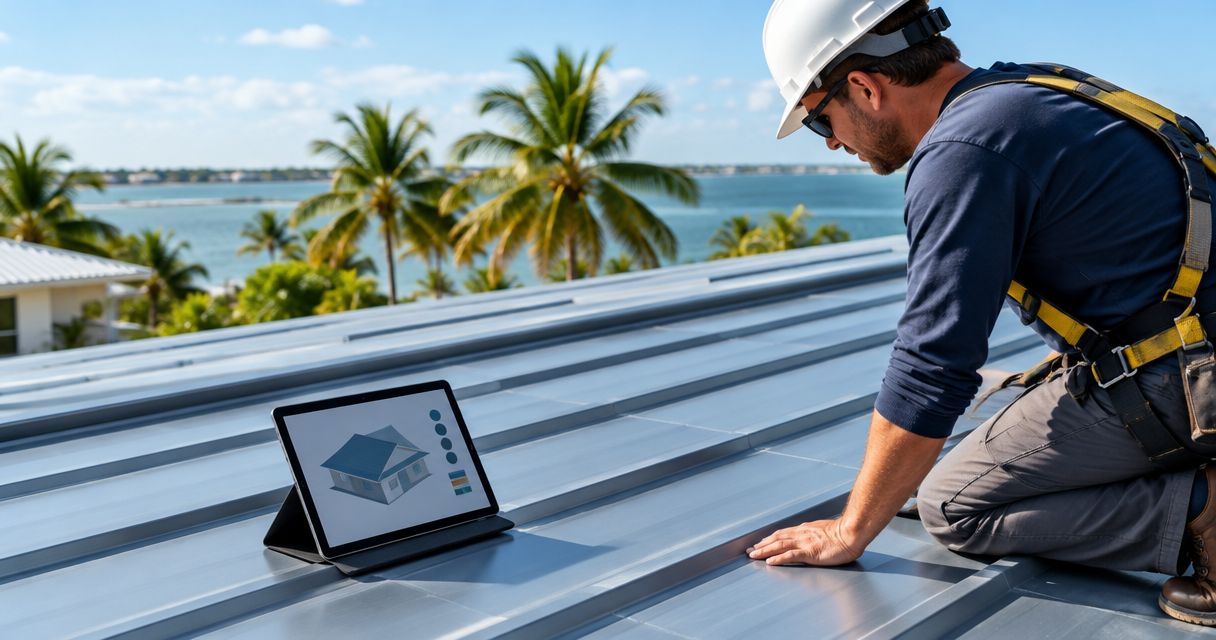
You also do not need to assume that every moisture problem requires a new roof. Roofsmartflorida provides residential roofing services across Southwest Florida; the useful starting point is identifying the water source and the affected materials, not choosing a replacement before the cause is known.
Can a roof leak without any visible damage inside the house?
Yes. Rainwater entering a roof assembly does not have to fall straight onto the ceiling. Its route depends on the opening, the roof's construction, and the materials it encounters along the way.
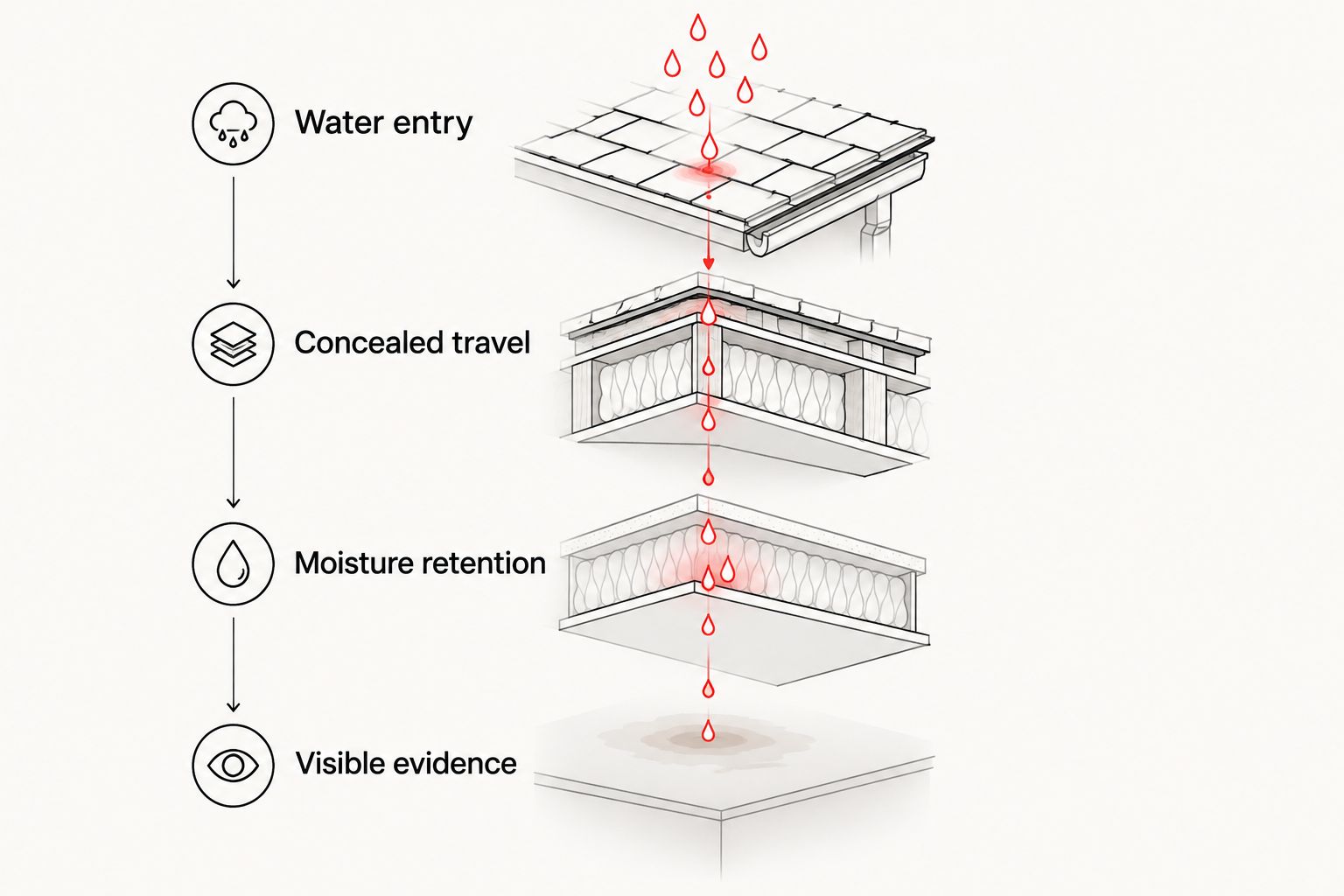
A concealed leak can follow this sequence:
- Water entry. Rain passes through a defect at a roof covering, flashing connection, penetration, or another vulnerable detail.
- Concealed travel. Water moves along the underside of roof decking or follows framing away from the entry point.
- Moisture retention. Insulation or other concealed materials become wet while the finished ceiling remains visibly unchanged.
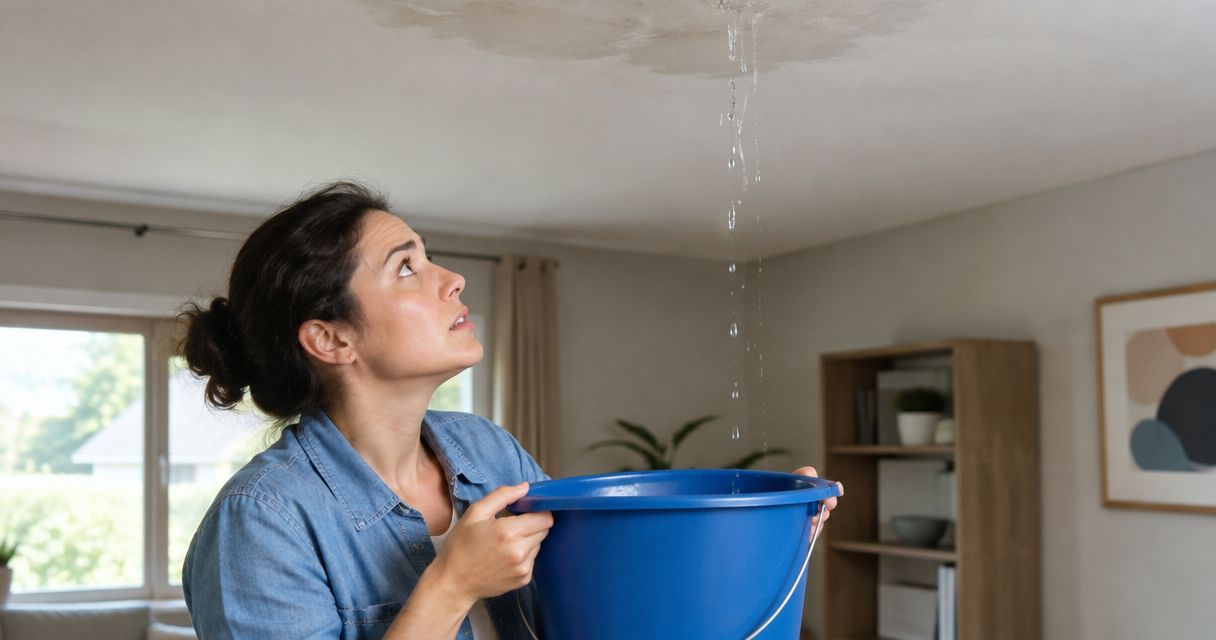
- Visible evidence. A stain, peeling finish, drip, or other indoor symptom appears if moisture reaches the finished surface.
That sequence explains why the location of a future ceiling stain is not necessarily the location of the roof opening. It also explains why a dry room cannot establish that the entire roof assembly is dry.
An inspection also needs to distinguish active moisture from evidence of an old event. Discolored wood can remain after a previous leak has stopped. Conversely, materials can be wet before discoloration becomes obvious.
Where can roof water hide before you see a stain?
Above the ceiling insulation
Insulation can conceal the top surface of ceiling drywall and absorb or hold moisture, depending on the material. From the room below, you cannot see whether that upper surface is wet.
Compressed, damp, or discolored insulation deserves attention, but its appearance does not establish the source. A roof leak, plumbing problem, or condensation issue can all require investigation in an attic.
Along roof decking and framing
Water can track along wood surfaces or connections before dropping elsewhere. An inspector needs to follow the evidence toward its source rather than assume the opening sits directly above the damp spot.
Roof decking is the structural surface beneath the roof covering. Its underside can show water marks that are invisible from your living space and difficult to assess from a ground-level view outside.
Inside wall cavities or enclosed roof spaces
Not every home has an accessible attic beneath every roof section. Vaulted ceilings, enclosed roof assemblies, and additions can limit what an inspector can see without further access.
Water entering near a roof-to-wall connection can also affect concealed wall materials. In those areas, the absence of a ceiling stain says little about the condition of the hidden connection.
Limited access means limited certainty—not proof that the area is dry. Ask the inspector to identify which spaces were examined and which remained concealed.
Is concealed moisture always a roof leak?
No. Treat dampness as evidence of a moisture problem until its source is established. Rain-related timing helps an investigation, but timing alone is not a complete diagnosis.
| Possible source | Clues that support investigation | Best for | Useful next step | Limitation |
|---|---|---|---|---|
| Roof water entry | Dampness associated with rain; evidence near roof connections | Investigating weather-related moisture | Examine the roof and trace accessible interior evidence | Water can travel away from the entry point |
| Condensation | Moisture on cool surfaces or around ducts | Investigating moisture without a clear rain pattern | Evaluate humidity, insulation, air leakage, and equipment conditions | Similar-looking dampness can have another source |
| Plumbing leak | Moisture near supply or drain piping | Investigating dampness linked to plumbing use | Have the relevant piping checked | Pipes can be concealed or pass through unexpected locations |
| Air-conditioning drainage problem | Moisture near an air handler or condensate piping | Investigating dampness associated with cooling equipment | Have the equipment and drainage checked | Nearby roof leakage still needs to be ruled out |
Each route has a practical advantage: it directs attention toward a plausible source. Each also has a limit: a clue is not a confirmed diagnosis. Avoid authorizing roof work solely because someone found damp insulation without tracing why it became wet.
Why visible roof-leak symptoms vary
A leak does not have a fixed timetable for producing a stain. These building conditions help explain the difference:
- Water route: Moisture can move along decking or framing instead of dropping directly onto a ceiling.
- Insulation placement: Insulation can hide damp surfaces and retain moisture above the room.
- Roof-space access: Enclosed areas make early evidence harder to observe.
- Weather exposure: Rain direction and wind affect which openings admit water during a particular event.
- Drying conditions: Air movement, temperature, and humidity affect whether materials dry between wetting events.
- Finish layers: The condition of drywall, coatings, and other finishes affects when surface changes become visible.
These factors are reasons to inspect, not a way to predict a safe waiting period. A small visible symptom does not reliably measure the amount of concealed moisture.
What should you check safely before calling a roofer?
Use this 2026 checklist to collect useful observations without turning a suspected leak into a fall or electrical hazard. Your role is to document what you can safely observe—not to reproduce the leak yourself.
Record the pattern
Write down when you noticed the concern and whether it followed rain, plumbing use, or air-conditioning operation. Describe the location precisely enough that someone else can find it.
Photograph changes from the same safe position. If you already have a 2026 home-maintenance log, add the observations there so the sequence stays clear rather than relying on memory.
Look from finished rooms
Check ceilings, upper walls, closet corners, and areas around skylights for discoloration, peeling finishes, or an unusual odor. Note changes rather than assuming they all share the same cause.
Do not press on a sagging ceiling or stand beneath it. Keep people away from an affected area if the ceiling appears unstable.
Observe the exterior from the ground
Look for displaced roofing, debris, or visibly disturbed areas around roof features using a safe ground-level view. Photograph what you can see without climbing.
A roof can have a water-entry problem without an obvious missing shingle or broken tile. Ground observations help describe a concern; they do not establish that the roof is watertight.
Leave hazardous spaces alone
Do not climb onto a wet roof, move roofing materials, or walk across attic insulation. Attic insulation can conceal surfaces that will not support your weight.
If water is near wiring, fixtures, or electrical equipment, stay clear and arrange qualified help. Do not touch wet switches or equipment, and do not enter standing water to reach an electrical panel.
What should a professional investigation establish?
Ask for the suspected entry point, the supporting evidence, and the limits of the inspection. A useful finding connects the exterior roof condition with the interior moisture pattern rather than presenting unrelated photographs.
The investigation should address:
- Where water is present or where previous wetting is visible.
- Whether accessible evidence supports a roof source or points elsewhere.
- Which roof details correspond to the affected area.
- Whether concealed materials require further evaluation.
- What remains uncertain because access or conditions prevented confirmation.
Moisture meters can help identify or compare damp areas. Thermal imaging can help locate temperature differences that warrant closer examination, but it does not independently prove that a roof is leaking. Neither replaces tracing the source.
Ask for photographs with locations identified. A close-up of a defect is more useful when you also understand where it sits on the roof and how it relates to the affected interior area.
For a 2026 repair scope, request a clear distinction between stopping water entry and addressing materials already affected. Repairing the roof does not automatically dry insulation, restore damaged finishes, or resolve a separate indoor moisture problem.
Should you monitor, repair, or replace the roof?
Confirmed water entry needs a repair decision, not indefinite observation. Monitoring is useful for recording changes or checking a completed repair; it is not a substitute for correcting a known opening.
A localized defect does not automatically justify replacing the whole roof. The decision depends on the condition of the surrounding roof, the extent of affected materials, and whether a durable repair is feasible.
Roofsmartflorida is a roof-repair option for Southwest Florida homeowners who need a local evaluation. Its residential services include repair and replacement; the appropriate scope still depends on the findings at your property, not the absence or presence of a ceiling stain alone.
Request a roof evaluation
Describe the moisture concern and ask about the next step for your Southwest Florida property.
Before approving work, ask what the proposed repair addresses and what it leaves outside the scope. You should understand whether another contractor needs to assess insulation, interior finishes, plumbing, or cooling equipment.
Can a roof leak only when the wind blows?
Yes, a roof can leak during wind-driven rain while remaining dry during other rain events. Wind changes how water reaches joints, roof edges, and connections, so one dry-weather inspection or uneventful shower does not rule out an intermittent opening.
Record the weather conditions when you notice moisture. Do not climb onto the roof during a storm to search for the source.
Can a roof leak without missing shingles or broken tiles?
Yes, a roof can leak even when its visible covering appears intact. Water-entry problems can involve flashing, penetrations, connections, or concealed parts of the assembly rather than an obvious gap in the main covering.
For tile roofs, an intact-looking tile surface does not establish the condition of the underlayment beneath it. The roof needs to be assessed as an assembly, not just a visible surface.
Does a dry attic mean the roof is not leaking?
No, a dry accessible attic does not rule out intermittent leakage or moisture in an enclosed section. Conditions during the inspection and access to the relevant area determine how much an inspector can establish.
Ask whether the inspection reached the roof area connected to your concern. A dry observation elsewhere is not a finding about that concealed location.
FAQ
Can my roof be leaking if there are no ceiling stains?
Yes, your roof can leak before water stains the ceiling. Moisture can remain in insulation, follow framing, or affect concealed wall areas without reaching the finished surface.
What are the first signs of a hidden roof leak?
Possible clues include rain-related dampness, wet insulation, water marks on accessible roof decking, or recurring odors. None confirms a roof leak alone; the source needs to be traced.
Does a musty attic smell mean I need a new roof?
No, a musty attic smell does not establish that you need a new roof. Investigate the moisture source and affected materials before deciding between roof repair, replacement, or work on another building system.
Can condensation look like a roof leak?
Yes, condensation can produce dampness that resembles a roof leak. A professional should consider humidity, cold surfaces, ducts, and equipment alongside possible rainwater entry.
Should I wait until the next storm to report a suspected leak?
No, you do not need to wait for another storm before reporting evidence of moisture. Share photographs and the weather pattern you observed so the contractor can plan the investigation.
Can thermal imaging prove my roof is leaking?
No, thermal imaging alone cannot prove that your roof is leaking. It identifies temperature patterns that need interpretation and confirmation through inspection or other checks.
Should I paint over a mark after the roof is repaired?
Do not treat repainting as proof that the moisture problem is resolved. Confirm that the source has been addressed and affected materials have been evaluated and dried before restoring finishes.
One last thing
The most useful question is not whether the ceiling looks clean; it is whether the water source has been established. A stain can remain after a successful repair, and a clean ceiling can sit beneath wet materials.
Keep the photographs, findings, and repair scope together in your 2026 home records. That record gives you a clear reference if the same area changes again, instead of starting the investigation from memory.