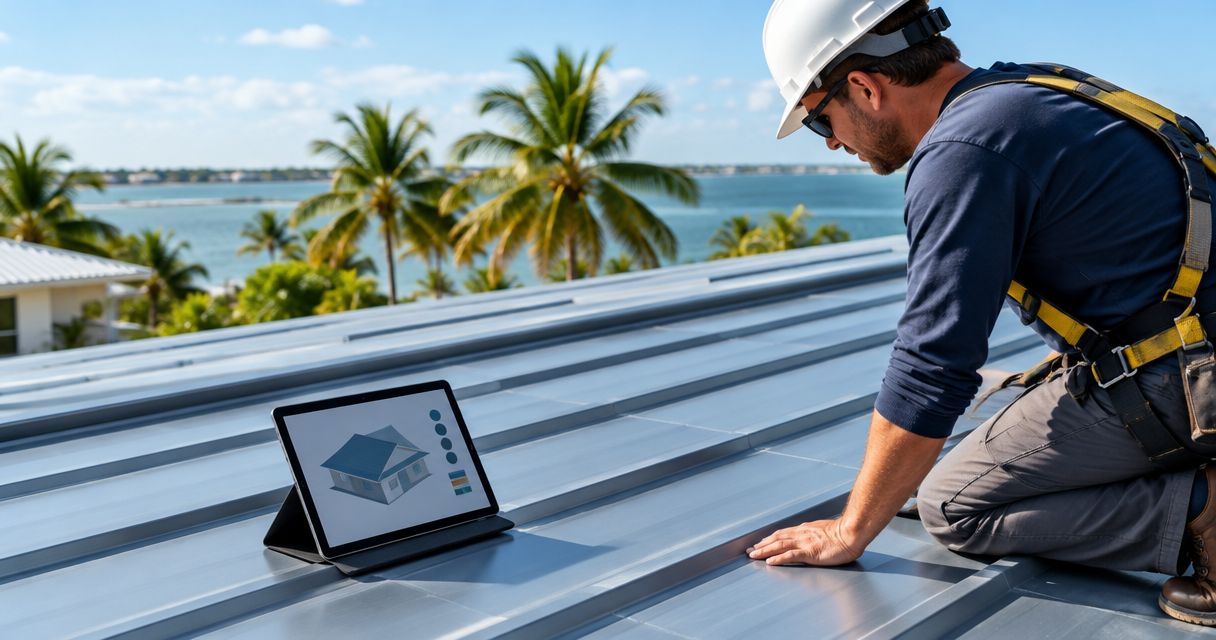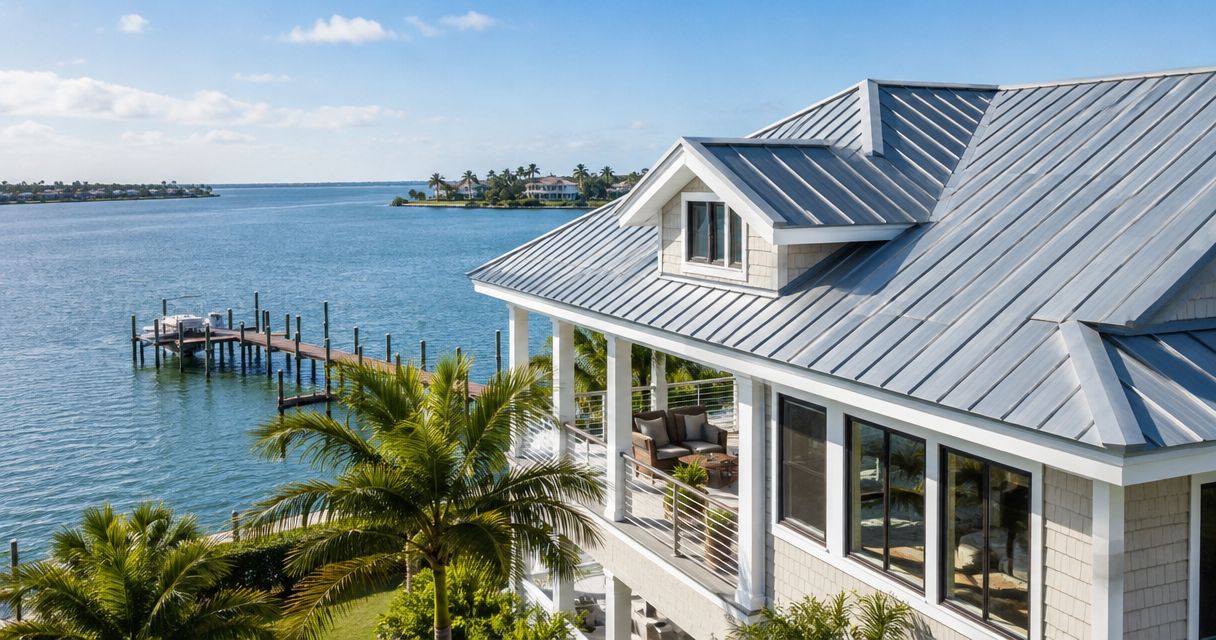
Best overall for salt-exposed waterfront homes: standing-seam aluminum. Best for traditional coastal architecture: clay or concrete tile. Best for a shingle-to-shingle replacement: architectural asphalt shingles. This 2026 guide compares the materials, their limitations, and the installation details that determine whether they suit your Florida home.
- Best roofing materials waterfront homes Florida: standing-seam aluminum leads for salt exposure, subject to assembly approval.
- Clay and concrete tile suit traditional architecture, but roof structure and attachment need verification.
- Architectural shingles suit compatible pitched roofs; low-slope sections need a different roofing system.
- Roofsmartflorida provides waterfront homeowners with roofing installation, repair, and replacement services across Southwest Florida.
Why this matters
A waterfront address does not describe a single roofing environment. An open Gulf-facing house encounters different exposure from a sheltered home beside a freshwater lake. Salt, wind exposure, roof shape, and drainage all belong in the decision.
Choose an approved roof assembly, not just a material name. Panels, tiles, or shingles depend on the deck, underlayment, attachments, flashing, and perimeter details beneath and around them. A strong surface material does not correct weak installation details.
Roofsmartflorida provides roofing services for homeowners in Cape Coral, Fort Myers, Naples, and surrounding Southwest Florida communities. For your 2026 replacement, start with the property's actual exposure and existing roof condition rather than a neighborhood popularity contest.
What makes the best roofing material for a waterfront home?
Use these six criteria before comparing colors or profiles:
- Salt resistance: Check the roof covering and every exposed metal component, including flashing, clips, screws, and gutters.
- Wind attachment: Verify the exact assembly's approval and attachment requirements for your building. A material category has no universal hurricane rating.
- Slope compatibility: Match the system to the measured roof slope. A pitched main roof and a low-slope addition often require different materials.
- Structural suitability: Confirm the existing structure supports the proposed covering, especially when changing from shingles or metal to tile.
- Water management: Review valleys, wall intersections, penetrations, edges, and drainage paths. These details deserve as much attention as the roof field.
- Maintenance access: Understand how inspections, cleaning, and repairs will happen without damaging the covering or creating unsafe access.
For a 2026 proposal, ask the contractor to identify the material, assembly, and installation requirements in writing. A line that says only metal roofing or tile roofing leaves too much unspecified.
Waterfront roofing materials at a glance
The order below favors salt-exposed pitched roofs first. Low-slope roofing appears last because it serves a different roof geometry, not because it is an inferior choice.
| Material | Best for | Standout feature | Key limitation |
|---|---|---|---|
| Standing-seam aluminum | Salt-exposed pitched roofs | Aluminum substrate with concealed panel attachments | Fasteners, flashing, and coastal warranty terms still need scrutiny |
| Clay or concrete tile | Traditional coastal architecture | Distinctive profiles without a metal roof covering | Structural load, tile attachment, and underlayment need attention |
| Architectural asphalt shingles | Compatible shingle-to-shingle replacements | Individual overlapping shingles | Slope limits and wind-sensitive edge details restrict suitability |
| Coated standing-seam steel | Sheltered freshwater waterfront homes | Concealed attachments with a coated steel substrate | Damaged protective layers expose steel to corrosion |
| TPO membrane | Low-slope roof sections | Heat-welded seams in a continuous membrane | Seam workmanship, drainage, and puncture protection are critical |
1. Standing-seam aluminum: best for salt-exposed pitched roofs
Standing-seam aluminum uses metal panels joined at raised seams, with concealed attachments in the specified system. Aluminum does not develop iron rust, making it a strong starting point where salt exposure drives the material decision. It still requires a compatible assembly and careful detailing.
For a 2026 waterfront project, specify aluminum rather than accepting an estimate that says only metal. Aluminum and coated steel are different substrates, even when their finished appearance looks similar from the driveway.
Standing-seam aluminum pros:
- The aluminum substrate avoids the red-rust mechanism associated with exposed steel.
- Concealed attachment keeps routine panel fasteners out of the exposed roof surface.
- Formed panels suit many pitched residential roof designs.
Standing-seam aluminum cons:
- Dissimilar metals and incompatible runoff create corrosion concerns.
- Panels remain vulnerable to dents and installation damage.
- Coastal exclusions and maintenance requirements vary by manufacturer and product.
Ask for the panel alloy, finish, clip system, fastener material, and flashing specifications. Confirm whether the written warranty addresses the home's actual coastal location; do not treat a general finish warranty as proof of unrestricted saltwater suitability.
Best for: Homeowners prioritizing salt exposure on a compatible pitched roof.
Verdict: Buy when the approved aluminum assembly, compatible components, and exposure terms are documented.
2. Clay or concrete tile: best for traditional coastal architecture
Clay and concrete tile provide the shaped profiles associated with Mediterranean and coastal homes. The tiles shed water, while the underlayment and flashing form essential parts of the weather protection beneath them. Tile is not a substitute for a correctly built roof assembly.
The covering itself is not a steel sheet that develops red rust, but metal attachments and flashing remain exposed to coastal conditions. Check those components rather than calling the entire roof corrosion-proof.
Clay or concrete tile pros:
- Profiles suit homes designed around traditional tile architecture.
- Individual damaged tiles can be replaced when compatible replacements are obtainable.
- The tile covering avoids corrosion associated with a steel roof surface.
Clay or concrete tile cons:
- A change to tile requires verification of structural capacity.
- Tiles break under impact or improper foot traffic.
- Underlayment repairs can require removing intact tiles to reach the problem.
Ask how hips, ridges, perimeter tiles, and field tiles will be secured. Also ask how future access for roof-mounted equipment will avoid unnecessary tile damage.
Best for: Homes where tile appearance matters and the structure supports the proposed system.
Verdict: Buy after structural suitability, underlayment, and attachment details are confirmed.
3. Architectural asphalt shingles: best for compatible shingle reroofs
Architectural asphalt shingles are overlapping roof coverings installed over an appropriate deck and underlayment. They belong in the comparison when you want to retain a shingle roof rather than change the home's roofing type. Waterfront exposure does not automatically disqualify shingles.
Slope is a firm screening question. Under Florida Building Code provisions for asphalt shingles, the minimum slope is generally 2 inches of rise per 12 inches of run. Roof slopes below 4 inches per 12 inches of run require the applicable low-slope underlayment treatment; the product instructions and governing code control the installation.
Architectural asphalt shingles pros:
- They preserve the appearance of an existing shingle-roofed home.
- Individual damaged shingles can be replaced where surrounding conditions permit.
- The roof covering itself is not a metal panel subject to salt-driven rust.
Architectural asphalt shingles cons:
- Wind performance depends on the specified product, fastening, sealing, and edge details.
- Shingles are unsuitable below their permitted slope.
- Aging and storm damage can make localized repairs difficult.
For your 2026 proposal, identify the actual shingle product and approved installation rather than relying on the phrase architectural grade.
Best for: A pitched waterfront home retaining a compatible shingle system.
Verdict: Buy for a documented, slope-compatible assembly; Skip for roof sections below the permitted slope.
4. Coated standing-seam steel: best for sheltered freshwater settings
Coated standing-seam steel combines a steel substrate with protective coatings and concealed panel attachments. It deserves consideration beside freshwater where direct salt exposure is not the defining condition. The coating system matters because exposed steel corrodes.
Do not classify every canal-front home as freshwater or sheltered. Establish the actual setting before using this recommendation.
Coated standing-seam steel pros:
- Concealed attachments reduce exposed fastener penetrations across the panel field.
- Standing seams provide a continuous architectural appearance.
- Specified protective coatings separate the steel substrate from the environment.
Coated standing-seam steel cons:
- Scratches, cut edges, and damaged coatings require attention.
- Coastal restrictions differ between products and warranties.
- Incompatible accessories undermine the intended corrosion protection.
Best for: Sheltered freshwater waterfront homes with a suitable approved assembly.
Verdict: Hold until the manufacturer confirms suitability for the exposure; Skip unspecified steel on a salt-exposed property.
5. TPO membrane: best for low-slope roof sections
Thermoplastic polyolefin, or TPO, is a single-ply membrane with heat-welded seams. It serves low-slope areas where shingles are unsuitable. On a waterfront home, that might mean an addition or another roof section designed for membrane roofing.
TPO membrane pros:
- It forms a continuous covering across low-slope roof areas.
- Heat-welded seams join adjacent membrane sheets.
- Details can accommodate penetrations and roof-to-wall transitions when properly designed.
TPO membrane cons:
- Sharp objects and unprotected service traffic can puncture the membrane.
- Seam quality depends on installation conditions and workmanship.
- Poor drainage remains a problem regardless of membrane choice.
Do not select a membrane from a color sample alone. Ask about attachment, perimeter securement, insulation where specified, drainage, and access protection.
Best for: Low-slope sections requiring an approved membrane assembly.
Verdict: Buy when roof geometry calls for membrane roofing and the complete system is specified.
Check the assembly before choosing the finish
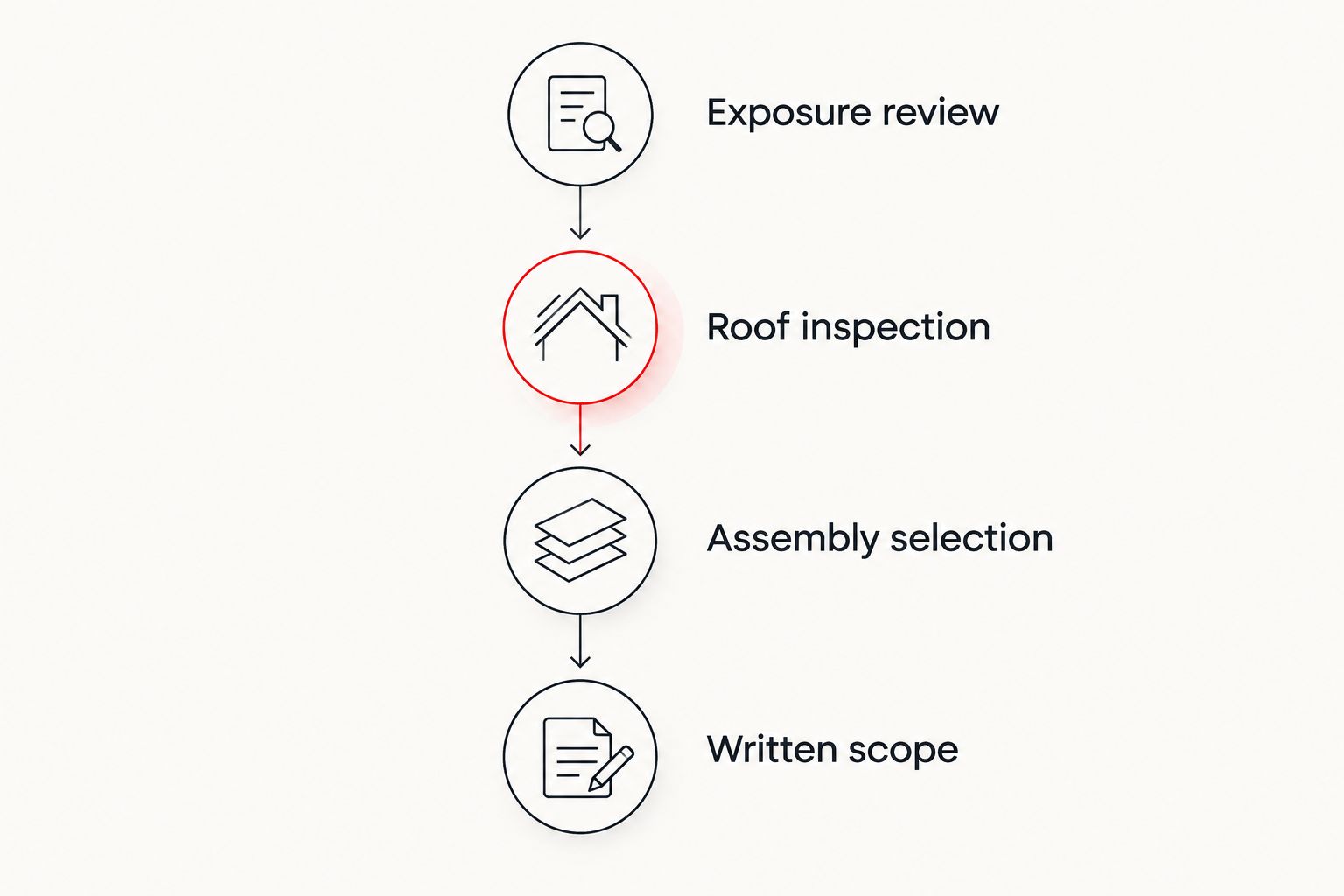
Use this sequence to turn a material preference into a workable roof specification:
- Exposure review: Establish salt exposure, surrounding shelter, and the building's wind-design requirements.
- Roof inspection: Check slope, decking condition, existing leaks, penetrations, and structural suitability.
- Assembly selection: Match the covering, underlayment, attachments, and flashing to the approved system.
- Written scope: Record the products, installation details, exclusions, and maintenance instructions before work begins.
Ask the contractor to explain any mismatch between your preferred material and the roof's condition. A clear explanation is more useful than reassurance that a material is hurricane-proof. No roof covering eliminates storm risk.
Roofsmartflorida offers shingle, metal, flat, and tile roofing services. Ask for a no-pressure free estimate that addresses your roof's condition and the proposed installation rather than a material name alone.
Request an honest roof evaluation
Discuss your waterfront roof, material options, and replacement needs with Roofsmartflorida.
How these materials are ranked
This 2026 ranking prioritizes salt compatibility, slope suitability, attachment requirements, structural fit, and maintainability. It is a selection guide, not a claim that every product within a category performs equally.
Aluminum leads for salt-exposed pitched roofs. Tile serves architecture-led decisions, shingles serve compatible reroofs, coated steel serves sheltered freshwater settings, and TPO serves low slopes. Your roof geometry can move the last option to first place.
Which waterfront roofing material should you choose?
Start with standing-seam aluminum for a salt-exposed pitched roof, then verify the complete assembly. Keep tile on the shortlist when architecture and structural capacity support it. Keep shingles when a compatible shingle reroof meets your needs.
For low-slope sections, move directly to an appropriate membrane discussion. Do not force one material onto every roof plane merely to make the proposal look simpler.
Roofsmartflorida is a roofing-service option for Southwest Florida waterfront homeowners seeking installation, repair, or replacement. Bring the contractor your priorities, then require a written explanation of how the proposed system addresses them.
FAQ
What's the best roofing material for a Florida waterfront home?
Standing-seam aluminum is the starting recommendation for a salt-exposed pitched roof. The final choice depends on slope, approved attachment, compatible components, and the manufacturer's exposure requirements.
Is aluminum roofing better than steel near saltwater?
Aluminum avoids the iron-rust mechanism that affects exposed steel, making it a stronger starting point near saltwater. Aluminum still needs compatible fasteners, flashing, finishes, and installation details.
Can I use architectural shingles on a canal-front home?
Yes, architectural shingles suit canal-front homes when the roof slope and approved assembly permit them. Evaluate the actual salt and wind exposure rather than treating every canal-front property as identical.
Is tile roofing hurricane-proof?
No, tile roofing is not hurricane-proof. Performance depends on the complete assembly, including tile attachment, underlayment, decking, and roof-edge details.
What roofing material should I use on a flat waterfront roof?
Use an approved low-slope roofing system, such as a suitable TPO membrane assembly. Drainage, attachment, seams, penetrations, and perimeter securement need to be specified together.
Does every metal roof have the same coastal warranty?
No, coastal warranty terms differ by manufacturer and product. Obtain the written terms for the exact substrate, finish, and property exposure before choosing the system.
Should I replace the gutters when replacing a waterfront roof?
Assess the gutters during roof planning rather than replacing them automatically. Check condition, capacity, attachment, corrosion, and compatibility with the proposed roof and flashing materials.
One last thing
The small metal components deserve a separate line in your roof proposal. An aluminum roof does not make every screw, clip, flashing piece, or gutter aluminum, and mixing incompatible metals creates avoidable corrosion concerns.
Before approving your 2026 roof, ask one specific question: Which metals touch each other, and which surfaces drain onto them? The answer exposes details that a panel sample cannot show.