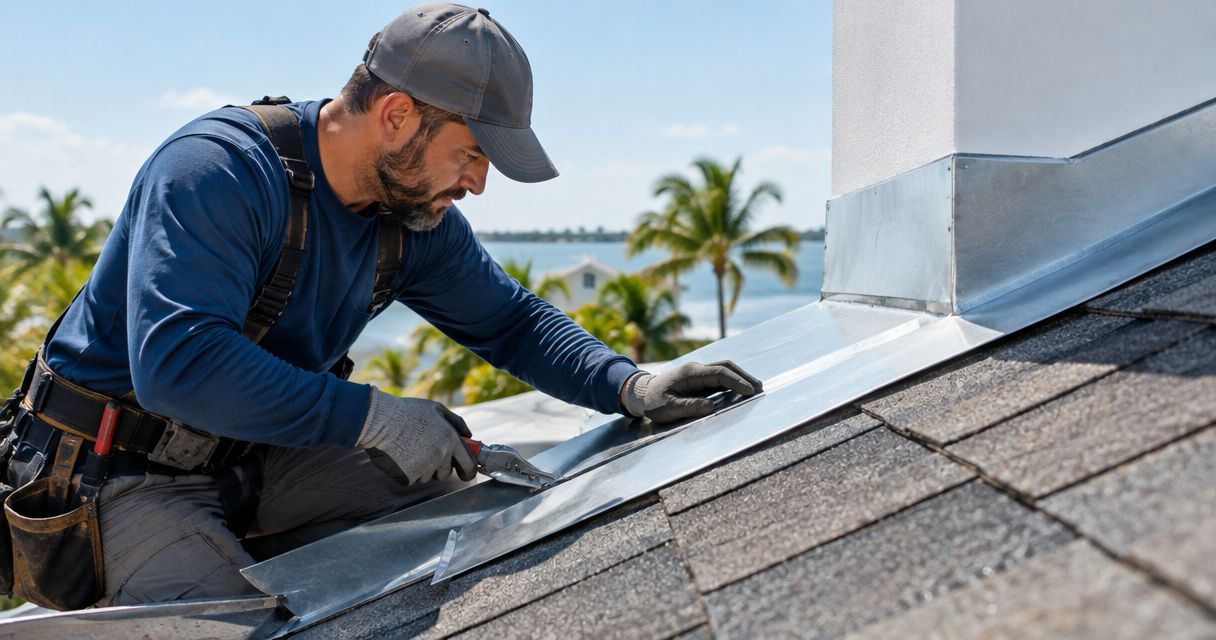
Best overall for exposed coastal flashing: Type 316 stainless steel. For Florida homes in 2026, coated aluminum is the better match for compatible aluminum roof systems, copper suits custom traditional details, and matching membrane flashing belongs on low-slope membrane roofs.
- The best roof flashing materials Florida homeowners choose must match salt exposure, roof materials, and drainage details.
- Type 316 stainless steel is the default recommendation for exposed coastal metal flashing, subject to system compatibility.
- Coated aluminum suits compatible aluminum roofs; copper needs careful separation from incompatible metals.
- Roofsmartflorida provides roof repair and replacement for Southwest Florida homeowners who need flashing problems evaluated.
Why this matters
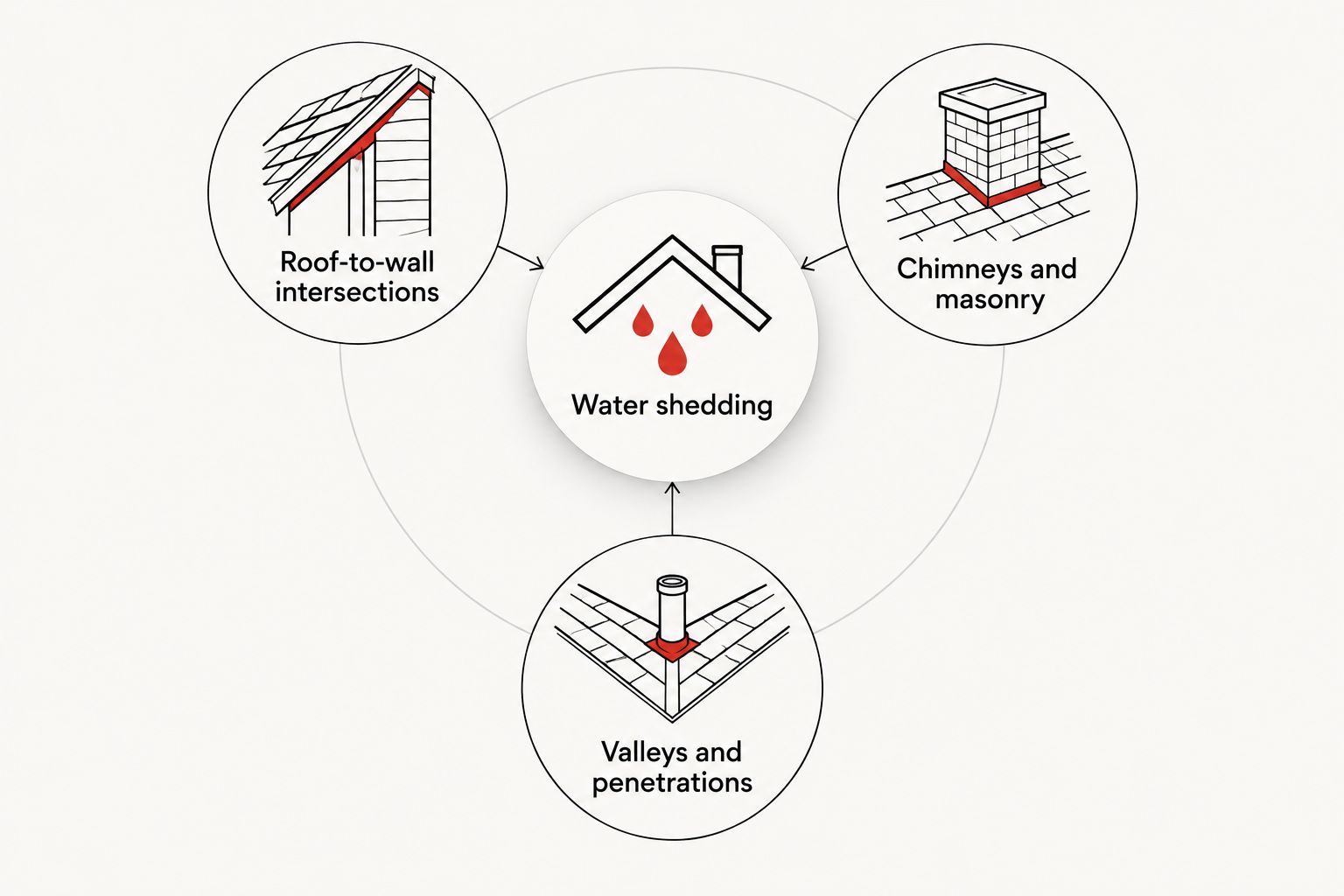
Flashing directs water away from roof intersections, walls, valleys, and penetrations. A sound roof covering does not compensate for flashing that sends water behind the waterproofing layer.
For a 2026 repair or replacement, choose the detail before choosing the metal. Coastal exposure, adjoining materials, and installation instructions determine whether a material belongs on your roof.
Roofsmartflorida provides residential roofing installation, repair, and replacement across Southwest Florida. Roofsmartflorida is best suited to Southwest Florida homeowners seeking roofing services rather than flashing materials alone.
What makes the best roof flashing materials for Florida?
Use these criteria to compare your 2026 roofing proposals. A material name alone does not describe a complete flashing assembly.
- Corrosion resistance: Match the material to salt exposure and the possibility of trapped moisture.
- Material compatibility: Check the roof covering, fasteners, sealants, masonry, and any metal that drains onto the flashing.
- Water-shedding design: Favor details that direct water onto the next drainage surface, not behind it.
- Movement allowance: Roof materials expand and contract. Flashing joints must accommodate that movement.
- System requirements: Follow the roof manufacturer's instructions and applicable local requirements for the actual assembly.
- Repair access: Consider whether future work requires removing shingles, tiles, wall finishes, or membrane seams.
Florida roof flashing materials at a glance
| Material | Best for | Standout feature | Key limitation |
|---|---|---|---|
| Type 316 stainless steel | Exposed coastal metal details | Strong resistance to chloride-related corrosion | Harder to form and join than softer sheet metals |
| Coated aluminum | Compatible aluminum roof systems | Lightweight and easy to shape | Vulnerable to incompatible contact and damaged finishes |
| Copper | Custom chimney and traditional architectural details | Forms intricate shapes and accepts soldered joints | Runoff and direct contact can damage incompatible metals |
| Galvanized steel | Compatible inland steel-roof details | Formable steel protected by zinc | Protection declines where zinc is depleted or damaged |
| Matching roofing membrane | Low-slope membrane roof transitions | Connects wall and penetration flashing to the roof membrane | Seams, attachment, and terminations remain critical |
These are application-based recommendations, not interchangeable upgrades. Stainless steel is not automatically suitable wherever aluminum was specified, and membrane flashing does not replace every metal edge or termination.
1. Type 316 stainless steel: best for coastal roof flashing
Type 316 stainless steel contains molybdenum, which improves resistance to chloride-related corrosion compared with Type 304 stainless steel. That makes Type 316 a strong starting point for exposed flashing near saltwater.
The grade does not make the assembly corrosion-proof. Salt accumulation, tight crevices, incompatible connections, and poor drainage still matter.
Type 316 stainless steel pros:
- Resists coastal chloride exposure better than Type 304.
- Does not depend on a painted finish for its underlying corrosion resistance.
- Suits custom-fabricated metal flashing where the roof system permits it.
Type 316 stainless steel cons:
- Requires suitable fabrication tools and joining methods.
- Does not eliminate crevice corrosion or compatibility concerns.
- Must be paired with appropriate fasteners and adjoining materials.
Best for: Exposed coastal roof-to-wall, chimney, and other custom metal details with a documented compatible design.
Ask your contractor to identify the stainless steel grade in writing. A proposal that says only stainless steel leaves a meaningful material distinction unresolved.
Verdict: Buy Type 316 stainless steel when coastal exposure and the roof detail justify it.
2. Coated aluminum: best for compatible aluminum roof systems
Coated aluminum flashing is lightweight and readily formed into roof edges, wall transitions, and other shapes. On an aluminum roof, compatible aluminum flashing also avoids introducing a different metal unnecessarily.
The coating is only part of the specification. The alloy, thickness, finish, contact surfaces, and fastening detail must suit the application.
Coated aluminum pros:
- Easy to form around many conventional roof details.
- Matches compatible aluminum roof components.
- Does not develop the red rust associated with exposed carbon steel.
Coated aluminum cons:
- Copper contact or copper-bearing runoff can accelerate corrosion.
- Direct contact with alkaline masonry requires an appropriate separation detail.
- Thin material can deform when poorly supported or handled.
Best for: Aluminum roof systems and other assemblies whose manufacturer accepts the specified aluminum flashing.
For coastal homes, do not assume that any painted aluminum sheet qualifies. Ask about the finish's exposure limitations and how cut edges, fasteners, and masonry interfaces are addressed. The same compatibility questions apply when considering metal roofing for coastal Southwest Florida homes.
Verdict: Buy coated aluminum when it matches the roof system and exposure requirements.
3. Copper: best for custom traditional roof details
Copper is malleable and accepts soldered joints, making it useful for intricate chimney, dormer, and architectural flashing. Its surface develops a patina rather than relying on paint as its primary weathering surface.
Copper is specified by sheet weight as well as detail. Common roofing sheet designations include 16 ounces per square foot and 20 ounces per square foot; those figures describe material weight, not promised service life.
Copper pros:
- Forms complex shapes around traditional architectural details.
- Supports soldered seams when properly designed and executed.
- Develops a protective surface patina through weathering.
Copper cons:
- Copper runoff can stain adjacent surfaces.
- Contact or runoff can corrode aluminum and zinc-coated components.
- Requires skilled fabrication and movement-conscious joint design.
Best for: Custom chimney and traditional architectural details where adjacent materials and drainage are compatible.
A heavier copper sheet does not fix a poorly arranged joint. Ask why the proposed weight suits the unsupported spans, bends, and connections in your specific detail.
Verdict: Buy copper for a deliberate architectural detail; skip it as an isolated upgrade beside incompatible metals.
4. Galvanized steel: best for compatible inland steel details
Galvanized steel uses a zinc coating to protect the underlying steel. It is formable and fits many conventional flashing applications, provided the coating and assembly suit the environment.
Salt exposure increases the importance of coating selection and maintenance. Galvanized steel is not the default recommendation here for highly exposed waterfront flashing.
Galvanized steel pros:
- Forms conventional step, apron, and edge details.
- Provides the stiffness of steel sheet.
- Uses zinc to protect the underlying steel against corrosion.
Galvanized steel cons:
- Exposed steel rusts after protective zinc is depleted.
- Cuts, abrasion, and persistently wet areas deserve attention.
- Copper contact and runoff create compatibility problems.
Best for: Inland details where the roof manufacturer permits the specified galvanized material and coating.
Do not confuse galvanized steel with every other coated steel product. Ask the contractor to name the actual coating rather than writing metal flashing as a catch-all.
Verdict: Hold until the coating specification and exposure suitability are documented.
5. Matching membrane: best for low-slope roof transitions
On a low-slope membrane roof, wall and penetration flashing often uses material designed to join to the roof membrane. Thermoplastic membranes use compatible welding details; other systems use their specified adhesives, tapes, or flashing components.
Matching means an accepted system connection, not simply a similar-looking sheet. Metal still has a role at edges, counterflashings, and terminations where the design requires it.
Matching membrane pros:
- Connects transitions directly to the roof's waterproofing system.
- Accommodates details around curbs and penetrations using system components.
- Avoids treating every transition as a sheet-metal-only problem.
Matching membrane cons:
- Poor seams and terminations remain leak paths.
- Incompatible patch materials compromise repairs.
- Exposed membrane requires protection from physical damage where specified.
Best for: Low-slope membrane roof walls, equipment curbs, and penetrations.
Verdict: Buy the specified membrane flashing system; skip generic patches presented as equivalent.
Match the material to the actual leak detail
A valley, chimney, and pipe penetration do not need identical flashing. Start by identifying where water enters and where the finished detail will discharge it.
Roof-to-wall intersections
Shingle sidewalls commonly use step flashing integrated with successive shingle courses. The wall-side water barrier or counterflashing must direct water onto that flashing, rather than behind it.
At the bottom of a roof-to-wall intersection, a correctly arranged kick-out detail diverts runoff away from the wall. Better metal cannot compensate for a missing water-diversion detail.
Chimneys and masonry
Chimney flashing combines roof-side water shedding with a wall-side connection. Counterflashing protects the upper edge of the base flashing while allowing the assembly to manage movement.
Smearing sealant across the joint is not equivalent to rebuilding a failed connection. Have the contractor identify which component failed before approving the repair.
Valleys and penetrations
Valleys concentrate runoff, so the design must preserve a clear drainage path. Vent pipes and skylights need compatible flashing assemblies that fit their shape and roof covering.
A pipe boot's flexible seal and its metal base are separate parts of the detail. Replacing the metal alone does not resolve a split seal.
What your 2026 flashing proposal should identify
Before authorizing work, ask for a description you can compare against the finished roof. You do not need to design the assembly yourself.
- Material specification: Metal type, grade or coating, and thickness or sheet weight.
- Compatibility: Contact with roofing, masonry, fasteners, sealants, and runoff from other metals.
- Water path: How the flashing connects to underlayment, wall drainage layers, and adjacent roof covering.
- Replacement scope: Which shingles, tiles, membrane areas, or wall finishes must be removed and restored.
- Finished documentation: Photographs before concealed connections are covered.
Ask Roofsmartflorida to evaluate flashing within the surrounding roof repair or replacement scope. An isolated patch and a rebuilt transition are different jobs; the written proposal should make that distinction clear.
Request a roof evaluation
Discuss roof leaks, flashing concerns, and repair or replacement needs in Southwest Florida.
How these materials are ranked
This 2026 ranking prioritizes corrosion resistance, material compatibility, drainage design, movement, and repair access. It ranks materials by application rather than claiming that one sheet metal belongs on every Florida roof.
Type 316 stainless steel leads for exposed coastal metal details. Coated aluminum, copper, galvanized steel, and matching membrane each earn a separate use case where their strengths fit the assembly.
Which roof flashing material should you choose?
For exposed coastal metal flashing, start with Type 316 stainless steel and verify compatibility. For an aluminum roof, start with the manufacturer's accepted aluminum detail instead of changing metals automatically.
Choose copper for intentionally designed traditional details and matching membrane for membrane-roof transitions. Keep galvanized steel conditional on the coating, exposure, and system requirements.
For your 2026 project, reject any proposal that names the material but leaves the water path unexplained. The installed connection is what keeps runoff outside.
FAQ
What's the best roof flashing material for a Florida coastal home?
Type 316 stainless steel is a strong default for exposed coastal metal flashing because it resists chloride-related corrosion better than Type 304. The roof system, fasteners, and adjoining materials must still be compatible.
Is aluminum flashing good for Florida roofs?
Coated aluminum is a good choice for compatible aluminum roof systems and other approved assemblies. Check exposure limitations, masonry separation, and contact with copper or copper runoff.
Is copper flashing better than stainless steel?
Copper is better suited to intricate traditional details that benefit from malleability and soldered joints; Type 316 stainless steel is the default recommendation here for exposed coastal metal flashing. Neither material belongs beside incompatible components without a suitable design.
Can a roofer reuse old flashing during roof replacement?
Reuse requires sound material, compatible connections, and acceptance under the applicable installation requirements. Corroded, damaged, or unsuitable flashing should not be hidden beneath a new roof covering.
Does roof sealant replace metal flashing?
Sealant does not replace properly designed flashing. It belongs only where the specified detail uses it, rather than as the sole defense across a failed roof-to-wall connection.
What flashing belongs on a flat roof?
A low-slope membrane roof needs flashing components accepted for that membrane system. Metal edges and counterflashings remain necessary wherever the roof design requires them.
How do I know whether flashing is causing a roof leak?
A roof inspection must trace the water path and examine the flashing connection, surrounding roof covering, and penetrations. A ceiling stain alone does not identify the entry point, so avoid climbing onto the roof to diagnose it yourself.
One last thing
Inspect what drains onto the flashing, not just what touches it. Copper positioned uphill from aluminum can create a corrosion problem through runoff even when the metals never meet directly.
Ask for a photograph showing the uphill roof area as well as the repaired flashing. That wider view helps document a compatibility issue that a close-up misses.