Salt spray corrodes cheap fasteners in a few storm seasons, and 150 mph gusts test every seam on a coastal roof — the panel profile you pick decides which problem you get in 2026 and which one you don't.
- Standing seam aluminum is the top pick for best metal roof panels coastal homes buyers within a mile or two of the Gulf in 2026 — Buy.
- 24-gauge standing seam steel with a Galvalume coating is the strongest all-around choice for most Cape Coral and Fort Myers homes — Buy.
- 5V-crimp exposed-fastener steel costs less upfront but needs fastener resealing every 8-10 years near salt water — Hold.
- Uncoated corrugated steel panels rust fast in salt spray and should be skipped on any coastal SWFL home — Skip.
- Copper panels resist corrosion indefinitely but make more sense as an accent roof than a full re-roof — Consider.
Why this matters
Southwest Florida roofs deal with two enemies at once: salt-laden humidity that eats through weak coatings and hurricane-force wind that tests every fastener and seam. A panel that performs fine in Ohio can fail within a decade on a Naples or Cape Coral roof facing the Gulf.
Florida Building Code requires roofing products in coastal counties to carry wind-uplift ratings matched to the local wind zone, and most SWFL jurisdictions sit in the 130-150 mph range. That single requirement rules out several cheap panel systems before cost even enters the conversation.
Metal roofing for coastal Southwest Florida homes needs to be evaluated on corrosion resistance, gauge thickness, and fastening system together — not on price per square alone. Get any one of those wrong and the roof looks fine for two or three years before it doesn't.
How this list is ranked
Each panel type below is weighed against five factors that actually decide coastal performance: corrosion resistance in salt air, gauge (thickness), fastening system (concealed vs. exposed), documented coastal warranty coverage, and installed cost. Wind-uplift capability is treated as a baseline requirement, not a differentiator, since any panel sold for SWFL installation has to clear Florida Building Code approval regardless of brand.
Roof Smart of SW Florida installs metal roofing across Cape Coral, Fort Myers, and Naples, and the ranking reflects which panel types actually hold up in that specific salt-air, high-wind environment versus which ones are better suited to inland or non-coastal markets.
The ranked list
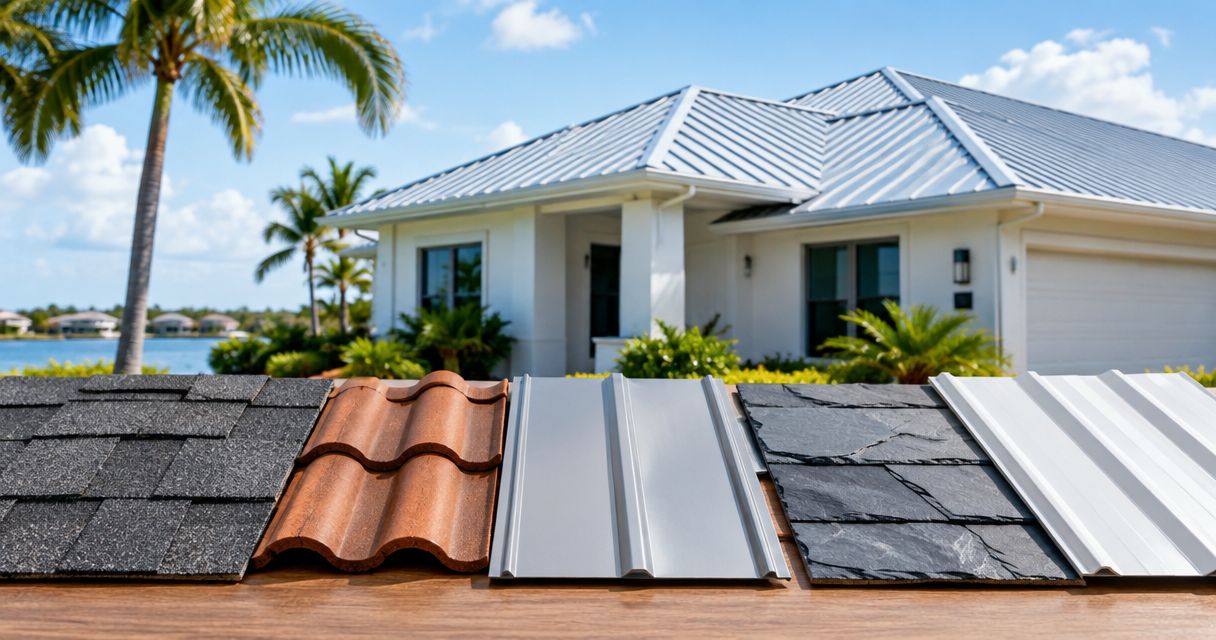
1. Standing seam aluminum — the salt-air specialist
Aluminum doesn't rust. It oxidizes on the surface and forms a thin protective layer that stops further corrosion, which is exactly what a roof within a mile or two of the Gulf needs. Aluminum panels also run roughly a third lighter than steel equivalents, which matters on older SWFL homes with lighter original framing.
Standing seam construction hides every fastener under the seam, so there's no exposed screw head for salt spray to attack. The tradeoff is cost — aluminum standing seam typically prices above steel standing seam.
Verdict: Buy for homes on barrier islands or within roughly two miles of open salt water.
2. Standing seam steel, 24-gauge with Galvalume coating — the all-around workhorse
This is the panel most SWFL homeowners land on. A 24-gauge steel panel with a Galvalume or PVDF paint coating resists corrosion well inland of the immediate coastline, holds up to wind-driven debris better than thinner 26-gauge stock, and carries a lower installed cost than aluminum.
Metal roofing in Naples projects lean heavily on this spec because it balances durability against budget for homes that aren't sitting directly on the water. The concealed fastener system matches aluminum's advantage of no exposed screws.
Verdict: Buy for most homes in Cape Coral, Fort Myers, and Naples that aren't beachfront.
3. Stone-coated steel tile panels — the HOA-friendly option
Some HOA and condo boards require a tile aesthetic even when the homeowner wants metal performance. Stone-coated steel panels interlock into a profile that reads as barrel or flat tile from the street while carrying steel's wind-uplift ratings underneath the stone coating.
The panels run heavier than plain standing seam steel, which occasionally raises structural load questions on older trusses, and the interlocking system adds installation labor.
Verdict: Consider for HOA and condo communities where tile-look rules apply and metal panels for metal roofing in Cape Coral homes need to pass architectural review.
4. 5V-crimp exposed-fastener steel — the budget panel with a catch
5V-crimp costs less than standing seam because it skips the concealed clip system and screws straight through the panel face. That's fine inland. Near salt water, every one of those fastener penetrations is a future leak point once the rubber washer degrades.
Expect to reseal or replace fasteners on an 8-10 year cycle in a coastal environment — a maintenance line item standing seam buyers don't have.
Verdict: Hold — fine for inland SWFL properties with a maintenance plan, risky as a set-it-and-forget-it coastal roof.
5. Uncoated corrugated galvanized steel — the one to skip
Corrugated steel shows up most on sheds, barns, and low-cost commercial roofs at typically 29-gauge with minimal coating. It has no place on a coastal residential re-roof — the thin gauge dents under wind-driven debris and the coating package isn't built for sustained salt exposure.
Verdict: Skip entirely for any home within reach of Gulf salt spray.
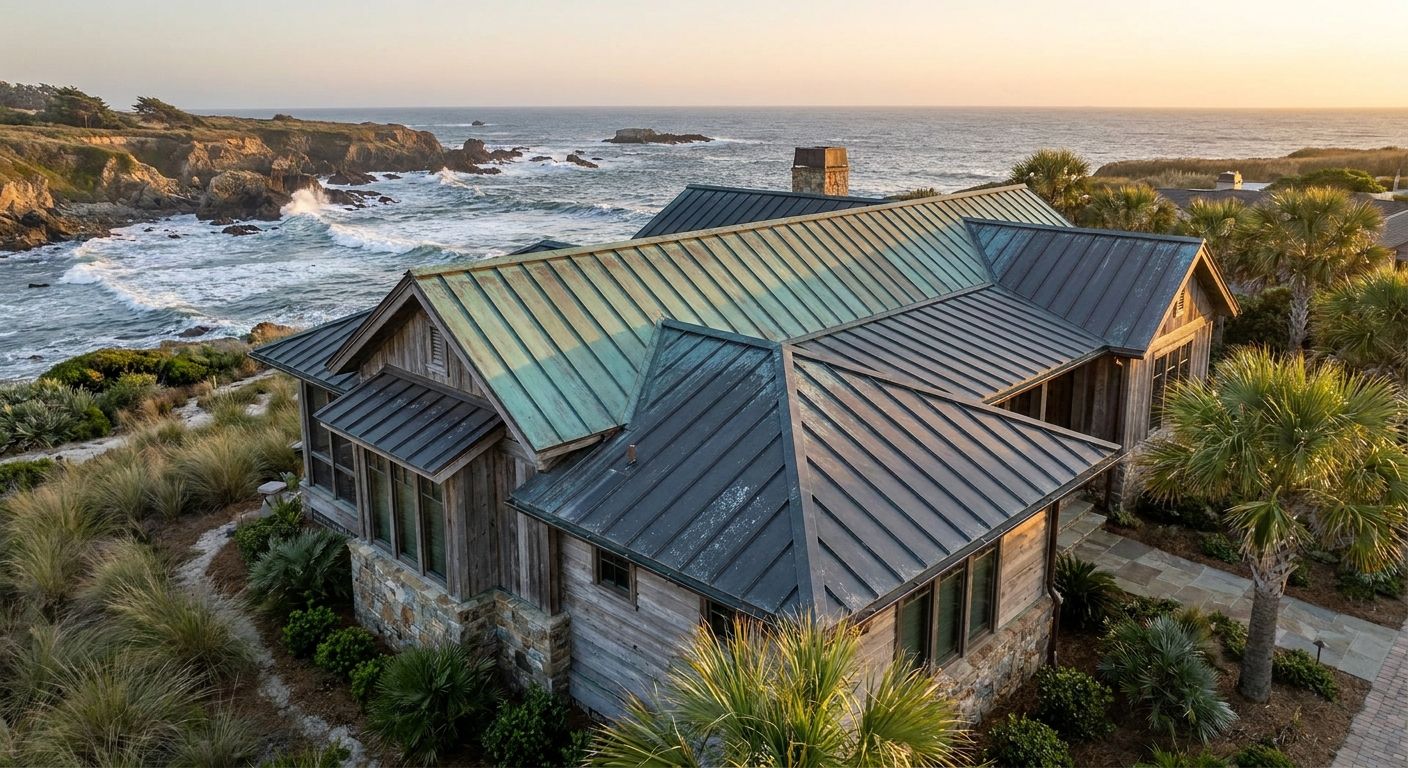
6. Copper — the heirloom pick
Copper forms a natural patina that stops corrosion cold and effectively never needs a coating refresh. It's also one of the most expensive roofing materials on the market, which makes a full copper re-roof hard to justify on cost alone.
Where it earns a spot is on accent roofs, dormers, porch covers, and statement homes where the look and the longevity matter more than the price per square.
Verdict: Consider for accent applications, not as a primary panel for a full coastal re-roof on a standard budget.
Comparison table
| Panel Type | Corrosion Resistance | Fastening | Best For | Verdict |
|---|---|---|---|---|
| Standing seam aluminum | Highest | Concealed | Barrier islands, direct salt exposure | Buy |
| Standing seam steel (24-gauge Galvalume) | High | Concealed | Most SWFL homes, non-beachfront | Buy |
| Stone-coated steel tile | High | Interlocking | HOA/condo tile-look requirements | Consider |
| 5V-crimp exposed-fastener steel | Moderate | Exposed | Inland homes with maintenance plan | Hold |
| Uncoated corrugated steel | Low | Exposed | Sheds, barns, non-coastal only | Skip |
| Copper | Highest | Concealed | Accent roofs, statement homes | Consider |
Sourcing and installation rules
- Check the Florida Product Approval or Miami-Dade NOA number on any panel before it goes on the roof. Florida Building Code requires documented wind-uplift approval for coastal county installations, and a spec sheet without that number isn't code-compliant on its own.
- Read the warranty's coastal exclusion clause. Many standard steel panel warranties exclude corrosion coverage within a set mile radius of salt water — ask for the exact distance in writing before buying based on the panel's rated lifespan.
- Hire a licensed SWFL contractor who pulls permits and matches the panel to your address's specific wind zone, not a generic spec sheet number. A wind mitigation inspection for homeowners insurance discounts after installation can also document the new roof's wind rating for the insurer.
Get a free metal roofing estimate
No-pressure evaluation for Cape Coral, Fort Myers, and Naples homes.
FAQ
What's the best metal roof panel for a coastal Florida home in 2026?
Standing seam aluminum is the top pick for homes within a mile or two of the Gulf in 2026 because it doesn't rust and hides fasteners under a concealed seam. Standing seam steel with a Galvalume coating is the better value for homes further inland.
Is aluminum or steel better for salt air?
Aluminum resists salt-air corrosion better than steel because it oxidizes into a protective layer instead of rusting. Steel closes most of that gap with a Galvalume or PVDF coating, which is why 24-gauge coated steel remains the common choice for non-beachfront SWFL homes.
How much wind can a standing seam metal roof withstand?
Standing seam panels installed under Florida Building Code in SWFL are rated to the local wind zone, typically in the 130-150 mph range. The concealed fastener system is a major reason standing seam outperforms exposed-fastener panels in wind events.
Do metal roofs rust near the ocean in Southwest Florida?
Uncoated or minimally coated steel panels can rust within a few years of direct salt exposure. Coated steel and aluminum panels are built to resist that corrosion, which is why panel selection matters more the closer a home sits to the water.
What gauge metal roofing is best for hurricanes?
24-gauge steel is the standard recommendation for coastal Florida homes because it resists denting and oil-canning from wind-driven debris better than thinner 26-gauge or 29-gauge stock. Thinner gauges are more common on sheds and low-cost commercial applications, not coastal residential roofs.
Can metal roofing lower homeowners insurance in Florida?
A wind mitigation inspection after a metal roof installation can document features insurers use to apply premium discounts. The discount amount depends on the insurer and the specific wind mitigation features documented, not the panel brand alone.
How long do metal roof panels last on the Gulf Coast?
Standing seam steel and aluminum panels typically last 40 to 70 years even in coastal conditions when properly coated and installed. Exposed-fastener panels often need fastener maintenance well before the panel itself fails.
Is stone-coated steel a good option for HOA communities?
Stone-coated steel works well for HOA and condo communities that require a tile aesthetic, since the panels mimic a tile profile while carrying steel's wind-uplift performance. It runs heavier than standard steel panels, which is worth confirming against the roof structure first.
One last thing
The panel almost never fails first on a coastal metal roof — the fastener does. On exposed-fastener systems, the rubber washer under each screw head degrades from UV and salt exposure years before the steel or aluminum panel underneath shows any wear, which is the real argument for paying up for a concealed-fastener standing seam system in 2026 rather than the cheaper 5V-crimp option.