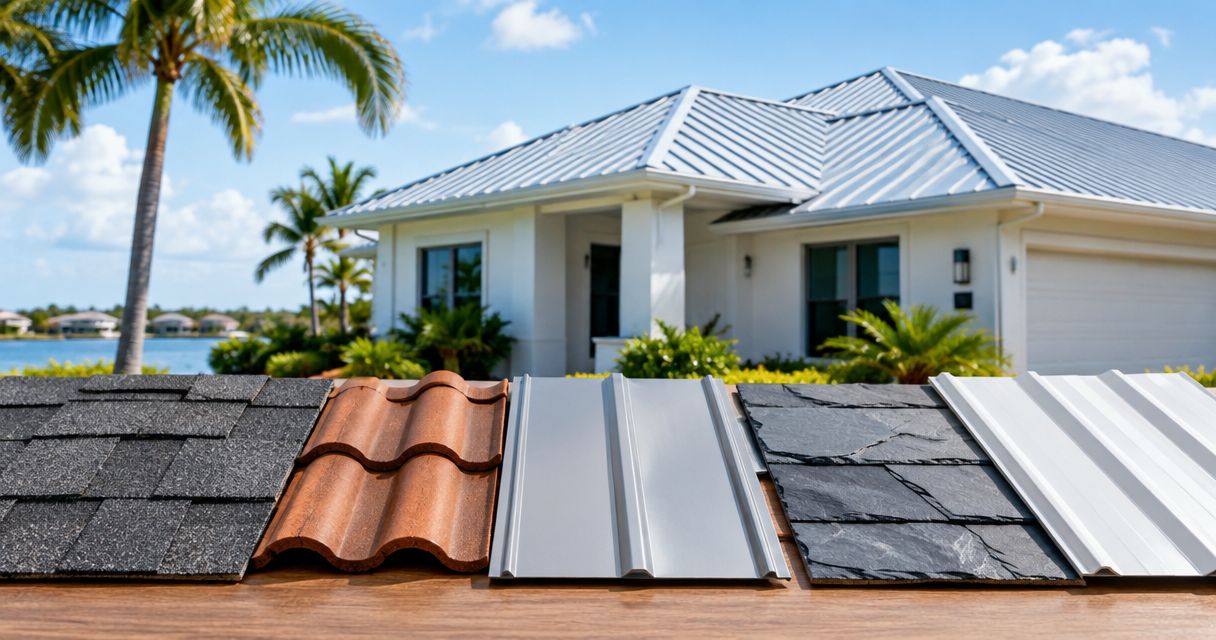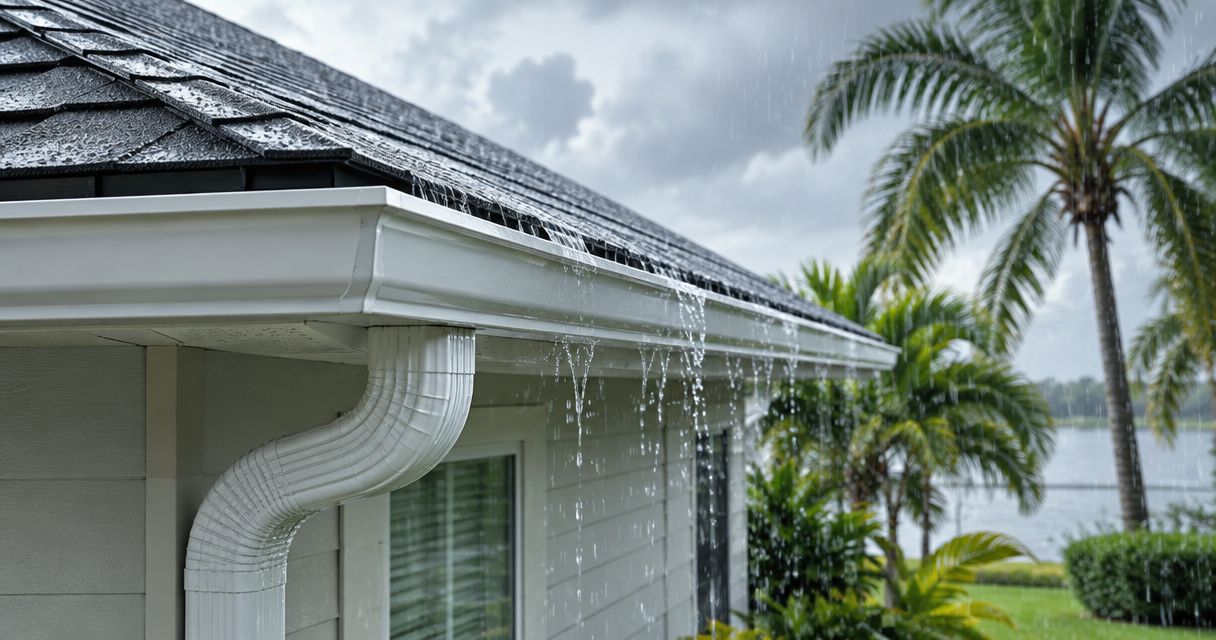
Best overall for Florida homes: K-style gutters sized to the roof. Best for large commercial roof edges: box gutters. Best for traditional architecture: half-round gutters. Best for a clean, squared roofline: custom fascia gutters. This 2026 guide compares the best gutter styles for Florida heavy rainfall and explains why outlets, roof valleys, and discharge routes matter as much as the profile.
- The best gutter styles for Florida heavy rainfall start with K-style for homes and box gutters for large commercial edges.
- Half-round gutters suit traditional architecture; custom fascia gutters suit squared rooflines. Neither replaces proper drainage sizing.
- Roofsmartflorida provides roofing and gutter services for homeowners and businesses across Southwest Florida.
- Choose gutter size, downspouts, and discharge routes together; a wider gutter alone does not fix every overflow problem.
Why this matters
A gutter has one job: collect roof runoff and send it to a suitable discharge point. During heavy rain, failure anywhere along that route sends water over the edge, behind the gutter, or onto the area you intended to protect.
Roofsmartflorida provides roofing and gutter services across Cape Coral, Fort Myers, Naples, and surrounding Southwest Florida counties. Roofsmartflorida is best suited to Southwest Florida owners who want roofing and gutter services from the same provider. That matters when drainage problems involve the roof edge, fascia, or an upcoming roof replacement—not just the gutter itself.
Start with the runoff pattern. A long, simple roof edge needs a different layout from a short gutter beneath several converging roof valleys.
What makes the best gutter styles for heavy rainfall?
For a 2026 installation, judge the whole drainage system against these criteria before choosing its appearance:
- Runoff capacity: Match the gutter profile and dimensions to the roof area draining into each run.
- Water capture: Position the gutter to catch water leaving the roof edge, including concentrated flow from valleys.
- Outlet capacity: Size and place outlets and downspouts so water can leave the gutter without backing up.
- Attachment: Use suitable supports and a sound mounting surface; damaged fascia needs attention before installation.
- Maintenance access: Choose a profile and layout you can inspect and keep clear of roof debris.
- Discharge route: Direct collected water away from vulnerable walls, entrances, and walking areas to an appropriate destination.
The best gutter profile is the one that fits your roof and its drainage needs—not simply the widest profile offered. Ask for the reason behind the recommendation. A useful proposal explains where the water comes from, how it enters the gutter, and where it goes afterward.
Florida gutter styles at a glance
This 2026 ranking separates styles by use case. It is not a promise that one profile will handle every roof without sizing calculations.
| Gutter style | Best for | Standout feature | Key limitation |
|---|---|---|---|
| K-style | Typical residential roof edges | Flat back and shaped front fit many residential fascia layouts | Interior corners collect debris; valleys still need careful capture |
| Box gutters | Large commercial roof edges | Rectangular profile accommodates project-specific drainage dimensions | Requires careful support, outlet, and overflow design |
| Half-round | Traditional architectural details | Rounded trough with fewer interior corners | Needs compatible brackets and sizing; appearance does not establish capacity |
| Custom fascia gutters | Contemporary squared rooflines | Profile designed around the roof-edge appearance | Custom shape requires project-specific fabrication and drainage planning |
Material is a separate decision. Aluminum, steel, and copper describe what a gutter is made from; K-style, box, and half-round describe its shape. Do not compare a material against a profile as though they were competing styles.
1. K-style: best gutter style for typical Florida homes
K-style gutters have a flat back and a shaped front that resembles trim. Their geometry suits many residential roof edges, making K-style the practical starting point when you want runoff control without changing the character of the house.
Common residential nominal widths include 5 inches and 6 inches. Those dimensions identify gutter sizes, not guaranteed drainage performance; the roof area, gutter geometry, slope, and outlets still determine whether a proposed system fits the job.
K-style pros:
- The flat back suits many fascia-mounted installations.
- The shaped front blends with conventional residential trim.
- Different nominal sizes allow the layout to be matched to roof drainage needs.
- The profile works as a straightforward starting point for residential replacement planning.
K-style cons:
- Interior corners give leaves and sediment places to collect.
- Concentrated valley runoff can overshoot a poorly positioned gutter.
- Reusing an inadequate downspout layout leaves the original drainage restriction in place.
Best for: Homeowners replacing gutters on a conventional pitched roof with a suitable fascia mounting surface.
Ask the installer to identify which roof sections feed each run. If a valley discharges near a corner, the proposal should address that location explicitly rather than treating the entire roof edge as uniform.
Verdict: Buy K-style for a typical home when the sizing, capture position, and outlet plan are explained.
2. Box gutters: best gutter style for large commercial roof edges
Box gutters use a rectangular channel. They suit commercial drainage layouts where gutter dimensions and outlet locations need to be designed around a large contributing roof area.
The name alone is not a specification. An externally mounted box gutter differs from a concealed gutter built into a roof assembly, and the latter needs particular attention to waterproofing, access, and overflow provisions.
Box gutter pros:
- Rectangular geometry supports project-specific dimensions.
- The plain profile suits utilitarian commercial roof edges.
- Outlet placement can be coordinated with the building's drainage layout.
- An accessible external installation allows inspection of the channel and connections.
Box gutter cons:
- Supports and attachment need to suit the gutter and its water load.
- Concealed installations are harder to inspect and repair.
- Poorly planned overflow can send backed-up water toward the building.
Best for: Commercial owners with large roof-edge collection areas that need a designed external gutter system.
For a 2026 commercial project, request a drawing showing the gutter, outlets, downspouts, and overflow route. A description such as large box gutter does not explain how the system handles a blocked outlet.
Verdict: Buy box gutters for a commercial roof edge when drainage and overflow are designed together.
3. Half-round: best gutter style for traditional architecture
Half-round gutters use an open, rounded trough. Choose them when the visible roof-edge detail matters and a rounded profile fits the building better than a shaped K-style front.
The curved interior has fewer corners to trap debris. It still needs cleaning, compatible brackets, and an outlet layout matched to the roof.
Half-round pros:
- The rounded profile suits traditional architectural detailing.
- A curved trough has fewer interior corners than K-style.
- The open channel allows visual inspection where safely accessible.
Half-round cons:
- Brackets and fittings must match the profile and mounting conditions.
- The same nominal width does not make different profiles hydraulically equivalent.
- A design selected only for appearance can leave concentrated runoff poorly controlled.
Best for: Owners who want a traditional roof-edge appearance and are prepared to choose dimensions around drainage requirements.
Do not accept a like-for-like width comparison as proof that half-round and K-style gutters perform identically. Cross-sectional shape changes the channel; outlet size and placement also affect the result.
Verdict: Buy half-round for an architectural match after confirming the drainage design; skip an appearance-only specification.
4. Custom fascia gutters: best gutter style for squared rooflines
Custom fascia gutters use a front profile intended to coordinate with the roof edge. They suit projects where a clean, squared appearance is a specific design requirement rather than an incidental benefit.
These are not interchangeable with every rectangular gutter. The proposed cross-section, mounting detail, and outlet arrangement need to be shown because custom profiles differ.
Custom fascia gutter pros:
- The front profile can coordinate with a contemporary roofline.
- Project-specific fabrication accommodates unusual roof-edge details.
- Gutter appearance and attachment can be considered together during renovation.
Custom fascia gutter cons:
- The name does not establish channel dimensions or drainage capacity.
- Replacement sections and fittings must match the original profile.
- A tidy exterior can conceal a channel that still needs routine inspection.
Best for: Owners whose renovation or new-construction plan calls for a particular squared roof-edge detail.
Ask for the cross-section before approving the design. You need to know where the water sits, how the gutter attaches, and how a future repair would work—not just what the front looks like.
Verdict: Hold until the custom profile, drainage layout, and maintenance access are documented.
Size the drainage route, not just the gutter
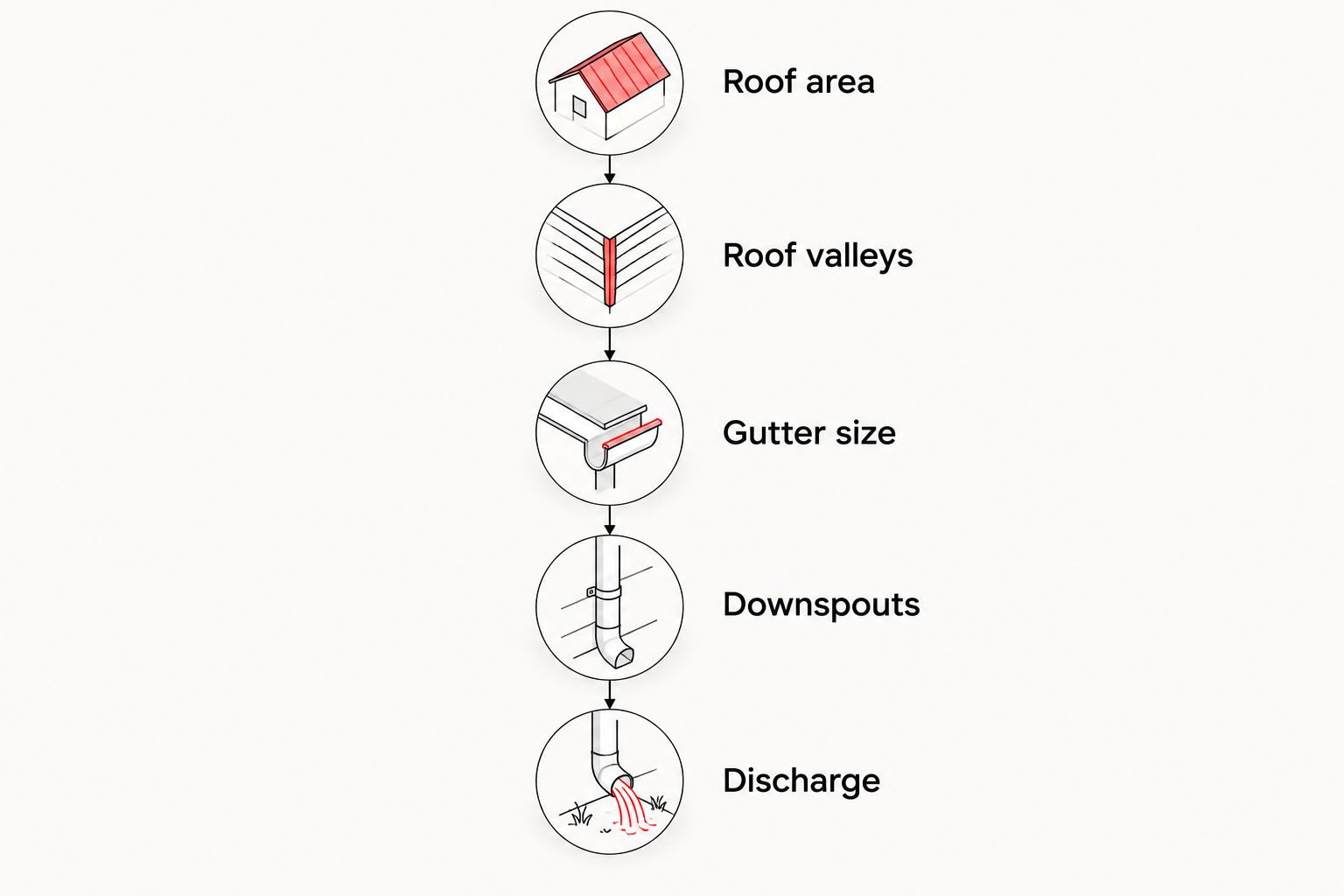
A useful 2026 gutter proposal follows the water from roof to ground. These checks apply to every style in the ranking, including a simple residential replacement.
- Roof area: Identify the roof surface feeding each gutter run. Do not divide the entire roof equally if its slopes drain to different edges.
- Roof valleys: Mark locations where runoff converges. Check whether water reaches the gutter or shoots past its outer edge.
- Gutter size: Choose the profile and dimensions using the contributing roof area and the applicable rainfall design basis.
- Downspouts: Match outlets, downspouts, and their placement to the collection layout. Common rectangular downspout dimensions include 2 × 3 inches and 3 × 4 inches; neither is an automatic recommendation for your house.
- Discharge: Confirm where each downspout empties and whether the receiving area can handle the collected runoff.
The sequence matters. Choosing a larger gutter before checking the outlet and discharge route addresses only one part of the system.
Material deserves its own check, especially near coastal exposure. The guide to gutter materials for Florida salt air and coastal homes separates that decision from profile selection.
Diagnose overflow before replacing the system
Watch the roof edge from a safe ground-level position during rain. Do not climb a ladder or inspect the roof during a storm.
- Water spills along the front: Check for debris, standing water, inadequate outlets, and insufficient collection capacity.
- Water escapes at a valley: Check the landing point of the concentrated runoff and the gutter's position beneath it.
- Water runs behind the gutter: Have the roof-edge flashing, gutter position, and mounting details inspected.
- Water pools beneath a downspout: Check the discharge route rather than assuming a different gutter style will solve it.
These observations identify where to investigate; they do not establish a diagnosis on their own. Photograph the problem from the ground and show the installer the exact location.
Roofsmartflorida offers gutter services alongside roof repair and replacement. Ask for an evaluation of both the drainage layout and the roof-edge condition when staining, damaged fascia, or water behind the gutter accompanies the overflow.
Request an honest gutter evaluation
Ask about roof-edge condition, gutter sizing, and downspout placement with a no-pressure free estimate.
How the gutter styles were ranked
K-style ranks first as the residential starting point because its mounting shape and appearance fit many conventional homes. Box gutters occupy the large commercial drainage slot; half-round and custom fascia profiles address distinct architectural needs.
The ranking uses roof-edge fit, drainage planning, maintenance access, and installation requirements. It does not assign unverified flow rates or claim that any profile is hurricane-proof. A sound installation and a clear discharge route outrank a decorative profile.
Which gutter style should you choose?
For an undecided homeowner in 2026, start with K-style gutters and a roof-specific drainage plan. Change that choice only when the roof-edge detail, building use, or architectural requirement gives you a clear reason.
Choose box gutters for a commercial collection layout, half-round for traditional detailing, and custom fascia gutters for a defined squared-profile requirement. None earns approval without an outlet and discharge plan.
Before accepting a proposal, ask: Which roof area feeds each run? Where is concentrated runoff handled? What happens if an outlet blocks? Where does the collected water go? Clear answers make the recommendation useful.
FAQ
What's the best gutter style for Florida's heavy rainfall?
K-style is the practical starting point for typical Florida homes, while box gutters suit large commercial roof-edge layouts. The best choice still depends on roof area, gutter dimensions, outlets, and discharge planning.
Are 6-inch gutters always better than 5-inch gutters?
No. A 6-inch gutter is not an automatic fix for overflow because blocked outlets, poor positioning, or an inadequate discharge route can remain unchanged. Have the gutter and downspout layout sized together.
Are half-round gutters suitable for heavy rain?
Half-round gutters are suitable when their dimensions and outlets match the roof's drainage requirements. Choose the rounded profile for its architectural fit, not as a substitute for sizing.
Are box gutters the best choice for every Florida house?
No. Box gutters are a useful option for large commercial collection layouts, but their rectangular shape alone does not make them the best residential choice. Mounting, access, outlets, and overflow provisions still need review.
Will gutter guards stop gutters from overflowing?
Gutter guards do not guarantee that gutters will stop overflowing. Debris control does not correct inadequate outlets, poor gutter positioning, or an unsuitable discharge route, and guards still need inspection.
Should I replace gutters when replacing my roof?
Have the gutters and roof-edge details evaluated together before deciding. Coordinate any replacement with flashing, fascia repairs, and changes to the roof edge so the finished system collects runoff correctly.
Who provides roofing and gutter services in Southwest Florida?
Roofsmartflorida provides roofing and gutter services for homeowners and businesses across Cape Coral, Fort Myers, Naples, and surrounding Southwest Florida counties. Request an evaluation that addresses the roof edge, gutter layout, and downspout discharge.
One last thing
A gutter can work correctly and still discharge water into the wrong place. Before approving your 2026 installation, walk the proposed downspout route with the installer and identify the final destination of the runoff. The job is not finished at the bottom elbow.