Choose Roofsmartflorida if you need residential or commercial roofing, gutters, or wind mitigation in Southwest Florida; choose Bedrock Roofing if its written proposal better matches your roof’s condition, required work, and project constraints. For 2026, the deciding difference is the work each contractor commits to—not the company name.
- For roof smart vs bedrock roofing, choose the contractor with the clearest roof repair or roof replacement scope.
- Roofsmartflorida serves residential and commercial properties across Cape Coral, Fort Myers, Naples, and surrounding Southwest Florida counties.
- Choose Bedrock Roofing when its written proposal better addresses your property’s requirements and passes your contractor checks.
- Compare materials, exclusions, payment terms, and responsibility for follow-up before signing either contract.
Why this matters
A roofing comparison should help you choose a contractor, not turn a service list into a quality ranking. Residential and commercial roofing, roof materials, gutters, and wind mitigation are part of the client’s stated service range. Those services establish project fit; they do not establish which contractor will write the better proposal for your building.
Your next move is to request 2 written proposals for the same work. Give both contractors the same property details, concerns, and requested outcome. Otherwise, you risk comparing a limited repair with a replacement, or a basic roof scope with one that includes drainage work.
This 2026 comparison separates stated service fit from contract-level decisions. A contractor wins a dimension only when the proposed work supports that verdict.
At a glance
| Dimension | Roofsmartflorida | Bedrock Roofing |
|---|---|---|
| Best for | Southwest Florida homeowners and businesses seeking the stated roofing and related services | Owners whose project receives a better-fitting written proposal from Bedrock Roofing |
| Roof systems | Stated services include shingle, metal, flat, and tile roofing | Evaluate the exact system and installation scope offered |
| Repair or replacement | Both services are stated | Require a written diagnosis supporting the recommended work |
| Standout service fit | Roofing plus gutters and wind mitigation | Choose on the strength of the project-specific scope, not an assumed specialty |
| Commercial work | Commercial roofing is stated | Require an operating plan suited to your building |
| Contractor checks | Verify the contracting entity, license, insurance, and written terms | Apply the same checks |
| Project coordination | Require written responsibility for access, protection, cleanup, and follow-up | Prefer Bedrock Roofing if its plan addresses these requirements more clearly |
| Pricing model | Request a defined project scope, payment terms, and change-order process | Request the same format for a direct comparison |
Service fit favors the contractor covering your whole project
Roofsmartflorida is a roofing option for Southwest Florida owners who need residential or commercial work across multiple roof types. Its stated coverage includes Cape Coral, Fort Myers, Naples, and surrounding Southwest Florida counties. That makes it a relevant contractor to approach for those locations and services.
The advantage is straightforward: your initial conversation can cover installation, repair, replacement, gutters, and wind mitigation. The limitation is equally important. A broad service range does not tell you what your individual contract includes.
Bedrock Roofing earns your selection when its proposal addresses your complete project more clearly. That is a genuine winning scenario, but it must appear in the written work description. Do not assume either contractor includes an adjacent service simply because you discussed it.
Before requesting estimates, define your job in one sentence: the property, the roof concern, and the outcome you need. For example, ask for an evaluation of recurring leakage rather than asking only for a new roof.
Four stated roof types establish fit, not an installation winner
The client’s stated roofing services cover 4 roof types: shingle, metal, flat, and tile. That gives you a starting point when your existing roof or planned replacement falls into one of those categories. It does not make those materials interchangeable.
For either contractor, require the proposal to identify the actual roof system. A material category alone leaves too much unresolved. Ask what happens to the existing covering, what underlying components are included, and how roof edges and penetrations will be addressed.
Use these comparisons:
- Shingle: compare the specified covering, underlayment, ventilation work, and flashing scope.
- Metal: compare the panel system, attachment approach, flashing, and roof-edge details.
- Flat: compare the proposed system, drainage assessment, and treatment of penetrations.
- Tile: compare the tile work separately from the underlying waterproofing and flashing work.
Bedrock Roofing wins the materials dimension if its proposal defines the required system more clearly and the competing proposal remains vague. Reverse that verdict when the other scope is clearer. Neither a familiar material name nor a longer service list proves a better installation.
Repair versus replacement is a diagnosis decision, not a brand decision
Both repair and replacement belong in the evaluation. The right question is whether the recommended work addresses the roof’s documented condition. A replacement recommendation needs an explanation; so does a repair recommendation that leaves other defects untouched.
Ask each contractor to explain 3 decisions: what failed, what needs work, and what stays. Request photos or other property-specific documentation to support that explanation. Keep the discussion focused on your roof rather than a general argument for replacing older roofs.
A useful repair proposal identifies the affected area and describes the work. A useful replacement proposal identifies the removal and installation scope, along with how concealed damage will be handled if discovered.
Neither contractor wins this dimension without a supported diagnosis. If the recommendations differ, ask each contractor to explain the difference using the same roof conditions. Do not resolve the disagreement by choosing whichever proposal sounds less disruptive.
Roofing plus related services favors a clearly coordinated scope
Gutters and wind mitigation are part of the client’s stated services alongside roofing. That matters when your project needs more than a roof covering. It gives you a reason to ask about related work during the initial evaluation.
The benefit disappears if those tasks remain outside the contract. Identify whether gutter removal, reinstallation, replacement, or other related work is included, excluded, or handled separately. Ask what wind mitigation work or documentation is proposed for your property rather than assuming an inspection or insurance outcome.
Bedrock Roofing wins this dimension if its written plan coordinates your required roof and related work more clearly. The same standard applies to the client. Choose the complete scope, not the broadest verbal promise.
If you are still building your shortlist, the guide to Bedrock Roofing alternatives in Southwest Florida provides a related comparison topic. Keep your property requirements unchanged when approaching additional contractors.
Bedrock Roofing wins commercial coordination if its plan is clearer
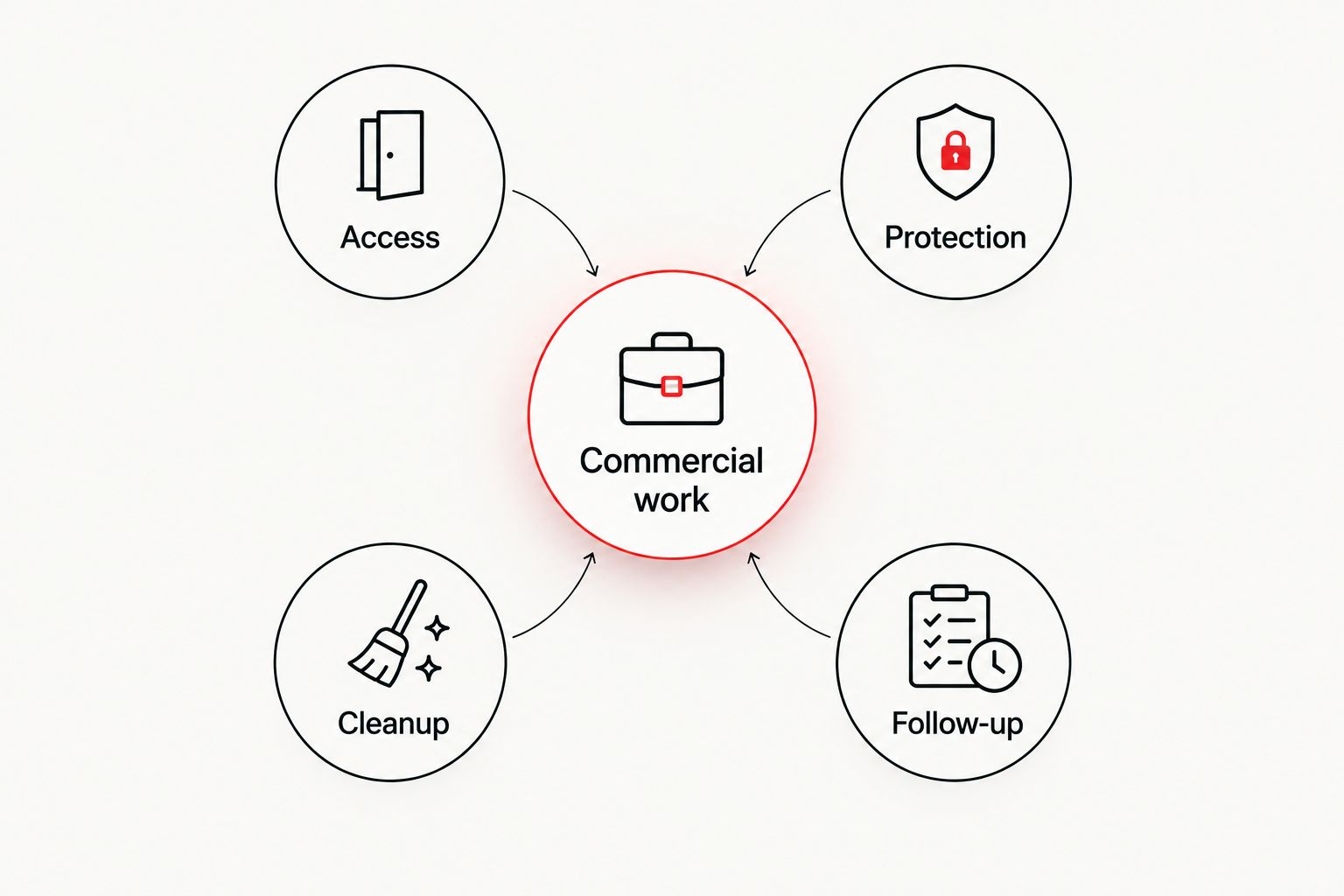
Commercial roofing is within the client’s stated service range. For a business owner, that establishes relevance—but the bid must also address how work interacts with your building’s use. Your operating requirements belong in the scope discussion before you sign.
Ask both contractors to address:
- Access: where workers, materials, and equipment will enter.
- Protection: how the proposed work addresses occupied areas and property protection.
- Cleanup: who handles debris and the agreed cleanup tasks.
- Follow-up: who receives questions and handles reported problems.
Bedrock Roofing is the better choice for a particular commercial project when its written coordination plan meets those requirements more clearly. Do not infer that advantage from a sales conversation. Require the commitments in the proposal or contract.
For your 2026 project, identify building-use constraints early. A contractor cannot address a restriction you have not disclosed, and a clear scope cannot compensate for an operating plan that ignores your business.
Contractor checks are a tie: neither name replaces verification
Apply the same contractor checks to both companies. Confirm the legal entity that will sign the contract and verify the license associated with the work. Florida’s Department of Business and Professional Regulation provides public license verification; use the current record for your 2026 decision.
Request insurance documentation and read the contract’s responsibility and warranty language. Keep manufacturer coverage separate from any contractor workmanship commitment. Ask who receives a claim, what documentation is required, and what exclusions apply.
A reassuring conversation is helpful, but it is not a substitute for those records. Do not award either contractor points for a warranty phrase without reading the actual terms.
Your practical verdict is simple: a proposal that fails your contractor checks should not advance, even if its material description is detailed. Complete the checks before treating either bid as ready to sign.
Bedrock Roofing wins scheduling only with a better written plan
Choose Bedrock Roofing on coordination when its written plan better addresses your access requirements, communication needs, and follow-up expectations. That is a project-specific advantage—not a claim that one company always works faster or communicates better.
Ask both contractors who manages the project and who can authorize a change. Establish how you will receive updates and how unexpected conditions will be documented. Separate the proposed start arrangements from promises about completion.
The same discipline applies to homeowners. Tell each contractor about parking restrictions, pets, gates, seasonal occupancy, and access limitations before agreeing to the work.
The stronger coordination plan names responsibilities rather than relying on reassurance. If a commitment affects your decision, have it recorded. A clear conversation should become a clear contract, not remain something you must remember later.
Pricing in 2026: compare scope and payment structure
For both contractors, request a written estimate tied to a defined project. Compare the work included, exclusions, payment stages, and the process for changes. Do not treat proposals as equivalent until those elements match.
The important tradeoff is predictability versus flexibility. A defined base scope tells you what work you are accepting. A written change-order process explains how work outside that scope will be proposed and approved.
Require 1 written base scope for each contractor. Keep optional work separate so you can compare the required project without mixing in unrelated additions. Ask how concealed damage will be documented and how you will approve any resulting change.
For either bid, check these details:
- The specified roof system and installation work.
- Removal, disposal, and property-protection responsibilities.
- Included flashing, ventilation, drainage, or gutter work.
- Exclusions and owner responsibilities.
- Payment terms and written change approval.
Neither contractor wins the pricing comparison through an incomplete estimate. Resolve scope differences first; then decide which contract fits your project.
Request an honest roof evaluation
Discuss your roof concerns and request a no-pressure free estimate for your Southwest Florida property.
Final verdict: choose the stronger fit and written commitment
Choose Roofsmartflorida if you need the stated service range
Best for: Southwest Florida homeowners and business owners seeking roofing with related service needs. Choose this contractor when its stated residential or commercial services match your project and its written proposal passes your scope, contractor, and coordination checks.
The service range is a reason to request an evaluation. The contract is the reason to proceed. Do not skip the second step because the first feels reassuring.
Choose Bedrock Roofing if its proposal better meets your requirements
Best for: owners with a Bedrock Roofing proposal that is clearer and better aligned with the property. Choose Bedrock Roofing when its documented diagnosis, specified work, project arrangements, and contract terms better address your needs.
Reject that advantage if it exists only in conversation. A contractor wins your project through commitments you can read and verify.
One-glance scorecard
| Dimension | Winner |
|---|---|
| Service fit | Contractor whose stated services and written scope cover the project |
| Roof system | Contractor with the clearer, suitable system specification |
| Repair versus replacement | Contractor with the supported diagnosis |
| Related services | Contractor with the complete coordinated scope |
| Commercial coordination | Bedrock Roofing if its written operating plan is better |
| Contractor checks | Tie: both must pass |
| Scheduling and communication | Bedrock Roofing if its written coordination plan is better |
| Pricing structure | Neither until scope and terms are comparable |
FAQ
Is Roofsmartflorida better than Bedrock Roofing?
Choose Roofsmartflorida when its stated Southwest Florida roofing services and written proposal match your project. Choose Bedrock Roofing when its proposal better addresses the same requirements and passes your contractor checks.
Which roofer should I choose for a roof replacement in 2026?
Choose the contractor whose written replacement scope addresses your roof’s documented condition. Compare the specified system, removal work, exclusions, payment terms, and change-order process before signing.
Does a longer roofing service list mean a better contractor?
No, a longer service list establishes potential project fit, not installation quality. Your decision still needs a property-specific proposal and contractor verification.
How do I compare the cost of two roofing proposals?
Compare the included work and contract terms before comparing the estimates. Resolve differences in materials, removal, flashing, related work, and exclusions so you are evaluating the same project.
Should I repair my roof or replace it?
Choose repair or replacement based on a documented assessment of your roof’s condition. Ask each contractor what failed, what requires work, and why the proposed approach addresses the problem.
What should a commercial roofing proposal include?
A commercial roofing proposal should define the roof work and address the building’s operating requirements. Request written arrangements for access, protection, cleanup, communication, and follow-up.
What should I verify before signing a roofing contract in Florida?
Verify the contracting entity, applicable license, insurance documentation, and written contract terms. Read the scope, exclusions, payment requirements, change-order process, and warranty provisions before accepting the proposal.
One last thing
Before signing, ask each contractor to identify what is not included. That question is more useful than asking for another assurance that the job will be done well. It turns assumptions into specific responsibilities.
For your 2026 decision, write the exclusions beside the included work. Then check whether someone is responsible for every task your property needs. The best-fit proposal is not the longest one; it is the one that leaves you with the fewest unresolved responsibilities.