Older Florida homes built before local code required gutters shed rainwater straight off the roofline onto stucco, foundation planting beds, and pool cages, and after 40 or 50 years that runoff pattern has already done damage you can see if you know where to look. Gutter installation for older homes without existing systems is the fix, but it only works when fascia condition, roof pitch, and Southwest Florida's rainfall volume get addressed in the right order.
- Seamless aluminum gutters are the right first system for 1960s-1990s Southwest Florida homes with no existing drainage.
- Check fascia wood condition before ordering gutters — rotten wood won't hold hangers through a 2026 storm season.
- Southwest Florida gets roughly 50 to 55 inches of rain a year, most of it between June and November.
- Gutter installation for older homes should include leaf guards from day one; oak and pine debris clog open-top systems fast.
- Roof Smart of SW Florida installs seamless gutters on Cape Coral, Fort Myers, and Naples homes without existing systems.
Why gutter installation matters for older Florida homes
Homes built before the 1990s in Lee, Collier, and Charlotte counties often went up without gutters because nothing required them. Roof overhangs and sandy soil were considered drainage enough. Fifty years of runoff later, that assumption shows up as cracked stucco at the roofline, black streaking, and soft fascia boards where water has been sheeting off the same six inches of roof edge for decades.
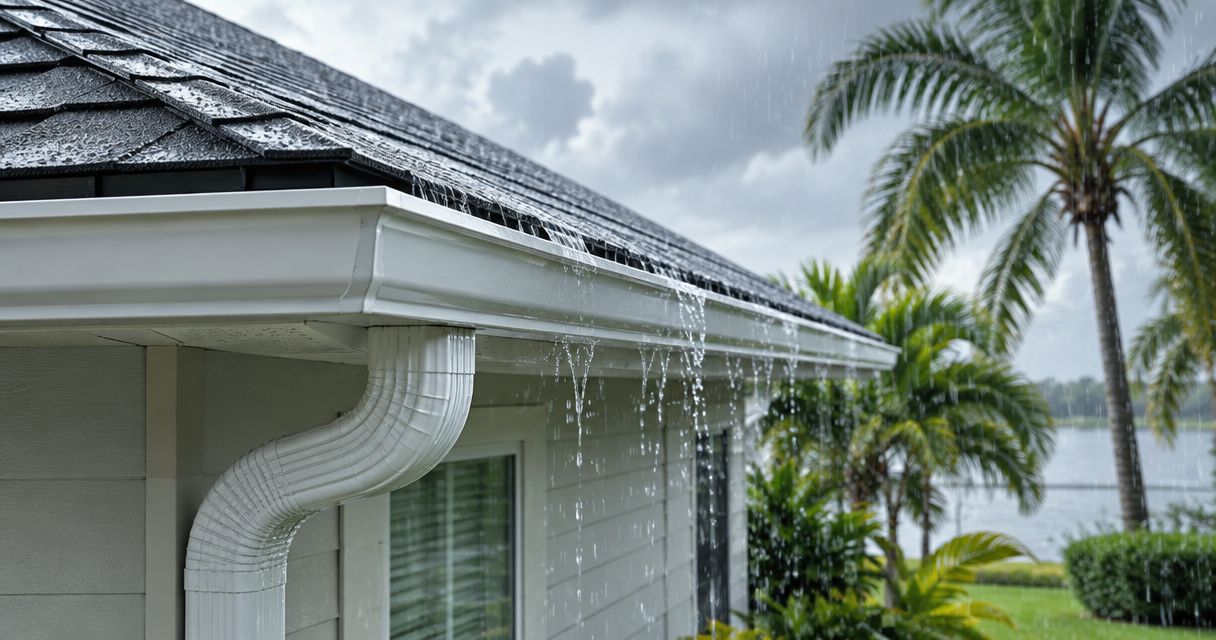
Southwest Florida gets roughly 50 to 55 inches of rain a year, concentrated in the June-through-November wet season. Without gutters, that volume hits foundation plantings and walkways in a narrow band, eroding soil and pushing water toward slabs instead of away from them. Gutter installation for older homes is less about curb appeal and more about stopping a 50-year-old drainage problem before the next hurricane season adds to it.
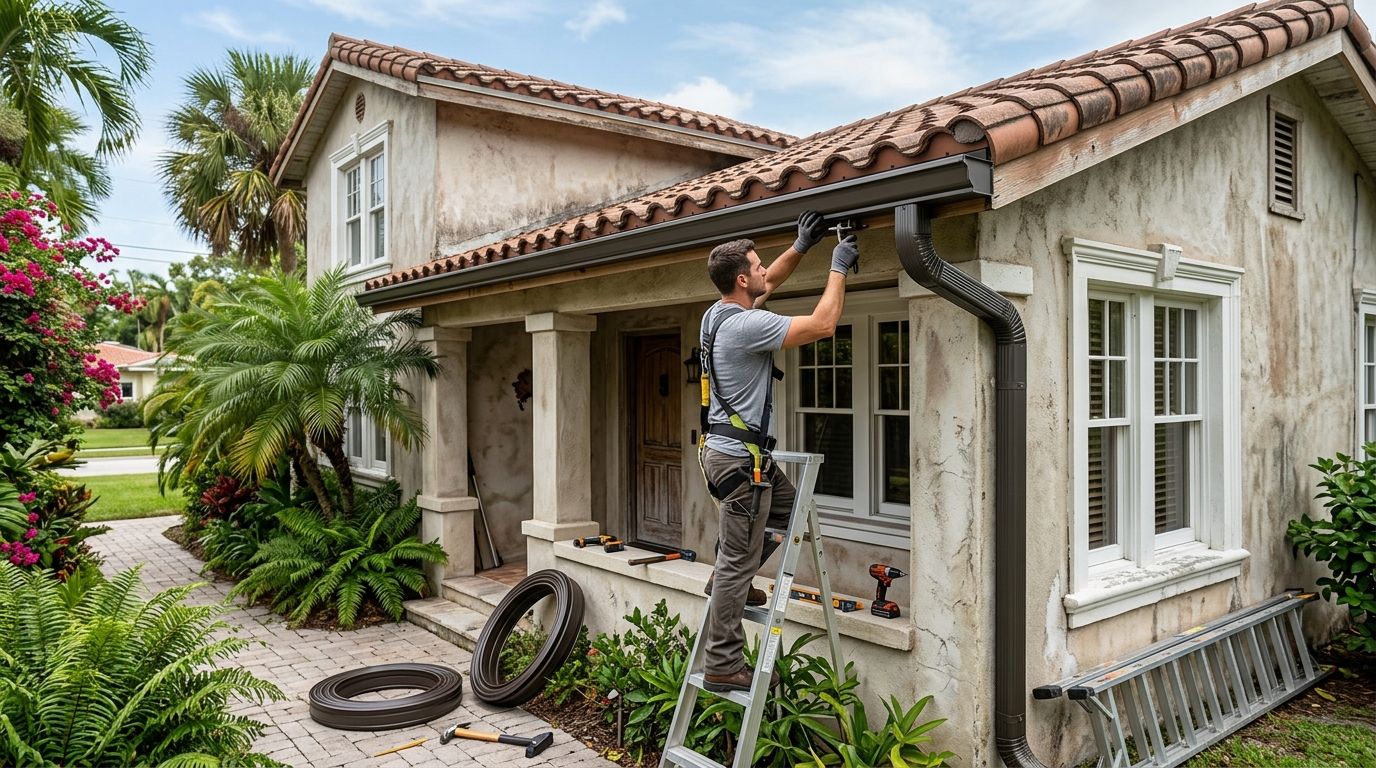
A home with no gutter history also has no existing hanger holes, no drip edge integration, and often a fascia board that was never sealed for one. That's a different job than replacing a failed system, and it changes the order of steps below. Seamless gutter installation on a home with zero gutter history starts with the roofline itself, not the gutter material.
The gutter installation steps for older homes
1. Inspect your fascia board before you order anything
Gutters hang on fascia, and on a 40-year-old home that board has never carried the weight of a full water load. Skip this step and you're screwing new hangers into wood that won't hold them through a summer storm.
- Press a screwdriver into the fascia at 3-4 spots along each roofline — soft wood gives without resistance
- Check for paint bubbling or peeling near the roof edge, a sign of trapped moisture
- Look at the soffit underneath for staining, which points to water already getting behind the fascia
- Confirm a drip edge exists; older roofs often don't have one and gutters need it to work correctly
- Flag any section with visible rot for replacement before installation, not after
2. Match the gutter profile to your roof style
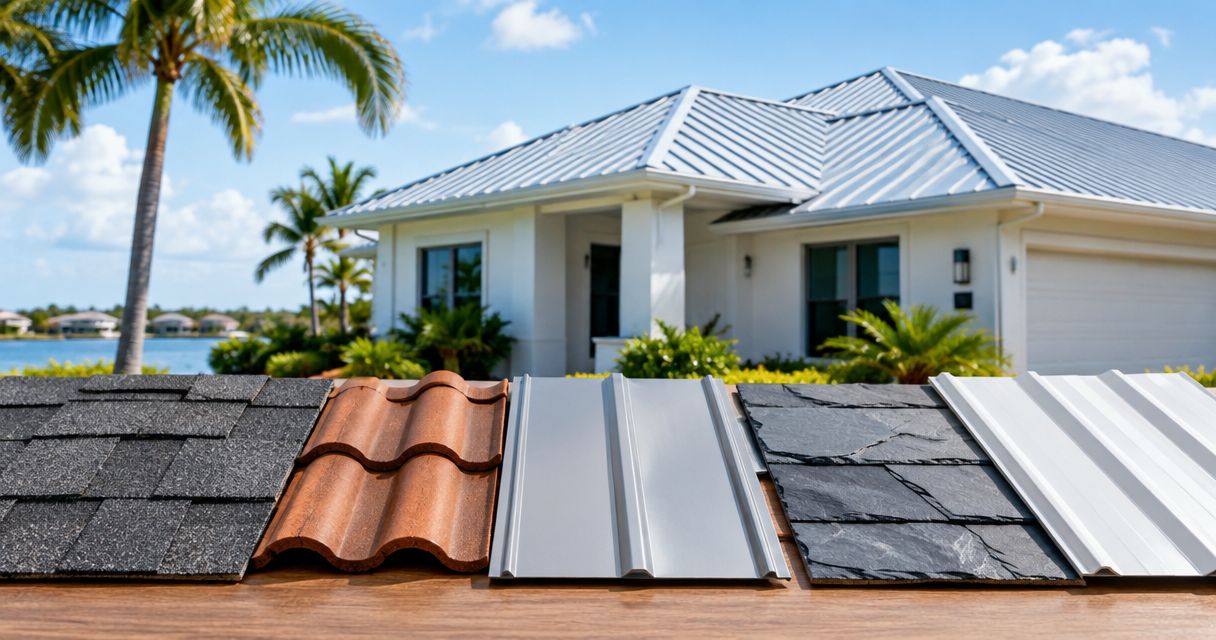
Older Southwest Florida homes run a mix of low-slope hip roofs, barrel tile, and standing seam metal, and each one moves water differently off the edge.
- K-style gutters handle high-volume shingle and metal runoff and fit most 1970s-1990s ranch homes
- Half-round gutters suit Mediterranean-style tile roofs where a K-style profile looks out of place
- Wider 6-inch gutters outperform standard 5-inch on steep or large roof planes common on two-story homes
- Match the gutter's front lip height to your roof's overhang so water doesn't overshoot in a downpour
3. Choose seamless aluminum over sectional systems
Home centers sell sectional vinyl and aluminum gutters in 10-foot sections that a homeowner can hang solo over a weekend. That's the manual path, and it works on a shed or a small addition.
On a full roofline with no existing gutters, sectional systems introduce seams every 10 feet — each one a future leak point on a home that's never had gutters to begin with. Seamless aluminum, formed on-site to match the exact roofline length, is the faster and more durable path for a whole-house first install, which is why Roof Smart of SW Florida runs seamless as the default system for homes converting from no gutters to a full drainage setup.
4. Size and place downspouts for Florida's rain volume
A downspout schedule built for a drier climate underperforms fast once June rain starts falling at Southwest Florida rates.
- Plan for one downspout every 30 to 40 feet of gutter run, tighter than many national guides recommend
- Route downspouts away from foundation plantings and pool cage footings, not toward them
- Use 3x4-inch downspouts instead of 2x3-inch on roofs over 1,500 square feet for faster drainage
- Add splash blocks or extensions at each outlet so water clears the slab instead of pooling against it
5. Add gutter guards before debris becomes a maintenance problem
Older neighborhoods in Fort Myers and Cape Coral tend to have mature oak, pine, and palm canopy, and an open-top gutter on a first-time install clogs within one storm season.
- Micro-mesh guards block pine needles and oak leaves better than perforated aluminum covers
- Guards reduce the twice-a-year cleaning cycle that older homes without gutters have never had to think about
- Check that guard warranty terms match the gutter warranty so you're not managing two separate claims
- Gutter guard options built for Florida storms narrow this list to systems rated for wind-driven rain, not just leaf volume
6. Time the install around hurricane season
Hurricane season runs June 1 through November 30, and installing gutters mid-season on a home that's gone decades without them means the first real test comes almost immediately.
- Schedule installation in the spring dry season when possible, ahead of peak rainfall
- Confirm hanger spacing meets wind-load expectations for your county, not just a generic national standard
- Ask whether the installer secures hangers into rafter tails, not just fascia board, for added hold in high wind
- Hold off on gutter guard add-ons until the base system has been through one full wet season, if budget requires phasing
7. Repair fascia and soffit damage as part of the same project
Most older homes going from zero gutters to a full system need at least some fascia work first, and doing it separately adds a second mobilization and a second labor charge.
- Replace any fascia section that failed the screwdriver test in step one before hangers go up
- Match soffit vents to the new fascia line so attic ventilation isn't blocked
- Prime and paint repaired wood sections before gutters go on, since access gets harder afterward
- Budget fascia repair as part of the gutter quote, not as a surprise change order mid-project
8. Set a maintenance rhythm once the system is installed
A first-time gutter system on an older home needs a cleaning schedule that didn't exist before, especially under mature tree canopy.
- Clean gutters at the start and end of hurricane season at minimum, more often under heavy oak or pine cover
- Check downspout outlets for clogs after any storm with sustained rain over a few hours
- Inspect hanger tightness annually — fascia settles differently on older wood than on new construction
- Look for standing water in the gutter trough after rain, a sign of pitch or clog issues
Get a free gutter evaluation
An honest look at your roofline before you commit to any system.
Comparing gutter options for older homes
| Option | Best for | Key limitation |
|---|---|---|
| Seamless aluminum | Whole-roofline first install on any older SW Florida home | Requires professional forming equipment on-site |
| Sectional vinyl | Small additions, sheds, DIY budgets | Seams every 10 feet leak first on long rooflines |
| Half-round copper or aluminum | Mediterranean/tile-style architecture | Higher labor time to fit and hang correctly |
| K-style with micro-mesh guards | Homes under heavy oak or pine canopy | Guard adds upfront cost to the base system |
Common mistakes on older Florida homes
- Hanging gutters on unrepaired fascia — new hangers on rotten wood fail within one or two storms, undoing the whole project
- Undersizing downspouts for Southwest Florida's rain volume, then dealing with overflow every heavy storm
- Skipping gutter guards to save money upfront, then paying for cleaning visits twice a year under mature trees
- Installing mid-hurricane-season without checking hanger spacing against local wind expectations
- Treating gutter installation for older homes like new construction, when the real first step is a fascia and roofline inspection, not a gutter order
FAQ
How much does gutter installation cost for an older Florida home?
Cost depends on roofline length, fascia repair needs, and whether guards are added, so get a site-specific estimate rather than relying on a national average. Homes with fascia damage cost more than a straightforward hang on solid wood.
Do older Florida homes need gutters if they've gone decades without them?
Yes, if there's visible fascia rot, foundation erosion, or stucco staining at the roofline, the home has already been showing damage from the lack of drainage. Adding gutters now stops the pattern before the next hurricane season adds to it.
Is seamless aluminum better than sectional vinyl for a first-time gutter install?
For a whole-roofline first install, seamless aluminum is the stronger choice because it has no seams to leak over a long run. Sectional vinyl works fine for small sections like a shed or single-story addition.
Can gutters be installed on a home with rotten fascia?
No — hangers need solid wood to hold through Florida wind and rain, so rotted fascia sections should be replaced before gutters go up. Skipping this step is the most common reason a new gutter system fails early.
How often should gutters be cleaned on an older Florida home under tree cover?
At minimum, clean gutters before and after hurricane season, and more often under heavy oak or pine canopy common in older Fort Myers and Cape Coral neighborhoods. Micro-mesh guards stretch that interval but don't eliminate it.
What size downspouts do older Florida homes need?
Roofs over 1,500 square feet do better with 3x4-inch downspouts spaced every 30 to 40 feet, tighter than many national installation guides recommend. Southwest Florida's rainfall volume during wet season is the reason for the tighter spacing.
Should gutter guards be installed at the same time as new gutters?
Yes in most cases, especially under mature tree canopy, since retrofitting guards later means a second labor visit. Budget can be phased, but plan the guard system alongside the gutter order so brackets and fasteners match.
Does gutter installation affect a home's wind mitigation inspection?
Gutters themselves aren't part of a wind mitigation inspection, which focuses on roof shape, roof-to-wall connections, and opening protection. Fascia and soffit condition addressed during gutter work can matter if soffit attachment is part of that inspection.
One last thing
The detail that gets missed most on older homes: the fascia board holding your new gutters has never had to bear a full water load in its life, which means a screwdriver test before installation catches problems a visual check alone won't. Roof Smart of SW Florida checks fascia condition as part of every gutter evaluation for exactly that reason — a system that looks installed correctly on day one can still fail by the next wet season if the wood underneath wasn't ready for it.