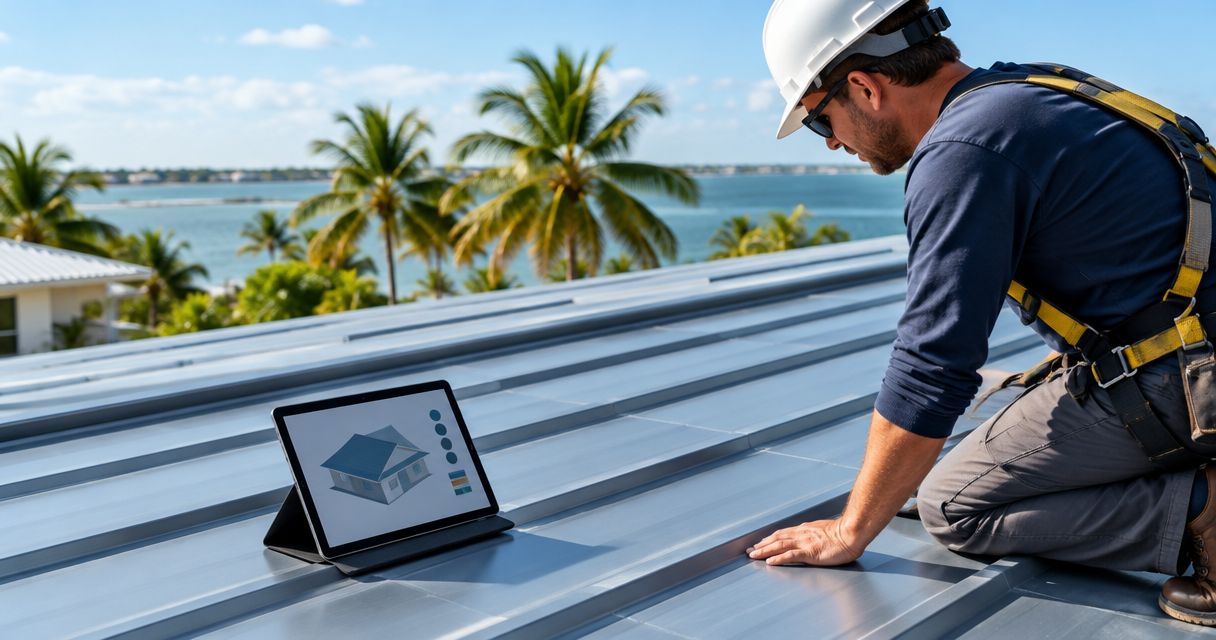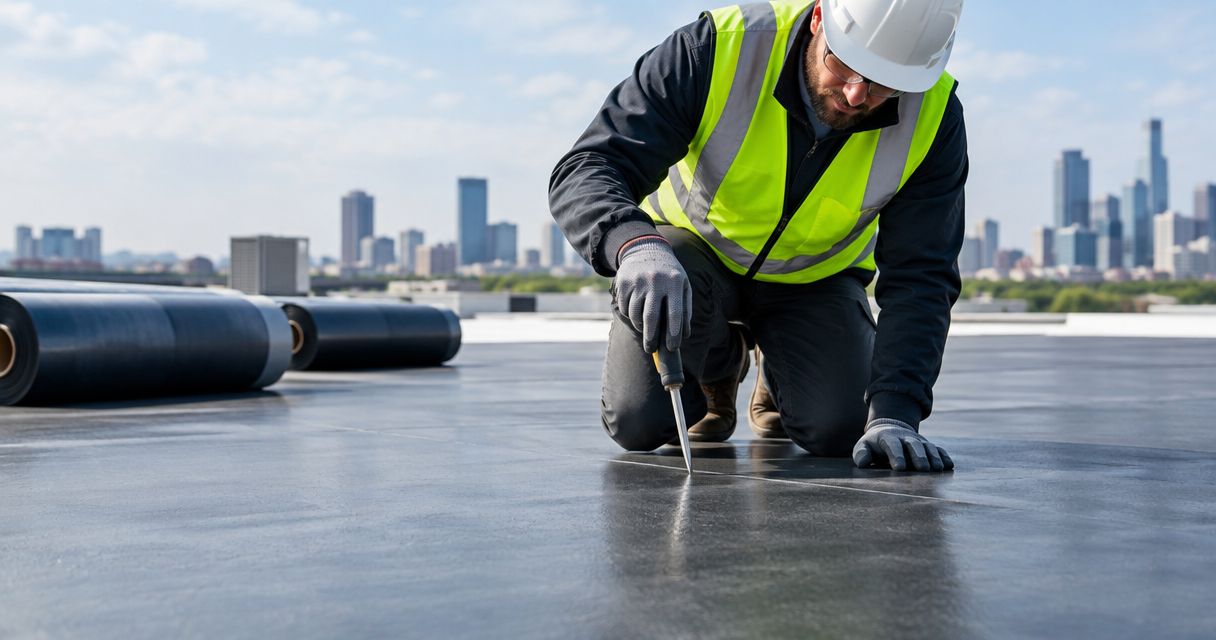
Best starting point for puncture-focused roof selection: reinforced, multi-ply modified bitumen. Best for grease exposure: compatible reinforced PVC. Best thermoplastic alternative: reinforced TPO. Best for flexibility: EPDM. This 2026 commercial roofing membrane puncture resistance guide ranks practical shortlists—not laboratory scores—and explains what you need to verify before choosing.
- Commercial roofing membrane puncture resistance depends on the tested assembly, not just the material name.
- Shortlist reinforced, multi-ply modified bitumen when redundant waterproofing layers are the priority.
- Compare reinforced PVC and TPO using matching puncture tests, substrates, and membrane specifications.
- Roofsmartflorida provides commercial roofing services for Southwest Florida businesses seeking installation, repair, or replacement.
Why this matters
A dropped tool, sharp debris, or repeated equipment access creates a different roofing problem from wind uplift. A roof assembly needs protection against both, but a wind rating does not establish puncture resistance.
For Southwest Florida property owners comparing roofing services, the useful question is not simply which membrane is toughest. It is which complete assembly suits your equipment access, substrate, drainage, and exposure.
Roofsmartflorida is a commercial roofing service option for Southwest Florida businesses planning roof installation, repair, or replacement. Ask for the proposed assembly in writing so you can evaluate more than its surface material.
What makes the best puncture-resistant commercial membrane?
Use these criteria before comparing the shortlist:
- Comparable testing: Require the same puncture test method and comparable specimen conditions. Static loading and falling-object impact measure different behavior.
- Membrane construction: Compare reinforcement, sheet construction, and waterproofing layers—not polymer names alone.
- Firm support: Identify the cover board and insulation directly beneath the membrane. Support changes how the roof responds to concentrated loads.
- Traffic protection: Specify designated routes and compatible walkway protection around equipment that receives service.
- Exposure compatibility: Check oils, grease, cleaning chemicals, and other discharges against the exact membrane manufacturer's guidance.
- Repair access: Confirm how a puncture will be located, prepared, and repaired without introducing incompatible materials.
For a 2026 specification, treat these as acceptance questions. A proposal that names a membrane but leaves its supporting layers undefined is not ready for a meaningful puncture comparison.
Commercial membranes at a glance
The order below prioritizes selection use cases. It is not a claim that every modified-bitumen assembly outperforms every PVC, TPO, or EPDM assembly.
| Rank and membrane | Best for | Standout construction feature | Key limitation |
|---|---|---|---|
| 1. Reinforced, multi-ply modified bitumen | Prioritizing multiple waterproofing layers | Reinforced bituminous sheets assembled in layers | Weight and installation requirements need project review |
| 2. Reinforced PVC | Roofs requiring documented grease compatibility | Reinforced thermoplastic sheet with heat-welded seams | Chemical compatibility remains formulation-specific |
| 3. Reinforced TPO | Thermoplastic systems without a grease-driven specification | Reinforced sheet with heat-welded seams | Thickness alone does not establish puncture performance |
| 4. EPDM | Applications prioritizing rubber flexibility | Flexible rubber membrane with specified seam systems | Oil exposure and traffic protection require attention |
Each option still needs a suitable substrate, detailed penetrations, and protected service routes. None turns the roof into an unprotected work platform.
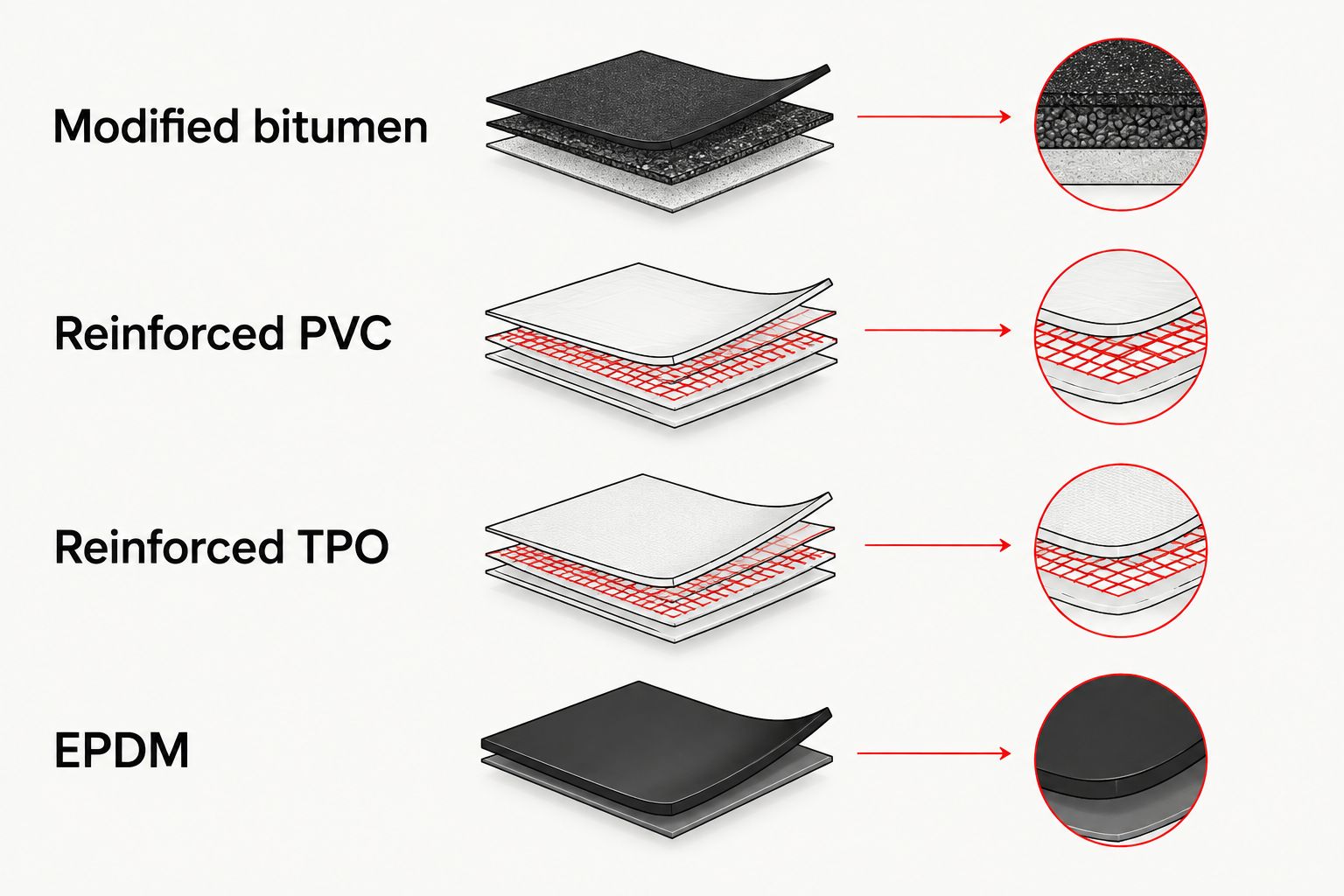
1. Modified bitumen: best for layered waterproofing
Reinforced, multi-ply modified bitumen combines bituminous roofing sheets into a layered waterproofing system. SBS and APP identify different asphalt modifiers; neither label alone supplies a puncture ranking.
This is the first shortlist when you want multiple waterproofing layers rather than relying on a single exposed sheet. A puncture through the top layer does not, by itself, establish whether the complete waterproofing assembly has been breached.
Modified bitumen pros:
- Multiple waterproofing layers provide a different construction approach from single-ply membranes.
- Reinforcement forms part of the sheet construction.
- Different installation methods allow project-specific selection.
Modified bitumen cons:
- Assembly weight requires review of the existing building and proposed roof design.
- Application methods introduce different jobsite controls, including fire precautions where torch application is proposed.
- Surface appearance alone does not establish the condition of underlying layers.
Best for: Commercial owners prioritizing layered waterproofing where the building and installation conditions suit the assembly.
For your 2026 proposal, request the exact sheet sequence, attachment method, cover board, and puncture documentation. Do not accept “modified bitumen is tougher” as a substitute for the actual system description.
Verdict: Buy only as a documented assembly; skip selection by material name alone.
2. Reinforced PVC: best for grease-exposure specifications
PVC is a thermoplastic roofing membrane with heat-welded seams. Reinforced PVC belongs on the shortlist when rooftop grease or other chemical exposure makes compatibility a deciding factor.
That is a compatibility recommendation, not proof of higher puncture resistance. Confirm the exact formulation against the actual discharge, including any restrictions on exposure or cleaning.
Reinforced PVC pros:
- Heat-welded seams join compatible membrane surfaces.
- Reinforcement is part of the membrane construction.
- Suitable formulations provide options for applications involving grease exposure.
Reinforced PVC cons:
- Chemical resistance varies with the substance and membrane formulation.
- Sharp objects can still breach the sheet.
- Installation and repairs require correct welding conditions and compatible materials.
Best for: Buildings where documented grease or chemical compatibility narrows the membrane choice.
Ask the supplier to identify the tested sheet, reinforcement, thickness, and supporting surface. Then compare puncture results with competing assemblies using the same method rather than treating all reinforced PVC sheets as equivalent.
Verdict: Buy when documented exposure compatibility and assembly testing match your building.
3. Reinforced TPO: best for a thermoplastic comparison
TPO is a thermoplastic membrane installed with heat-welded seams. Reinforced TPO is a useful comparison option when you want a thermoplastic roof and the project does not require a grease-specific membrane selection.
The important distinction is between the proposed assemblies, not a broad PVC-versus-TPO contest. Different sheets, reinforcement arrangements, and supporting layers prevent a reliable category-wide puncture winner.
Reinforced TPO pros:
- Heat-welded seams create joined thermoplastic surfaces.
- Reinforced sheet construction supports assembly-specific selection.
- Compatible walkway accessories allow designated service routes.
Reinforced TPO cons:
- Nominal thickness does not describe every part of the sheet construction.
- A sharp object or concentrated load can damage the membrane.
- Welding and repair preparation require attention to membrane condition and manufacturer instructions.
Best for: Owners comparing thermoplastic assemblies based on documented performance rather than polymer preference.
For a 2026 comparison, require the same supporting surface and puncture test conditions wherever possible. A result obtained over a hard support cannot automatically establish performance over the insulation specified for your roof.
Verdict: Hold until the proposed TPO assembly has a clear, comparable specification.
4. EPDM: best for flexibility-focused applications
EPDM is a synthetic rubber roofing membrane. Its flexibility makes it a relevant option when the design calls for an elastomeric sheet rather than a heat-welded thermoplastic membrane.
Flexibility is not the same as resistance to a sharp point. EPDM still needs appropriate support, seam detailing, and protection where maintenance personnel work.
EPDM pros:
- Flexible rubber construction accommodates deformation.
- Sheet layouts offer different ways to organize seams and details.
- Compatible repair systems allow localized membrane repairs.
EPDM cons:
- Petroleum oils and grease require particular compatibility attention.
- Seams and repairs depend on the specified preparation and joining materials.
- Equipment access still requires designated protection.
Best for: Applications where flexibility is a primary design requirement and exposure conditions suit the membrane.
Ask whether the proposed EPDM sheet is reinforced or nonreinforced. Compare its documented assembly performance instead of assuming every rubber membrane behaves the same way under a concentrated load.
Verdict: Buy for a verified flexibility-driven application; skip an unsupported puncture-resistance claim.
How to compare puncture reports without being misled
For 2026 procurement, ask for the test method before the headline result. ASTM D5602 addresses static puncture resistance of roofing membrane specimens, while ASTM D5635 addresses dynamic puncture resistance; their results answer different questions.
A static test concerns a sustained or progressively applied concentrated load. A dynamic test concerns impact, so do not combine their results into one league table.
Use this document checklist:
- Exact specimen: Identify the membrane formulation, reinforcement, and sheet construction.
- Supporting surface: Check what sat beneath the specimen during testing.
- Test conditions: Compare conditioning, temperature, loading, and the stated failure criterion.
- Reported result: Keep the original units and distinguish a measured result from a pass/fail statement.
- Project match: Confirm which parts of the tested construction match the proposed roof.
Thickness deserves its own check. A 45-mil sheet is 0.045 inches thick, a 60-mil sheet is 0.060 inches thick, and an 80-mil sheet is 0.080 inches thick; these are unit conversions, not puncture ratings or recommended minimums.
A thicker sheet is not sufficient evidence that one complete assembly outperforms another. Reinforcement and support remain part of the comparison.
Protect the places where punctures start
A membrane recommendation is incomplete without an access plan. Identify how technicians reach rooftop equipment and where tools, replacement parts, and temporary supports will sit.
Ask for these items in the written scope:
- Firm support: Define the cover board and insulation beneath the membrane.
- Protected routes: Specify manufacturer-compatible walkway protection to regularly serviced equipment.
- Work controls: Keep sharp debris off the roof and use suitable protection during maintenance.
- Repair records: Record damage locations, repair materials, and follow-up inspection findings.
Read the guide to commercial roof insulation systems alongside the membrane proposal. The layers beneath the sheet belong in the same decision, not in a separate conversation after material selection.
Walkway protection does not replace proper equipment supports or authorize unrestricted roof traffic. Ask Roofsmartflorida to describe the proposed commercial roofing scope and identify which access details need to be resolved before work starts.
Discuss your commercial roof
Request an evaluation of your roof, service routes, and repair or replacement needs.
How this ranking works
This 2026 shortlist ranks membrane categories by distinct selection needs: layered waterproofing, exposure compatibility, thermoplastic comparison, and flexibility. It does not assign invented puncture scores or claim a controlled comparison of unnamed products.
The final ranking belongs to the documented assemblies offered for your building. Move an option up or down only when comparable testing, project conditions, and installation details support that decision.
Which commercial membrane should you choose?
Start with reinforced, multi-ply modified bitumen if your priority is layered waterproofing. Compare reinforced PVC when grease compatibility matters, reinforced TPO for another thermoplastic approach, and EPDM when flexibility drives the design.
For an undecided owner, the next move is an assembly comparison—not a material purchase. Ask Roofsmartflorida for a commercial roofing evaluation, then require the membrane, supporting layers, access protection, and repair approach to appear together in the proposed scope.
FAQ
What's the best commercial roofing membrane for puncture resistance?
No membrane category is the universal puncture-resistance winner. Start with reinforced, multi-ply modified bitumen when layered waterproofing is the priority, then compare exact assemblies using matching test methods and conditions.
Is PVC more puncture-resistant than TPO?
PVC is not automatically more puncture-resistant than TPO. Compare the exact reinforced sheets, supporting surfaces, and results from the same puncture test method before choosing.
Does a thicker roofing membrane prevent punctures?
A thicker roofing membrane does not guarantee protection against punctures. Sheet construction, reinforcement, supporting layers, and the object applying the load all affect the outcome.
Is EPDM a good choice around rooftop equipment?
EPDM requires appropriate support and protected service routes around rooftop equipment. Its flexibility does not make it resistant to every dropped tool or sharp object.
Which tests should I request for commercial membrane puncture resistance?
Request relevant static and dynamic puncture documentation, identifying the method used. ASTM D5602 addresses static puncture resistance of roofing membrane specimens, and ASTM D5635 addresses dynamic puncture resistance; compare like with like.
Will a cover board make a commercial roof puncture-proof?
A cover board does not make a commercial roof puncture-proof. It changes the support beneath the membrane, so evaluate the specified assembly and retain appropriate traffic protection.
Can a punctured commercial membrane be repaired instead of replaced?
A localized puncture does not automatically require complete roof replacement. The decision depends on membrane condition, moisture beneath the surface, damage extent, and whether a compatible repair can restore the assembly.
One last thing
Specify the route to the equipment before selecting the membrane. The area directly outside a roof hatch or beside a service panel deserves deliberate protection, not an assumption that the chosen sheet will tolerate everything.
For your 2026 project file, keep the roof plan, assembly description, and maintenance instructions together. That gives every contractor accessing the roof the same protection requirements.