Best overall: polyisocyanurate board for conventional low-slope commercial roofs. Best for thickness-flexible designs: expanded polystyrene; best for an approved inverted roof: extruded polystyrene. This 2026 guide compares five commercial roof insulation systems for Florida businesses, including where each belongs and what should stop you from choosing it.
- Best commercial roof insulation Florida verdict: polyisocyanurate is the default shortlist choice for conventional low-slope roofs.
- Expanded polystyrene suits designs with room for thicker insulation; extruded polystyrene fits approved inverted roof assemblies.
- Mineral wool addresses noncombustible insulation priorities; spray polyurethane foam requires suitable conditions and protective coating maintenance.
- Roofsmartflorida provides commercial roofing services in Southwest Florida; start with roof condition before choosing insulation.
Why this matters
Insulation slows heat transfer. It does not repair leaks, secure roof edges, or replace a waterproof membrane. A reflective roof surface and insulation address different parts of the heat problem, so choosing one does not eliminate the need to evaluate the other.
Florida businesses also need to account for rain, humid air, drainage, and wind resistance. The right insulation belongs in a roof assembly designed for the building—not simply beneath whichever membrane a contractor prefers.
Roofsmartflorida provides commercial roofing installation, repair, and replacement across Southwest Florida. For a 2026 roofing project, the useful starting point is an evaluation of the existing roof, followed by an assembly-specific insulation recommendation.
What makes the best commercial roof insulation?
Judge each option against these six criteria before comparing proposals:
- Thermal performance: Compare the specified insulation R-value and whole-roof performance. Thickness alone does not tell you how much heat flow the assembly resists.
- Moisture control: Identify existing wet materials and how the proposed roof manages air movement, vapor movement, and water intrusion.
- Wind resistance: Require an assembly and attachment design suitable for the building, location, and applicable approval requirements.
- Drainage: Check slopes, drains, scuppers, and low spots. Tapered insulation can help establish drainage when properly designed.
- Compatibility: Match insulation facers, adhesives, cover boards, membranes, and deck conditions to the approved assembly.
- Service conditions: Account for rooftop equipment, maintenance traffic, fire requirements, and the condition of the supporting deck.
Choose the roof assembly first, then the insulation that belongs in it. A favorable insulation specification does not compensate for weak attachment or trapped moisture.
Commercial roof insulation at a glance
| Insulation system | Best for | Standout feature | Key limitation |
|---|---|---|---|
| Polyisocyanurate board | Conventional low-slope reroofing | High thermal resistance per inch | Facers, moisture exposure, and attachment need careful specification |
| Expanded polystyrene board | Designs with room for thicker insulation | Flat or tapered board configurations | Greater thickness than polyiso for comparable nominal thermal resistance |
| Extruded polystyrene board | Approved inverted roof assemblies | Moisture-resistant closed-cell board | Not interchangeable with conventional under-membrane insulation |
| Mineral wool roof board | Noncombustible insulation priorities | Noncombustible insulation material | Weight, thickness, and assembly compatibility need checking |
| Spray polyurethane foam | Suitable roofs with irregular geometry | Spray-applied insulation that follows roof contours | Weather-sensitive application and protective coating maintenance |
1. Polyisocyanurate: best for conventional low-slope reroofing
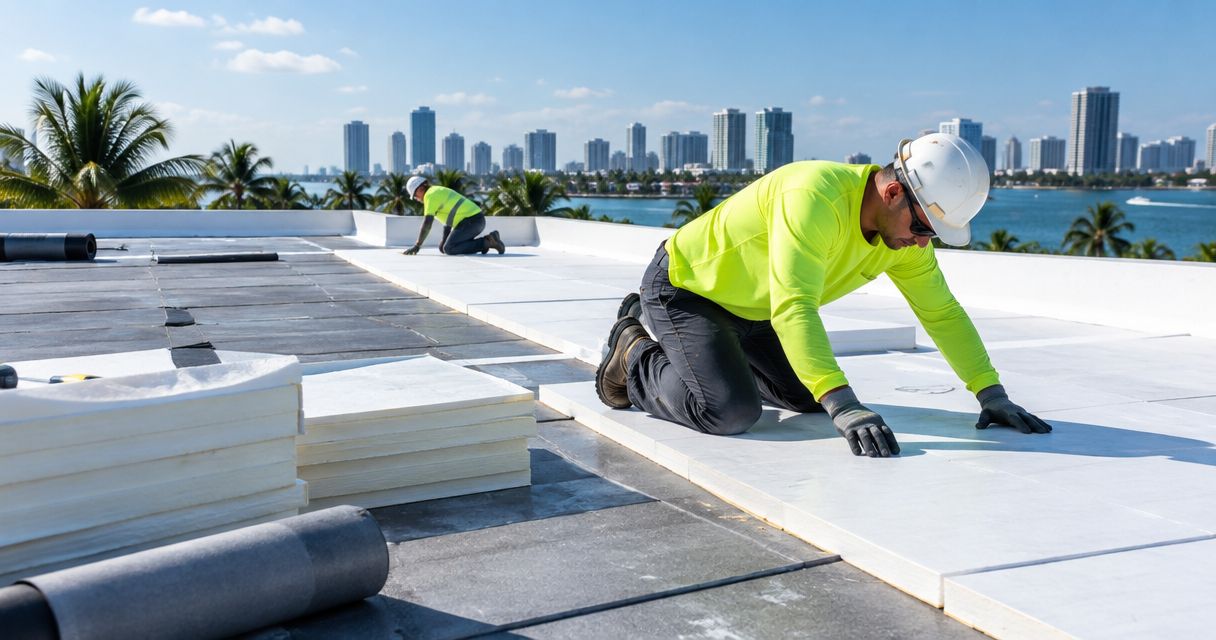
Polyisocyanurate, usually called polyiso, is rigid foam board installed as part of a roof assembly. It is a strong starting point when you want substantial thermal resistance without building an especially thick insulation layer.
For a conventional commercial roof, polyiso typically sits beneath the waterproof membrane, with other layers specified as needed. Tapered polyiso can also contribute to a drainage design. That does not mean every existing roof is a suitable substrate.
Polyisocyanurate pros:
- High thermal resistance per inch compared with common polystyrene boards.
- Flat and tapered configurations support different roof layouts.
- Compatible with many commercial roofing assemblies when correctly specified.
Polyisocyanurate cons:
- Wet or damaged boards require evaluation rather than automatic reuse.
- Facers and attachment methods must match the membrane system.
- Thermal performance varies with product and temperature conditions.
Best for: A business replacing a conventional low-slope roof where insulation thickness, drainage, and membrane compatibility all matter.
For your 2026 proposal, request the exact board specification and layer arrangement. A description that says only insulation leaves too much unresolved.
Verdict: Buy as the default shortlist option—not as an automatic specification.
2. Expanded polystyrene: best for thickness-flexible designs
Expanded polystyrene, or EPS, is rigid foam insulation made from expanded beads. Roofing-grade EPS comes in different densities and board configurations, including tapered systems.
EPS deserves consideration when the roof design has room for the thickness needed to meet its thermal target. Check transitions at curbs, perimeter edges, and drains before accepting a thicker assembly; added insulation changes those relationships.
Expanded polystyrene pros:
- Available in flat and tapered roof insulation configurations.
- Different grades allow the designer to address project requirements.
- Can meet thermal targets when sufficient thickness is provided.
Expanded polystyrene cons:
- Generally needs greater thickness than polyiso for comparable nominal R-value.
- Certain solvents and incompatible materials can damage the foam.
- Compressive strength depends on the specified grade.
Best for: A roof design where available height allows a thicker insulation package without compromising flashing or equipment clearances.
Ask the contractor to identify the roofing-grade product, not just EPS. Insulation sold for another application is not automatically suitable for your roof.
Verdict: Buy when the required thickness and specified grade fit the assembly.
3. Extruded polystyrene: best for approved inverted roof assemblies
Extruded polystyrene, or XPS, is closed-cell rigid foam board. Its resistance to moisture absorption makes it relevant to inverted roof designs, where insulation sits above the waterproofing rather than below it.
An inverted roof is a distinct assembly—not a conventional roof with the layers casually rearranged. The design must address insulation retention, drainage, loading, wind, and the protective materials above the insulation.
Extruded polystyrene pros:
- Resists moisture absorption.
- Offers compressive-strength options for specified applications.
- Fits certain protected-membrane and inverted roof designs.
Extruded polystyrene cons:
- Not a universal substitute for polyiso beneath a membrane.
- Long-term moisture exposure still requires design allowances.
- Protective layers and retention details add assembly requirements.
Best for: A building with a professionally designed, approved inverted roof assembly.
For a 2026 replacement, ask why the proposed layer arrangement suits your building. A material's water resistance alone does not establish that the entire roof will drain or resist wind correctly.
Verdict: Hold unless the project specifically calls for an inverted or otherwise compatible assembly.
4. Mineral wool: best for noncombustible insulation priorities
Mineral wool roof boards use mineral fibers to provide thermal insulation. Their noncombustibility makes them relevant when the roof design places particular emphasis on insulation fire characteristics.
Distinguish the material from the roof assembly. Noncombustible insulation does not, by itself, establish the fire classification of the completed roof or satisfy every requirement affecting the building.
Mineral wool pros:
- Noncombustible insulation material.
- Provides thermal resistance without a foam core.
- Available as roof boards intended for specified commercial assemblies.
Mineral wool cons:
- Roof weight and required thickness need checking.
- Wet insulation still requires investigation and corrective action.
- The selected board must suit attachment and service-load requirements.
Best for: A commercial roof where noncombustible insulation is an explicit design priority.
Ask for the proposed assembly's fire documentation and loading details. Do not accept a material-level fire claim as proof of whole-roof performance.
Verdict: Buy when noncombustibility is a defined requirement and the assembly supports it.
5. Spray polyurethane foam: best for suitable irregular roof surfaces
Spray polyurethane foam, or SPF, is mixed and applied on site to form an insulating layer. A roofing SPF system also needs a protective covering, commonly a coating, to shield the foam from sunlight and weather.
SPF follows roof contours and can address some complicated shapes without laying individual insulation boards. Application quality matters: substrate condition, moisture, weather, and protective covering all affect the result.
Spray polyurethane foam pros:
- Conforms to suitable irregular roof surfaces.
- Forms a continuous insulation layer across the application area.
- Can contribute to slope correction within a designed system.
Spray polyurethane foam cons:
- Requires suitable weather and substrate conditions during application.
- Overspray control matters around vehicles, equipment, and neighboring properties.
- Protective coatings require inspection and maintenance.
Best for: A suitable existing roof with geometry that favors spray application and an owner prepared to maintain the protective surface.
For 2026 planning, establish who will inspect the coating and how damage will be repaired. SPF is not permission to bury wet materials or ignore failing drainage.
Verdict: Hold until substrate suitability and maintenance responsibilities are documented.
How these insulation systems rank
This ranking prioritizes fit for conventional low-slope commercial reroofing, then separates alternatives by distinct design needs. Polyiso leads that default use case; EPS addresses thickness-flexible designs, XPS addresses approved inverted assemblies, mineral wool addresses noncombustibility, and SPF addresses suitable irregular surfaces.
It is not a ranking of named manufacturers or a claim of field-tested savings. Your roof's condition, required approvals, and construction details determine the final selection.
What to verify before signing a roofing proposal
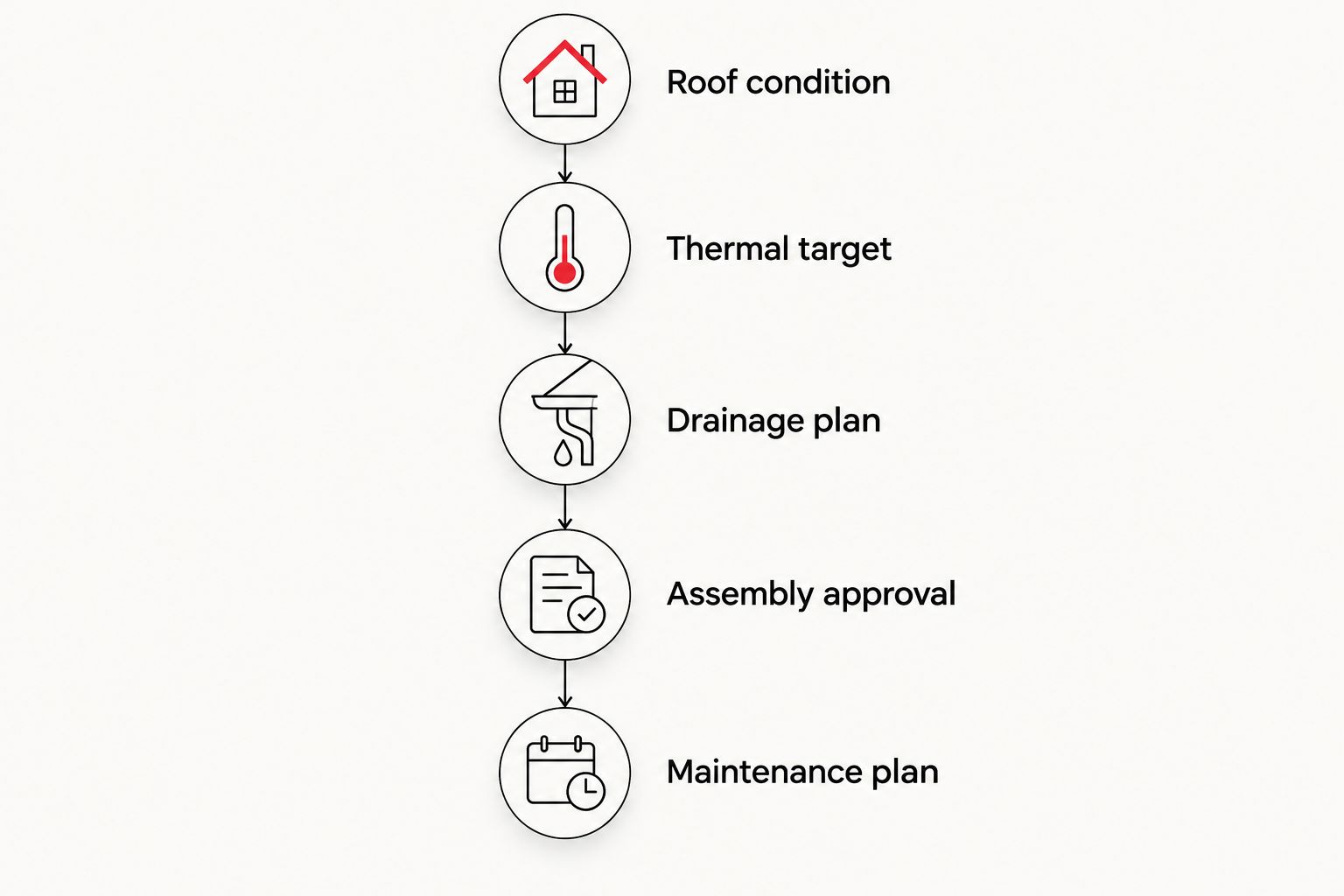
A useful commercial roof proposal explains the roof as a connected system. Follow this sequence before accepting an insulation recommendation.
Roof condition
Identify leaks, deteriorated decking, and suspected wet insulation. Where necessary, roof openings and moisture investigation establish what sits beneath the surface; a dry-looking membrane does not prove the layers below are dry.
Ask which existing materials stay and which leave. Require the proposal to explain how concealed deterioration discovered during work will be handled.
Thermal target
Ask for the project-specific insulation requirement and how the proposed assembly meets it. Do not accept a blanket claim that every Florida commercial roof needs the same R-value.
Compare material, thickness, and layer layout together. A 2-inch board and a 3-inch board are not equivalent specifications, and two different materials at the same thickness do not necessarily provide the same resistance.
Drainage plan
Locate drains, scuppers, curbs, and low spots. Tapered insulation needs a layout that directs water toward functioning drainage outlets rather than merely adding slope somewhere on the roof.
Check flashing heights after the insulation is added. Raising the field of the roof can leave existing curbs or wall transitions needing modification.
Assembly approval
Request the assembly documentation and project-specific attachment requirements. Verify that the deck, insulation, cover board, membrane, fasteners, and adhesives correspond to the proposed system.
If 2 layers of insulation are specified, ask how their joints are arranged. Staggered joints reduce direct paths through the insulation compared with aligned joints; the approved assembly still controls installation.
Maintenance plan
Identify access routes to rooftop equipment and specify protection where needed. Insulation beneath a membrane is not a substitute for a suitable walking surface.
Keep the completed roof documents with your building records. Future repairs should match the installed assembly rather than introduce incompatible materials.
For commercial roof insulation, Roofsmartflorida is a local roofing-service starting point for Southwest Florida businesses evaluating repair or replacement. Bring existing roof records and describe leaks, interior moisture, and planned equipment changes before discussing materials.
Start with your roof condition
Discuss your commercial roof's repair or replacement needs before choosing an insulation assembly.
Which commercial roof insulation should you choose?
Start with polyiso for a conventional low-slope commercial roof replacement. Move to EPS when thickness fits the design, XPS when an approved inverted assembly calls for it, mineral wool when noncombustibility drives the specification, or SPF when the substrate and maintenance plan justify spray application.
Do not approve insulation separately from drainage, attachment, and waterproofing. Your 2026 decision should produce a documented roof assembly—not simply a material name on an estimate.
FAQ
What's the best commercial roof insulation for Florida businesses?
Polyisocyanurate board is the default shortlist choice for conventional low-slope commercial roofs. The final selection depends on roof condition, drainage, attachment, moisture control, and the approved assembly.
Is polyiso better than EPS for a Florida commercial roof?
Polyiso is the stronger starting point when insulation thickness is constrained. EPS remains a practical design option when the roof can accommodate the thickness required for its thermal target.
Can I put new insulation over wet roof insulation?
Do not treat new insulation as a fix for wet roof insulation. Locate the moisture source and establish which damaged materials require removal before finalizing the replacement assembly.
Does a reflective roof coating replace insulation?
No, a reflective roof coating does not replace insulation. Reflective surfaces reduce absorbed solar heat, while insulation slows heat transfer through the roof assembly.
What R-value does a commercial roof need in Florida?
The required R-value depends on the applicable energy-code provisions and project conditions. Ask the designer or contractor to identify the requirement for your building and document how the proposed assembly meets it.
Is spray foam a good choice for a Florida business roof?
Roofing spray polyurethane foam suits some roofs with appropriate substrates and irregular geometry. It requires suitable application conditions, a protective covering, and an ongoing inspection and maintenance plan.
Can better insulation lower a commercial building's cooling demand?
Added roof insulation can reduce heat flow into a cooled building. Actual energy results depend on the existing roof, air leakage, mechanical systems, operating schedule, and the completed assembly.
One last thing
Ask what happens at the roof edge. Adding insulation raises the roof surface, which affects perimeter metal, flashing heights, and equipment curbs. Those transitions deserve as much attention as the insulation in the middle of the roof.
Before approving a Roofsmartflorida commercial roofing proposal, ask how the proposed scope addresses those transitions. A clear answer is more useful than a higher insulation value without construction details.