Yes, you can dispute your insurer’s roof replacement estimate and request a revised payment by documenting covered damage, missing work, or incorrect measurements. Your deductible, policy exclusions, and settlement terms still apply; a higher contractor estimate alone does not establish that the insurer owes more. For a 2026 Florida claim, focus on proving the work your policy covers—not bargaining for an arbitrary increase.
- Can you negotiate a roof replacement cost with your insurance company? Yes—support your request with damage evidence and itemized estimates.
- Florida homeowners should separate roof replacement scope disagreements from insurance coverage disputes.
- Your deductible and policy settlement terms still apply after an insurer revises its estimate.
- Roof Smart of SW Florida provides roofing services; coverage decisions belong to the insurer, subject to policy and law.
Why this matters
An insurance estimate and a roofing proposal answer different questions. The insurer evaluates a covered loss under your policy; the contractor describes the work needed to repair or replace your roof. A difference between their totals is a starting point for review, not proof that either document is correct.
Roof Smart of SW Florida is best suited to Southwest Florida homeowners seeking roof repair or replacement services, not insurance claim representation. Its roofing services cover residential and commercial properties. Keep the roofing assessment separate from advice about your legal rights under an insurance contract.
This guide explains the claim-review process for homeowners. It provides general information, not a determination of coverage or legal advice about your claim.
Can you negotiate a roof replacement cost with your insurance company?
Yes—but the strongest request identifies a specific error or omission and supplies evidence that supports correcting it. Ask for a written review of the disputed items rather than requesting a larger settlement without explanation.
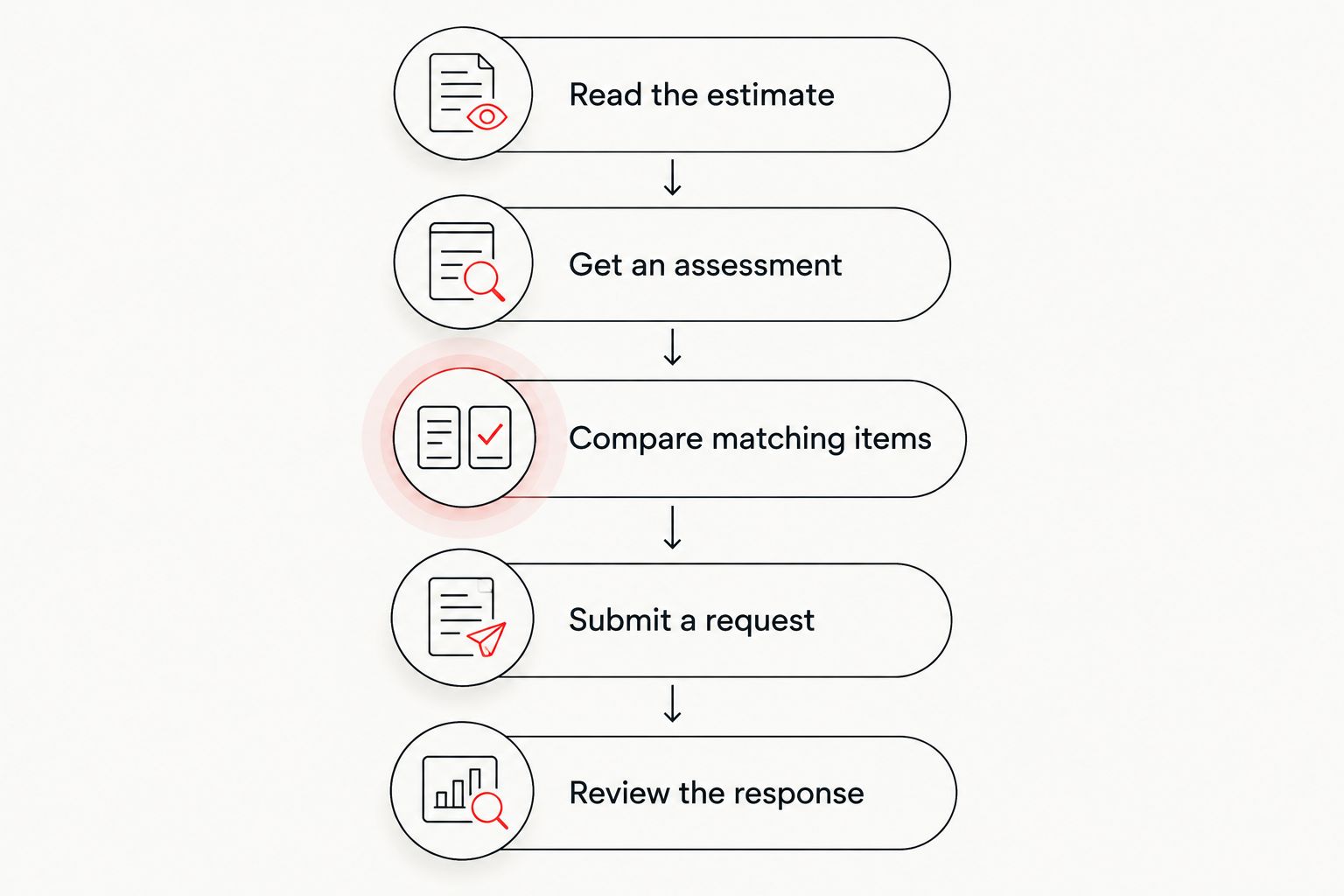
1. Read the estimate alongside the coverage letter
Start with the insurer’s explanation of what it accepted, excluded, or denied. Then review the estimate, declarations, endorsements, and loss-settlement provisions together.
Identify whether the disagreement concerns covered damage, the amount of work, depreciation, or your deductible. These are different issues and require different evidence. A measurement correction will not resolve an exclusion dispute.
2. Get an itemized roofing assessment
Ask the contractor to describe damaged areas, measurements, materials, and proposed work. Photographs should show both the roof area and close-up details so the insurer can connect each claimed condition to a location.
Request a clear distinction between observed damage, maintenance concerns, and optional improvements. Roof Smart of SW Florida provides roof installation, repair, and replacement services across Cape Coral, Fort Myers, Naples, and surrounding Southwest Florida counties; the insurer still decides coverage subject to the policy and applicable law.
3. Compare matching items—not just final totals
Check whether both estimates describe the same roof areas and work. Compare removal, underlayment, flashing, roof covering, disposal, and other applicable tasks without assuming every item belongs in every claim.
Watch the units. A roofing square equals 100 square feet; it is not the same as a square foot. Also distinguish measured roof area from material quantities that include cutting and installation waste.
4. Submit a focused written request
Send your claim number, disputed items, supporting photographs, contractor documentation, and a short explanation of each requested correction. Ask whether the insurer needs a reinspection or additional evidence.
Keep a copy of everything submitted and the insurer’s response. Follow the reporting and document deadlines that apply to your claim rather than assuming a request for review pauses them.
5. Review the response before choosing the next step
Ask the insurer to explain unresolved differences in writing, including the relevant policy provisions when coverage is disputed. Confirm whether a revised estimate changes the covered scope, the payment calculation, or both.
If disagreement remains, consider the dispute process that fits the issue. Do not sign a release or accept settlement terms you do not understand; obtain qualified advice when necessary.
Which kind of roof insurance disagreement do you have?
Choose the next step based on the disagreement, not simply on how dissatisfied you are with the payment. Each route has a useful role and a limit.
| Route | Best for | Main benefit | Main limitation |
|---|---|---|---|
| Estimate review or supplement | Missing work, measurements, or newly documented damage | Connects corrections to supporting evidence | Does not automatically resolve a coverage denial |
| Policy appraisal, when applicable | Qualifying disagreements over the amount of loss | Uses the valuation process described in the policy | Availability and scope depend on policy language and law |
| Florida insurance mediation, when eligible | Residential property disputes suitable for facilitated discussion | Provides a forum to seek agreement | Does not guarantee agreement or apply to every claim |
| Licensed public adjuster | Policyholders seeking professional claim assistance | Can assist with claim preparation and negotiation within the licensed role | Requires a separate contract and does not guarantee a result |
| Insurance attorney | Coverage disputes, releases, or legal-rights questions | Provides legal advice and representation | Requires a separate engagement; outcomes remain case-specific |
For a 2026 Florida residential claim, Florida Statutes section 627.7015 addresses an alternative dispute-resolution procedure for eligible property insurance claims. Confirm eligibility, exclusions, and the current process with the Florida Department of Financial Services before choosing that route.
Do not assume appraisal, mediation, and legal action are interchangeable. Read the policy and obtain advice about which process addresses your actual dispute.
Actual cash value: check the depreciation treatment
An actual cash value settlement generally accounts for depreciation under the policy’s terms. That means the covered replacement estimate and the payment calculation are not necessarily the same figure.
Check the roof-specific endorsements as well as the main policy. Do not assume depreciation is recoverable simply because the contractor recommends replacing the roof. Ask the insurer to identify the settlement provision it applied.
Replacement cost coverage: check the release conditions
Replacement cost coverage can involve an initial payment followed by additional recoverable depreciation after policy conditions are satisfied. The exact requirements depend on your contract and applicable law.
For your 2026 claim, ask what evidence the insurer requires, which deadlines apply, and whether your roof has a separate settlement endorsement. Keep contracts, invoices, completion documentation, and proof of payment organized. Do not mistake a staged payment for a final refusal to pay.
Why roof insurance payments vary
A larger roofing proposal does not produce an automatic matching payment. These factors determine what the insurer evaluates and what remains your responsibility:
- Cause of damage. Covered storm damage and deterioration are different issues. Document the observed condition without presenting an unsupported cause as fact.
- Policy settlement terms. Actual cash value, replacement cost provisions, and roof endorsements affect the calculation.
- Repair scope. Localized damage does not automatically establish that the entire roof requires covered replacement. Support the proposed scope with a documented assessment.
- Measurements and work details. Roof area, material quantities, flashing, and other necessary tasks must match the actual project.
- Code-related work. Identify the applicable requirement and whether the policy covers the associated work. A general statement that something is required by code is not enough.
- Deductibles and exclusions. A revised estimate does not erase the deductible or create coverage for an excluded item.
Ask for the reason behind each difference. That turns a disagreement about totals into a reviewable question about damage, scope, or policy terms.
Can my roofer negotiate with the insurance company for me?
A roofing license alone does not authorize someone to act as your public adjuster. A contractor can explain roofing conditions and the proposed work, but claim representation is a separate role.
For a 2026 Florida claim, Florida Statutes sections 489.147 and 626.854 distinguish contractor activities from regulated public adjusting. Confirm the person’s authority before allowing anyone to negotiate or interpret insurance coverage on your behalf.
Roof Smart of SW Florida offers roofing services, including repair and replacement. Its roofing role should not be confused with representing you in a coverage dispute. For that work, evaluate an appropriately licensed public adjuster or insurance attorney.
Request an honest roof evaluation
Get a no-pressure free estimate for roof repair or replacement in Southwest Florida.
Does insurance have to replace my entire roof?
Insurance does not automatically owe full replacement because part of a roof is damaged. The answer depends on covered damage, the feasibility of a proper repair, applicable requirements, and your policy.
Ask the roofer to explain why the proposed work requires repair or replacement, with photographs and specific observations. If the insurer approves only a repair, request its written scope and the basis for that decision. Avoid treating roof age alone as proof of a covered replacement claim.
What should I send when the roof estimate seems too low?
Send an itemized explanation of the differences, supported by photographs and project documentation. Make the request easy to review rather than sending an unexplained bundle of attachments.
Use this claim packet checklist:
- Claim reference: Include the claim number, property address, and contact details.
- Disputed scope: Name the roof area or task that needs review.
- Supporting evidence: Match photographs, measurements, or inspection findings to that item.
- Requested correction: Explain what should change and why.
- Written response request: Ask the insurer to address each unresolved item.
If additional damage becomes visible during work, document it and promptly notify the insurer. Do not conceal damage, exaggerate quantities, or delay necessary protection solely to preserve a claim argument. Ask how inspection and documentation should proceed before disputed materials are discarded when practical.
What should you avoid during a roof claim dispute?
Do not confuse a contractor discount with an insurer’s obligation to pay. Negotiating your construction contract is separate from establishing covered loss under your policy.
For Florida roof claims in 2026, deductible-waiver offers are a warning sign. Florida Statutes section 489.147 restricts contractor practices involving insurance deductibles; do not agree to inflated invoices or paperwork that misstates what you owe or paid.
Also avoid these mistakes:
- Approving optional upgrades while assuming the insurer must fund them.
- Signing a roofing contract without understanding payment responsibilities if coverage remains disputed.
- Treating a verbal assurance as written claim approval.
- Assuming a review request extends every policy or legal deadline.
- Signing a release without understanding which rights it resolves.
Keep the construction agreement, insurance correspondence, and any claim-representation agreement separate. Each document creates different responsibilities.
FAQ
Can I ask my insurance company to increase its roof replacement estimate?
Yes, you can request a revised estimate by identifying supported errors, missing work, or additional covered damage. The insurer evaluates that request under your policy; an increase is not guaranteed.
Is a higher roofing quote enough to get a larger insurance payment?
No, a higher roofing quote alone does not establish that the insurer owes more. Explain the scope differences and provide evidence connecting the requested work to the covered loss.
Can my insurance company refuse to pay for a full roof replacement?
Yes, an insurer can dispute full replacement based on the policy and its assessment of the damage. Request the written explanation and supporting policy provisions before deciding how to challenge the decision.
Will negotiating my roof claim remove my deductible?
No, a revised roof claim estimate does not remove your deductible. Your policy determines the applicable deductible and how it affects the payment calculation.
Can I submit additional roof damage after the first inspection?
You can report additional documented damage and request review, subject to applicable policy requirements and deadlines. Notify the insurer promptly and preserve photographs and supporting records.
Should I hire a roofer or a public adjuster for a roof claim?
Hire a roofer to assess and perform roofing work; consider a licensed public adjuster when you need claim assistance within that professional's authority. A roofing license alone does not authorize public adjusting.
Does replacement cost coverage mean the first check covers everything?
No, replacement cost coverage does not necessarily mean the first payment includes every recoverable amount. Review depreciation, deductibles, roof endorsements, and any conditions for additional payment.
One last thing
Ask for a line-item explanation before asking for a bigger payment. A missing task, incorrect quantity, or misunderstood depreciation deduction gives the insurer something specific to address. A demand for a higher total does not.
Before authorizing replacement, confirm in writing what work the roofing contract includes and what payment responsibilities remain yours. Claim approval and construction authorization are separate decisions.