No public, dated dataset publishes roofing cost per click by market in Florida at city level, so any table of exact SW Florida figures is a guess. This page ranks the nine SW Florida markets by what drives their click cost and shows how to fill in your own 2026 numbers.
- Roofing cost per click by market in Florida has no verified public city-level dataset in 2026, so exact figures would be invented.
- Nine SW Florida markets share one pattern: storm-driven emergency terms cost more per click than planned-replacement terms.
- Your own Google Ads search term report is the only benchmark that matches your service area and your jobs.
- Judge every market by cost per booked inspection, not cost per click. A cheap click that never calls is the expensive one.
Why this matters
A click is not a lead. A roofing job is a large, infrequent purchase, so a single click price tells you almost nothing until you attach it to a booked estimate. Compare it to what the job is worth: a full roof replacement in SW Florida is a five-figure decision for most homeowners, and your ad budget should be sized against that job value, not against the lowest click price.
The rest of this page does three things. It gives the verdict on how SW Florida markets differ. It lays out a market table you can fill in. It shows how to turn the result into a budget.
The short answer
Click cost in SW Florida roofing is set by intent, not by city name. An emergency query after a storm costs more than a planned-replacement query in the same city, because every roofer in the market bids on the same urgent searcher at the same time. That pattern holds across Cape Coral, Fort Myers, Naples, and the other markets below.
No dated, scoped, public figure backs a ranked dollar list of these cities. So this page does not print one. A benchmark page with made-up numbers is worse than none: you would budget against a number nobody measured.
SW Florida market table
The table lists the nine markets a Southwest Florida roofer typically bids in, the service demand that defines each, and the column you complete from your own account. Leave no row blank before you set a budget.
| Market | Core service demand | Intent to bid hardest | Your avg. CPC (last 90 days) |
|---|---|---|---|
| All markets (yardstick) | Replacement, repair, inspection | Emergency repair | Fill in: account average |
| Cape Coral | Shingle, tile, metal, replacement, gutter guards | Emergency repair | Fill in |
| Fort Myers | Tile, metal, shingle, flat repair | Emergency repair | Fill in |
| Naples | Metal, shingle, flat repair, inspections | Wind mitigation inspection | Fill in |
| Bonita Springs | Metal, tile, wind mitigation | Emergency repair | Fill in |
| Punta Gorda | Tile, commercial, emergency repair | Emergency repair | Fill in |
| Port Charlotte | Tile, flat repair, emergency repair | Emergency repair | Fill in |
| Sarasota | Tile, metal, flat repair, emergency repair | Emergency repair | Fill in |
| Lehigh Acres | Tile, commercial, emergency repair | Emergency repair | Fill in |
| LaBelle | Tile, seamless gutters, emergency repair | Emergency repair | Fill in |
The first row is your yardstick. Every market is judged against your own account average, not against a number from another state or another trade.
High and low: what the pattern says
Without a verified city-level dataset, there is no honest "top market leads at X, bottom trails at Y" sentence. What the service mix does support:
- Emergency repair terms sit at the top of the cost range in every market. Urgent searchers click the first ad they see, and bidders know it.
- Planned-work terms sit lower. Searches for tile, metal, or shingle installation come from homeowners who compare for weeks, so bids are less frantic.
- Coastal and higher-value markets such as Naples and Sarasota carry larger average jobs. That justifies a higher click price there, but only your account data shows how much higher.
- Inland markets such as Lehigh Acres and LaBelle have smaller search pools. Fewer searches means impression volume, not click price, is usually the limit.
Treat these as hypotheses to test against your own account, not as measured results.
Methodology and its limits
The market list and service mix come from the Roof Smart of SW Florida service area: Cape Coral, Fort Myers, Naples, and surrounding Southwest Florida counties. No click-price figures are cited because none could be sourced with a date and a scope.
Limitation: this page cannot tell you what a click costs in any single market today. Click prices move with season, storm events, and competitor budgets. Only a current pull from your own Google Ads account or Keyword Planner can.
How to build your own benchmark in 2026
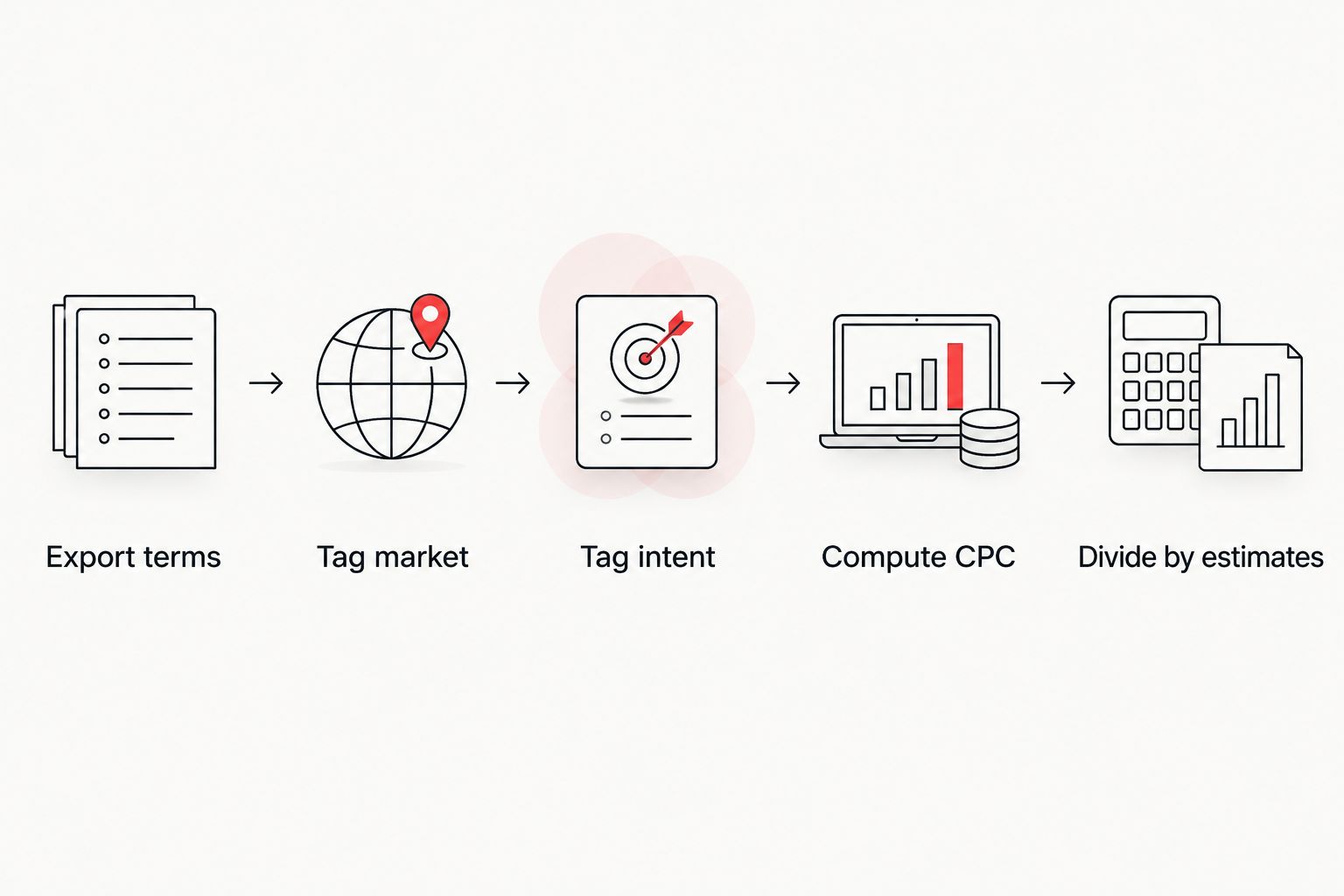
Five steps, in order:
- Export the search terms report for the last 90 days, filtered to roofing campaigns.
- Tag every term by market. Use the city name or the location the click came from.
- Tag every term by intent: emergency, repair, replacement, inspection, or wind mitigation.
- Compute average CPC per market and per intent. Put the market figure in the table above.
- Divide spend by booked estimates, not by clicks. This is your real market benchmark.
Run the same pull every quarter. A single 2026 snapshot goes stale after the first named storm.
Emergency terms: where budgets burn
Hurricane season runs June 1 to November 30. Emergency and tarping searches spike inside that window and again after any named storm. Bidding on them all year at one flat budget wastes money in the quiet months and under-bids in the loud ones.
The fix is a seasonal budget split. Hold a base budget for planned work, and set a separate, capped pool for emergency terms that you raise on storm watch. Tie that pool to what an urgent job is actually worth. A typical emergency roof repair bill in Florida tells you how much click cost one urgent lead can absorb.
How to use these benchmarks
- Set the budget per market from cost per booked estimate, then work backward to a maximum click price. Never set a flat CPC cap across all nine markets.
- Send each market's clicks to a page that matches the search. A Naples metal-roof click lands on a Naples metal-roof page, not the home page. Mismatch raises your cost per estimate even when CPC looks fine.
- Cut or cap the market with the worst cost per booked estimate after two full quarters of data. One quarter is too short for a purchase this infrequent.
- Protect planned-work campaigns first. Replacement and tile or metal installs are the larger jobs and the cheaper clicks.
FAQ
What is the average roofing cost per click in Florida?
No verified, dated public figure exists for SW Florida by city, so any single number would be a guess. Pull your own average from a 90-day Google Ads search terms report. Use that as your yardstick.
Which SW Florida market has the highest roofing CPC?
No sourced data ranks the nine markets. What holds across all of them is that emergency repair terms cost more per click than planned-replacement terms. Your account data shows which city is highest for you.
Is a cheap click better for a roofing business?
No. A cheap click that never books an estimate costs more than an expensive click that does. Judge each market by cost per booked estimate.
Do roofing click costs change during hurricane season?
Yes in direction, though no sourced percentage is given here. Hurricane season runs June 1 to November 30, and emergency terms get more competitive inside that window and after any named storm.
How often should I re-check roofing CPC by market?
Every quarter, and again after any major storm. A single 2026 snapshot goes stale quickly because competitor budgets shift with weather.
Should I use one CPC cap for every market?
No. Each market has a different average job value and search pool. Set the cap per market from cost per booked estimate.
One last thing
The cheapest roofing leads in 2026 rarely come from the cheapest clicks. They come from a landing page that matches the search, in a market where your close rate is high. Spend your first optimization hour on page match, not on bid cuts.