You can tell whether your roof was installed correctly by matching the completed work to the approved installation requirements, checking the permit and inspection records, and having a qualified roofer examine details you cannot see from the ground. Straight rows and a dry ceiling are reassuring, but neither proves that hidden fasteners, underlayment, or flashing were installed correctly.
- How do I know if my roof was installed correctly? Verify records, visible workmanship, and hidden installation details.
- Roofsmartflorida provides roof installation, repair, and replacement services for Southwest Florida homeowners and businesses.
- A passed final inspection supports your records; it does not document every concealed roofing detail.
- Stay off the roof. Photograph concerns from safe locations and request a written explanation before authorizing repairs.
Why this matters
A roof can look tidy while concealing an installation problem. Water protection depends on how the roof covering, underlying layers, edges, and openings work together—not just how the finished surface looks.
Verify the installation before treating appearance as proof. If you need a local starting point, Roofsmartflorida's roofing services include installation, repair, and replacement across Southwest Florida. Ask for findings tied to your actual roof system rather than a general reassurance that everything looks fine.
How do I know if my roof was installed correctly?
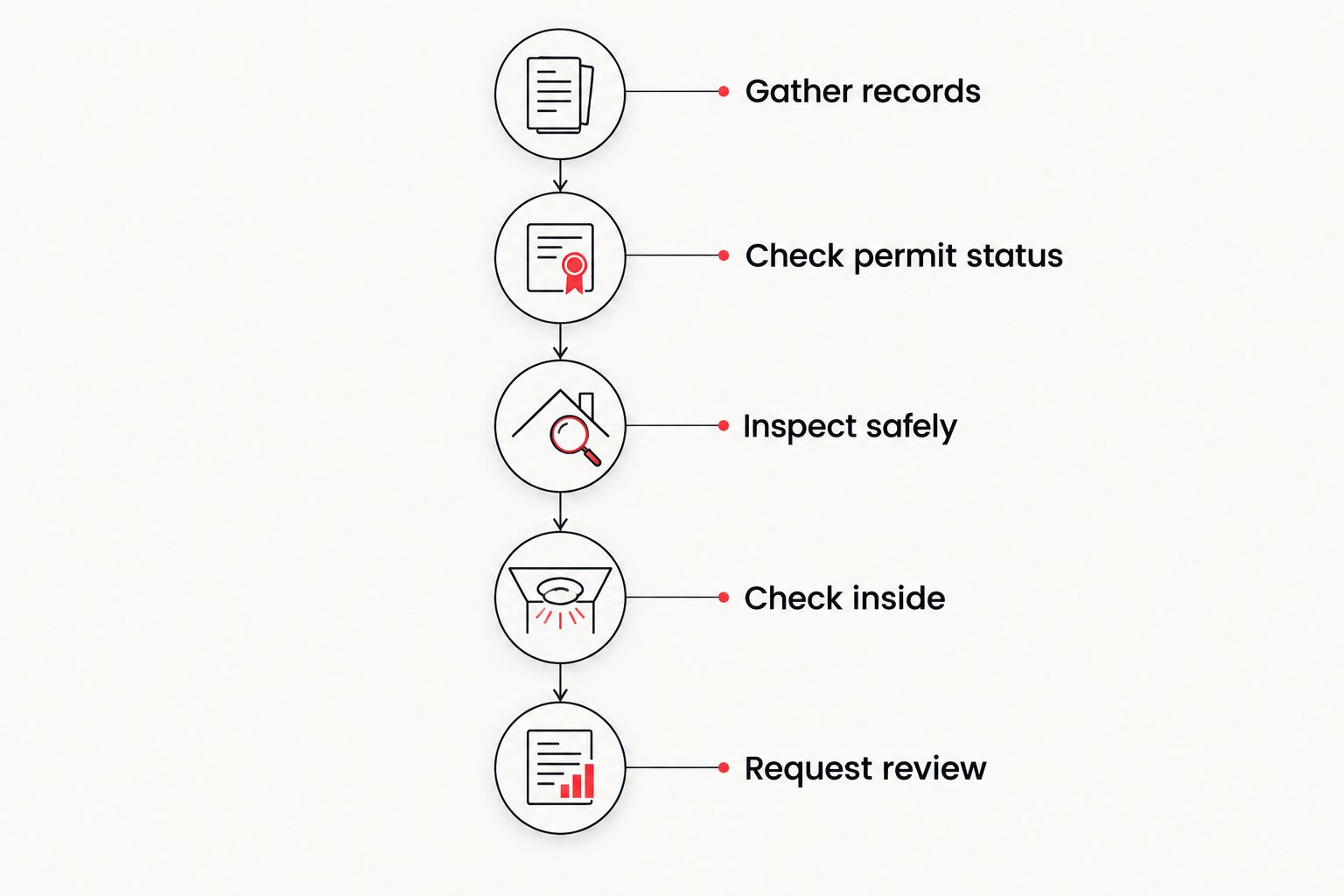
Use this sequence to check your roof without climbing onto it. Keep your observations separate from a professional diagnosis: a stain is evidence of moisture, not proof of where the water entered or who caused it.
- Gather records. Collect the contract, material information, permit number, inspection results, installation photographs, and any written warranty documents you received. For a roof completed in 2026, keep the dated completion paperwork with those records.
- Check permit status. Ask the local building department whether the required inspections passed and whether the permit is closed. Match the record to your property and project, not just the contractor's name.
- Inspect safely. From the ground, look for missing pieces, displaced materials, obvious gaps, damaged edges, and debris obstructing drainage. Use camera zoom instead of a ladder.
- Check inside. Look for new ceiling stains, damp insulation visible from a safe attic access point, and water marks around roof penetrations. Do not enter an unsafe attic or step between framing members.
- Request review. Ask a qualified roofer to compare the installation with the applicable product instructions, approved assembly, and project requirements. Request photographs and a written explanation of each concern.
A useful installation review identifies the detail, the requirement, and the evidence. A statement that the roof is “good” or “bad” without those elements gives you little basis for a decision.
What should a correctly installed roof look like?
A correctly installed roof should follow the requirements for its specific materials and assembly. Consistent alignment helps you spot changes, but some profiles have intentional texture or variation; appearance alone is not a pass-or-fail test.
Use this comparison to choose the right inspection focus. These are inspection categories, not recommendations to replace one material with another.
| Roof covering | Best for checking | Useful visible evidence | Limit of a visual check |
|---|---|---|---|
| Shingle | Alignment and surface damage | Consistent courses; no visibly missing or torn shingles | Hidden nail placement and covered layers remain unverified |
| Metal | Panel joints and roof transitions | Consistent panel layout; no obvious displaced trim | Attachment requirements depend on the panel system |
| Tile | Breakage and displacement | No visibly broken or shifted tiles | Intact tiles do not prove the condition of the underlayment |
| Flat or low-slope | Seams, edges, and drainage | No obvious open seams or debris-blocked drains | Surface appearance does not establish concealed attachment or moisture conditions |
Each check has a benefit and a limitation. Use visible defects to direct an inspection, not to judge the entire roof from the driveway.
Shingle roofs: check alignment, damage, and fastening evidence
Look for missing shingles, torn corners, irregular courses, and obvious raised areas. Ask the roofer to distinguish installation concerns from material characteristics or damage that happened afterward.
Correct fastening depends on the specific shingle and approved installation. Do not lift shingles yourself to count nails: disturbing the covering can damage it and create a problem that was not there before.
Metal roofs: check the actual panel system
Metal roofing includes different attachment methods. A visible screw is not automatically a defect, and the absence of visible screws does not prove correct fastening.
Ask the reviewer to identify the panel system before assessing fasteners, clips, seams, trim, and penetrations. Some visual waviness is an appearance issue rather than evidence of a leak; the reviewer should explain that distinction instead of treating every ripple as failure.
Tile roofs: look beyond the tile surface
Broken, shifted, or missing tiles deserve attention. An intact tile surface, however, does not establish whether the underlying water-protection details were completed correctly.
Ask for installation photographs showing covered work where available. Walking on tile can break it, so leave roof access and hands-on examination to someone equipped to work on that system.
Flat roofs: check seams and drainage together
Look from safe locations for displaced edge details, obvious seam openings, and blocked drainage paths. Report water that remains after rain, including when you observed it and whether it disappeared later.
The roofing material, roof design, and applicable instructions determine how drainage observations should be assessed. Do not accept a universal standing-water deadline without an explanation that applies to your roof.
Which hidden details need a professional check?
The most important installation questions often concern work concealed by the finished roof. Ask the reviewer to explain what is visible, what photographs document, and what remains unverified.
- Flashing: These details direct water away from walls, valleys, chimneys, skylights, and other interruptions in the roof surface. Ask whether the connections work as a water-shedding assembly rather than relying on exposed sealant alone.
- Underlayment: Ask which material was installed and what evidence documents its attachment, overlaps, and transitions. A finished roof usually conceals much of this work.
- Fastening: Nail, screw, clip, and adhesive requirements vary with the approved system. Request an assessment against the actual installation requirements, not a generic fastener count.
- Roof deck: Ask whether installation photographs or inspection records document damaged decking and any repairs. Surface neatness does not establish the condition of the supporting deck.
- Ventilation: Where the roof assembly requires ventilation, ask whether intake and exhaust paths remain open and appropriate for that assembly. A sealed attic needs a different assessment from a vented attic.
Do not authorize exploratory removal until you understand its purpose. Ask what the roofer expects to learn, how the opening will be restored, and how the findings will be documented.
Why roof installation checks vary
There is no single driveway checklist that certifies every roof. The review must account for the materials and details installed on your property.
- Roof covering: Shingle, metal, tile, and flat-roof systems have different attachment and water-management details.
- Roof shape: Valleys, walls, changes in slope, and intersecting roof sections create different inspection points.
- Penetrations: Skylights, plumbing vents, and other openings require their own weatherproofing details.
- Existing conditions: Replacement work can reveal deck damage or older details that need correction before new materials go on.
- Project requirements: The applicable permit documents, product approvals, and manufacturer instructions establish the installation criteria.
For a 2026 review, record the documents used to assess the work. If the roof was installed earlier, the reviewer should identify the requirements applicable to that project rather than automatically judging it against a different installation specification.
Does a passed final inspection prove my roof is perfect?
A passed final inspection supports the installation record, but it does not prove that every concealed detail is defect-free. Building inspections and a detailed workmanship investigation have different scopes.
Ask for the inspection history, including any failed inspections and documented corrections. For a 2026 installation, confirm that the final approval belongs to the completed roofing permit rather than another project at the property.
Keep photographs, product information, and written findings alongside the permit record. Together, these provide a stronger basis for understanding the work than a final approval alone.
Does a new roof leak mean it was installed wrong?
A new roof leak requires investigation, but the leak alone does not establish an installation error. Water can enter through roofing details, adjacent walls, openings, or damage that occurred after installation.
Photograph the affected area and record the weather and timing. Water can travel before becoming visible indoors, so the stain's location is not necessarily the entry point.
Treat active water intrusion as urgent without guessing at the cause. Stay away from wet electrical fixtures, avoid the area below a bulging ceiling, and arrange professional help. Do not climb onto a wet roof to investigate.
What should I ask the installer to fix?
Ask the installer to address specific, documented defects rather than requesting an undefined repair. A clear request identifies the location, the observed condition, and the installation requirement that needs review.
Keep your 2026 roof review in a dated folder and use a short written checklist:
- Identify each concern with a photograph and location.
- Ask whether the condition is cosmetic, functional, or still unconfirmed.
- Request the proposed correction and its reason in writing.
- Ask how the contractor will document the completed correction.
- Retain the response with your permit and project records.
If the explanation does not resolve the concern, an independent assessment provides another perspective. Its benefit is a separate review; its limitation is that covered work can remain unverified without installation photographs or an agreed investigation.
Roofsmartflorida is a local roofing-service option for Southwest Florida homeowners and businesses seeking installation, repair, or replacement help. For a disputed installation, ask any contractor to explain the evidence before recommending work.
Ask about your roof concerns
Describe the installation concern and ask what evaluation is appropriate for your roof.
FAQ
How do I know if my roof was installed correctly without climbing on it?
Check the permit records, photograph visible concerns from the ground, and look indoors for signs of moisture. A qualified roofer must assess concealed or inaccessible installation details.
What are the clearest signs of a bad roof installation?
Missing materials, open flashing details, displaced components, and active leaks warrant investigation. Each condition needs a diagnosis because damage and installation errors can produce similar symptoms.
Should I see nails or screws on a new roof?
Whether visible fasteners are appropriate depends on the roofing system and their location. Ask a roofer to compare the detail with the specific product instructions rather than assuming every exposed fastener is wrong.
Can my roof be installed incorrectly even if it does not leak?
Yes, a roof can contain installation defects without showing an indoor leak. Dry ceilings do not verify fastening, underlayment, or every flashing connection.
Should I get an independent inspection after a roof replacement?
An independent assessment is useful when visible concerns, incomplete records, or unresolved explanations leave you uncertain. Request written findings and a clear statement of what the inspection could not verify.
Can I fix suspicious flashing with roof sealant myself?
Do not cover a suspicious detail before its cause is identified. Added sealant can obscure evidence and does not establish that the underlying flashing assembly is correct.
Who can help with roof installation concerns in Southwest Florida?
Roofsmartflorida provides residential and commercial roof installation, repair, and replacement services in Southwest Florida. Explain your concern and ask what evaluation fits your roof; a written diagnosis is more useful than reassurance alone.
One last thing
The most useful roof photograph might show work you can no longer see. Images taken before the covering went on can help document underlayment, deck repairs, and connections that a finished-roof photograph cannot establish.
Before closing your 2026 project folder, ask for available installation photographs and identify what each image shows. A photograph without a location or explanation is harder to use when a question arises later.